

AI Customer Relationship Management: How AI Is Transforming Customer Engagement…
25 Nov, 2026
Summary Customer relationships influence revenue, repeat business and long-term growth....
Updated: 25th November, 2026
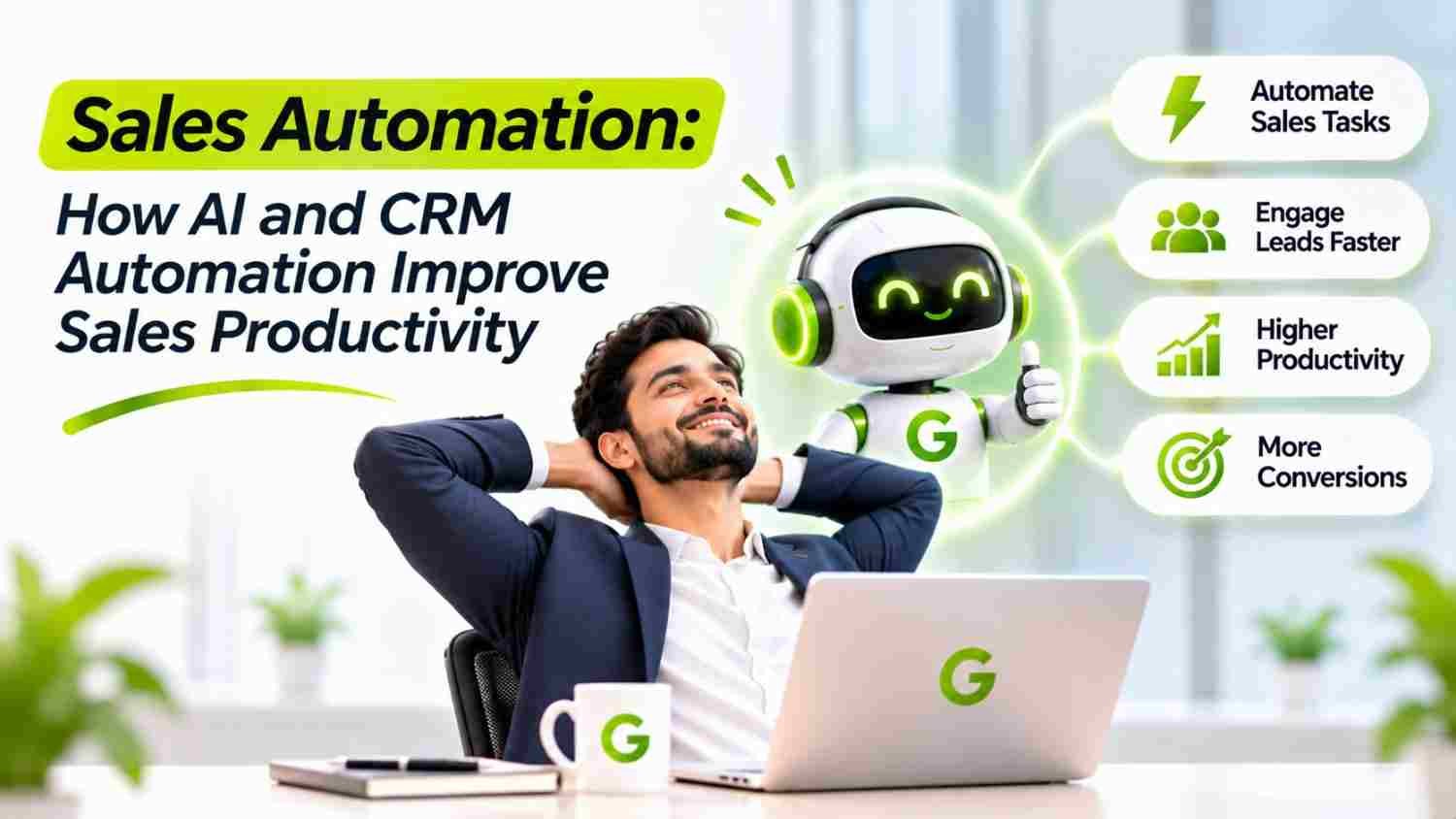
Sales Automation helps businesses streamline repetitive sales activities and improve the way teams manage customer opportunities.
From lead capture and qualification to follow-ups, calling and reporting, automation creates a more consistent sales process.
AI-powered workflows help businesses respond faster, prioritise promising leads and reduce the administrative workload on sales teams.
With the right CRM system, sales automation can improve operational visibility while allowing salespeople to focus on customer relationships and revenue growth.
As businesses expand, managing sales activities becomes increasingly complex. More enquiries, multiple communication channels, larger sales teams and longer buying cycles create pressure on existing processes.
Sales representatives often spend a significant part of their working day on activities surrounding selling: entering lead information, assigning enquiries, updating CRM records, sending reminders, preparing quotations and tracking follow-ups.
These activities are necessary, but they do not always require manual effort.
Sales Automation helps businesses streamline repeatable sales activities through predefined workflows, CRM rules and AI-powered actions. It connects different stages of the sales process so that routine tasks happen at the right time, with less dependence on manual intervention.
According to McKinsey’s sales automation research, approximately 31% of sales-related activities were estimated to be automatable with technology available at the time of the study. The opportunity extends across lead management, quotation, order management and sales support.
For business leaders, the objective is not simply to reduce manual work. It is to build a sales operation that can handle more opportunities, maintain consistent customer engagement and give management better visibility into execution.
Sales automation delivers greater value when different activities work together instead of operating as disconnected tools.
A connected sales process can automate activities from the moment an enquiry enters the business to the point where an opportunity becomes an order.
| Sales activity | What automation handles | Business impact |
|---|---|---|
| Lead capture | Collects enquiries from websites, ads and other channels | Centralised lead information |
| Lead assignment | Routes leads using predefined rules | Faster ownership |
| Lead qualification | Collects requirements and evaluates lead readiness | Better sales prioritisation |
| Follow-up management | Triggers reminders and communication | More consistent engagement |
| Meeting management | Creates tasks and meeting reminders | Better sales coordination |
| Quotation management | Supports quotation preparation and tracking | Faster commercial response |
| Sales reporting | Updates dashboards and performance records | Better operational visibility |
| Order management | Connects sales outcomes with order workflows | Smoother execution |
The level of automation depends on the sales process, CRM configuration and business requirements. Some activities can run automatically, while others should include approval or human intervention.
The effectiveness of sales automation depends on whether it addresses the activities that slow down sales execution.
When enquiries arrive through multiple sources, manual collection and distribution can delay the first response.
Sales automation captures incoming leads and creates records in a central CRM system. Assignment rules can then distribute enquiries according to location, product, territory, availability or other business-defined conditions.
This helps businesses reduce manual allocation and maintain clearer ownership of every enquiry.
With Groweon Sales CRM, businesses can manage lead capture, rule-based assignment, follow-ups and sales activities within a connected system.
Not every enquiry has the same level of buying intent. Sales teams need to understand a prospect’s requirements, budget, timeline and decision-making status before investing significant time.
Automated qualification workflows can collect relevant information through predefined questions, forms, calls or messaging interactions.
AI-powered qualification can take this further by conducting conversations, understanding responses and identifying leads that meet defined criteria.
This allows representatives to prioritise opportunities based on business relevance rather than treating every enquiry equally.
Missed follow-ups can affect customer experience and create avoidable gaps in the sales process.
A CRM-based follow-up workflow can create reminders, schedule communication and notify representatives when an opportunity requires attention.
For example:
The workflow should also recognise customer responses and stop or change automated communication when further outreach is no longer appropriate.
Calling and messaging remain important parts of sales execution, particularly for businesses handling a high volume of enquiries.
Automation can support call scheduling, bulk calling, call activity tracking, communication reminders and CRM updates.
AI-powered calling adds another capability. An AI Calling Agent can initiate conversations, ask qualification questions, capture responses and share relevant information with the sales team.
Similarly, WhatsApp automation can help businesses respond to enquiries and maintain communication across different stages of the buying journey.
Incomplete CRM records affect reporting, coordination and decision-making.
Sales automation can reduce repetitive data entry by capturing relevant information from forms, calls, meetings and customer interactions.
It can also support activity logging, task creation, lead history updates and structured meeting notes.
The result is a more consistent record of sales activity without requiring representatives to manually document every routine interaction.
Preparing quotations, tracking proposals and compiling sales reports can consume considerable administrative time.
A connected CRM workflow can help teams prepare quotations, maintain proposal records, track opportunity status and monitor sales performance.
Automated dashboards can give managers visibility into lead volume, representative activity, conversion rates and pending opportunities.
These capabilities help connect everyday sales execution with business performance.
Traditional sales automation generally follows predefined instructions.
For example, when a lead enters the CRM, the system assigns it to a representative and creates a follow-up task.
AI-powered sales automation introduces the ability to interpret information, respond to customers and support decisions based on available context.
This creates a more advanced approach to sales execution.
| Traditional sales automation | AI-powered sales automation |
|---|---|
| Assigns leads using predefined rules | Supports lead prioritisation using AI insights |
| Sends scheduled reminders | Supports context-aware follow-up actions |
| Records manual call outcomes | Can generate call summaries and CRM updates |
| Uses fixed qualification forms | Can conduct conversational qualification |
| Requires representatives to draft messages | Can generate contextual email and WhatsApp messages |
| Reports recorded activities | Helps analyse lead and sales performance |
The two approaches are complementary. Rule-based automation provides consistency, while AI can support more flexible interactions and analysis.
Research from McKinsey on B2B sales technology discusses how advanced analytics and automation can improve sales execution across the value chain.
Groweon’s AION Autopilot brings AI-powered sales execution into the CRM workflow.
Instead of limiting automation to reminders and predefined tasks, AION can engage incoming leads, qualify prospects and route sales-ready opportunities to representatives.
Its capabilities include:
With AION Autopilot, businesses can bring lead engagement, qualification, communication and CRM updates into a connected sales automation environment.
The value of sales automation should be measured through improvements in business operations, not simply by counting the number of automated tasks.
Automated lead capture, assignment and engagement help reduce delays between an enquiry and the first response. This is especially useful for businesses receiving leads outside regular working hours.
By reducing repetitive administrative work, sales representatives can dedicate more time to customer conversations, meetings, negotiations and deal progression.
McKinsey’s research on technology driven growth highlights the relationship between automation, technology adoption and sales productivity.
Automated reminders and communication workflows reduce dependence on individual memory. Managers can also identify pending actions and intervene when opportunities are not progressing.
A centralised CRM system helps management monitor lead sources, sales activities, opportunity status and conversion performance.
For additional perspectives, Gartner’s sales operations research discusses the evolving role of sales operations in supporting technology adoption and business performance.
As lead volume increases, businesses can use automation to manage more routine activities without increasing administrative workload at the same rate.
This is particularly relevant for organisations operating across multiple teams, branches, territories or business segments.
Implementing automation is only the first step. Businesses should evaluate whether the workflows are improving actual sales outcomes.
The following metrics can help sales leaders assess performance:
| KPI | What to evaluate |
|---|---|
| Lead Response Time | Time between enquiry generation and first response |
| Lead Assignment Time | Time taken to assign incoming enquiries |
| Follow-Up Completion Rate | Percentage of planned follow-ups completed |
| Lead Qualification Rate | Percentage of enquiries meeting qualification criteria |
| Lead-to-Demo Conversion | Percentage of leads progressing to demonstrations |
| Demo-to-Sale Conversion | Percentage of demonstrations resulting in sales |
| Sales Cycle Length | Average time required to close a deal |
| Sales Representative Productivity | Revenue or conversions relative to sales effort |
| Automation Adoption | Usage and completion of configured workflows |
Sales leaders should establish a baseline before introducing automation and compare performance over time.
For more context on performance measurement, see Gartner’s seller productivity indicators and sales performance analytics.
Automation should be introduced with a clear understanding of existing sales processes. Automating an inconsistent workflow can simply make the same problems happen faster.
A structured implementation approach can help businesses avoid this.
Review where representatives spend time on manual data entry, lead allocation, reminders, reporting and communication.
Define ownership, sales stages, qualification criteria, follow-up expectations and approval requirements.
Bring lead details, communication history, sales activities and opportunity records into a connected CRM system.
Start with workflows that directly affect response time, lead management and follow-up consistency.
Use AI for suitable activities such as lead qualification, calling, communication assistance and information analysis.
Review conversion rates, response times, workflow completion and user adoption. Improve automation rules based on actual results.
This approach is consistent with McKinsey’s automation implementation guidance, which emphasises prioritising use cases, standardising processes and scaling implementation progressively.
Sales workflows vary according to the product, customer journey, buying cycle and sales team structure. A single automation model may not suit every organisation.
Businesses can explore industry specific CRM, real estate CRM, education CRM and automobile CRM to understand how workflows can be aligned with different business requirements.
Automation should improve the effectiveness of salespeople, not remove the human element from selling.
AI and workflow automation can manage repetitive tasks, initial engagement and structured qualification. However, complex negotiations, relationship building, commercial decisions and sensitive customer conversations often require human judgement.
Businesses should establish clear rules for when automation can act independently and when a representative or manager must take over.
Responsible AI adoption also requires attention to transparency, data quality, access controls and risk management. Organisations can refer to the NIST AI Risk Framework and NIST generative AI guidance when developing governance practices for AI-enabled workflows.
Sales automation works best when lead information, communication, follow-ups and sales activities are connected within one system.
Groweon CRM combines sales management capabilities with AION AI-powered automation to help businesses streamline routine activities and improve sales execution.
Businesses can use Groweon to manage lead capture, automatic assignment, follow-ups, sales pipeline activities, quotations, meetings and performance reporting. AION Autopilot extends these workflows with AI calling, WhatsApp engagement, lead qualification and automated follow-up capabilities.
For organisations looking to reduce manual sales work while improving visibility and response consistency, Groweon sales automation provides a connected approach to managing sales operations.
Build a sales process that works consistently, even when your team is busy.
Explore Groweon CRM solutions and see how sales automation can support your business operations.
Businesses can begin with repetitive activities that create delays or administrative workload, such as lead capture, lead assignment, follow-up reminders, activity logging and sales reporting.
Sales automation reduces repetitive manual work and helps representatives spend more time on customer conversations, opportunity management and deal closure.
Yes. Automation can be built into a CRM or connected through supported integrations. Businesses should evaluate data synchronisation, workflow compatibility and reporting requirements before implementation.
Traditional sales automation generally follows predefined rules and triggers. AI sales automation can also support conversational engagement, lead analysis, qualification and context-aware assistance.
No. It supports routine tasks and improves execution consistency. Representatives remain important for relationship building, negotiation, complex decisions and closing deals.
Businesses can compare response times, administrative effort, follow-up completion, conversion rates, sales cycle length and revenue outcomes before and after implementation.
Yes. Small businesses can automate basic lead handling and follow-ups, while larger organisations can configure more advanced workflows across teams, branches, territories and business units.

25 Nov, 2026
Summary Customer relationships influence revenue, repeat business and long-term growth....

25 Nov, 2026
AI CRM software is changing how businesses manage sales, customer...

25 Nov, 2026
Summary Sales Automation helps businesses streamline repetitive sales activities and...

24 Nov, 2026
Summary AI CRM is changing how businesses understand customers, manage...

24 Nov, 2026
Summary Sales Pipeline Management gives business leaders a clear view...