

AI CRM in 2027: How Artificial Intelligence Is Transforming Sales,…
24 Nov, 2026
Summary AI CRM is changing how businesses understand customers, manage...
Updated: 24th November, 2026
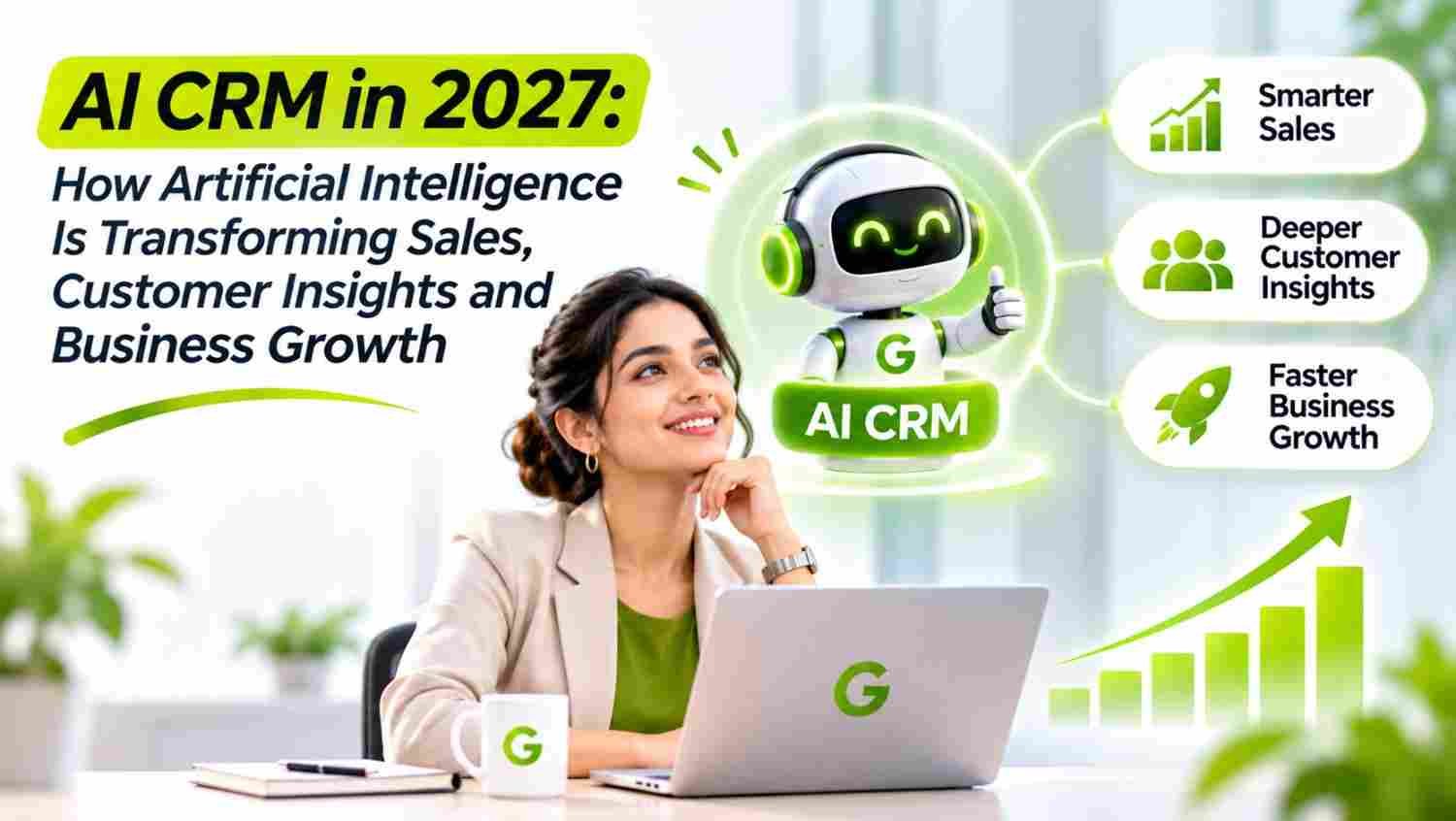
AI CRM is changing how businesses understand customers, manage sales opportunities and make decisions.
By combining customer data with artificial intelligence, modern CRM platforms can identify buying signals, prioritise leads and recommend relevant actions.
Predictive insights, automated workflows and AI-powered communication help sales teams reduce manual work and improve execution.
In 2027, the focus is shifting from simply storing customer information to using AI to turn that information into measurable business outcomes.
Businesses generate customer information through website enquiries, phone calls, emails, WhatsApp conversations, meetings, advertisements and sales interactions. The challenge is not collecting this information. It is understanding what it means and using it at the right time.
Traditional CRM systems help organisations maintain customer records, track sales activities and manage opportunities. However, much of the analysis and decision-making still depends on individual employees.
Sales representatives manually review conversations, identify promising prospects, update records and decide which opportunity needs attention. Managers often depend on reports to understand what has already happened rather than receiving clear signals about what should happen next.
AI CRM brings artificial intelligence into this process.
It can analyse customer information, identify patterns, support lead prioritisation, generate communication and recommend actions based on available data.
The direction of CRM technology is also changing. AI is moving beyond individual features towards connected workflows that can perform defined tasks. A recent analysis of enterprise CRM trends describes this shift from systems that primarily record information to platforms that can take action across customer workflows.
For business leaders, the value of AI CRM is not simply having more technology. It is improving the quality of decisions, reducing operational friction and helping teams manage customer relationships more effectively.
AI CRM combines different artificial intelligence capabilities to support sales, marketing and customer management.
The most useful capabilities are those that solve practical business problems rather than simply adding AI features to an existing interface.
Incomplete customer records create problems across sales operations. Representatives may forget to record call outcomes, update requirements or document important discussions.
AI-powered data capture can help extract relevant information from supported interactions such as calls, emails and meetings.
It can then organise that information into appropriate CRM fields, notes or activity records.
This helps businesses maintain more consistent customer information while reducing repetitive data entry.
Important buying signals are often hidden inside customer conversations.
A prospect may mention a pricing concern, request a different product configuration, identify another decision-maker or promise to reconnect after a particular date.
Conversation intelligence can analyse supported interactions, summarise discussions and identify information that sales representatives should consider.
This makes customer history more useful because teams can understand the context of an opportunity without reviewing every conversation manually.
Not every lead has the same likelihood of becoming a customer.
AI-powered lead scoring can analyse available information such as lead source, engagement, previous interactions, requirements and historical conversion patterns.
The system can then help sales teams prioritise prospects according to their potential.
For example, a prospect who has responded to multiple communications, requested a product demonstration and shared a purchase timeline may deserve more immediate attention than an enquiry with limited engagement.
Predictive scoring should be treated as decision support, not a guarantee of conversion. Its usefulness depends on data quality, model performance and the relevance of the selected signals.
Sales forecasting often depends on opportunity values, sales stages and estimates provided by representatives.
AI can add another layer by analysing historical performance, deal movement, engagement patterns and other available pipeline signals.
This can help managers identify opportunities that may be at risk and understand where projected revenue may need closer review.
Businesses can explore IBM’s AI overview to understand how AI techniques are applied to business analysis and decision support.
Knowing the current status of an opportunity is useful. Knowing what action may help move it forward is even more valuable.
AI CRM can use available customer and opportunity context to suggest relevant next steps, such as:
These recommendations should be relevant to the sales process and explainable to the people using them.
The difference between traditional CRM and AI CRM is not simply the presence of artificial intelligence.
It is how customer information is used.
| Business area | Traditional CRM | AI CRM |
|---|---|---|
| Customer records | Stores manually entered information | Can help capture and organise supported information |
| Lead management | Tracks lead status and ownership | Can support predictive lead prioritisation |
| Conversation history | Stores call notes and activity records | Can summarise conversations and identify important signals |
| Sales forecasting | Uses pipeline values and representative estimates | Can analyse historical and current opportunity signals |
| Communication | Provides templates and scheduled workflows | Can generate contextual communication |
| Sales recommendations | Relies largely on representative judgement | Can suggest next actions using available context |
| Reporting | Shows recorded business performance | Can support deeper analysis and predictive insights |
| Workflow execution | Follows configured rules | Can combine automation with AI-supported decisions and actions |
Traditional CRM remains important for maintaining structured business information. AI CRM builds on that foundation by helping teams interpret information and act on it.
The strongest implementations combine both approaches rather than replacing reliable business processes with unverified AI outputs.
The business case for AI CRM should be evaluated through improvements in sales execution, customer engagement and operational performance.
Sales representatives often manage more enquiries than they can engage with immediately.
AI-assisted scoring can help identify leads that show stronger buying signals, allowing teams to allocate attention more effectively.
Updating records, preparing summaries and drafting routine messages can consume significant time.
AI-supported workflows can reduce these activities and give representatives more time for customer conversations and commercial discussions.
When customer information and communication history are available in one place, teams can respond with better context.
Automated reminders and AI-supported follow-ups can also reduce the chances of opportunities being overlooked.
AI can help managers identify patterns across leads, representatives, opportunities and sales activities.
Instead of reviewing only the total number of open leads, managers can investigate lead quality, engagement levels and possible conversion risks.
Marketing, sales and customer service teams often work with different pieces of customer information.
A connected CRM environment can help make relevant information accessible across these functions, subject to permissions and business requirements.
The KPMG customer report identifies AI, automation, unified CRM systems and advanced analytics as important customer-technology investment priorities. <Cite refs={[“turn601824search12”]}/>
The term AI CRM is used broadly across the software market. However, not every platform offers the same capabilities.
Business leaders should evaluate whether the AI features solve specific operational problems and integrate with the existing CRM process.
| AI CRM feature | Business application |
|---|---|
| AI Lead Scoring | Helps prioritise prospects |
| Lead Analysis | Identifies customer requirements and opportunity signals |
| Conversation Intelligence | Summarises interactions and captures important details |
| Predictive Analytics | Supports forecasting and performance analysis |
| AI Email Writer | Helps prepare contextual sales emails |
| AI WhatsApp Writer | Supports customer communication |
| Automated Data Capture | Reduces manual CRM updates |
| Next-Best-Action Suggestions | Recommends relevant sales activities |
| AI Calling Agent | Supports automated lead conversations |
| Workflow Automation | Executes configured business actions |
The important consideration is how these features work together. A lead score becomes more useful when it connects with follow-up actions. A call summary becomes more valuable when it updates the correct customer record. A recommendation becomes actionable when the CRM helps the representative complete the next step.
One of the important developments in CRM is the movement from AI assistance towards agentic workflows.
A conventional AI assistant may analyse information and suggest an action. An AI agent can be configured to carry out certain approved tasks through connected systems.
For example, consider a new business enquiry:
This connects data analysis, communication and sales execution.
However, autonomous actions should operate within defined permissions. Businesses should decide which tasks AI can perform independently and which require employee approval.
The NIST AI framework provides guidance on managing AI risks, while the NIST GenAI profile addresses additional considerations associated with generative AI.
For organisations exploring the wider transition, Gartner’s agentic AI research provides additional industry context.
AI CRM is not limited to sales representatives. Its capabilities can support different business functions when customer information and workflows are connected.
Sales teams can use AI for lead prioritisation, opportunity analysis, call summaries, follow-up assistance and sales forecasting.
This helps representatives focus on relevant opportunities while giving managers better visibility into execution.
Marketing teams can use CRM information to understand lead sources, customer segments and campaign performance.
AI can help analyse engagement patterns and support more relevant communication based on available customer information.
Customer-facing teams can use AI to summarise customer history, identify recurring issues and support response workflows.
This helps employees understand the context of an interaction without reviewing multiple disconnected records.
Leadership teams need visibility into sales performance, customer engagement and operational efficiency.
AI-powered reporting can help identify patterns, highlight areas requiring attention and support more informed decisions.
For further reading, McKinsey’s analytics research discusses the role of data and analytics in commercial decision-making.
Different industries have different customer journeys, sales cycles and operational requirements. AI CRM should therefore support workflows that reflect the organisation’s actual business model.
| Industry | AI CRM application | Business objective |
|---|---|---|
| Real Estate | Lead scoring, property requirement analysis and follow-ups | Prioritise serious buyers |
| Education | Student enquiry analysis and admission follow-ups | Improve counselling coordination |
| Automobile | Vehicle enquiry qualification and customer engagement | Support dealership sales |
| Healthcare | Customer enquiry routing and appointment communication | Organise interactions |
| B2B Distribution | Product requirement analysis and sales follow-ups | Improve opportunity management |
| Manufacturing | Enquiry tracking, quotation support and account insights | Improve sales coordination |
For example, an education company may need to understand a student’s preferred course, qualification and admission timeline. A real estate business may need to analyse budget, location and property requirements.
An AI CRM should be configurable enough to support these different workflows.
Businesses can explore Groweon’s industry CRM, real estate CRM, education CRM and automobile CRM for industry-specific requirements.
AI adoption does not automatically improve business performance. The results depend on data quality, workflow design, user adoption and the way AI capabilities are governed.
Before implementing AI CRM, businesses should consider the following areas.
AI systems depend on the information available to them.
Duplicate records, outdated contact details, missing fields and inconsistent sales stages can affect the quality of AI-generated insights.
Businesses should establish clear data standards and maintain accurate customer records.
AI should support the organisation’s actual business process.
Before automating an activity, define who owns it, what triggers it, what information is required and what should happen after completion.
AI features should work with the CRM’s customer records, communication history, sales activities and reporting environment.
Disconnected tools can create fragmented information and additional administrative work.
Sales representatives should understand why an AI system has prioritised a lead or recommended an action.
High-impact decisions should have suitable human review, especially when the available information is incomplete or uncertain.
Customer information should be protected through appropriate access controls, retention policies and monitoring.
Businesses should evaluate the security and governance practices of their AI CRM provider before deployment.
The OECD AI principles provide a useful foundation for responsible AI adoption. Organisations can also review Microsoft’s responsible AI guidance and Google’s AI principles when developing internal governance practices.
AI CRM should be evaluated through measurable business improvements rather than the number of AI features activated.
The following metrics can help businesses assess performance:
| Metric | What it measures |
|---|---|
| Lead-to-Demo Conversion | Percentage of leads progressing to demonstrations |
| Lead-to-Sale Conversion | Percentage of leads resulting in sales |
| Lead Response Time | Time between enquiry generation and first response |
| Lead Qualification Rate | Percentage of leads meeting defined criteria |
| Sales Cycle Length | Time taken to close opportunities |
| Follow-Up Completion Rate | Percentage of planned follow-ups completed |
| Forecast Accuracy | Difference between projected and actual revenue |
| CRM Data Completeness | Availability of required customer information |
| Sales Productivity | Sales outcomes relative to team effort |
| Cost per Qualified Lead | Cost of generating qualified opportunities |
Businesses should establish a performance baseline before introducing AI features. Comparing results over time helps identify whether automation is improving productivity, conversion and customer engagement.
For a wider perspective, Deloitte’s AI insights and Harvard’s analytics research provide additional context on applying data and technology to business decisions.
AI CRM creates greater business value when intelligence is connected with everyday sales activities.
Groweon CRM combines customer and lead management capabilities with AION AI-powered features to support sales teams across lead analysis, communication and automation.
Its AI capabilities include:
AION Autopilot extends these capabilities through AI Calling Agent, WhatsApp AI Chatbot, Auto Lead Qualifier, automated follow-ups and custom automation workflows.
This allows businesses to connect customer engagement with lead qualification, CRM updates and subsequent sales actions.
Explore Groweon AI CRM to understand its AI-powered CRM capabilities.
Businesses can also explore AION Autopilot, AI calling agent, lead automation workflows and Groweon CRM platform to understand how AI can support connected sales operations.
The future of CRM is not just about knowing more about customers. It is about using customer intelligence to take the right action at the right time.
Traditional CRM primarily stores customer information, tracks sales activities and manages business relationships. AI CRM adds capabilities such as predictive lead scoring, conversation analysis, automated data capture and AI-supported recommendations.
AI CRM can help businesses prioritise promising leads, improve response consistency and identify opportunities that require attention. Actual conversion improvements depend on lead quality, sales execution and the effectiveness of the configured workflows.
Useful capabilities include AI lead scoring, lead analysis, conversation summaries, predictive forecasting, AI email writing, automated follow-ups and next-best-action recommendations.
Yes. Depending on the platform, AI CRM can support lead assignment, calling, qualification, follow-ups, communication assistance and CRM record updates. Businesses should define which activities can run automatically and which require human approval.
Yes. Enterprise organisations can use AI CRM to support customer intelligence, sales forecasting, workflow automation and coordination across multiple teams. Data governance, integration and access controls are important considerations.
No. AI can reduce repetitive work and support decision-making, but human representatives remain important for relationship building, negotiations, complex requirements and commercial judgement.
Yes. Reliable customer data is important for useful predictions and recommendations. Duplicate records, incomplete information and inconsistent processes can reduce the quality of AI outputs.
Businesses can compare lead response time, conversion rates, sales cycle length, follow-up completion, administrative effort and cost per qualified lead before and after implementation.
Yes. AI CRM can be configured for different customer journeys and workflows, including real estate, education, automobile, healthcare, manufacturing and B2B distribution.
Evaluate AI capabilities, CRM integration, data quality requirements, workflow flexibility, reporting, security, user adoption and the ability to measure business outcomes.

24 Nov, 2026
Summary AI CRM is changing how businesses understand customers, manage...

24 Nov, 2026
Summary Sales Pipeline Management gives business leaders a clear view...

23 Nov, 2026
Summary Generating leads is only one part of the sales...

23 Nov, 2026
Summary Every sales enquiry deserves timely attention, but manual follow-ups...

23 Nov, 2026
Summary Businesses receive enquiries throughout the day, but manually calling...