

The State of Field Sales Automation in 2026: Trends, Challenges…
02 Nov, 2026
Field sales teams play an important role in businesses that...
Updated: 2nd November, 2026
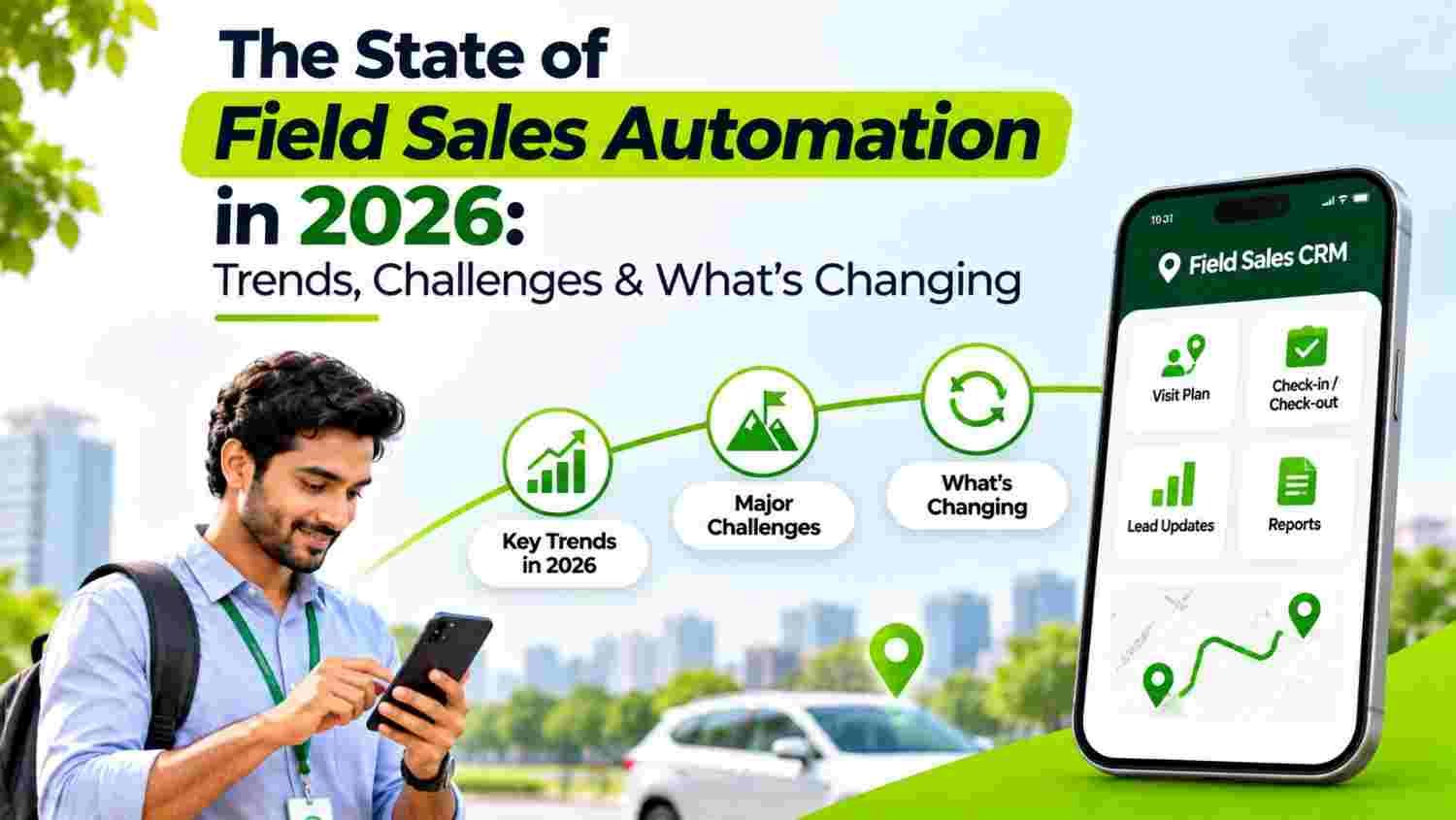
Field sales teams play an important role in businesses that depend on customer visits, dealer networks, distributors, retailers, and on-ground sales activities. However, managing a field sales team is not always easy. Managers need to coordinate daily visits, monitor attendance, track employee locations, review sales performance, and ensure that customer follow-ups happen on time.
Traditional methods such as spreadsheets, paper-based reports, phone calls, and WhatsApp updates often make this process complicated. Information gets scattered, reporting gets delayed, and managers may struggle to understand what is actually happening in the field.
In 2026, field sales automation is moving beyond basic employee tracking. Businesses are adopting GPS-based tracking, automated attendance, mobile CRM applications, route planning, AI-powered insights, and real-time performance dashboards to improve field operations.
For Indian businesses, especially manufacturers, distributors, FMCG companies, and sales-driven organisations, these technologies can help improve team productivity and operational visibility.
This guide explores the latest field sales automation trends in 2026, the challenges businesses face, and how modern Field Track CRM software can support better field team management.
Field sales automation is transforming how businesses manage their on-ground sales teams in 2026. Technologies such as GPS tracking, AI-powered analytics, mobile CRM, automated attendance, route optimisation, and real-time reporting are helping businesses reduce manual work and improve sales visibility. This article explains the key trends, challenges, benefits, and essential features businesses should consider when choosing field sales automation software.
| Trend | Business Impact |
|---|---|
| AI-powered sales intelligence | Better sales insights and decision-making |
| Offline-first mobile applications | Field activities can continue with limited connectivity |
| Real-time GPS tracking | Improved field team visibility |
| Route optimisation | More efficient customer visit planning |
| Automated CRM updates | Less manual data entry |
| CRM and ERP integration | Connected business operations |
| Performance analytics | Better employee productivity monitoring |
| Conversational AI | Easier information access and task automation |
Field sales automation refers to the use of digital tools and software to manage and automate the daily activities of sales representatives working outside the office.
Instead of depending on manual reports, phone calls, and spreadsheets, businesses can use a centralised platform to manage field sales activities.
A field sales automation system can help businesses manage:
The objective is not to replace field sales representatives. It is to reduce repetitive administrative work, improve coordination, and give employees more time to focus on customer interactions and sales.
Learn more about field sales and how CRM platforms support modern sales operations.
Field sales operations are becoming increasingly technology-driven. Businesses are moving away from systems that only record employee activities towards platforms that provide real-time visibility and help managers make better decisions.
The original Delta Sales App article highlights cloud-based deployment, mobile accessibility, GPS tracking, AI integration, and connected sales workflows as important developments in the field sales automation industry.
Several factors are driving this transformation:
According to Grand View Research, field force automation is an evolving technology market with applications across multiple industries.
Field sales automation is particularly useful for businesses where employees regularly visit customers, dealers, retailers, or project locations.
| Industry | Common Field Sales Activities |
|---|---|
| FMCG | Retailer visits, order collection, beat planning |
| Manufacturing | Dealer visits, distributor management |
| Pharmaceuticals | Doctor visits, medical representative tracking |
| Real Estate | Site visits, customer meetings, lead follow-ups |
| Telecom | Field representative tracking and customer visits |
| Distribution | Retailer coverage, order collection, payment follow-ups |
| Electrical & Electronics | Dealer management and product demonstrations |
| Building Materials | Contractor visits, dealer meetings, order tracking |
Industry resources from McKinsey and Deloitte provide further perspectives on how technology is changing business and operational workflows.
Artificial intelligence is becoming an important part of modern sales management. Instead of simply recording customer visits and sales activities, businesses are increasingly looking for systems that can analyse information and provide useful insights.
AI-powered sales intelligence can help managers understand customer behaviour, identify sales opportunities, and recognise patterns in team performance.
How AI Is Transforming Field Sales
For example, a distributor may have hundreds of retailers across different locations. AI-assisted analytics can help identify customers with declining order frequency or potential sales opportunities.
Businesses can explore Salesforce AI and Microsoft AI to understand how artificial intelligence is being applied to business workflows.
Groweon’s AION AI+ also focuses on AI-powered CRM capabilities that support lead analysis, scoring, and sales communication.
What businesses should do: Start by maintaining accurate customer, visit, and sales records. AI insights are only as useful as the quality of the underlying data.
Field sales representatives often work in locations where internet connectivity may be inconsistent. They may visit remote areas, warehouses, industrial locations, or customer sites with limited network coverage.
An offline-first mobile application helps employees continue essential activities even when an internet connection is unavailable.
Depending on the software, employees may be able to:
For example, a field representative visiting retailers in a rural area may not have reliable internet access. An offline-capable application can help record visit information and synchronise it when connectivity returns.
Mobile technology resources from Android Developers explain offline-first application design.
Businesses should also evaluate Google Android and Apple Business device compatibility when selecting mobile field applications.
What businesses should do: Check whether the field tracking application supports offline access and automatic data synchronisation. Do not assume every mobile CRM includes complete offline functionality.
GPS tracking has become an important feature for businesses managing employees who work outside the office.
Managers need visibility into field activities, while sales representatives need a practical way to organise customer visits and daily routes.
Modern field tracking systems can help businesses monitor employee locations, record visit information, and improve territory planning.
Important GPS Tracking Capabilities
Route optimisation can also help employees reduce unnecessary travel and plan more efficient visit sequences.
For example, a sales representative visiting 12 retailers in one day can organise visits by location rather than travelling randomly between different areas.
Explore Google Maps Platform, Google Maps Routes, and HERE Technologies for more information about digital mapping and route planning technologies.
What businesses should do: Choose a GPS-enabled field tracking system that supports appropriate location permissions, transparent employee policies, visit records, and practical reporting.
Manual data entry is one of the common challenges faced by field sales representatives.
After completing customer visits, employees may need to update spreadsheets, prepare reports, share WhatsApp messages, and inform managers about daily activities. These tasks consume time that could otherwise be spent on customer interactions.
Automation can reduce repetitive administrative work.
Examples of Automated Field Sales Activities
For example, when a sales representative completes a customer visit, the system can help maintain a digital record of the activity instead of depending entirely on handwritten reports.
Businesses can explore HubSpot CRM, Zoho CRM, and Salesforce Sales Cloud to understand how CRM platforms organise customer information and sales activities.
What businesses should do: Identify the field activities that require repeated manual reporting and automate the processes that can be reliably digitised.
Field sales teams need more than employee location information. They also need access to customer details, product information, order history, and relevant stock information.
When field tracking software operates separately from other business systems, employees may need to contact the office repeatedly to obtain information.
Integrated business systems help connect field activities with sales and operational workflows.
Benefits of Connected Business Systems
For example, a distributor’s sales representative visiting a retailer may need to check product availability before confirming an order. Connecting field sales with inventory information can make this process more efficient.
Businesses can explore SAP ERP, Oracle NetSuite, and Microsoft Dynamics 365 to understand connected business applications.
Groweon also offers connected solutions for CRM software, inventory management, and order management.
What businesses should do: Select software that fits existing business workflows and evaluate available integrations before implementation.
Field sales managers need to understand more than the number of visits completed by employees. They also need to evaluate sales outcomes, customer coverage, target achievement, and follow-up activities.
Performance analytics helps managers review field operations using organised data and reports.
Important Field Sales KPIs to Monitor
| KPI | What It Measures |
|---|---|
| Daily visits | Number of customer visits completed |
| Visit productivity | Effectiveness of customer interactions |
| Sales target achievement | Actual sales compared with targets |
| Lead conversion rate | Percentage of leads converted into customers |
| Follow-up completion | Timely completion of scheduled follow-ups |
| Territory coverage | Customer or outlet coverage across an area |
| Order value | Value of orders generated by representatives |
For example, two representatives may complete the same number of customer visits, but their sales results may be very different. Performance analytics helps managers evaluate both activity and outcomes.
Resources from Tableau, Power BI, and Gartner can help businesses understand sales analytics and performance management.
What businesses should do: Create a simple set of measurable KPIs and review them regularly. Use reports to support coaching and improvement rather than relying only on employee activity counts.
Field representatives frequently work while travelling between customers, handling product enquiries, and recording sales information.
Voice technology and conversational AI can make certain activities easier by allowing users to interact with digital systems through spoken commands or natural language.
Potential applications include:
For example, after a customer meeting, a sales representative may use voice-to-text functionality to record important discussion points rather than typing a lengthy report.
Conversational AI is also developing across customer-facing workflows. Businesses can explore Google Cloud AI, IBM watsonx, and OpenAI for broader developments in AI-powered business applications.
Groweon’s AION Autopilot focuses on AI-powered calling and conversational automation for sales workflows.
What businesses should do: Identify repetitive communication and documentation tasks where voice or conversational tools can save time. Ensure that any AI-generated records are reviewed when accuracy is important.
Field employees need tools that work comfortably on mobile devices. A complicated application with too many steps can reduce adoption, even if it includes many advanced features.
Mobile-first field workforce management focuses on making everyday activities accessible through a simple mobile interface.
Useful Mobile Capabilities
A mobile-first system can help managers and field employees stay connected without depending on office-based reporting processes.
Businesses can explore Google Workspace, Microsoft 365, and Apple Business for examples of mobile-enabled workplace tools.
Groweon’s Groweon Lite is another mobile CRM option for managing leads, contacts, and meetings.
What businesses should do: Test the mobile application with actual field employees before implementation. The application should be easy to learn and should support the activities employees perform every day.
Even with better technology, field sales teams continue to face operational challenges. Introducing software alone does not guarantee better performance. Businesses also need clear processes, employee adoption, and reliable data.
When employees share updates through phone calls, WhatsApp messages, or spreadsheets, managers may not have a complete view of field activities.
A centralised field tracking platform can help organise attendance, location records, customer visits, and activity reports.
Field representatives may spend significant time preparing daily reports and updating customer information.
Digital visit logging, automated reporting, and mobile CRM tools can reduce repetitive administrative work.
Without proper planning, representatives may travel unnecessarily or miss important customer appointments.
Route planning, customer scheduling, and territory management can help organise daily field activities.
Some employees may consistently achieve targets, while others may struggle with customer coverage or follow-ups.
Performance dashboards can help managers identify these patterns and provide timely support.
Field employees may not receive updated product information, customer details, or business instructions on time.
Connected CRM platforms and centralised communication can improve coordination between office and field teams.
Employees who are accustomed to paper-based reports and informal communication may find it difficult to adopt a new application.
Businesses should provide practical training and choose software that is easy to use.
Field sales automation is moving from basic digital record-keeping towards more connected and intelligent workflows.
| Area | Traditional Approach | Direction in 2026 |
|---|---|---|
| Attendance | Manual registers | Digital attendance systems |
| Employee tracking | Phone calls and updates | GPS-based location visibility |
| Customer visits | Paper-based visit reports | Digital visit records |
| Route planning | Manually planned routes | Digital route optimisation |
| Sales reporting | End-of-day spreadsheets | Centralised dashboards |
| CRM updates | Manual data entry | Automated and assisted updates |
| Performance monitoring | Periodic reviews | More frequent performance insights |
| Communication | Separate messaging tools | Connected CRM workflows |
The important change is that businesses are not just digitising field activities. They are connecting information to improve decision-making and operational efficiency.
Choosing field tracking software requires more than comparing feature lists. Businesses should understand their field operations and select a system that supports the actual work of their sales representatives.
Before choosing a platform, evaluate these important factors.
| Feature | What to Check |
|---|---|
| GPS tracking | Location visibility and tracking records |
| Attendance management | Digital attendance and reporting |
| Customer visit tracking | Planned and completed visit records |
| Route planning | Territory and visit scheduling |
| Task management | Activity assignment and follow-up reminders |
| Mobile CRM | Access to customer and sales information |
| Performance dashboard | Employee and team performance reports |
| Integrations | Compatibility with existing business tools |
| Ease of use | Simple interface for field employees |
| Scalability | Ability to support growing teams and locations |
Businesses should also evaluate software pricing, customer support, data security, user permissions, and implementation requirements.
For additional guidance, explore NIST Cybersecurity and OWASP Security resources when assessing the security of business applications.
Field sales automation can improve business operations by connecting employees, customers, and management through a centralised system.
Managers can review available location information, attendance records, and field activity reports without depending entirely on phone calls.
Automating routine reporting and administrative activities gives representatives more time for customer visits and sales activities.
Digital visit management helps businesses plan customer meetings and maintain a record of completed activities.
Route planning and territory visibility can help employees organise their daily schedules and improve customer coverage.
Digital records and centralised dashboards reduce the effort required to collect information from multiple employees.
Managers can review targets, activities, customer visits, and sales results to identify areas that need attention.
Access to customer information and previous interactions can help representatives prepare for meetings and respond more effectively.
Automated attendance, visit reports, and task reminders can reduce repetitive administrative activities.
Managing field employees becomes challenging when attendance, location records, customer visits, and daily reports are maintained through separate tools.
Groweon Field Track CRM is designed to help businesses organise and monitor field operations through a digital platform.
With Groweon Field Track, businesses can explore field management capabilities such as:
Businesses can also connect field sales activities with wider business workflows through Groweon’s Sales CRM and CRM platform.
For organisations managing customer enquiries and follow-ups alongside field operations, Groweon’s AION AI+ and AION Autopilot offer additional AI-powered sales capabilities.
The goal is to help businesses bring more structure to field operations, improve visibility, and reduce dependence on disconnected manual processes.
Explore Groweon solutions to understand how its business management products can support your sales operations.
1. What is field sales automation?
Field sales automation uses digital software and tools to manage activities performed by sales representatives outside the office. It can include GPS tracking, attendance, customer visits, route planning, sales reporting, and task management.
2. What are the major field sales automation trends in 2026?
Major trends include AI-powered sales intelligence, offline-first mobile applications, GPS tracking, route optimisation, automated CRM updates, system integrations, performance analytics, and conversational AI.
3. How does GPS tracking help field sales teams?
GPS tracking can help managers view employee location information, review recorded movement, support customer visit verification, and improve field activity visibility.
4. What is Field Track CRM software?
Field Track CRM software helps businesses manage field employees and their activities through digital tools. Depending on the platform, it may include GPS tracking, attendance, customer visit management, task assignments, and performance reports.
5. How can businesses monitor field sales employee performance?
Businesses can monitor performance using KPIs such as daily visits, sales target achievement, customer coverage, follow-up completion, order value, and attendance records.
6. Why is route optimisation important for field sales teams?
Route optimisation helps representatives organise customer visits based on location and priority. It can reduce unnecessary travel and help employees manage their daily schedules more effectively.
7. Can field sales software work without an internet connection?
Some field sales applications support offline functionality, allowing employees to record selected activities without an active internet connection. Data may synchronise when connectivity returns. Businesses should verify this capability before selecting software.
8. Which industries need field sales automation?
FMCG, manufacturing, pharmaceuticals, distribution, retail, telecom, real estate, and building materials businesses can benefit from field sales automation when they manage employees working across customer locations.
9. What features should businesses look for in field tracking software?
Important features include GPS tracking, attendance management, customer visit tracking, route planning, task management, mobile access, reporting, integrations, and performance dashboards.
10. How does Groweon Field Track CRM help businesses?
Groweon Field Track CRM helps businesses organise field operations through capabilities such as GPS tracking, attendance management, field activity records, customer visit management, task management, and performance monitoring.
Field sales automation in 2026 is moving beyond basic employee location tracking. Businesses are increasingly adopting AI-powered insights, mobile CRM applications, automated reporting, route planning, and connected business systems to improve field operations.
For Indian manufacturers, distributors, FMCG companies, and other sales-driven organisations, these technologies can help improve employee visibility, organise customer visits, and reduce manual reporting.
However, successful automation depends on choosing the right software, maintaining reliable business data, and ensuring that employees can easily use the system.
A well-implemented Field Track CRM can help businesses bring their field activities into one organised workflow and make sales team management more structured.
Want better visibility into your field sales operations? Explore Groweon Field Track and discover a more organised way to manage your field team.

02 Nov, 2026
Field sales teams play an important role in businesses that...

02 Nov, 2026
Summary Excel may help businesses track sales initially, but managing...

31 Oct, 2026
Summary Lead Assignment Software helps businesses automatically distribute incoming leads...

31 Oct, 2026
Summary A free mobile CRM app helps small businesses manage...

31 Oct, 2026
Quick Summary Order Management CRM software connects customer information, sales...