

AI CRM ROI: What Indian SMBs Should Actually Expect in…
25 Sep, 2026
Summary (TL;DR): An AI CRM pays back $8.71 for every...
Updated: 11th August, 2026
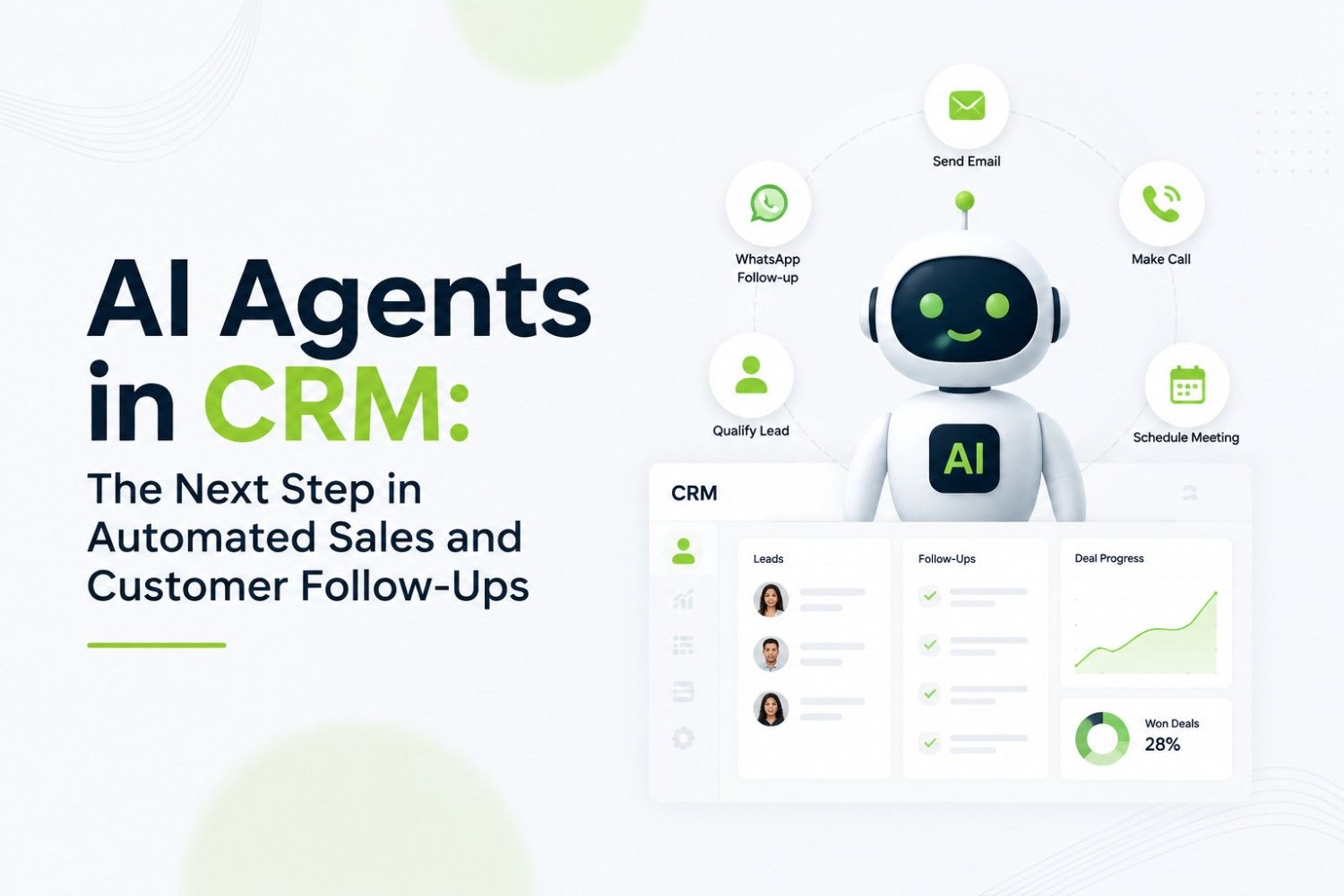
CRM software has already changed the way businesses manage leads, customer information, sales pipelines, and follow-ups. Automation made CRM even more useful by reducing repetitive work such as lead assignment, reminders, notifications, and routine communication.
But sales teams now face a different challenge.
They are not only dealing with more leads. They are also dealing with more customer conversations, more data, more communication channels, and greater pressure to respond quickly.
This is where AI agents in CRM are becoming important.
Instead of simply triggering a predefined action, AI agents can analyse information, work with context, perform defined tasks, and support multi-step workflows.
McKinsey’s 2025 global AI survey found that 62% of organisations are already experimenting with AI agents, although most are still at the early stage of scaling them across the business.
The shift is therefore not from “CRM to AI CRM” overnight.
It is a gradual move from:
Manual CRM → Automated CRM → AI-Powered CRM → Agentic CRM
An AI agent is a software system that can perform tasks on behalf of a user or business within a defined objective.
Unlike a simple automation rule, an AI agent can work with information and context to coordinate multiple steps.
For example:
New Lead → Assign Salesperson → Create Follow-Up Reminder
New Lead → Understand Enquiry → Qualify Lead → Prioritise Opportunity → Respond → Update CRM → Create Next Action
The level of autonomy depends on how the system is designed and what permissions it has.
The important difference is that AI agents can help move CRM from recording activity to supporting action.
NASSCOM describes AI agents as software programs that can sense, assess, act and learn to pursue complex goals with a degree of autonomy.
Salespeople spend a considerable amount of time on activities around selling rather than directly selling.
These activities include:
This creates a simple business problem:
The more time salespeople spend managing sales administration, the less time they have for actual customer conversations.
AI-powered CRM can help reduce this gap.
The goal is not to remove the salesperson from the process.
The goal is to let AI handle repetitive work while salespeople focus on activities that require human judgement.
| Sales Activity | Traditional CRM Automation | AI-Powered CRM |
|---|---|---|
| Lead capture | Records enquiry | Captures and interprets available information |
| Lead qualification | Manual or fixed rules | AI-assisted qualification |
| Lead prioritisation | Manual/rule-based | AI-assisted scoring |
| Follow-up | Creates reminders | Can support context-based follow-up |
| Communication | Templates | AI-assisted personalised communication |
| CRM updates | Manual | AI-assisted updates |
| Customer history | Stored | Used as context |
| Next action | Salesperson decides | AI can recommend next action |
| Workflow | Rule-based | Can coordinate multiple defined steps |
The difference is not that traditional automation becomes useless.
It is that AI adds context and intelligence to the workflow.
A new enquiry does not automatically mean a sales-ready opportunity.
A business may receive:
An AI-powered lead qualification workflow can analyse the information available and help identify the customer’s requirement.
For example:
New Lead → Requirement → Budget → Timeline → Interest → Qualification → Salesperson
Instead of sending every enquiry to a salesperson in exactly the same way, businesses can create a more structured qualification process.
This makes AI lead qualification particularly useful for teams handling large lead volumes.
A salesperson may have dozens or hundreds of active leads.
The question is not simply:
“How many leads do we have?”
It is:
“Which leads deserve attention first?”
AI-powered lead scoring can consider multiple signals, such as:
For example:
| Customer Signal | Possible Sales Meaning |
|---|---|
| Requested a demo | Higher buying intent |
| Asked about pricing | Commercial interest |
| Responded to multiple messages | Active engagement |
| Repeatedly visited product information | Stronger interest |
| No activity for a long period | Lower immediate priority |
AI scoring does not replace a salesperson’s judgement.
It helps the salesperson use that judgement more efficiently.
Follow-up is one of the most important parts of sales.
It is also one of the easiest things to miss.
A customer may say:
“Call me tomorrow.”
Another may say:
“I need to discuss this with my team.”
Someone else may stop responding after receiving a quotation.
A traditional CRM can create a reminder.
An AI-powered CRM can help make the next interaction more relevant.
A workflow could look like:
Customer Enquiry → Initial Response → No Response → Follow-Up → Customer Reply → Next Action
AI can also use previous conversation context to assist with the follow-up message.
That means the salesperson does not always have to start from a blank message or use the same template for every customer.
Modern sales teams communicate through:
AI can assist with:
For example, instead of opening an entire conversation before making a follow-up, a salesperson could have a concise summary:
Customer: Interested in enterprise plan
Main concern: Pricing
Last interaction: Product demo completed
Current stage: Evaluation
Suggested action: Commercial follow-up
This reduces the time required to understand the customer’s situation.
This is one of the most important changes in AI-powered CRM.
Traditional CRM answers:
“What happened?”
AI can help answer:
“What should happen next?”
For example:
Demo completed + pricing requested + no response for two days
→ Follow-up recommended
Or:
Customer responded + high engagement + decision-maker involved
→ Salesperson attention recommended
This makes CRM more proactive.
Instead of salespeople constantly checking the CRM for pending work, the system can help surface opportunities that require attention.
AI agents can assist with repetitive CRM tasks such as:
This gives salespeople more time for:
The objective is not:
AI replaces salespeople.
The objective is:
AI handles repetitive work so salespeople can focus on selling.
AI works best when businesses clearly define what should be automated and what should remain under human control.
| Activity | Suitable Approach |
| Lead data entry | Automation / AI |
| Basic qualification | AI |
| Lead prioritisation | AI + Salesperson |
| Routine follow-up | AI / Automation |
| Customer questions | AI + Human |
| Negotiation | Human |
| Complex requirements | Human |
| High-value opportunities | Human + AI |
| Sales reporting | AI + Manager |
This creates a human-in-the-loop CRM.
AI manages repetitive and scalable activities.
Salespeople remain responsible for decisions where judgement, trust, negotiation, and relationships matter.
AI cannot work effectively without reliable information.
A CRM may contain:
If this information is incomplete or spread across different systems, AI has less context.
This is already a major concern for businesses adopting agentic AI.
McKinsey’s 2026 research notes that eight in ten companies cite data limitations as a roadblock to scaling agentic AI.
That means businesses should not evaluate AI CRM software only by asking what AI features it has.
They should also ask:
Can the CRM provide AI with reliable, connected customer data?
AI-agent adoption is growing, but businesses are still figuring out how to scale it.
McKinsey’s 2025 global survey found that 62% of respondents said their organisations were at least experimenting with AI agents, while fewer than 10% reported scaling agents in any individual business function.
This is important for businesses considering AI-powered CRM.
The goal should not be to automate everything immediately.
Instead, businesses should identify high-value workflows where AI can create measurable improvements.
For sales, these could include:
Lead Qualification → Lead Prioritisation → Follow-Up → Customer Communication → CRM Updates
Before selecting an AI-powered CRM, businesses should evaluate practical capabilities rather than simply looking for an “AI” label.
AI Lead Qualification
Can the system identify and organise relevant prospects?
AI Lead Scoring
Can it help salespeople prioritise high-potential leads?
Follow-Up Automation
Can repetitive follow-ups run automatically?
AI Communication
Can AI assist with personalised emails and messages?
Conversation Intelligence
Can customer conversations be summarised and analysed?
CRM Automation
Can AI work with existing business workflows?
Next-Action Recommendations
Can the system suggest what the salesperson should do next?
Human Handoff
Can complex conversations move to a human salesperson?
Data Integration
Can the AI access accurate customer and sales information?
Security and Governance
Can businesses control what AI can access and what actions it can perform?
These factors matter more than simply counting AI features.
CRM has evolved through several stages.
Stage 1: Contact Management
Store customer information
Stage 2: Sales CRM
Manage leads, opportunities and pipelines
Stage 3: CRM Automation
Automate assignments, reminders and repetitive workflows
Stage 4: AI-Powered CRM
Analyse data and assist sales teams
Stage 5: Agentic CRM
AI agents perform defined tasks and coordinate parts of the workflow
This does not mean every CRM will suddenly become fully autonomous.
The transition will happen workflow by workflow.
Businesses will first automate repetitive tasks, then introduce AI-assisted decisions, and eventually allow agents to execute clearly defined activities with appropriate controls.
Consider a new lead entering a CRM.
Lead Received → Salesperson Checks Lead → Qualifies → Writes Response → Updates CRM → Creates Reminder
Lead Received → AI Analyses Lead → Qualification → Lead Scoring → Response Assistance → CRM Update → Follow-Up Workflow → Human Sales Conversation
The salesperson is still involved.
But much of the preparation around that conversation can be handled by the system.
That is the practical value of AI-powered CRM automation.
The next generation of CRM will not simply be about storing more customer data.
It will be about using that data to take better action.
AI agents can help businesses:
For businesses, the key is not to adopt AI because everyone is talking about it.
The key is to identify where AI can make the sales process faster, smarter and more consistent.
Groweon CRM combines lead management, sales workflows, communication, follow-ups, automation, analytics and AI-powered capabilities in one connected platform.
With AION, Groweon’s AI capabilities can support activities such as AI calling, lead qualification, WhatsApp conversations, lead scoring, follow-ups and sales assistance.
The aim is simple:
Capture the lead → Understand the opportunity → Take the right action → Keep the salesperson in control.
As AI agents become more capable, CRM is moving from being a system that records sales activity to a system that can actively support the sales process.
The future of CRM is not just automated sales. It is intelligent sales execution.
What are AI agents in CRM?
AI agents in CRM are software systems that can perform defined sales and customer-related tasks using available data, context and business workflows.
How are AI agents different from CRM automation?
Traditional automation usually follows predefined rules. AI agents can analyse information and support more context-based, multi-step tasks.
Can AI agents replace salespeople?
AI agents are better suited to repetitive and scalable activities. Salespeople remain important for negotiation, complex requirements, relationship building and high-value decisions.
How can AI improve CRM follow-ups?
AI can identify leads that need attention, analyse previous interactions, assist with personalised communication and support automated follow-up workflows.
Why is CRM data important for AI agents?
AI agents need accurate customer and sales information to make useful recommendations and perform appropriate actions.

25 Sep, 2026
Summary (TL;DR): An AI CRM pays back $8.71 for every...

24 Sep, 2026
Summary (TL;DR): An agentic CRM is a system where AI...

23 Sep, 2026
Summary (TL;DR): The best CRM for car dealerships in India...

23 Sep, 2026
Summary (TL;DR): The best CRM for B2B sales teams in...

23 Sep, 2026
Summary (TL;DR): The best WhatsApp CRM in India combines the...