

10 Must-Have Features in AI CRM Software for Modern Businesses
12 Nov, 2026
Summary AI CRM Software helps businesses manage customer relationships through...
Updated: 11th November, 2026
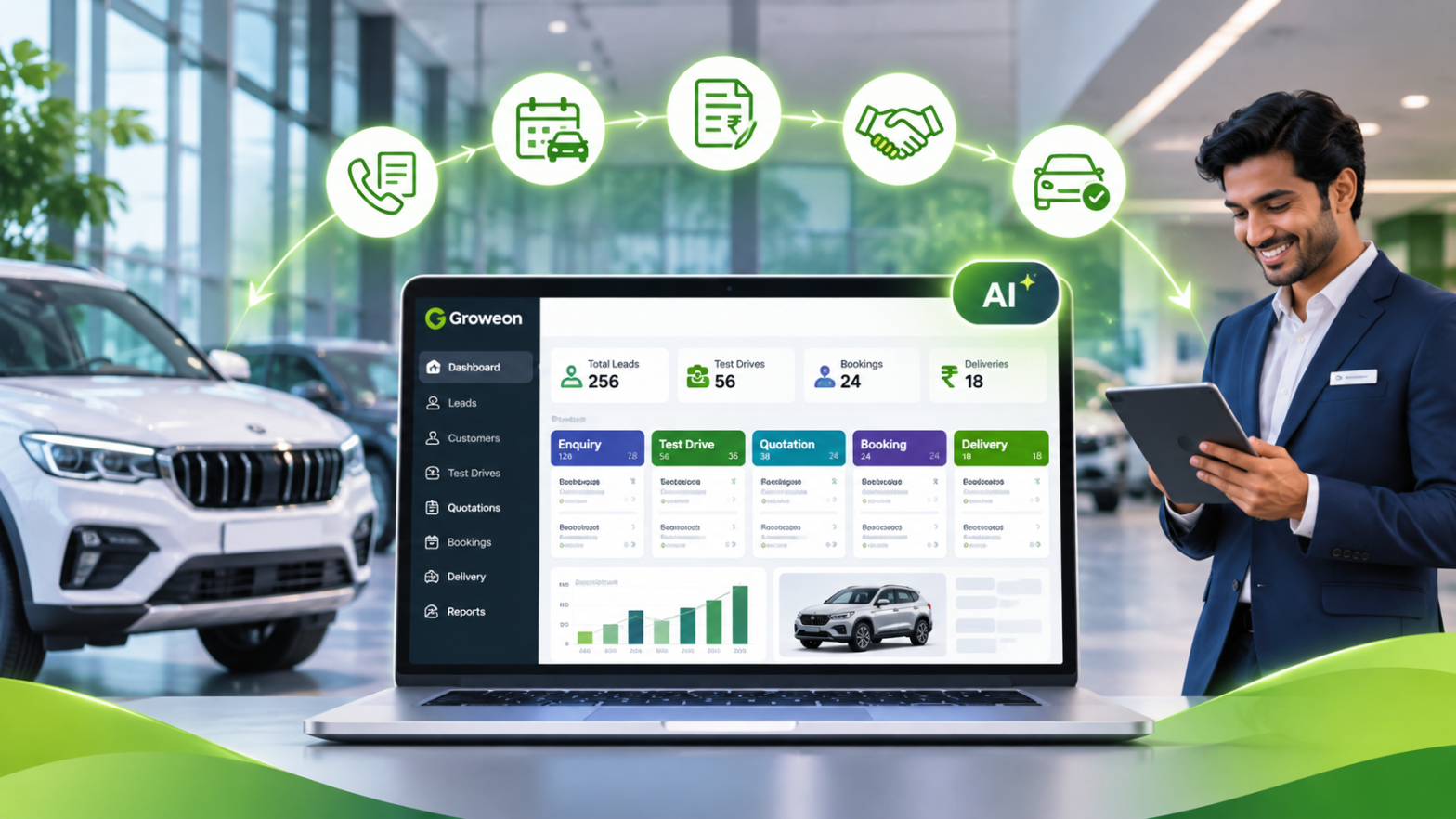
AI CRM for car dealerships helps automotive businesses capture enquiries, manage prospective buyers, and organize sales activities from the first interaction to vehicle delivery.
It brings lead management, test drive scheduling, customer communication, quotation tracking, and follow-up activities into a structured workflow.
AI-powered capabilities can support lead prioritization, communication assistance, and repetitive sales tasks while keeping human representatives involved in important decisions.
This guide explains the essential CRM features, implementation considerations, and practical ways dealerships can improve sales coordination and customer experience.
Buying a vehicle involves several decisions. Customers research different models, compare specifications, evaluate prices, explore financing options, schedule test drives, and discuss delivery timelines before selecting a vehicle. Throughout this process, they may interact with multiple sales representatives and dealership departments.
For car dealerships, managing these interactions efficiently is essential. An enquiry received through a website, automotive marketplace, advertisement, phone call, or showroom visit needs to be recorded, assigned, and followed up appropriately. If customer information is scattered across spreadsheets and messaging applications, sales teams can struggle to maintain continuity.
An AI CRM for car dealerships provides a centralized approach to managing these activities. It helps dealerships organize prospective buyers, monitor sales opportunities, coordinate test drives, and maintain customer communication records. AI-powered capabilities can further support lead analysis and selected workflow automation.
The objective is to create a connected sales process in which every customer interaction has a clear record, responsible team member, and appropriate next action.
A vehicle purchase journey includes several stages, and each stage creates information that the dealership needs to manage. A structured automotive CRM helps connect these activities rather than treating every customer interaction as a separate task.
A potential buyer may discover a dealership through its website, online advertisements, automotive marketplaces, social media, referrals, or a showroom visit.
When enquiries arrive through different channels, maintaining one accurate customer record becomes important. Sales representatives should be able to understand where the enquiry originated, which vehicle the customer is interested in, and what action is required next.
An automotive CRM can help centralize information such as:
For example, a customer enquiring about a particular SUV through a website form should have that requirement recorded against the lead. If the customer later calls the dealership, the representative can refer to the existing information.
Dealerships can also review Google lead forms and Meta lead ads when planning digital enquiry capture.
A centralized Groweon CRM approach can help businesses organize customer records and sales activities in one place.
Automated lead capture and assignment may reduce manual data entry when the relevant channels and integrations are supported and configured.
Not every vehicle enquiry represents the same level of purchase intent. Some customers are researching options, while others are ready to schedule a test drive, request an on-road quotation, or discuss booking.
AI-powered CRM capabilities can help sales teams analyze available lead information and identify enquiries that may require quicker attention.
For example, consider two enquiries:
Both enquiries are valuable, but their immediate requirements are different. A CRM can help representatives record these differences and organize the next actions accordingly.
AI-assisted lead scoring may consider available information such as enquiry details, customer interactions, and recorded sales activity. However, dealerships should validate scoring recommendations against actual sales outcomes rather than treating an AI score as a guaranteed prediction.
For more information on responsible AI adoption, businesses can refer to Google AI principles.
A structured Groweon sales CRM workflow can also help teams organize lead ownership and follow-up activities.
A test drive is a significant stage in the vehicle buying journey. It allows potential buyers to evaluate driving comfort, vehicle performance, features, and suitability for their requirements.
Delayed scheduling or poor coordination can create an inconvenient customer experience.
CRM software can help sales teams record test drive requests, preferred dates, vehicle models, and appointment outcomes.
A structured test drive workflow can include:
For example, if a buyer requests a weekend test drive, the assigned representative can record the preferred appointment and track its confirmation.
Dealerships should also understand customer experience principles through resources such as J.D. Power research.
A mobile CRM application can help representatives access relevant customer records and update sales activities while working outside the showroom.
After a test drive, customers may request an on-road price, compare variants, discuss exchange offers, or ask about financing options.
If these conversations are not recorded properly, representatives may struggle to maintain continuity. Customers may also need to repeat their requirements when speaking to another team member.
A CRM can help teams document:
For example, if a buyer is comparing two vehicle variants, the representative can record the customer’s preferences and the information already shared.
CRM records should not be treated as a replacement for official quotations or financial documentation. Vehicle prices, discounts, finance terms, and availability should always be confirmed through authorized dealership processes.
Businesses can understand digital customer communication through Google Business Profile and WhatsApp Business.
For dealerships using multiple customer communication channels, AI WhatsApp Writer is another Groweon capability worth exploring for AI-assisted message creation.
Once a customer decides to purchase, the dealership needs to coordinate several activities. These may include booking confirmation, documentation, payment updates, financing coordination, vehicle allocation, and delivery scheduling.
A CRM workflow can help teams track these activities and maintain a record of customer communication.
A delivery-stage checklist may include:
For example, if a customer has confirmed the booking but is waiting for a delivery date, the sales team can record the pending action and assign responsibility to the appropriate employee.
The CRM should provide visibility into these stages without implying that it automatically performs every financial, registration, or logistics activity. Those processes may require separate systems and integrations.
Dealerships can refer to Deloitte automotive insights and McKinsey automotive research to understand broader developments in automotive retail and customer experience.
For businesses managing related operational workflows, Groweon Order Management provides an additional area to explore.
AI can support dealership teams by reducing repetitive administrative work and helping representatives manage customer interactions more consistently.
The most useful applications are those that address identifiable workflow problems rather than introducing automation without a clear business purpose.
A common challenge in vehicle sales is maintaining timely communication with every interested buyer.
CRM automation can help schedule reminders and trigger approved follow-up workflows based on customer activity or sales-stage updates.
For example, after a test drive, a representative may receive a reminder to contact the customer, record feedback, and discuss the next step.
A follow-up workflow may be designed around:
Businesses can explore Google Workspace and Microsoft Power Automate to understand how digital workflows and task automation can support business operations.
AI-powered writing tools can help representatives prepare personalized messages for different stages of the buying journey.
These may include:
AI-generated communication should be reviewed before sending, especially when messages contain vehicle prices, offers, financing terms, delivery dates, or commitments.
Dealerships can also explore Groweon AION AI+ for information about Groweon’s AI-powered business capabilities.
CRM dashboards can help dealership managers monitor:
These indicators help managers identify bottlenecks and understand where additional attention may be required.
For example, if a dealership receives many enquiries but relatively few test drive appointments are completed, management can investigate response time, appointment availability, and follow-up practices.
Businesses can learn more about Microsoft Power BI and Google Analytics when planning reporting and performance measurement across their business operations.
Choosing the right CRM requires more than comparing feature lists. Dealerships should evaluate whether the platform supports their actual sales process, team structure, and customer communication requirements.
|
|---|
Dealerships should also assess integration requirements, user permissions, data security, reporting flexibility, and the ease of adoption by their sales teams.
For a wider understanding of CRM and business technology, refer to Salesforce CRM and Microsoft Dynamics 365.
Businesses evaluating connected operational processes can also explore Groweon Inventory Management, particularly when vehicle-related or accessory inventory workflows need to be considered separately.
The best CRM for a dealership is not necessarily the one with the most features. It is the one that fits the dealership’s sales process and provides reliable visibility into customer interactions.
Before selecting a platform, dealerships should evaluate the following areas.
Map the customer journey from the first enquiry to booking and delivery.
Identify which departments and employees are involved at each stage. This helps determine how customer records should be assigned and which activities need to be tracked.
List all channels through which the dealership receives enquiries.
Verify whether the CRM can connect with the required websites, advertising platforms, telephony systems, and communication tools.
Do not assume that every integration is available by default. Confirm supported connections, additional costs, and configuration requirements.
Sales representatives should be able to update records, review tasks, and access customer information without unnecessary complexity.
A difficult interface can reduce adoption and lead to incomplete data.
Check whether managers can monitor enquiry sources, sales pipeline stages, representative activities, test drive outcomes, and pending follow-ups.
Reports should provide information that supports actual management decisions.
Dealerships collect personal information such as names, phone numbers, vehicle preferences, and communication records.
They should review access permissions, data storage, backup arrangements, retention practices, and the provider’s security documentation.
For security guidance, consult the NIST Cybersecurity Framework and ISO 27001 information.
For Indian businesses, the MeitY website provides official information about India’s digital governance and data protection framework.
A product demonstration or pilot can help dealerships understand how the system works in real sales situations.
Ask the provider to demonstrate a complete workflow: capture a lead, assign a representative, record a test drive, document a quotation discussion, and create the next follow-up task.
This is more useful than evaluating a software platform only through a feature list.
Groweon provides CRM capabilities designed to help businesses organize leads, customer information, and sales activities through a centralized platform.
For automotive businesses evaluating CRM technology, relevant areas to assess include lead management, sales tracking, follow-up management, communication workflows, mobile access, and reporting.
Explore Groweon CRM to understand its broader customer and sales management capabilities.
Businesses looking to improve sales-team visibility can also review Groweon Sales CRM.
For mobile-based access, dealerships can explore Groweon Lite.
Groweon’s AION Autopilot also represents its approach to Agentic AI and sales workflow automation.
The suitability of these capabilities for a car dealership depends on its specific requirements, workflow configuration, and integration needs. Dealerships should validate the required processes through a product demonstration before implementation.
CRM adoption should be evaluated through measurable business activities rather than software usage alone.
Dealership managers can monitor the following indicators:
|
|---|
These metrics should be interpreted together. A high number of calls or test drives does not automatically indicate better sales performance if customer requirements are not being addressed effectively.
Dealerships can use Google Looker Studio and Power BI reporting to understand reporting approaches and performance visualization.
Automotive retail is becoming more digitally connected. Customers research vehicles online, compare available options, communicate through different channels, and expect dealerships to provide timely and relevant information.
CRM technology can help dealerships connect these interactions with sales activities, customer records, and follow-up processes.
AI may further support lead analysis, communication assistance, and selected repetitive workflows. However, important decisions involving pricing, financing, vehicle suitability, negotiations, and customer commitments should remain subject to appropriate human review.
The future of automotive sales management will depend on combining organized customer information, responsible AI adoption, reliable processes, and knowledgeable sales representatives.
How does AI CRM help car dealerships manage customer enquiries?
AI CRM helps dealerships centralize enquiries, organize customer details, assign leads, support follow-ups, and analyze available lead information. The exact AI capabilities depend on the CRM platform and its configuration.
Can CRM software track test drives?
Yes. A suitably configured CRM can record test drive requests, preferred dates, assigned representatives, appointment status, and customer feedback.
Can AI CRM manage the complete vehicle sales journey?
A suitably configured CRM can track enquiries, test drive activities, quotation discussions, booking progress, and delivery-related updates. Financial, registration, and logistics activities may require separate systems or integrations.
How can car dealerships reduce missed follow-ups?
Dealerships can use CRM reminders, task assignments, lead ownership, sales-stage tracking, and approved communication workflows to improve follow-up consistency.
Which CRM features are most important for car dealerships?
Important capabilities include multi-channel lead capture, lead assignment, test drive tracking, sales pipeline management, communication history, mobile access, reporting, and workflow automation.
Is AI CRM suitable for multi-location car dealerships?
It can be suitable when the platform supports the required user permissions, location-wise reporting, centralized customer records, and team coordination. Dealerships should verify these capabilities before implementation.
Can CRM software improve customer experience in automotive sales?
CRM can support a more consistent customer experience by helping representatives access previous interactions, understand buyer requirements, manage appointments, and complete follow-ups on time. Actual results depend on implementation and team adoption.
An AI CRM for car dealerships can bring structure to a complex vehicle buying journey. By organizing enquiries, prioritizing sales opportunities, tracking test drives, supporting quotation follow-ups, and improving delivery coordination, CRM technology can make dealership operations more visible and manageable.
The right solution should fit the dealership’s sales process, support its employees, provide reliable reporting, and protect customer information. AI should be used where it adds practical value, while human representatives remain responsible for important customer conversations and purchase decisions.
For dealerships preparing for the future of automotive retail, combining a well-implemented CRM with responsible AI adoption can create a more organized, responsive, and customer-focused sales operation.
12 Nov, 2026
Summary AI CRM Software helps businesses manage customer relationships through...

12 Nov, 2026
Summary Pharmaceutical companies manage complex relationships with doctors, medical representatives,...

12 Nov, 2026
Summary Indian businesses receive sales enquiries through websites, advertisements, WhatsApp,...

12 Nov, 2026
Summary E-commerce businesses interact with customers across websites, marketplaces, mobile...

11 Nov, 2026
Summary Real estate businesses receive enquiries from property portals, websites,...