

Best AI CRM Software in India (2027): 10 Platforms Businesses…
04 Nov, 2026
Summary This blog explores the best AI CRM software in...
Updated: 4th November, 2026
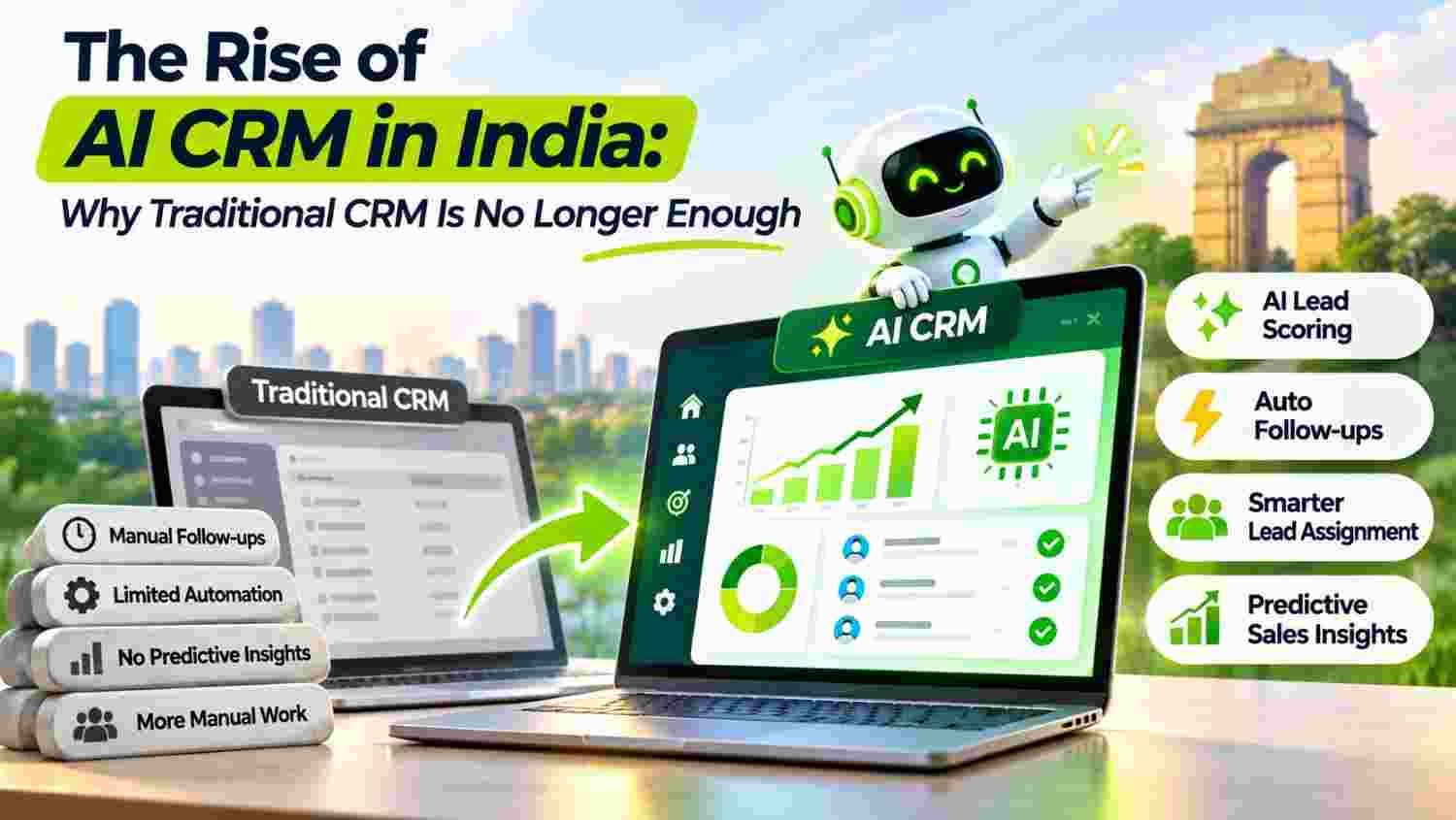
AI CRM in India is changing how businesses manage leads, customer relationships, and sales operations by moving beyond traditional record-keeping systems. Conventional CRM platforms often depend heavily on manual data entry, repetitive follow-ups, and reactive reporting, creating challenges for growing sales teams. AI-powered CRM introduces intelligent lead prioritisation, predictive insights, automated communication, and workflow assistance to help businesses work more efficiently. This article explores why AI CRM is gaining importance in India, what businesses should evaluate before adopting it, and how to choose a solution that supports long-term growth.
Let’s be honest: CRM was originally designed to help businesses organise customer information, track sales activities, and manage relationships.
And it still does those things.
But the way businesses sell has changed dramatically.
Today, customers interact with companies through websites, WhatsApp, phone calls, email, social media, marketplaces, and offline meetings. Sales teams are expected to respond quickly, personalise communication, maintain accurate records, and close opportunities without losing track of existing customers.
A traditional CRM can store all this information. The challenge is that storing information and acting intelligently on it are two different things.
This is where AI CRM in India is gaining attention.
Instead of simply showing sales representatives what happened, AI-powered CRM systems can help them understand what may need attention next, identify patterns, and automate selected repetitive activities.
The CRM is gradually evolving from a digital database into an intelligent sales assistant. This shift is part of the wider generative AI landscape.
Indian businesses are increasingly exploring AI across sales, marketing, customer service, and operations. See the NASSCOM AI outlook and India AI Mission for broader ecosystem context.
According to Salesforce’s 2026 India workplace study, Indian workers reported strong AI adoption, while unsuccessful AI pilots highlighted the importance of business context, personalisation, and practical implementation. AI adoption study.
The opportunity is especially relevant for sales teams because their daily work involves several repetitive activities:
AI can assist with these tasks when it has access to accurate, relevant customer and business information. For context, review AI risk guidance and responsible AI principles.
The conversation is no longer limited to asking AI to write emails or generate content. Businesses are exploring how AI can become part of everyday workflows.
Salesforce’s 2026 State of Sales report found that 91% of surveyed Indian sales professionals considered AI agents mission-critical to business success. Sales AI report.
The practical question for businesses is no longer simply, “Should we use AI?”
It is:
Where can AI reduce sales friction without compromising customer relationships or business control?
Traditional CRM is not useless. In fact, it remains the foundation of customer and sales management.
The problem appears when businesses outgrow manual processes.
Sales representatives may spend valuable time entering call notes, updating lead statuses, and maintaining records instead of speaking with prospects.
AI-enabled tools can assist with activity capture, summarisation, and CRM updates, depending on the platform and integrations. See Microsoft Copilot and Google Workspace AI for examples of AI assistance across work.
A lead may receive an enquiry response but never hear from the sales team again.
Traditional CRM can provide reminders, but sales representatives still need to decide what to do and execute the follow-up.
AI CRM can help recommend next steps, generate follow-up messages, or automate approved workflows. Explore HubSpot AI and Zoho Zia for examples of CRM AI features.
A sales report might show that a lead has been inactive for several days—but the opportunity may already be lost.
AI-powered analysis can help identify patterns such as delayed responses, stalled deals, or low engagement. These insights are only as reliable as the data available. IBM discusses these issues in its AI business report.
When businesses receive hundreds or thousands of enquiries, treating every lead equally is inefficient.
AI lead scoring can help rank prospects using available information and historical patterns. Salesforce describes related capabilities through Einstein AI. However, businesses should understand how scoring works and whether it can be adjusted to their sales process.
A lead’s information may exist across WhatsApp, email, spreadsheets, call records, and different sales tools.
AI cannot create reliable customer intelligence from disconnected or inaccurate data. The foundation still needs to be organised.
This is why AI CRM should be evaluated as a complete business system—not just an AI feature.
Not every CRM that advertises AI provides the same level of intelligence.
Some platforms offer AI writing assistance. Others support forecasting, lead scoring, conversation analysis, or workflow automation. Agentic systems may also perform selected tasks within defined permissions.
For Indian businesses, useful evaluation criteria include:
| Evaluation Area | What to Check |
|---|---|
| AI lead scoring | Can it help prioritise leads? |
| Follow-up assistance | Can it suggest or prepare relevant follow-ups? |
| Automation | Can repetitive sales tasks be automated? |
| Data quality | Can customer information be kept accurate and connected? |
| Communication | Does it support relevant channels such as email, calls, or WhatsApp? |
| Reporting | Can managers identify pipeline issues and trends? |
| Integration | Does it connect with existing business tools? |
| Usability | Can sales representatives adopt it without excessive complexity? |
| Control | Can teams review AI actions and set permissions? |
| Scalability | Can the CRM support increasing leads, users, and workflows? |
The goal is not to find the CRM with the most AI features. Gartner CRM research can help buyers understand how platforms are evaluated.
It is to find the CRM with AI capabilities that solve real business problems.
| Capability | Traditional CRM | AI CRM |
|---|---|---|
| Customer records | Stores customer information | Stores and may analyse customer information |
| Lead management | Tracks lead status | Can assist with lead prioritisation |
| Follow-ups | Reminders and manual execution | Suggestions, message generation, and selected automation |
| Sales reporting | Reports based on recorded data | Can support analysis and pattern identification |
| Communication | Templates and manual messaging | AI-assisted personalisation and conversation support |
| Sales forecasting | Rule-based or manual forecasts | May use predictive analysis, depending on platform |
| Sales representative support | Displays tasks and records | Can recommend next steps and assist with tasks |
| Workflow execution | Primarily rule-based automation | May include AI-driven or agentic workflows |
The distinction is important: AI CRM does not automatically mean fully autonomous sales.
The level of intelligence and automation depends on the product, configuration, integrations, and permissions. Review AI governance guidance when establishing organisational controls.
AI can analyse available lead information and help sales teams identify prospects that may deserve priority.
For businesses receiving enquiries from IndiaMART, websites, advertisements, and other channels, this can help organise incoming opportunities. Businesses can explore Groweon Sales CRM for sales pipeline workflows.
AI CRM works alongside integrations and automation to capture enquiries and route them to the right sales representative.
This reduces manual handling and helps teams respond faster.
Explore Groweon CRM for lead management capabilities.
Follow-ups are one of the most repetitive activities in sales.
AI can help prepare personalised follow-up messages, recommend the next action, and support timely communication. See Groweon AION AI+ for AI assistance.
AI calling agents can support defined calling workflows, such as initial qualification or enquiry handling. Explore AION Autopilot for agentic sales automation.
Businesses should evaluate language support, call quality, consent requirements, escalation options, and the ability to transfer conversations to human representatives. India’s DPDP Act is relevant when handling personal data.
AI can help summarise call conversations, meeting notes, and customer interactions.
This can make CRM records easier to review and reduce the burden of manual documentation.
AI-powered analytics may help identify trends in sales activity, deal progression, and pipeline performance. Learn more about predictive analytics.
These insights should support—not replace—managerial judgment.
AI can help sales representatives create relevant messages based on customer information and conversation context. See Groweon AI Email Writer for email-writing assistance.
For example, a follow-up for a prospect who requested a quotation should differ from a message sent to someone who is still exploring options.
AI CRM can work with automation to trigger actions based on business conditions. Groweon also offers AI WhatsApp Writer to support customer messaging. Microsoft provides a general overview of workflow automation.
Examples include assigning leads, preparing reminders, updating task lists, or escalating overdue activities.
Managers can use dashboards and AI-assisted insights to understand lead movement, sales activity, and pipeline bottlenecks.
The value depends on accurate records and clearly defined sales processes.
The next evolution is agentic CRM: systems that can perform selected tasks rather than only recommend actions. McKinsey explores agentic AI sales.
For example, an AI agent might qualify a lead, initiate an approved follow-up workflow, or update information after an interaction.
However, businesses should define clear permissions, escalation rules, and approval requirements before allowing AI to take action independently.
Choosing an AI CRM in India should begin with your sales process—not a feature checklist.
Prioritise lead capture, source tracking, assignment rules, and response-time visibility. For mobile teams, explore Groweon Lite.
Look for reminders, AI follow-up assistance, automated workflows, and escalation rules.
Evaluate dashboards, pipeline reporting, activity tracking, and forecasting capabilities.
Check calling integrations, call logs, conversation summaries, and AI calling features where available. Also consider Groweon FieldTrack for field-sales workflows.
Ask what the agent can actually do, what permissions it requires, whether actions can be reviewed, and how exceptions are handled.
A CRM should make your sales process more effective—not force your team into unnecessary complexity.
Before shortlisting a CRM, answer these five questions:
Use the answers to create a shortlist.
Then test the shortlisted platforms with a real sales workflow. For example, capture a lead, assign it, record a conversation, prepare a follow-up, and review the reporting.
A product demo should demonstrate your actual process—not just impressive AI features. Consider reviewing CRM buying criteria before shortlisting vendors.
AI CRM is moving towards more connected and context-aware workflows.
The next phase is likely to focus on:
But there is an important challenge.
AI needs reliable customer information, clear processes, and appropriate governance. The OECD AI principles outline an international framework for trustworthy AI. A 2026 ServiceNow report highlighted data management, legacy integration, and AI governance as significant enterprise concerns in India. AI investment report.
Businesses that focus only on deploying AI without improving their underlying processes may struggle to achieve meaningful results.
AI CRM is not a magic solution for poor sales performance.
If your sales process is unclear, your data is inaccurate, or your team does not follow a consistent workflow, AI may simply automate existing problems.
The real value comes when businesses combine:
Traditional CRM helped businesses organise their customer relationships.
AI CRM aims to help them understand those relationships and take action more intelligently. Salesforce’s CRM AI trends report explores related developments.
That is a meaningful evolution—but choosing the right system requires looking beyond the AI label.
What is AI CRM in India?
AI CRM in India refers to customer relationship management software used by Indian businesses that incorporates artificial intelligence to assist with lead management, sales analysis, customer communication, automation, and related workflows.
How is AI CRM different from traditional CRM?
Traditional CRM primarily stores and organises customer information and sales activities. AI CRM adds capabilities such as lead scoring, predictive analysis, message assistance, intelligent recommendations, and selected AI-powered automation.
Is AI CRM suitable for small businesses in India?
Yes. Small businesses may benefit from AI CRM when it addresses practical challenges such as lead tracking, follow-ups, sales visibility, and repetitive administrative work. The right solution should match their budget, workflow, and team size.
Can AI CRM automate sales follow-ups?
Many AI CRM platforms can assist with follow-up reminders, message generation, and workflow automation. The exact level of automation varies by product, configuration, and integration.
Does AI CRM replace sales representatives?
No. AI CRM can assist with repetitive tasks, analysis, and communication, but sales representatives remain important for relationship building, negotiation, complex customer needs, and judgment-based decisions.
What should businesses check before buying AI CRM software?
Businesses should evaluate lead management, automation, AI capabilities, integration, data security, usability, reporting, pricing, and the ability to control or review AI actions.
The rise of AI CRM in India reflects a broader shift in how businesses approach sales and customer relationships.
Traditional CRM remains valuable for organising customer information, but growing businesses increasingly need help with prioritisation, analysis, communication, and execution.
AI CRM can support that shift by helping sales teams reduce repetitive work and focus on meaningful customer interactions.
The best choice is not necessarily the platform with the most advanced AI claims. Businesses managing orders alongside sales can review Groweon Order Management and Inventory Management. It is the one that fits your business process, gives your team useful intelligence, and helps improve sales operations without creating unnecessary complexity.
Explore how Groweon CRM can support your sales workflows:
Groweon CRM

04 Nov, 2026
Summary This blog explores the best AI CRM software in...

04 Nov, 2026
Summary AI CRM in India is changing how businesses manage...

03 Nov, 2026
Summary AION Autopilot represents a new approach to AI-powered sales...

03 Nov, 2026
Summary Traditional CRM software helps manage customer relationships, sales opportunities...

02 Nov, 2026
Summary AI CRM Software is helping Indian sales teams manage...