

Best AI CRM Software in India (2027): 10 Platforms Businesses…
04 Nov, 2026
Summary This blog explores the best AI CRM software in...
Updated: 3rd November, 2026
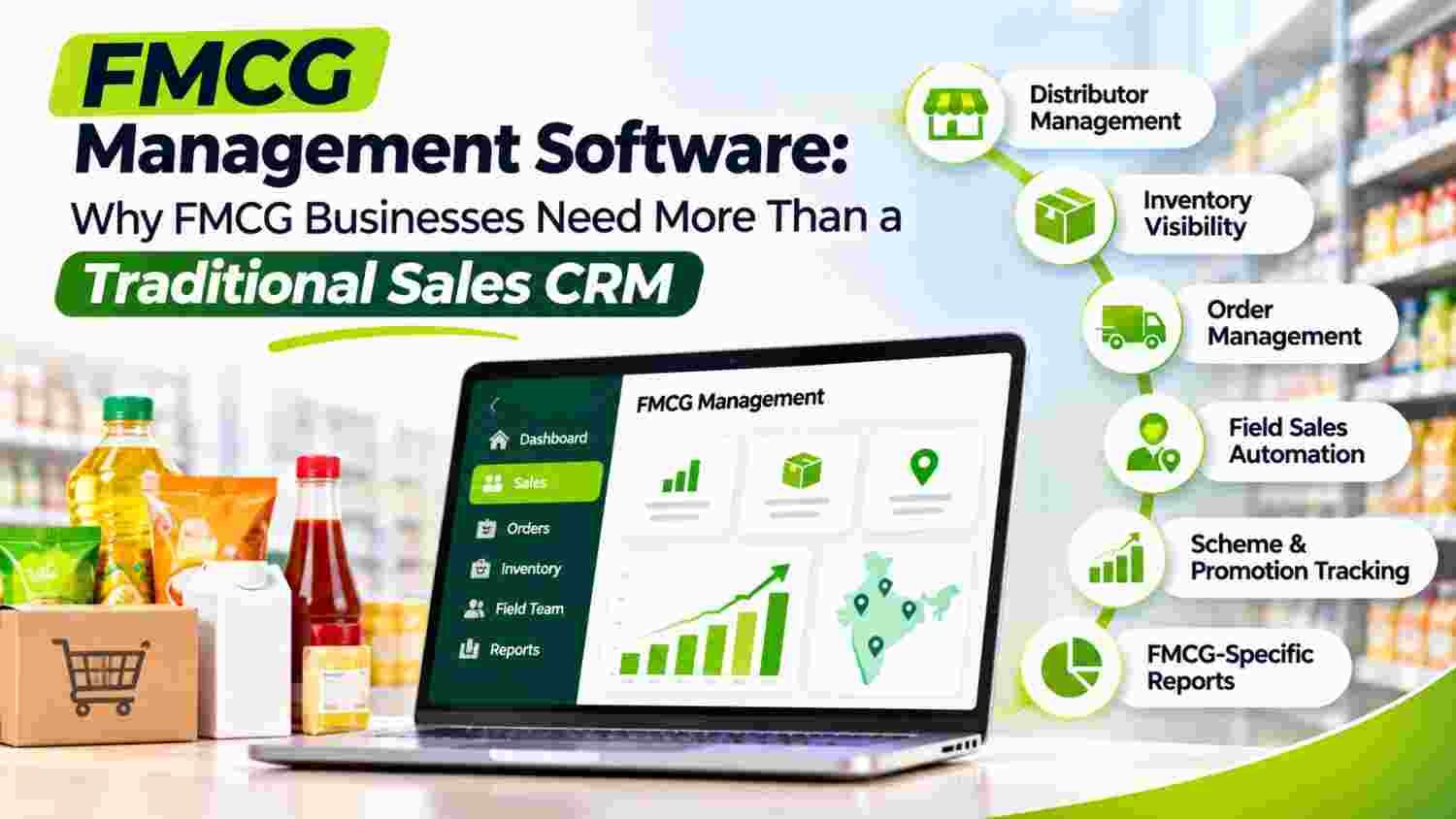
Traditional CRM software helps manage customer relationships, sales opportunities and communication.
FMCG businesses also require field sales management, distributor coordination, retailer coverage and frequent order handling.
FMCG Management Software connects sales activities with field execution and distribution workflows.
Choosing the right solution depends on business processes, integrations and operational requirements.
Traditional Customer Relationship Management (CRM) software helps businesses organise customer information, sales opportunities, communication and follow-ups.
However, Fast-Moving Consumer Goods (FMCG) businesses operate differently from companies with long sales cycles and a limited number of customers.
An FMCG sales representative may visit multiple retailers every day, follow a fixed beat, collect orders, coordinate with distributors and report market feedback. Sales managers need visibility into outlet coverage, field activities, distributor relationships and territory performance.
A traditional CRM can store retailer contact details, but it may not independently support the entire field sales and distribution process.
This is where FMCG Management Software becomes important. It connects customer management with field sales activities, distributor coordination, order workflows and market visibility.
According to NIQ’s FMCG market insights, consumer demand, channel performance and retail execution are important considerations for FMCG businesses.
The difference is not that traditional CRM is useless for FMCG. Instead, FMCG companies often require additional capabilities beyond basic customer relationship management.
| Business Requirement | Traditional CRM | FMCG Management Software |
|---|---|---|
| Lead and customer records | Core functionality | Essential |
| Distributor management | May require configuration | Important |
| Retailer and outlet management | May be limited | Important |
| Beat planning | May require an add-on | Often essential |
| Field visit tracking | Depends on platform | Important |
| Frequent order capture | May require integration | Important |
| Territory-level reporting | Often configurable | Critical |
| Inventory visibility | Usually separate or integrated | May be connected |
| Distributor billing | Usually outside CRM scope | May require DMS |
| Retail execution | May require customisation | May require dedicated tools |
FMCG CRM, Sales Force Automation (SFA), Distributor Management System (DMS) and ERP are related but different systems.
For an overview of FMCG distribution workflows, explore IMAST’s FMCG distribution software.
FMCG sales representatives typically work across assigned territories and retailer routes. Their daily schedules may include kirana stores, supermarkets, wholesalers, distributors and other outlets.
Without organised beat planning, businesses may face:
FMCG Management Software with field sales capabilities can help teams plan visits and review completed activities.
Businesses can learn more about route and field sales processes through Sales Force Automation resources.
For an industry-specific view, explore xMatix’s FMCG SFA overview.
Distributors play a major role in FMCG sales and market expansion. Businesses need visibility into distributor details, territory assignments, communication, sales activities and follow-ups.
A simple CRM contact record may not provide enough information to manage distributor relationships effectively.
A structured workflow can help organise:
However, distributor billing, stock reconciliation, credit limits and claims may require a dedicated DMS or ERP integration.
For further reading, see GoSales’ DMS buying guide.
FMCG businesses may deal with hundreds or thousands of retail outlets. Retailer records should support the representative’s daily work—not simply store contact information.
Important retailer information may include:
This makes it easier for representatives to understand the retailer’s history before visiting.
Learn about retail product identification through GS1 barcode standards and supply-chain traceability through GS1’s traceability standards.
FMCG businesses often handle repeat orders from retailers and distributors. A representative may need to record products, quantities, customer information and order requirements during a market visit.
Traditional CRM software may not be designed for high-frequency order capture.
Businesses should evaluate whether their software connects with:
For businesses with dedicated order workflows, an Order Management System can complement CRM.
Explore Oracle’s supply chain management resources and IBM’s supply chain management overview for broader operational context.
FMCG sales representatives work outside the office for much of the day. They need mobile access to customer information, planned visits, activities and follow-ups.
A field sales system should help representatives:
Mobile usability is critical. If an application is difficult to use, field teams may avoid updating it consistently.
Businesses can explore Microsoft Dynamics 365 and SAP CRM solutions when evaluating broader customer and sales technology ecosystems.
Monthly revenue alone may not explain what is happening across the field sales team.
Managers need to understand whether representatives are covering planned outlets, completing visits and following up with distributors.
Useful FMCG sales metrics include:
This helps managers identify operational gaps and improve territory planning.
For broader sales execution insights, explore McKinsey’s sales and channel management resources.
FMCG operations extend beyond customer relationships. Businesses may need to coordinate sales, stock, orders, procurement, warehouses, invoices and fulfilment.
A traditional CRM may not independently handle every operational function.
Instead, businesses should evaluate how their solution connects with:
For a wider industry perspective, read Nestlé India’s Annual Report and explore Deloitte’s consumer industry insights.
Choosing the right software starts with understanding which system manages which part of the business.
| Software | Main Purpose |
|---|---|
| CRM | Customer relationships, sales activities and communication |
| SFA | Field sales execution, visits, beat plans and sales activities |
| DMS | Distributor operations, stock, billing and distribution transactions |
| ERP | Business-wide operational and financial management |
An FMCG company may use one platform for multiple functions or connect specialist systems.
The decision should depend on the company’s distribution structure, business size, process complexity and existing technology.
For additional industry reading, explore OZZO’s FMCG software overview and DFIE’s distribution management platform.
Before selecting a platform, FMCG businesses should review the following requirements.
Check whether representatives can manage customer information, activities, visits and follow-ups from mobile devices.
Evaluate how teams create routes, organise outlet visits and monitor planned versus completed activities.
Check whether the system maintains centralised customer and channel partner information.
Evaluate territory-wise reporting, field activity visibility, team performance and management dashboards.
Confirm whether the platform connects with order creation, tracking, fulfilment and dispatch workflows.
If sales representatives need stock information, verify whether the platform provides this directly or through integration.
Test the mobile experience with actual field representatives before deployment.
Check compatibility with existing ERP, DMS, accounting, inventory and business applications.
Ensure the platform can support additional users, territories, outlets and distributors as the business grows.
Evaluate training, data migration, support, usability and implementation requirements—not only feature lists.
Groweon’s published FMCG CRM solution describes capabilities designed to help businesses organise field sales teams, distributors, retailers and sales activities.
Its FMCG solution highlights:
Explore Groweon FMCG CRM to review the published features and request a demonstration.
Related Groweon solutions include:
Businesses should confirm specific requirements such as distributor billing, collections, trade schemes, secondary sales, offline order capture and advanced inventory workflows during product evaluation. These may require dedicated DMS, ERP or other integrations.
For a related comparison, read Best FMCG CRM Software in India.
Consider an FMCG company with field representatives working across several territories.
The benefits depend on implementation, integrations and consistent employee adoption. Software alone does not automatically eliminate manual work.
How Is FMCG Management Software Different from Traditional CRM?
FMCG Management Software may combine customer relationship management with field sales, beat planning, distributor coordination, retailer management and order-related workflows. Traditional CRM generally focuses more on customer records and sales relationships.
Is FMCG Management Software the Same as Sales Force Automation?
No. CRM focuses on customer relationships and sales information, while SFA focuses on field sales execution, visit planning, activity tracking and order capture.
Is FMCG Management Software the Same as Distributor Management Software?
Not necessarily. CRM manages customer relationships and sales activities. DMS may handle distributor stock, billing, claims, collections and distribution transactions.
Which Features Should FMCG Businesses Prioritise?
Beat planning, retailer and distributor management, field sales tracking, follow-ups, mobile access and sales reporting are important. Businesses should also assess order, inventory and DMS integrations.
Can Traditional CRM Work for FMCG Companies?
Yes. Traditional CRM can work for key accounts, institutional buyers and relationship-focused sales processes. Field-heavy FMCG businesses may need additional SFA and distribution capabilities.
Does Every FMCG Business Need a DMS?
No. The requirement depends on whether the business manages distributor billing, inventory, claims, collections and secondary sales directly or through another system.
How Should Businesses Choose FMCG Software?
Map existing workflows, involve field representatives, test mobile usability, review reporting, verify integrations and compare implementation costs before selecting software.
Traditional CRM software remains useful for managing customer relationships, sales opportunities and communication. However, FMCG businesses operate through complex networks of distributors, retailers, field representatives and frequent transactions.
The right FMCG Management Software should support daily market execution through beat planning, retailer coverage, distributor coordination, field activity tracking, sales reporting and connected order workflows.
In 2026, FMCG businesses should evaluate software based on how well it connects customer relationships with field execution—and how effectively it integrates with systems responsible for inventory, orders and distribution.
The goal is not just to manage contacts. It is to connect sales relationships with everyday FMCG operations.
04 Nov, 2026
Summary This blog explores the best AI CRM software in...
04 Nov, 2026
Summary AI CRM in India is changing how businesses manage...

03 Nov, 2026
Summary AION Autopilot represents a new approach to AI-powered sales...
03 Nov, 2026
Summary Traditional CRM software helps manage customer relationships, sales opportunities...

02 Nov, 2026
Summary AI CRM Software is helping Indian sales teams manage...