

Best Order Management Solution for Distributors: A Complete 2027 Buyer’s…
13 Nov, 2026
Summary Choosing the right order management solution helps distributors organize...
Updated: 13th November, 2026
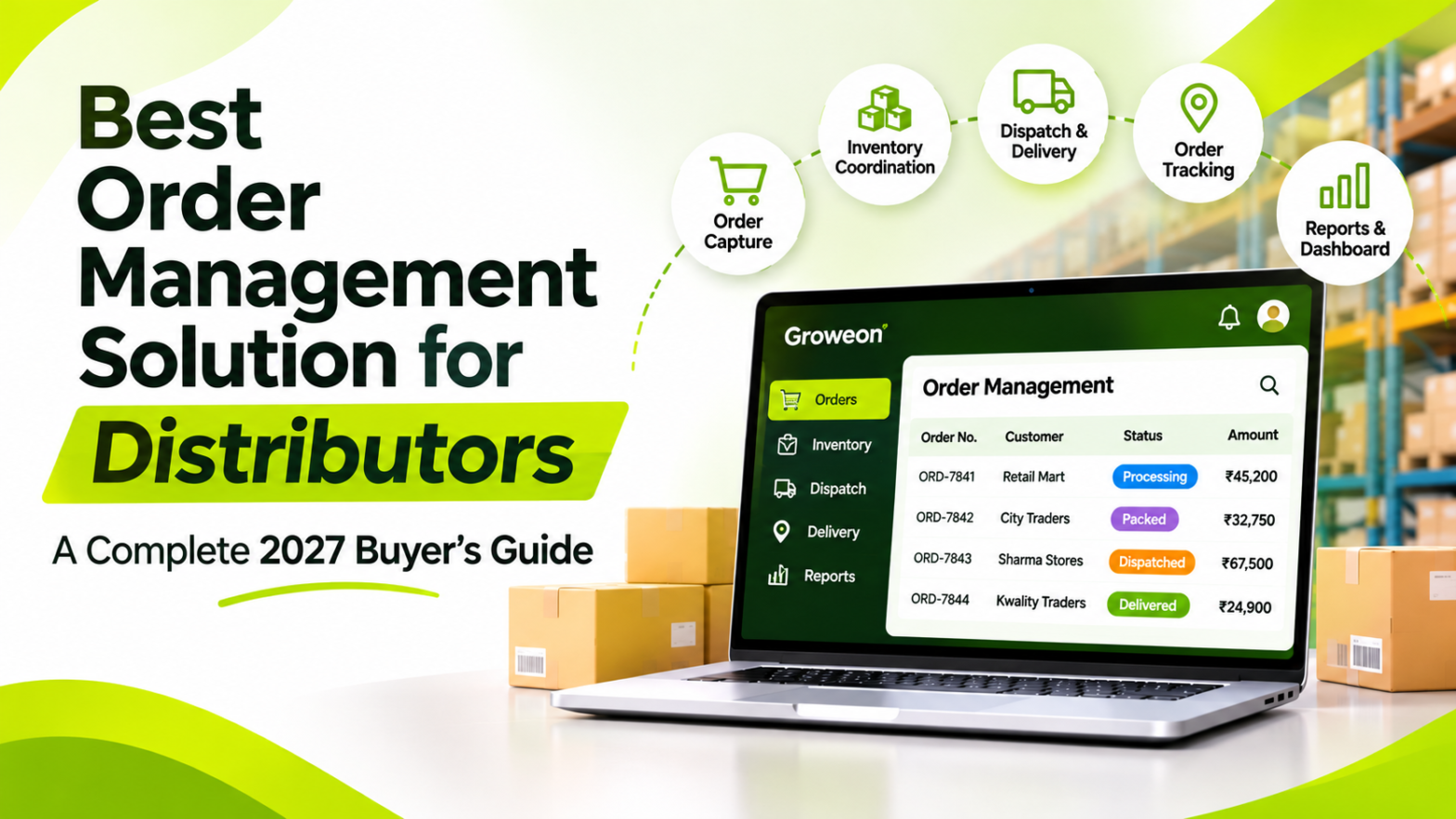
For distributors, managing orders is not simply about recording what a customer wants to purchase. Every order involves multiple activities: receiving requirements, checking product availability, coordinating with sales teams, processing orders, arranging dispatch, tracking deliveries, and keeping customers informed.
As order volumes increase, these activities become harder to manage through spreadsheets, phone calls, WhatsApp messages, and disconnected software. A delayed stock update or an incorrect order entry can affect fulfilment timelines, customer relationships, and business efficiency.
According to SAP’s guide to order management, order management covers the complete order lifecycle, from placement and inventory checks to shipping, delivery, and returns.
This is where an effective order management solution becomes important.
The right system gives distributors better control over their order operations by bringing order information, inventory coordination, processing, dispatch, and delivery updates into a connected workflow. Instead of depending on manual communication, teams can work with structured information and clearer responsibilities.
For businesses managing multiple sales channels, Microsoft’s order management overview explains how order processing connects with accounting, customer information, inventory, and fulfilment activities.
However, not every order management software is designed for distribution businesses. Before investing, distributors should evaluate how well a solution supports their actual order workflows, business scale, and operational requirements.
Distribution businesses often manage multiple customers, product categories, sales representatives, suppliers, and delivery locations. As the business expands, coordinating these activities manually can create operational gaps.
Some common challenges include:
A centralised order management solution helps address these challenges by creating a structured process for handling orders from capture to fulfilment.
The Shopify B2B order management guide explains how business-to-business orders move through submission, account validation, inventory allocation, fulfilment, invoicing, tracking, and reordering.
For distributors working with multiple warehouses and sales channels, Descartes’ order management technology guide also highlights the importance of connecting order information with inventory and fulfilment visibility.
Before choosing order management software, distributors should look beyond basic order entry. Evaluate whether the platform can support the complete order lifecycle and coordinate the teams involved.
Distributors may receive orders through sales representatives, phone calls, email, WhatsApp, POS systems, and digital channels.
A good order management solution should help bring order information into a centralised environment. This reduces dependence on scattered records and gives employees a consistent view of incoming orders.
During a software demo, check:
The Shopify guide to B2B order management software discusses how businesses can coordinate orders across different purchasing channels and fulfilment locations.
An order should be checked before it moves further into the fulfilment process.
Order management software should help teams review customer details, product information, quantities, and availability before processing. A structured validation process can reduce avoidable mistakes and prevent incomplete order records from moving forward.
For distributors handling frequent bulk orders, this capability is particularly important.
Evaluate whether the platform supports approval workflows, order corrections, pricing validation, and clear processing stages. The Microsoft Dynamics 365 OMS process overview provides additional context on order placement and processing.
Inventory visibility plays an important role in distribution operations. Teams need to understand whether products are available before confirming and processing customer orders.
Evaluate whether the order management solution can connect order processing with inventory information and help employees identify availability-related issues.
Ask the vendor:
Do not assume that every order management platform includes advanced warehouse or inventory planning features. Verify the exact capabilities included in the plan.
For more information, read Oracle’s research on order management, which discusses order lifecycle management and integration with inventory and other business applications.
Once an order is validated, the next step is to coordinate its fulfilment.
Distributors may need to allocate products from different locations or coordinate activities between sales, inventory, purchasing, and logistics teams.
An effective order management system should make order ownership and processing status easier to understand. Evaluate how the software handles allocation, employee responsibilities, and order handoffs.
The B2B order management guide from Ultra Commerce explains the importance of order orchestration and coordinating fulfilment across manufacturers, suppliers, and distribution points.
Knowing where every order stands is essential for distributors managing multiple customers and delivery schedules.
Order tracking should help teams identify whether an order is newly created, being processed, awaiting stock, ready for dispatch, dispatched, or delivered, depending on the workflow supported by the software.
Centralised tracking also helps sales teams respond to customer enquiries without repeatedly contacting different departments.
Explore Amazon Business’s explanation of order management for additional information on order lifecycle visibility and fulfilment coordination.
Order processing does not end when products leave the warehouse. Distributors also need visibility into dispatch activities and delivery progress.
Evaluate whether the order management software connects dispatch information, carrier coordination, shipment updates, and delivery confirmation with the original order record.
A connected process helps employees identify delayed deliveries and follow up on exceptions more efficiently.
The Wipro OMS buyer’s guide highlights fulfilment flexibility, delivery visibility, and integration as important considerations when selecting an order management platform.
Distributors frequently work with repeat customers who place orders at regular intervals.
Access to previous order records helps employees understand customer purchasing activity, review earlier transactions, and respond with relevant information.
Look for a solution that connects customer records with order history and makes information accessible to authorised employees.
Explore how Groweon CRM software supports customer and sales management alongside business operations.
A distributor needs more than a list of completed orders. Managers need visibility into the overall order pipeline.
An order management dashboard should help teams review relevant operational information, such as:
The availability of specific reports and dashboard metrics should be confirmed during the product demonstration.
For a broader perspective on distribution operations and reporting, explore Tecsys’ guide to modern distribution management.
Sales representatives often work outside the office, visiting customers and collecting new requirements.
Mobile accessibility can help field employees access relevant customer and order information while coordinating with office teams.
If your business relies on field sales, check whether the platform offers a mobile application, what actions employees can perform, and how updates are synchronised.
You can explore Groweon’s mobile CRM application for its mobile business management capabilities.
The software you select should support your current operations while allowing room for future growth.
As your distribution network expands, you may need additional users, more order volume, new business locations, and connections with other business systems.
Before purchasing, evaluate:
The SAP order management selection guide recommends evaluating business goals, integration requirements, scalability, security, vendor capabilities, and total cost of ownership.
Manual order handling may work when a distributor manages a small number of customers and orders. But as operations grow, spreadsheets and disconnected communication can make it difficult to maintain consistent information.
|
|---|
The difference is not simply digital versus manual. It is about how effectively a distributor can coordinate people, orders, and fulfilment activities as the business grows.
The Shopify distributor growth guide also highlights the importance of connected data, organised product information, and integration between business systems as distribution operations scale.
Shortlisting software based only on a feature list can lead to the wrong purchase decision. The best approach is to evaluate each platform against your actual business processes.
Document how orders currently move through your business.
Identify how orders are received, checked, approved, processed, allocated, dispatched, and delivered. Also identify where delays, repeated data entry, and communication gaps occur.
The Wipro order management buyer’s guide provides useful considerations for assessing order volumes, fulfilment requirements, and existing system limitations.
Separate essential requirements from optional capabilities.
For example, a distributor handling large volumes of sales-assisted orders may prioritise order capture, customer records, inventory coordination, and sales team visibility.
A distributor operating across several locations may place greater importance on allocation, dispatch coordination, and delivery tracking.
For additional B2B considerations, refer to Shopify’s B2B purchasing workflow guide.
List the business applications that need to exchange information with your order management system.
These may include CRM, accounting software, inventory applications, purchasing tools, and logistics platforms.
Ask the vendor which integrations are available, whether additional configuration is required, and whether any integration charges apply.
You can also review Microsoft’s overview of OMS integration capabilities to understand how order management connects with other business functions.
Do not settle for a presentation of features. Ask the vendor to demonstrate a real order workflow similar to your business.
For example, show how an employee creates an order, checks relevant information, moves it through processing, coordinates dispatch, and reviews delivery status.
A practical demonstration helps identify workflow limitations before purchase. You can use the SAP guide to selecting an OMS as a reference for evaluating the vendor and testing the system.
Compare more than the initial subscription price.
Understand the costs associated with implementation, additional users, integrations, customisation, training, and ongoing support.
Also confirm the vendor’s onboarding process and support arrangements.
The IDC MarketScape order management research offers further context on the capabilities and business applications associated with modern order management platforms.
Use these questions during vendor discussions and product demonstrations.
|
|---|
For a more detailed evaluation, the Ultra Commerce B2B order management guide discusses order orchestration, delivery scheduling, and reverse logistics considerations.
Distributors need a connected process that helps sales, operations, inventory, and fulfilment teams work with consistent order information.
Groweon’s Order Management Solution is designed to bring order activities into a connected workflow, covering order capture, validation, allocation, processing, tracking, and fulfilment.
Here is how its capabilities can support day-to-day order operations.
Bring order information from supported business channels and teams into one organised environment. This helps employees work with accessible order records instead of depending on disconnected communication.
Connect order activities with inventory and purchase management workflows to improve coordination between order requirements and product availability.
Keep order processing, dispatch, and delivery activities connected. Teams can review order progress and identify exceptions that require attention.
Connect shipment and delivery information with the original order record. This gives employees a clearer view of order progress and helps them respond to customer enquiries.
Get an overview of order activity, processing status, inventory, dispatch, delivery, and exceptions through a connected operational view.
Businesses can also explore Groweon’s dealer management and sales CRM capabilities to understand how customer and sales operations can work alongside order management.
The right configuration and availability of specific features should be confirmed with the Groweon team during a product demonstration.
An order management solution becomes valuable when manual processes start affecting order accuracy, employee productivity, customer communication, or fulfilment visibility.
For distributors experiencing increasing order volumes, it can help create a more structured way to manage daily operations.
Before investing, consider the operational problems you want to solve. Estimate how much time employees spend on manual order entry, status checking, follow-ups, and preparing reports. Then compare those costs with the software’s subscription, implementation, and maintenance expenses.
For more insight into how order management supports business operations, read SAP’s overview of order lifecycle management.
A practical evaluation should focus on measurable improvements rather than promises of automation alone.
1. What is an order management solution for distributors?
An order management solution helps distributors capture, process, track, and fulfil customer orders through a structured system. It can connect order information with inventory, purchasing, dispatch, delivery, and customer records, depending on the software’s capabilities.
2. What features should distributors look for in order management software?
Distributors should evaluate centralised order capture, order validation, inventory visibility, allocation, order tracking, dispatch coordination, customer history, reporting, mobile accessibility, and integration capabilities.
3. Can order management software handle bulk orders?
Some order management platforms support bulk order workflows. However, distributors should verify supported order quantities, product line limits, pricing rules, approval processes, and processing capabilities with the software provider.
4. How does an order management system improve order accuracy?
A structured order management system can reduce repetitive manual entry and help employees validate order information before processing. Centralised records also make it easier for teams to work with consistent order details.
5. Is order management software suitable for small distributors?
Yes. Small distributors can benefit from organised order records, better processing visibility, and reduced dependence on spreadsheets. The software should be selected according to current requirements, budget, and expected business growth.
Managing distribution orders efficiently requires more than recording customer requirements. Businesses need a structured way to coordinate order capture, inventory information, processing, dispatch, delivery, and customer communication.
The right order management solution can help distributors reduce manual coordination, improve order visibility, and build more consistent fulfilment workflows.
Before making a purchase, evaluate the software through your actual business processes, verify integration requirements, and compare its capabilities against your operational priorities.
If you want to bring your order operations into a more connected workflow, explore Groweon’s Order Management Solution and book a product demonstration to understand how it fits your distribution business.

13 Nov, 2026
Summary Choosing the right order management solution helps distributors organize...

13 Nov, 2026
Summary Service Ticket Management helps businesses capture, assign, track, and...
13 Nov, 2026
Summary Choosing the right inventory management software can help businesses...

12 Nov, 2026
Summary AI CRM Software helps businesses manage customer relationships through...

12 Nov, 2026
Summary Pharmaceutical companies manage complex relationships with doctors, medical representatives,...