

10 Must-Have Features in AI CRM Software for Modern Businesses
12 Nov, 2026
Summary AI CRM Software helps businesses manage customer relationships through...
Updated: 12th November, 2026
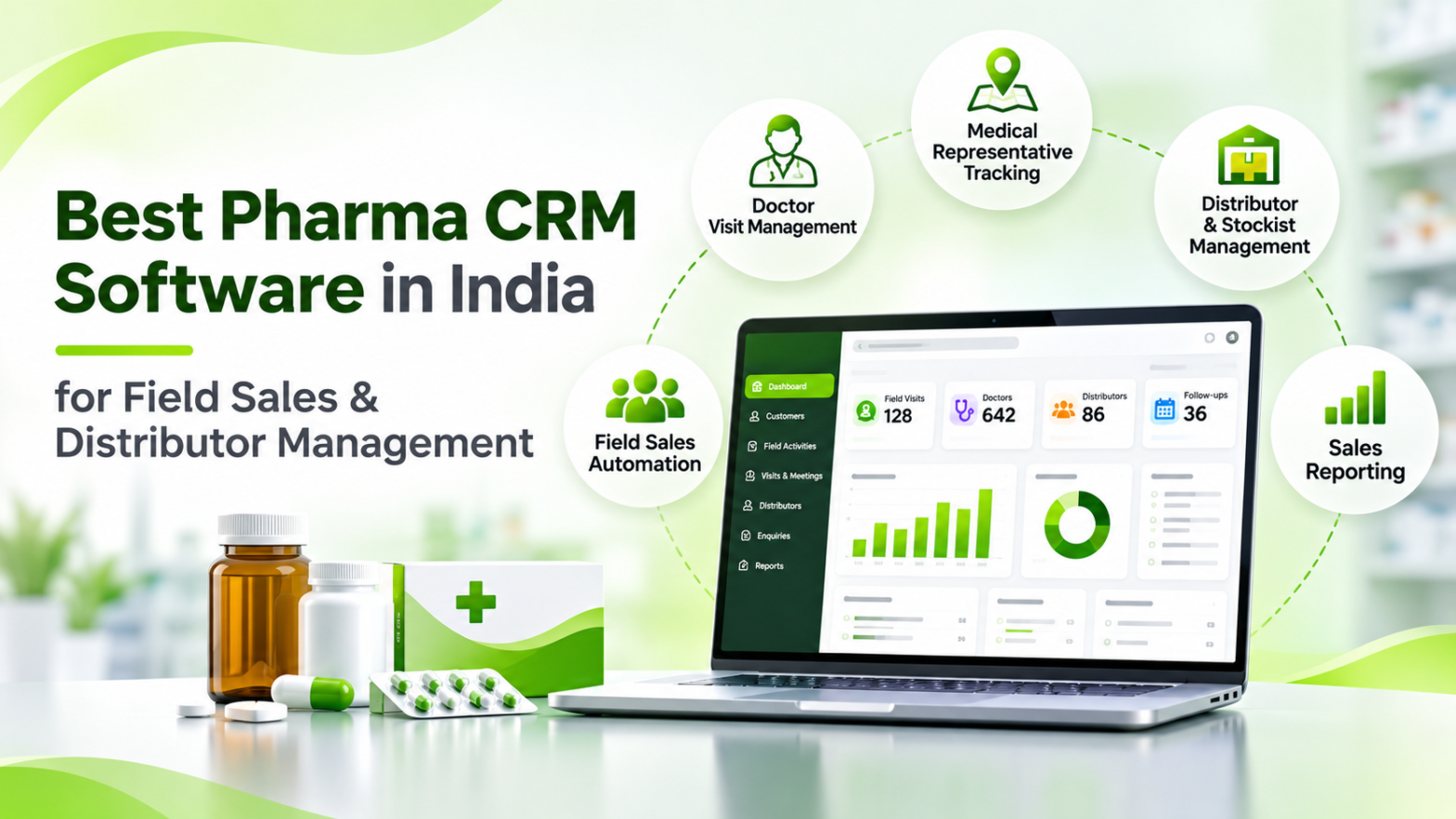
Pharmaceutical companies manage complex relationships with doctors, medical representatives, distributors, stockists and chemists.
Pharma CRM Software connects customer information, field activities, sales enquiries and follow-ups through a centralised platform.
It helps businesses improve territory visibility, coordinate distributor networks and make sales operations more measurable.
The right CRM can create a stronger foundation for organised, efficient and scalable pharmaceutical sales management.
India’s pharmaceutical industry has developed into a major global manufacturing and export ecosystem. Its business network includes pharmaceutical manufacturers, marketing companies, distributors, stockists, chemists, hospitals and healthcare professionals. Managing these relationships across different territories requires accurate information and consistent coordination.
According to the Indian pharmaceutical industry overview published by IBEF, India is a major global supplier of generic medicines and pharmaceutical products. The scale of this industry creates significant operational requirements for sales teams and distribution networks.
For pharmaceutical businesses, Pharma CRM Software provides a structured way to manage customer relationships, field sales activities, business enquiries and follow-ups. Instead of depending on separate spreadsheets, personal notebooks and scattered communication records, companies can organise important sales information through one connected system.
The objective is not simply to digitise paperwork. It is to give sales representatives better access to information, managers greater visibility into field operations and business owners a clearer understanding of their sales processes.
Pharmaceutical sales involve several stakeholders, and each relationship requires a different approach. Medical representatives interact with doctors, distributor managers coordinate with stockists, and regional managers monitor territory performance.
When these activities are managed through disconnected tools, businesses may face operational challenges such as:
A centralised CRM can help organise these activities by connecting customer records, meeting histories, sales enquiries and assigned tasks.
The PIB pharmaceutical factsheet provides an overview of India’s pharmaceutical manufacturing, exports and industry development. As businesses grow, maintaining structured sales information becomes increasingly important for managing their commercial operations.
A connected system helps different teams work with a shared view of customer information.
For example, when a representative records a distributor meeting, the relevant interaction history can be available to authorised managers and other responsible employees.
This reduces dependency on individual employees for basic customer information and helps maintain continuity when responsibilities change.
Manual reports often require representatives to collect information at the end of the day and submit it separately.
A digital CRM can make activity recording more consistent and provide managers with access to updated information, depending on the platform’s features and implementation.
Medical representatives are responsible for maintaining professional relationships, conducting field visits, sharing approved product information and reporting relevant interactions.
Because they spend a significant amount of time outside the office, managers need a reliable way to understand field activities without depending entirely on manual updates.
Pharma CRM Software can support this requirement through structured activity tracking and digital meeting records.
Representatives can organise their schedules around assigned territories, customer priorities and planned meetings.
A digital visit plan can help record:
For example, a representative managing several doctors across a city can maintain a weekly schedule and update each interaction after the meeting.
Managers can review the plan and identify pending activities without collecting separate spreadsheets from every representative.
A suitable CRM may provide activity records that help managers understand how field teams are working.
Depending on the platform, this can include meeting completion, task status, customer interaction history and location-based features where appropriately enabled.
Businesses should evaluate employee privacy, location permissions and access controls before implementing location-based tracking.
After a customer interaction, representatives can record the meeting date, purpose, relevant discussion points and next action.
This creates a consistent history that can be reviewed before future meetings.
For businesses seeking a structured sales activity system, Groweon sales CRM provides information about its sales and field meeting management capabilities.
Doctor Visit Management requires organised information, relevant communication and consistent follow-up scheduling.
Without a centralised record, representatives may struggle to access previous interaction details or prepare for future meetings.
A CRM can help pharmaceutical companies maintain professional customer profiles and interaction histories.
Depending on business requirements and applicable data policies, customer profiles may contain:
This helps representatives prepare for meetings and reduces unnecessary duplication of customer records.
CRM reminders can help representatives remember planned follow-ups and maintain continuity in professional relationships.
For example, when a representative schedules a future discussion after sharing approved product information, the next activity can be recorded and assigned in the CRM.
Pharmaceutical companies must ensure that interactions with healthcare professionals follow applicable ethical requirements.
The WHO ethical criteria for medicinal drug promotion provide an important foundation for responsible pharmaceutical communication.
A CRM should support accurate documentation and controlled communication workflows rather than encourage excessive or inappropriate promotional activity.
Pharmaceutical sales do not end with medical representative visits. Companies also need to maintain relationships with distributors, stockists, chemists and other commercial partners.
When channel partner information is maintained across different files and communication channels, it becomes difficult to track interactions and pending business opportunities.
Pharma CRM Software helps organise these relationships through a centralised customer and distributor database.
A distributor database can maintain:
Managers can use these records to identify which distributor relationships require attention and which enquiries are progressing.
Businesses can also explore distributor network management practices to understand how digital systems can support channel coordination.
Stockists often serve as important links between pharmaceutical companies and retail distribution networks.
A CRM can help sales teams maintain stockist profiles, interaction histories and follow-up schedules.
For example, when a stockist requests a quotation or product-related information, the enquiry can be recorded and assigned to the relevant employee.
Pharmaceutical companies may also need to maintain structured records of chemist and pharmacy relationships.
A CRM can organise contact information, assigned representatives and relevant business interactions.
However, customer relationship records should not be confused with pharmacy inventory, dispensing or prescription management systems. These functions may require separate specialised software.
Pharmaceutical companies often operate across multiple regions, cities and sales territories. Assigning the right customers and activities to the right representatives is important for maintaining effective coverage.
Pharma Sales Force Automation helps organise field activities through digital workflows.
Sales managers can organise customer records according to geographical territories and representative responsibilities.
This makes it easier to identify areas with limited customer coverage or overlapping assignments.
A CRM can help assign enquiries, meetings and follow-up tasks to responsible employees.
For example, a new institutional enquiry from a particular region can be assigned to the relevant territory manager.
Automated reminders can reduce dependence on manually maintained task lists.
Sales teams can receive reminders for pending activities, scheduled meetings and important customer follow-ups.
The HubSpot sales automation guide explains how automation can reduce repetitive administrative work and improve sales workflow consistency.
Regional managers can review activity and sales information across their assigned territories.
This helps them identify operational gaps and understand whether teams are following their planned activities.
Pharmaceutical companies receive enquiries from distributors, hospitals, institutional buyers and other commercial customers.
Managing these enquiries systematically is important because a delayed response or unclear ownership can affect business opportunities.
A Pharma CRM Software platform can help organise the enquiry journey from initial contact to the next sales action.
A structured enquiry process can include:
This makes it easier for managers to understand which enquiries are active and which require attention.
When an enquiry progresses into a commercial order, the sales team may need to coordinate with accounts, inventory, purchasing or logistics.
A CRM can help preserve customer and enquiry information while connecting with appropriate order management workflows.
Businesses can explore Groweon order management to understand its broader order-related capabilities.
When sales and back-office teams work with disconnected records, employees may repeatedly request the same customer information.
A connected system can help reduce this duplication and improve coordination between departments.
Pharmaceutical CRM and inventory management systems serve different but complementary purposes.
A CRM primarily manages customer relationships, sales activities, enquiries and follow-ups. Inventory management focuses on product quantities, stock movements, warehouses and replenishment.
For pharmaceutical companies, inventory operations may also require batch identification, expiry tracking, storage conditions and product traceability.
The WHO distribution guidelines explain the importance of quality assurance throughout pharmaceutical distribution.
Pharmaceutical businesses should assess whether their inventory or ERP systems can record batch numbers, manufacturing dates, expiry dates and other required product information.
These capabilities should be verified separately rather than assumed to be included in every CRM.
The PIB QR traceability update discusses the expansion of QR-code-based drug traceability requirements in India.
The GS1 India healthcare resources explain how standardised identification can support healthcare product traceability and supply-chain visibility.
Businesses can also review GS1 traceability standards for information about product identification and tracking.
For international context, the GS1 pharmaceutical guidelines explain how standardised information exchange can support pharmaceutical chain-of-custody processes.
The GS1 healthcare standards overview provides additional information about product identification and healthcare supply-chain data.
The GS1 global healthcare strategy also describes the role of global standards in supporting consistent healthcare information exchange.
Pharmaceutical products may have specific storage and transportation requirements.
The WHO storage practices document explains good storage and distribution practices for medical products.
The CDSCO guidance documents include Indian regulatory guidance related to pharmaceutical distribution practices.
Companies should ensure that their inventory and logistics systems support the operational and regulatory requirements applicable to their products.
For businesses evaluating digital stock operations, Groweon inventory management provides information about product, warehouse and stock management.
Sales reporting helps pharmaceutical managers understand how their teams perform across territories, customer segments and business activities.
When reports are prepared manually, management may spend considerable time collecting information instead of analysing results.
A centralised CRM can help bring operational information together.
Managers can review:
Territory-level reports help managers compare sales activities and business outcomes across different regions.
This can help identify areas where additional training, customer engagement or operational support may be required.
Interaction histories help teams understand which relationships require follow-up and which enquiries are moving forward.
A dashboard can bring relevant information into one view, reducing the need to combine multiple spreadsheets before management meetings.
The Salesforce sales documentation provides an overview of CRM-supported sales activities, opportunities, forecasting and sales operations.
Businesses can also explore Groweon CRM software to understand its broader customer and sales management capabilities.
Pharmaceutical sales involve interactions with healthcare professionals, making ethical communication and appropriate documentation essential.
In India, the Uniform Code for Pharmaceutical Marketing Practices (UCPMP) 2024 establishes a framework for ethical pharmaceutical marketing.
The official UCPMP portal provides access to the code and related information.
The UCPMP compliance FAQs explain important aspects of the code, including its application to pharmaceutical companies and interactions with healthcare professionals.
The Department of Pharmaceuticals policy page provides access to the code and subsequent updates.
Businesses can also refer to the UCPMP detailed document for the actual provisions.
A CRM may help businesses maintain organised records of meetings, customer interactions and approved follow-up activities.
Companies can also establish role-based access and approval workflows to support internal processes.
However, CRM software does not automatically guarantee regulatory compliance. Pharmaceutical organisations remain responsible for employee training, ethical policies, approval processes and monitoring.
The Department pharmaceutical schemes provide additional context about government initiatives supporting the pharmaceutical industry.
The pharmaceutical industry policy page also provides information about relevant industry development and support schemes.
Selecting the right platform requires an understanding of the organisation’s sales structure, field activities, distributor network and integration requirements.
A pharmaceutical manufacturer may have different needs from a marketing company, API supplier or distributor.
Before selecting Pharma CRM Software in India, businesses should evaluate the following areas.
Check whether the platform supports visit planning, meeting records, activity tracking and territory-wise reporting.
Evaluate whether customer profiles can be organised according to business requirements, with appropriate permissions and interaction histories.
Check whether the CRM can maintain distributor records, assigned representatives, enquiries and follow-up activities.
Look for structured enquiry capture, assignment, tracking and follow-up capabilities.
Field representatives should be able to access relevant customer and activity information conveniently while working outside the office.
Evaluate whether managers can access representative-wise, territory-wise and customer-related reports.
If the company already uses inventory or ERP software, verify whether the CRM can connect with the required systems.
Review authentication, access controls, backups and the vendor’s documented data protection practices.
Consider whether the system can accommodate additional employees, territories and business workflows as the organisation grows.
Ask the vendor to demonstrate actual workflows, such as recording a doctor visit, assigning a distributor enquiry and reviewing pending follow-ups.
The best solution is one that matches the company’s operational requirements rather than simply offering the longest feature list.
Pharmaceutical companies need a connected way to manage enquiries, customer relationships, field activities and follow-ups.
Groweon Pharma CRM is designed to support pharmaceutical business operations through CRM capabilities focused on lead management, customer relationships, field activities and sales coordination.
Businesses can organise incoming enquiries, assign responsibility and maintain follow-up records through structured lead management workflows.
Centralised customer information helps sales teams maintain interaction histories and coordinate communication with business partners.
Sales teams can organise meetings and record relevant field activities, giving managers better visibility into operational execution.
Structured reports help managers review sales activities and understand follow-up requirements across teams.
Groweon’s AION Autopilot capabilities include AI calling, lead qualification, automated follow-ups and workflow-based lead engagement.
These capabilities can be evaluated for suitable pharmaceutical business enquiries and approved commercial communication workflows.
Groweon’s AION AI+ features include AI-assisted lead scoring, lead analysis and communication drafting.
Such capabilities can support selected sales activities, while pharmaceutical organisations should apply appropriate human review and industry-specific communication controls.
For businesses handling API and bulk drug enquiries, the pharma manufacturing CRM article provides additional context on managing enquiries, quotations and customer relationships.
The right implementation depends on each company’s requirements. Organisations should separately verify batch tracking, expiry management, regulatory documentation, inventory integration and distributor order workflows before selecting a platform.
1. Which Pharma CRM Software features are most important for pharmaceutical companies?
Important features include medical representative tracking, doctor visit management, distributor records, lead management, follow-up reminders, territory-wise reporting, mobile access and integration capabilities.
2. How does Pharma CRM Software improve medical representative productivity?
It helps representatives organise meetings, maintain customer information, record field activities and manage follow-ups. Managers also gain better visibility into team activities.
3. Can Pharma CRM Software manage doctor visits?
Yes. Suitable CRM platforms can maintain professional contact records, schedule meetings, record interaction details and track follow-up activities.
4. Does Pharma CRM Software support distributor management?
CRM platforms can organise distributor profiles, communication histories, enquiries and follow-ups. Full stock management and order processing may require additional modules or integrations.
5. Is Pharma CRM Software useful for small pharmaceutical companies?
Yes. Smaller businesses can use CRM to organise customer information, improve follow-up consistency and establish structured sales reporting.
6. Can Pharma CRM Software automate medical representative reporting?
Some platforms support digital meeting records, activity tracking and automated dashboards. The exact capabilities depend on the selected software.
7. Does Pharma CRM Software include pharmaceutical inventory management?
Not necessarily. CRM and inventory management are separate functions. Companies should verify batch tracking, expiry management, warehouse operations and ERP integration separately.
8. How does Pharma CRM Software improve territory management?
It can support customer allocation, representative assignments, territory-wise activity tracking, visit planning and sales performance analysis.
9. Does Pharma CRM Software automatically ensure UCPMP compliance?
No. CRM software can support documentation and controlled workflows, but compliance requires appropriate policies, employee training, approvals and monitoring.
10. How should pharmaceutical companies select CRM software in India?
Businesses should evaluate field sales requirements, distributor management, reporting, mobile accessibility, integration options, data security, implementation support and scalability.
Pharmaceutical sales management requires coordination between medical representatives, managers, healthcare professionals, distributors and other commercial partners.
When information remains scattered across spreadsheets and individual communication channels, businesses can struggle to maintain consistent follow-ups, monitor field activities and understand territory performance.
Pharma CRM Software helps address these challenges by bringing customer relationships, sales activities, enquiries and reporting processes into a structured environment.
For pharmaceutical companies in India, the right CRM should match actual business workflows, provide useful management visibility and integrate with the systems required for order processing, inventory and other operations.
By connecting people, information and sales processes, pharmaceutical businesses can build more organised operations and create a stronger foundation for sustainable growth.
12 Nov, 2026
Summary AI CRM Software helps businesses manage customer relationships through...
12 Nov, 2026
Summary Pharmaceutical companies manage complex relationships with doctors, medical representatives,...

12 Nov, 2026
Summary Indian businesses receive sales enquiries through websites, advertisements, WhatsApp,...

12 Nov, 2026
Summary E-commerce businesses interact with customers across websites, marketplaces, mobile...

11 Nov, 2026
Summary Real estate businesses receive enquiries from property portals, websites,...