

Lead Management Software vs CRM: Which Does Your Team Need?
08 Oct, 2026
Summary The lead management software vs CRM choice comes down...
Updated: 9th July, 2026
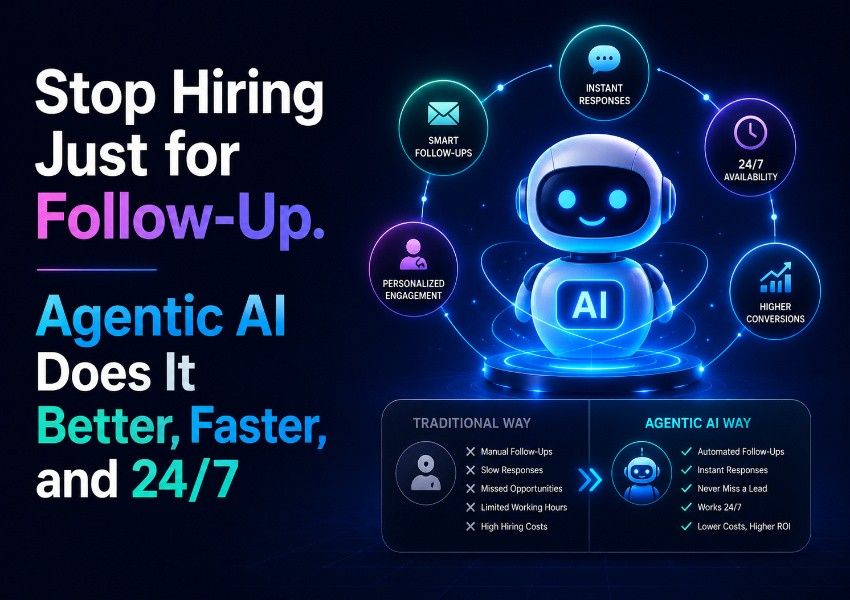
Agentic AI for sales follow-up removes the bottlenecks in slow, inconsistent, manual outreach by engaging leads within seconds, qualifying them across channels, and routing only high-intent opportunities to your human team. For Indian SMBs managing high lead volumes on lean teams, this is the highest-impact fix in the sales workflow. Human reps remain essential for closing. The question is whether they should also be doing the work that AI can handle better before the first meaningful conversation begins.
Most sales teams do not lose leads because their reps are lazy. They lose them because manual follow-up is too slow, inconsistent, and impossible to scale.
In high-volume sales, the biggest conversion variable is often not the pitch itself, but how quickly it arrives. The average business takes around 47 hours to respond to a new lead, while responding within 5 minutes makes a team 21 times more likely to qualify that lead. That is not a marginal difference. It describes a market where the fastest responder wins the deal, not always the one with the better product or lower price.
The trend, however, has been moving in the wrong direction. In 2011, an estimated 23% of companies never responded to inbound leads at all. By 2024, one study by RevenueHero tracking over 1,000 companies found that number had risen to 63%. More tools, more headcount, but slower and patchier outcomes. The issue is not effort. It is a workflow that was never designed to move at the speed buyers now expect.
Hiring another follow-up rep, therefore, adds cost and training time but does not fix the model. What the problem demands is a system that responds the moment a lead arrives, every time, without exception. That is what agentic AI for sales follow-up delivers.
Agentic AI is not a chatbot and not a pre-written message sequence. Instead, it refers to autonomous systems that plan, decide, and act independently within a defined workflow.
In a sales context, that means an AI receives a new lead, selects the right engagement channel, asks qualification questions that adapt based on what the lead says, logs every outcome to the CRM, and triggers the next step, all without a human in the loop. Gartner identifies agentic AI as a “major evolution” beyond generative tools, describing systems capable of handling prospecting, qualification, and follow-ups without requiring direct human input at each step.
The practical workflow looks like this. A lead comes in from Meta Ads. The AI calls within 60 seconds. If the call goes unanswered, a WhatsApp message fires immediately. When the lead responds, the AI collects budget, timeline, intent, and objections through a conversation that adapts dynamically to what the lead says. The outcome is then scored and structured into a qualified lead record. As a result, the rep receives that record, not a cold contact.
That distinction matters because most “AI follow-up” tools on the market are still rule-based: they fire a sequence of messages on a fixed timer regardless of what the lead does. Agentic AI, by contrast, reads the conversation and responds to it.
78% of customers buy from the company that responds first, and according to InsideSales.com, 35 to 50% of sales go to the vendor that responds first. At pipeline scale, therefore, delay is not a service issue. It is a pipeline leakage.
The after-hours dimension makes this especially acute. Around 52% of leads come in outside standard business hours. For a team running 9 AM to 7 PM, that means more than half of all inbound enquiries sit untouched until the following morning. By that point, the lead has often cooled, spoken to a competitor, or simply moved on.
Agentic AI closes most of this gap by responding within 60 seconds, even outside business hours. It operates with no shift, no weekend, and no queue. As a result, every lead that arrives at 11 PM on a Saturday receives the same response quality as one that arrives on Monday morning.
The comparison between a human follow-up rep and an agentic AI system is not about who is better at conversation. Experienced reps are better at nuance, empathy, and negotiation. However, the comparison is about what happens in the first three minutes after a lead arrives, and in that window, the manual model breaks in predictable ways.
Response speed
A human rep in a queue responds when they get to it. Agentic AI responds in seconds. At 200 leads per day, that queue never fully clears.
Consistency
One rep asks about the budget. Another skips it. A third forgets to log the objection. Agentic AI, by contrast, runs the same qualification process on every lead, every time, regardless of workload or shift timing.
Availability
Human coverage ends at shift close. Agentic AI engages across call and WhatsApp simultaneously, with automatic retries on no-answers, around the clock.
Handoff quality
A rep following up manually passes a contact name to the next stage. Agentic AI passes a pre-scored lead record with an intent score, AI summary, objections flagged, and a recommended next action. As a result, the rep’s first conversation starts at the context level the AI left off at.
None of this argues for removing reps from the sales process. It argues for reallocating them. Instead of spending their shift on cold outreach and manual CRM updates, they focus on qualified opportunities where human judgment and relationship-building actually close deals.
When sales managers evaluate agentic AI, they often compare the cost to a software subscription. The more accurate comparison, however, is to a full-time follow-up hire, or several.
A dedicated follow-up rep in an Indian SMB means recruitment time, onboarding, training, and a productivity ramp before they contribute meaningfully. That rep handles roughly 80 to 100 calls per day, cannot work after hours, and will eventually leave.
According to research cited by sales automation analysts, teams save around 6 hours per week per rep by automating manual follow-up tasks. Additionally, automation can significantly increase the volume of sales-ready leads while reducing cost per lead. An agentic AI system, therefore, handles concurrent leads at a fraction of the annual rep cost, with no ramp-up period and no attrition.
The reps who benefit most are the ones who receive a pipeline that is already qualified. According to HubSpot’s 2024 State of AI in Sales, professionals who use AI daily are twice as likely to exceed their sales targets. That improvement comes not from AI replacing the rep, but from the rep spending their time on better opportunities.
In India’s SMB sales environment, the follow-up problem is amplified by volume and by the nature of inbound lead sources.
An education institute running seasonal campaigns may generate 200 to 500 leads per day. An automobile dealership during a campaign weekend may receive 150 enquiries in 48 hours. No human team can respond to all of those leads within 5 minutes. Leads left waiting for 24 hours are often already enrolled elsewhere, booked with a competitor, or no longer reachable.
The after-hours dimension is particularly costly for Indian SMBs. Meta Ads audiences are highly active after 8 PM and through the weekend, precisely the hours when most sales teams are offline. According to the Drift Lead Response Report, companies with 24/7 response capability convert at 2.5 times the rate of those operating only during standard hours. For teams spending heavily on digital lead generation, the inability to respond after hours translates directly into lost campaign ROI.
Research compiled by Master of Code Global suggests that 65% of B2B companies report stronger client engagement rates since implementing agentic AI solutions, and 90% observe more efficient workflows. For Indian SMBs where follow-up bottlenecks are the primary conversion gap, these gains are operational, not theoretical.
The shift to agentic follow-up changes what a CRM is for. Today, most CRMs function as record-keeping tools that reflect what reps remembered to update. As a result, pipeline views show what happened last week, not what is happening now.
With agentic AI operating inside the CRM, every touchpoint gets logged in real time. Every call attempt, every WhatsApp exchange, and every qualification outcome is structured, timestamped, and searchable. Lead scores update after every interaction. Stage changes happen automatically based on engagement signals rather than on whether the rep clicked update before their next call.
For sales managers, this shifts the conversation from “did you call that lead?” to “this lead is at 84 intent score and the AI flagged a pricing objection — what is your plan to close?” Pipeline discussions improve because the data underneath them is complete and current.
AION Autopilot is Groweon’s agentic sales engine, built specifically for this workflow. It connects five components into a single autonomous follow-up layer: AI Calling Agent, WhatsApp AI Chatbot, Rule-Based Calling, Bulk Calling, and Auto Lead Qualifier.
The trigger is a new lead from any source: Meta Ads, Google, website form, or WhatsApp opt-in. From that point, the sequence runs without human input.
The AI Calling Agent dials within 60 seconds. If unanswered, the WhatsApp AI Chatbot engages in parallel. Questions adapt to what the lead says, in Hindi, English, or Hinglish. Budget, timeline, product preference, and objections are captured live and written automatically to the lead record. The Auto Lead Qualifier then scores the lead and places it at the correct pipeline stage. The rep receives an instant alert with the full context: score, AI summary, objection noted, and recommended next action.
For sales teams, that means fewer missed leads, faster handoffs, and far less manual follow-up work inside the CRM. AION works best for teams generating 50 or more inbound leads per day from digital sources, where after-hours coverage and response consistency are the primary conversion gaps. Most teams go live within 48 hours, with no technical setup required on the client side.
For most high-volume sales teams, the case for agentic AI in sales follow-up is no longer theoretical. It is operational.
Leads your team does not reach in the first five minutes rarely wait around. They are already speaking to whoever got there first. Agentic AI closes most of that gap by responding within 60 seconds, at any hour, without adding headcount or extending shift hours.
As a result, the reps you have become more productive. Their pipeline arrives pre-qualified and context-rich. CRM data reflects the actual state of every opportunity in real time. Additionally, the follow-up gap that was costing conversions every day closes permanently.
If your team is generating leads faster than it can respond, agentic AI for sales follow-up is the workflow fix to prioritise first.
AION Autopilot by Groweon responds to every lead within 60 seconds, qualifies automatically across calls and WhatsApp, and hands only high-intent opportunities to your reps, 24/7. Book a 30-minute demo to see how it works on your actual lead volume and sources.
What is agentic AI for sales follow-up?
Agentic AI for sales follow-up refers to autonomous AI systems that engage new leads immediately after enquiry, ask adaptive qualification questions, log every outcome to the CRM, and route high-intent leads to human reps without manual intervention at each step. Unlike rule-based automation that fires fixed sequences on a timer, agentic AI reads the conversation and responds to it dynamically.
Is agentic AI suitable for small sales teams in India?
It is particularly well-suited for small teams. A lean team with agentic AI handles lead volumes that would otherwise require multiple dedicated follow-up hires. The AI manages the first three to five touchpoints autonomously and routes leads to human reps only once the qualification threshold is met.
How is agentic AI different from a standard CRM automation sequence?
Standard automation fires messages on a fixed schedule regardless of the lead’s behaviour. Agentic AI reads the lead’s responses, adjusts the next question based on what was said, and determines the appropriate next action from the outcome. As a result, teams get not just faster follow-up but meaningfully better qualification data going into the CRM.
What does a rep receive when AION hands off a qualified lead?
The rep sees a CRM record with the lead’s intent score, source, AI summary of the conversation, objections flagged, budget and timeline captured, and a recommended next action. The first conversation starts at the context level the AI left off at, not from zero.
Can AION Autopilot follow up in Hindi?
Yes. AION’s AI Calling Agent and WhatsApp AI Chatbot operate in Hindi, English, and Hinglish, adapting to the lead’s preferred language during the conversation.
How quickly can a team go live with AION Autopilot?
Most teams are live within 48 hours. Groweon’s onboarding team configures the qualification flow, question scripts, and CRM integration. No technical work is required on the client side.
What happens to leads that AION cannot reach after multiple attempts?
AION runs an automatic retry sequence across calls and WhatsApp. Every attempt gets logged with a timestamp and outcome. Leads that remain unresponsive after the configured retry count move automatically into a WhatsApp drip nurture sequence for later re-engagement.
[wpforms id=”535″]

08 Oct, 2026
Summary The lead management software vs CRM choice comes down...

08 Oct, 2026
Summary (TL;DR) A CRM with Meta Ads integration should do...

07 Oct, 2026
Summary (TL;DR): A free mobile CRM can replace messy notebooks...

07 Oct, 2026
Summary A mobile CRM for real estate agents keeps every...

07 Oct, 2026
Summary A WhatsApp CRM app gives small sales teams in...