

CRM Buying Checklist for Indian SMBs: 12 Points to Verify…
05 Oct, 2026
Summary (TL;DR): Most CRM buying mistakes trace back to a...
Updated: 21st August, 2026
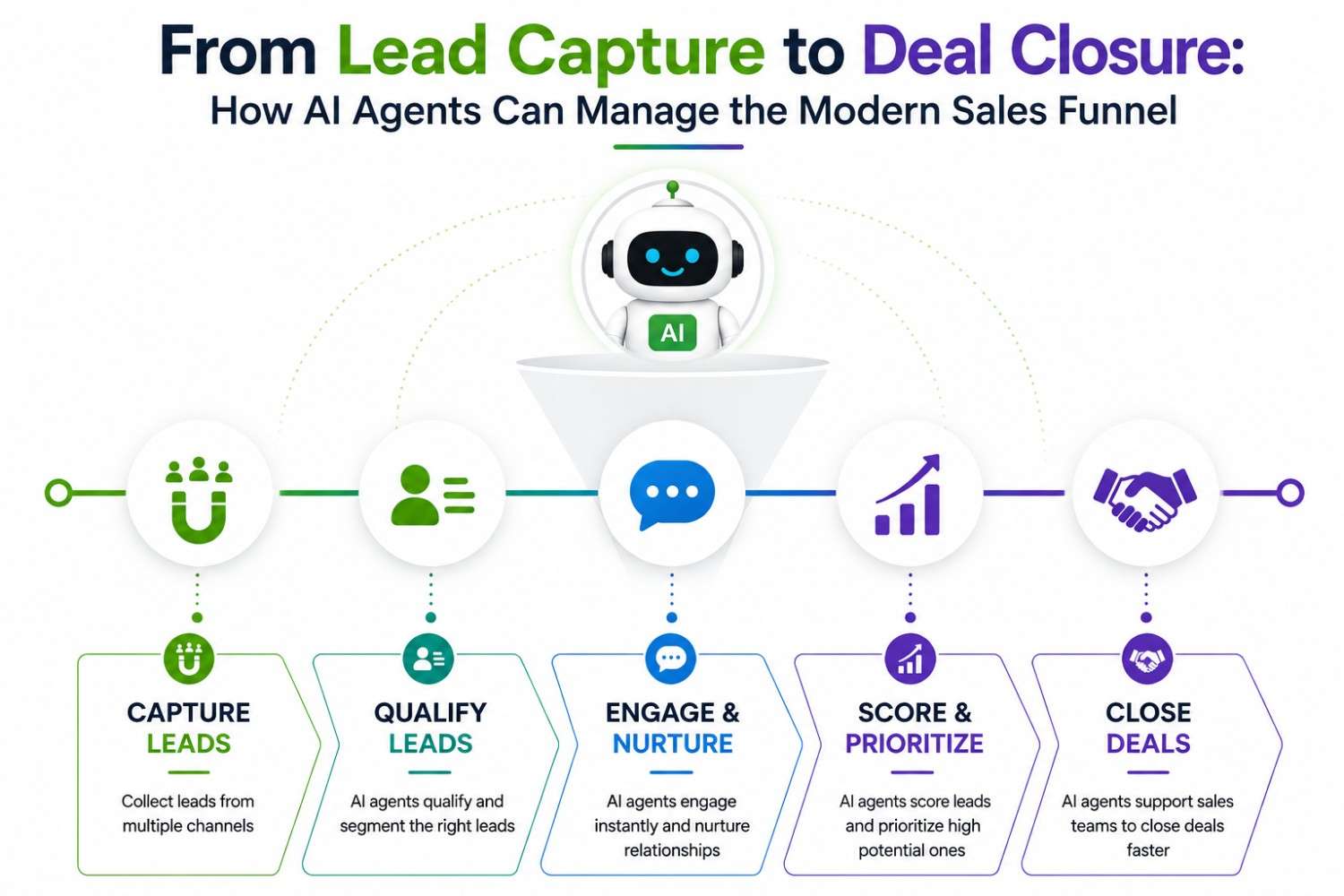
A modern sales funnel rarely follows a straight path.
A prospect may discover a business through an advertisement, submit an enquiry, respond on WhatsApp, ask for pricing, disappear for a few days, request a demo and finally involve multiple decision-makers before making a purchase.
For sales teams, the challenge is not simply generating leads. It is moving the right leads through every stage of the funnel without losing momentum.
Traditional CRM software has made this process more organised by bringing leads, contacts, activities and sales pipelines into one system. But salespeople still have to decide what to do next, make calls, send follow-ups, update records and identify which opportunities need attention.
AI agents are changing this model.
Instead of only recording what happened, an AI agent can help understand customer intent, take defined actions, update the CRM and involve a salesperson when human judgement is needed. IBM explains that AI agents can support sales activities such as prospect engagement, qualification, follow-ups and handoffs. AI agents in sales
The opportunity is not to remove humans from sales. It is to make the sales funnel faster, more consistent and more intelligent.
A traditional sales funnel usually looks like:
Lead Capture → Qualification → Follow-Up → Opportunity → Proposal → Negotiation → Deal Closure
The problem is that every stage can depend on manual action.
An AI-powered sales funnel adds an intelligent layer:
Lead Capture → AI Engagement → AI Qualification → Lead Prioritisation → Automated Follow-Up → Human Handoff → Proposal → Negotiation → Closure
The AI does not need to control every stage. Instead, it handles repetitive and data-driven activities while salespeople focus on conversations requiring expertise, judgement and relationship building.
This is also where agentic CRM becomes relevant. Rather than simply storing customer information, an intelligent CRM can help turn that information into the next sales action.
Modern businesses receive leads through multiple channels:
Capturing these enquiries in one place is the foundation of effective sales funnel management.
Once a lead enters the CRM, AI can help analyse the available information and trigger the appropriate workflow.
For example:
New Lead → AI Engagement → Qualification → Salesperson Assignment
Groweon’s AI lead conversion approach connects lead capture, qualification, engagement and conversion within the CRM.
The objective is simple: do not let a newly generated lead sit untouched.
Lead generation only creates an opportunity. Qualification determines whether that opportunity deserves immediate sales attention.
An AI agent can ask questions based on the business’s qualification criteria.
For a B2B company, it may ask about:
For real estate, it may ask about:
For education, it may ask about:
This information gives the sales team more context before they enter the conversation.
Research from McKinsey also highlights the potential of AI agents to support sales activities such as lead prioritisation, outreach, follow-ups and scheduling. McKinsey’s research on AI agents in sales
Not every enquiry has the same buying intent.
Consider two prospects:
| Lead A | Lead B |
|---|---|
| Budget shared | Budget unknown |
| Demo requested | General enquiry |
| Requirement clearly defined | Requirement unclear |
| Purchase timeline confirmed | Timeline unknown |
| Repeated engagement | No response |
Both are leads, but they should not necessarily receive the same level of sales attention.
AI-powered lead scoring can help sales teams identify stronger opportunities using signals from customer interactions.
For example:
Demo requested + pricing discussed + defined timeline = higher priority
This does not mean low-scoring leads should be ignored. It simply helps salespeople organise their time more effectively.
Groweon’s AI lead qualification capabilities are designed to help sales teams distinguish stronger opportunities from low-intent enquiries.
Follow-up is one of the most time-consuming parts of sales.
A traditional CRM may create a reminder:
“Call this lead tomorrow.”
But the reminder still requires a salesperson to perform the task.
An AI agent can automate defined follow-up activities.
For example:
Day 1: Initial engagement
Day 2: Requirement-based follow-up
Day 4: Relevant information shared
Day 7: Buying timeline check
Day 10: Re-engagement
Positive response: Salesperson alerted
This can help reduce missed follow-ups while allowing salespeople to focus on conversations that require human involvement.
The goal should not be to send more messages. It should be to send more relevant messages at the right time.
A prospect’s response often reveals where they are in the buying journey.
Compare:
“I am just checking the pricing.”
with:
“Can you arrange a demo tomorrow?”
These are completely different signals.
AI can analyse conversational information and help identify whether a prospect is:
This can make the sales funnel more dynamic.
Instead of relying entirely on a salesperson to manually update every stage, customer interactions themselves can provide useful signals.
Qualification is only useful if the opportunity reaches the right person.
Businesses may have separate sales teams based on:
An AI-powered workflow can use these factors to help route leads according to predefined business rules.
A qualified lead can then reach the salesperson with the information already collected.
For example:
Company: ABC Pvt. Ltd.
Requirement: CRM for 40 users
Current system: Excel
Timeline: 30 days
Interest: High
Next action: Demo
The salesperson can begin with the actual sales conversation instead of repeating basic qualification questions.
A pipeline can look healthy on a dashboard while several deals are actually inactive.
For example:
| Opportunity | Stage | Last Activity |
|---|---|---|
| A | Proposal | 2 days ago |
| B | Negotiation | 5 days ago |
| C | Demo Completed | 14 days ago |
| D | Qualified | 21 days ago |
Opportunity D may require immediate attention.
An AI-powered CRM can monitor activity patterns and help identify opportunities that have remained inactive for too long.
The workflow can become:
Detect inactivity → Understand context → Recommend action → Alert salesperson
This turns CRM from a passive reporting system into a more proactive sales tool.
AI agents can manage many repetitive sales activities, but they should not replace human judgement everywhere.
Human involvement remains particularly valuable for:
The ideal model is therefore:
AI handles repetition.
Humans handle judgement.
When a lead becomes sales-ready, the AI can hand the opportunity to a salesperson with the relevant context already available.
This creates a smoother transition between automated engagement and human selling.
| Area | Traditional Approach | AI-Powered Approach |
|---|---|---|
| Lead response | Manual | AI-assisted |
| Qualification | Salesperson-led | AI-assisted |
| Lead scoring | Manual/rules | AI-assisted |
| Follow-up | Reminders | Automated execution |
| Lead routing | Manual/rules | Context-based |
| CRM updates | Often manual | Can be automated |
| Opportunity monitoring | Dashboard review | Proactive alerts |
| Human handoff | Manual | Trigger-based |
| Deal closure | Human-led | Human-led with AI support |
The biggest difference is simple:
Traditional CRM records the journey.
AI-enabled CRM can actively participate in the journey.
As AI becomes part of the sales process, businesses evaluating the best CRM software should look beyond contact management and pipeline tracking.
Important capabilities include:
Can the CRM bring enquiries from websites, campaigns, calls and messaging channels into one system?
Can the system understand customer requirements and identify buying intent?
Can it manage repetitive follow-up without requiring salespeople to create every reminder?
Can it identify which opportunities need attention first?
Can it recognise when a salesperson should take over?
Are AI conversations, actions and outcomes recorded in the customer history?
Can managers understand where leads are being lost or where opportunities are getting stuck?
A good CRM software platform should not simply add AI as a feature. AI should improve the actual sales workflow.
Groweon’s AION Autopilot is designed to bring AI-driven lead engagement, qualification, follow-up and sales actions into the CRM environment.
The concept can be simplified as:
Capture → Understand → Act → Qualify → Handoff → Convert
AION can support AI calling, WhatsApp conversations, lead qualification, automated follow-ups and qualified-lead alerts.
This allows salespeople to spend less time on repetitive lead management and more time on demos, negotiations and closing opportunities.
The modern sales funnel is moving away from a fixed sequence where every prospect receives the same treatment.
Instead, AI can help businesses respond according to what each prospect actually does.
A traditional approach might look like:
Lead → Call → Email → Follow-Up → Demo → Proposal → Closure
An intelligent approach can become:
Lead → Understand Intent → Engage → Qualify → Prioritise → Follow Up → Human Handoff → Close
That difference can have a major impact when businesses manage hundreds or thousands of enquiries.
The goal is not to automate everything.
The goal is to automate the right things.
AI agents are changing the way businesses manage the sales funnel—from the first lead interaction to the final deal.
They can help businesses:
But the future of sales is not AI versus humans.
It is AI + human expertise.
AI can manage repetitive actions and continuous engagement, while salespeople focus on the conversations where trust, judgement and negotiation matter.
For businesses looking for the best CRM software, the real question is no longer simply whether the system can store leads.
It is whether the CRM can help move the right lead, through the right action, at the right time—until it becomes a customer.
That is the real potential of AI agents in modern sales funnel management.

05 Oct, 2026
Summary (TL;DR): Most CRM buying mistakes trace back to a...

01 Oct, 2026
Summary (TL;DR): Lead management software captures, scores, routes, and nurtures...

01 Oct, 2026
Summary (TL;DR): CRM pricing in India typically runs ₹250 to...

30 Sep, 2026
Summary (TL;DR): A CRM with native Meta Conversions API integration...

29 Sep, 2026
Summary (TL;DR): The best choice depends on whether you want...