

Lead Management Software vs CRM: Which Does Your Team Need?
08 Oct, 2026
Summary The lead management software vs CRM choice comes down...
Updated: 24th August, 2026
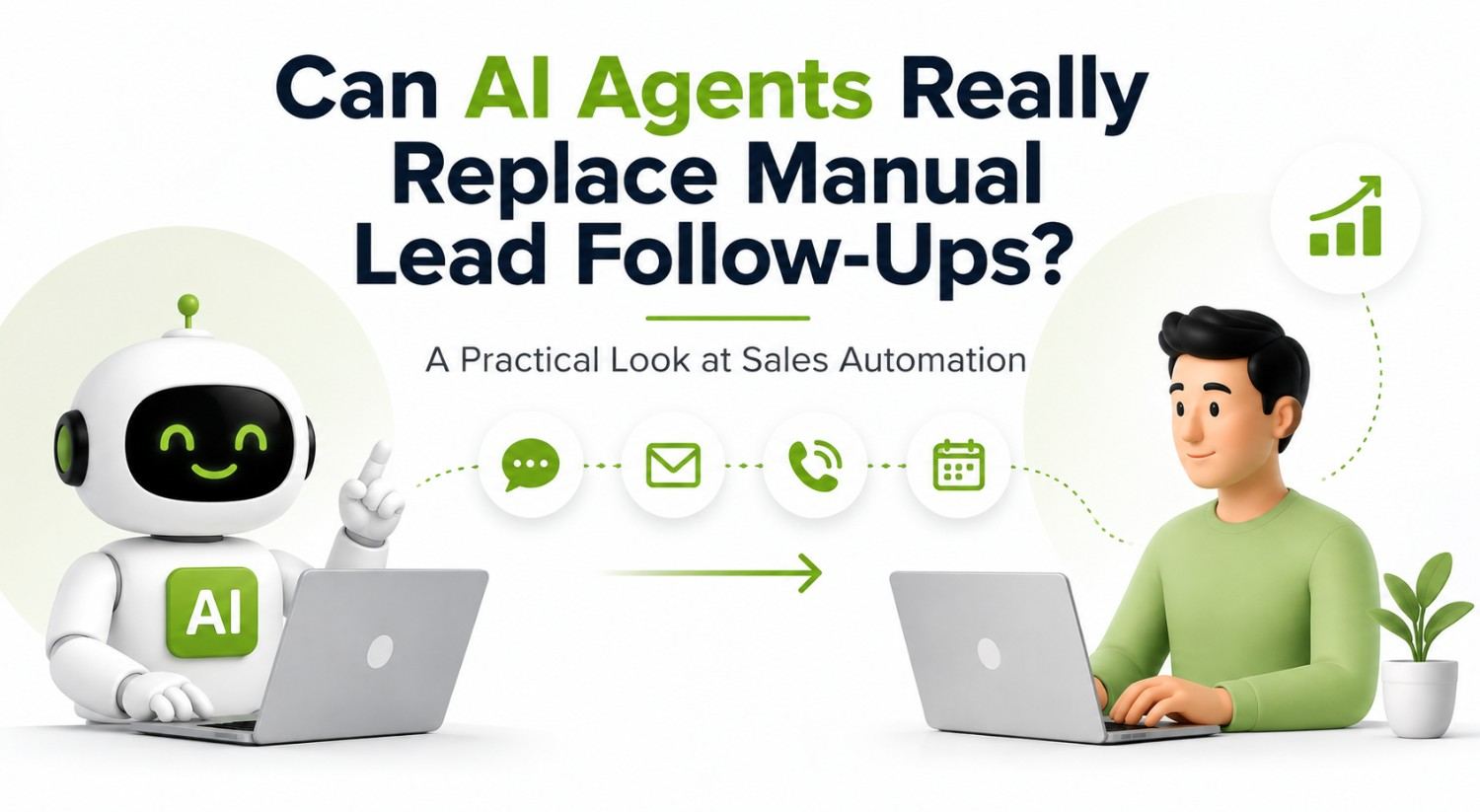
Following up with leads sounds simple until a sales team has hundreds of enquiries to manage every week.
A lead comes in. Someone needs to call. If the prospect does not answer, another attempt is required. If they respond on WhatsApp, the conversation needs to be tracked. If they ask for pricing, the salesperson needs to remember to follow up again. If the lead goes silent, someone has to decide when and how to re-engage.
This is where manual follow-up becomes a serious operational challenge.
The question businesses are now asking is:
The short answer is yes, for a large part of repetitive follow-up work—but not for every sales conversation.
AI agents can automate lead engagement, qualification, follow-up sequences, CRM updates and re-engagement. Human salespeople can then take over when the conversation requires negotiation, relationship building, complex objections or a final buying decision.
The shift is already becoming measurable. A 2026 Gartner survey found that AI tools were saving sellers an average of 4.8 hours per week, although many organisations were not yet reinvesting that saved time into higher-value sales activities. Gartner’s 2026 sales AI research shows why sales automation needs to be connected to a redesigned sales process rather than treated as another standalone tool.
The real opportunity, therefore, is not replacing the sales team.
It is replacing the manual work surrounding the sales team.
Manual follow-up works reasonably well when a business receives a small number of leads.
Suppose a salesperson receives ten enquiries a day.
They can probably remember:
Now imagine the same salesperson handling 100 or 200 enquiries.
The problem changes completely.
A typical manual process can look like this:
Lead arrives → Salesperson gets notification → Calls lead → No answer → Sets reminder → Calls again → Sends WhatsApp → Updates CRM → Waits → Follows up again
Every additional lead adds another sequence to manage.
The problem is not necessarily a lack of sales effort.
It is the number of repetitive actions involved.
An AI sales agent can take responsibility for defined parts of the follow-up workflow.
Instead of waiting for a salesperson to remember the next action, the agent can:
The important difference is execution.
A basic CRM reminder might tell a salesperson:
“Follow up with Rahul today.”
An AI sales agent can potentially perform the follow-up itself.
That changes the workflow from:
CRM reminds → Human acts
to:
AI identifies → AI acts → Human receives qualified opportunity
Not every automated follow-up system is an AI agent.
This distinction matters.
A traditional automation might be:
Day 1 → Send Email A
Day 3 → Send Email B
Day 7 → Create Task
The system follows a predefined sequence.
An AI agent can work with more context.
For example:
Lead enquires → AI understands requirement → Lead responds → AI changes next action → Lead becomes inactive → AI starts re-engagement → Lead shows buying intent → Human salesperson is alerted
The workflow can respond to what happens during the interaction rather than simply following a fixed calendar.
This is one of the defining differences between basic automation and agentic AI.
For repetitive follow-up activities, yes.
But “replace” needs to be understood correctly.
AI can replace the manual execution of activities such as:
But AI should not automatically replace the human salesperson for:
The strongest model is therefore:
AI handles repetition.
Humans handle judgement.
One of the biggest problems with manual follow-up is inconsistency.
A salesperson may follow up with one lead five times and another lead only once.
Another salesperson may be excellent at follow-up but become overloaded when lead volume increases.
AI agents can apply the same defined process consistently.
For example:
New enquiry
↓
Immediate response
↓
Qualification
↓
No response
↓
Follow-up
↓
Second follow-up
↓
Re-engagement
↓
High buying intent
↓
Salesperson alert
The process can continue even when the sales team is busy.
Groweon’s AION Autopilot is designed around this type of agentic sales workflow, where AI can engage leads, qualify them, run follow-up sequences and hand qualified opportunities to human salespeople.
Modern customers do not communicate through one channel.
A prospect may:
If every interaction is managed separately, the salesperson has to switch between systems.
An AI agent connected to the CRM can coordinate follow-up across available channels.
For example:
Website enquiry → AI call → WhatsApp follow-up → Email → Human handoff
This creates a connected customer journey instead of separate conversations.
For businesses looking at AI-powered CRM software, this capability is particularly important because the AI should not operate independently from customer records.
The interaction needs to become part of the CRM history.
Imagine a prospect says:
“I am interested, but I need to discuss it with my management team first.”
A generic reminder system may simply create a task for the salesperson.
An AI agent can use that context to determine that immediate repeated calling may not be appropriate.
The next interaction could instead focus on:
This makes follow-up more contextual.
The goal is not to send more messages.
The goal is to send more relevant messages.
Follow-up becomes much more valuable when the AI understands which leads deserve immediate human attention.
Consider two enquiries.
| Lead A | Lead B |
|---|---|
| Requirement clearly defined | Requirement unclear |
| Budget shared | Budget not shared |
| Timeline: This month | Timeline: “Just researching” |
| Specific product interest | General interest |
| Demo requested | No action requested |
Both are leads.
But the salesperson should probably not spend the same amount of time on both.
An AI sales agent can ask qualification questions and use the responses to help categorise leads.
Groweon’s AI lead qualification approach focuses on assessing incoming enquiries and helping sales teams distinguish stronger opportunities from low-intent or unsuitable leads.
This means the sales team is not simply receiving a list of enquiries.
They are receiving context-rich opportunities.
Manual follow-up has a built-in limitation:
People have working hours.
Leads do not.
A prospect may submit an enquiry:
If the business waits until the next working day, the first interaction is already delayed.
An AI agent can provide an immediate response and begin the appropriate qualification or follow-up workflow.
This does not mean every lead should receive an aggressive sales call immediately.
It means the business can establish a controlled first response rather than leaving the enquiry untouched.
Many businesses generate enough leads.
The problem occurs between:
Lead Generated
and
Lead Contacted
and again between:
Lead Contacted
and
Lead Converted
This gap can contain:
AI sales automation is designed to reduce this operational gap.
Instead of asking:
“Did someone follow up with this lead?”
the business can move toward:
“What happened during the follow-up, and what should happen next?”
That is a much more useful sales question.
| Activity | Manual Follow-Up | AI-Powered Follow-Up |
|---|---|---|
| Initial response | Salesperson required | Can be automated |
| Qualification | Manual | AI-assisted / automated |
| Follow-up reminders | Required | Automated |
| Repeated outreach | Manual | Automated |
| CRM updates | Often manual | Can be automated |
| Lead prioritisation | Salesperson judgement | AI-assisted |
| 24/7 engagement | Difficult | Possible |
| Multi-channel follow-up | Manual coordination | Can be orchestrated |
| Context tracking | Depends on CRM discipline | AI can maintain interaction context |
| Human handoff | Manual | Triggered by defined conditions |
| Complex negotiation | Human | Human |
| Relationship building | Human | Human |
The objective is not to make AI responsible for every stage.
It is to remove the repetitive work that prevents salespeople from focusing on high-value conversations.
No.
This is a common misconception.
Poorly designed automation can actually make the customer experience worse.
If an AI sends the same message repeatedly without considering what the prospect has already said, the business may appear intrusive.
Effective AI follow-up should consider:
For example:
Bad automation:
“Are you interested?”
“Are you interested?”
“Are you interested?”
Contextual follow-up:
“You mentioned that you were comparing CRM options for your 30-member sales team. Would you like us to help you compare the features most relevant to your workflow?”
The second approach is more useful because the communication is connected to the customer’s actual requirement.
Not every lost lead is a dead lead.
Some prospects were interested but were:
These leads often remain inside the CRM but receive little attention after the initial sales cycle.
AI can help identify dormant leads and run controlled re-engagement workflows.
For example:
Old lead → Previous requirement identified → New relevant message → Response detected → AI qualification → Salesperson alert
Groweon’s AI lead conversion approach connects lead capture, qualification, engagement and follow-up within the CRM rather than treating follow-up as an isolated activity.
This is where the concept of agentic CRM becomes important.
A traditional CRM can store the lead.
It can show:
Lead Name → Lead Source → Salesperson → Stage → Last Activity
But the salesperson still needs to decide what happens next.
An agentic CRM can use AI to:
Observe → Understand → Decide → Act → Update → Escalate
Groweon’s agentic CRM model moves the CRM beyond simply recording sales activity toward a system where AI agents can carry out sales tasks such as calling leads, qualifying prospects, running follow-ups and routing opportunities.
This is the key difference between CRM automation and agentic sales automation.
Despite the potential of AI, there are important areas where human salespeople remain essential.
Complex Negotiation
AI can provide information, but high-value negotiations often require judgement and flexibility.
Relationship Building
Long-term business relationships depend on trust, understanding and human interaction.
Strategic Accounts
Large accounts may involve multiple decision-makers, changing requirements and complex commercial considerations.
Sensitive Conversations
Customers may want a human when discussing complaints, difficult situations or major concerns.
Final Decision-Making
AI can support the sales process, but businesses should define clear boundaries around autonomous actions and human approval.
This human oversight is increasingly important as AI agents gain access to business systems. NIST’s 2026 work on AI-agent security specifically highlights the need for appropriate identity, authorization and controls when agents can access data and applications. NIST’s AI Agent Standards Initiative addresses these concerns around secure and interoperable agent adoption.
The practical model is therefore:
AI handles repetitive sales operations → Salespeople handle high-value sales conversations.
If a business is considering AI-powered CRM software, it should look beyond the phrase “AI-powered.”
A practical evaluation should include:
CRM Integration
Does the AI work with the customer and lead data already stored in the CRM?
Lead Qualification
Can it ask relevant questions and understand the responses?
Multi-Channel Engagement
Can it work across the channels your customers actually use?
Context Preservation
Does the AI understand previous conversations?
Automated Follow-Up
Can it continue follow-ups without requiring a salesperson to create every reminder?
Human Handoff
Can it identify when a salesperson needs to take over?
CRM Updates
Are conversations and outcomes automatically recorded?
Analytics
Can managers understand response rates, qualification, follow-up activity and pipeline movement?
Control and Guardrails
Can businesses define what the AI is allowed to do and when human approval is required?
These factors matter more than simply asking whether a platform has an AI chatbot.
The business case for AI follow-up is not simply about reducing headcount.
It is about using sales capacity better.
Consider a salesperson who spends several hours every day on:
Those activities are necessary, but they do not all require a salesperson’s full attention.
If AI can handle the repetitive portion, the salesperson can spend more time on:
This is where the productivity benefit becomes meaningful.
Gartner’s 2026 research found that organisations that achieved AI-driven time savings and reinvested those hours into high-impact sales activities were more likely to exceed growth and lead-to-opportunity conversion goals.
So the objective should not be:
“How many salespeople can AI replace?”
It should be:
“How much more selling can our existing sales team do when repetitive follow-up is automated?”
The strongest AI sales strategy is not about removing people from the process.
It is about changing where people enter the process.
Instead of:
Lead → Salesperson → Qualification → Follow-Up → Follow-Up → Conversion
the workflow can become:
Lead → AI Engagement → AI Qualification → Automated Follow-Up → Intent Detection → Human Handoff → Conversion
This means the salesperson receives a lead after some of the repetitive work has already been completed.
For example:
Lead: ABC Pvt. Ltd.
Requirement: CRM for 50 users
Interest: High
Qualification: Completed
Main concern: Enterprise pricing
Demo: Requested
Previous interaction: AI qualification completed
The salesperson can now begin with the actual business conversation instead of asking the same basic questions again.
Groweon’s AION Autopilot is designed to handle the repetitive top-of-funnel work that traditionally consumes sales-team time.
Its workflow can include:
Lead Capture
↓
AI Engagement
↓
AI Calling / WhatsApp Conversation
↓
Lead Qualification
↓
Automated Follow-Up
↓
Lead Prioritisation
↓
Qualified Lead Alert
↓
Human Salesperson
According to Groweon’s own product documentation, AION can engage leads through AI calling and WhatsApp, qualify them, run follow-up sequences and update the lead record inside Groweon CRM.
This means the sales team does not have to manually initiate every follow-up.
The AI takes care of the repeatable process, while the salesperson focuses on opportunities where human involvement matters.
The traditional sales model looks like this:
Lead → Salesperson → Follow-Up → Follow-Up → Follow-Up → Conversion
The AI-powered model can look like:
Lead → AI Engagement → AI Qualification → Automated Follow-Up → Intent Detection → Human Handoff → Conversion
This allows salespeople to enter the conversation when their involvement has the highest value.
And this shift is becoming part of the broader AI-agent ecosystem. In 2026, NIST launched an initiative focused specifically on standards for AI agents capable of autonomous actions, including security and interoperability.
For businesses, however, adopting AI agents should not simply be about following a technology trend.
The technology needs to solve an actual operational problem.
So, can AI agents really replace manual lead follow-ups?
Yes — but only the manual part that follows a repeatable process.
AI agents can take over much of the repetitive work involved in:
Calling → Qualifying → Following Up → Re-engaging → Updating → Alerting
But they should not be expected to replace the human elements of:
Negotiating → Advising → Building Relationships → Handling Complex Objections → Closing Strategic Deals
The best sales teams will therefore not necessarily have the most AI.
They will have the right division of work between AI and people.
For businesses evaluating the best CRM software, the better question is not simply whether the platform offers AI.
Ask:
Can the AI actually engage the lead, understand the requirement, follow up, update the CRM and know when to bring a salesperson into the conversation?
If the answer is yes, AI is no longer just assisting your sales team.
It is becoming part of the sales process itself.
And that is where AI sales automation moves from a technology feature to a genuine business advantage.

08 Oct, 2026
Summary The lead management software vs CRM choice comes down...

08 Oct, 2026
Summary (TL;DR) A CRM with Meta Ads integration should do...

07 Oct, 2026
Summary (TL;DR): A free mobile CRM can replace messy notebooks...

07 Oct, 2026
Summary A mobile CRM for real estate agents keeps every...

07 Oct, 2026
Summary A WhatsApp CRM app gives small sales teams in...