

Best CRM for Rubber and Tyre Manufacturers
16 Oct, 2026
Summary (TL;DR) The best CRM for rubber and tyre manufacturers...
Updated: 24th August, 2026
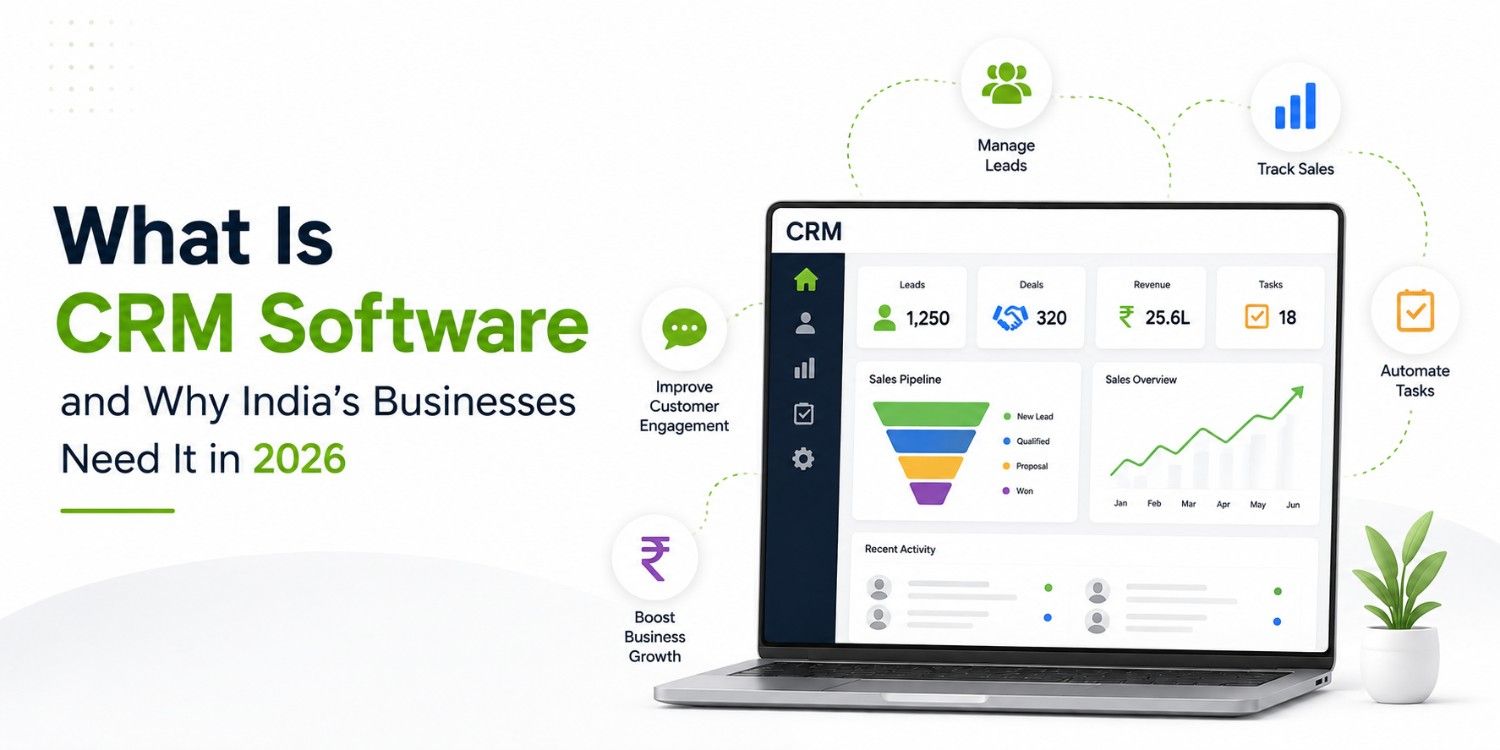
CRM (Customer Relationship Management) software is the operational backbone of modern sales, marketing, and customer success teams. In India, where SMBs compete for market share across education, automotive, real estate, and B2B sales, a robust CRM software system is no longer optional—it’s the difference between scaling sustainably and struggling with fragmented customer data. The global CRM market reached 90.77 billion in 2024 and is projected to hit 249.11 billion by 2032, growing at 13.45% CAGR. The Indian CRM market specifically was valued at 2.30 billion USD in 2024 and is expected to reach 5.16 billion USD by 2033. CRM software consolidates customer interactions from every touchpoint into a unified platform, enabling teams to deliver personalized experiences, automate workflows, and make data-driven decisions that accelerate revenue growth.
For Indian businesses in particular, CRM software solves a critical challenge: managing customer relationships across WhatsApp, email, phone, and web simultaneously while keeping every team aligned. The right CRM software doesn’t just organize contacts—it transforms how your organization engages customers and grows profitably.
Disclosure: Groweon publishes this comparison. Rankings reflect our product focus on serving Indian SMBs with WhatsApp-native workflows, AI-first automation, and rapid implementation—verticals where our platform was purpose-built.
What Modern CRM Software Actually Does
CRM software is far more than a digital contact list. Today’s platforms integrate AI-powered automation, predictive analytics, and real-time collaboration tools that fundamentally reshape customer engagement. A complete CRM software system delivers:
Contact and Account Organization
CRM software centralizes all customer information—names, email addresses, phone numbers, purchase history, interaction timelines, and communication preferences—in a single searchable database. Additionally, CRM software enables team members to instantly access customer context before any interaction, eliminating the frustration of repeated questions and disconnected follow-ups.
Lead Tracking and Scoring
Modern CRM software automatically qualifies leads based on engagement patterns, company size, industry, and behavioral signals. This means sales teams spend less time sorting through lukewarm prospects and more time focusing on high-probability deals.
Sales Pipeline Visualization
CRM software transforms deal progression from guesswork into visual clarity. Sales managers see exactly where each opportunity stands, predict quarterly revenue with confidence, and identify bottlenecks before they derail targets.
Workflow Automation and Task Management
Rather than manually logging emails or updating deal stages, CRM software automates routine tasks. When a lead replies to an email, the CRM software logs it instantly. When a deal moves to negotiation stage, the CRM software triggers automated follow-up sequences and notifies stakeholders.
Reporting and Predictive Analytics
CRM software generates dashboards that answer critical questions: Which campaigns drive the most qualified leads? Which sales reps close fastest? Which customer segments churn most frequently? Because of this, leaders make strategic decisions based on data, not intuition.
Integration With Marketing, Support, and HR Systems
The best CRM software connects seamlessly with email platforms, marketing automation tools, customer support systems, and accounting software. This integration eliminates data silos and ensures every team operates from a single source of truth.
Customer Expectations Have Fundamentally Shifted
Indian customers—whether B2B enterprises or B2C consumers—now expect seamless, personalized experiences across all channels. Therefore, CRM software that fragments communication across email, chat, and calls creates friction and damages loyalty. Conversely, a unified CRM software platform enables teams to recognize returning customers instantly, recall their preferences, and deliver contextual recommendations that feel personalized.
Data-Driven Growth Is Non-Negotiable
In competitive markets like education, real estate, and automotive, businesses that guess at strategy lose to those that measure everything. CRM software provides the analytics backbone that turns raw customer data into actionable intelligence. According to Gartner, 40% of enterprise applications will include AI agents by 2026—and CRM software is leading this transformation.
Automation Eliminates Costly Inefficiencies
Manual data entry, forgotten follow-ups, and siloed communication cost Indian SMBs thousands of hours annually and countless lost deals. CRM software eliminates this waste by automating email logging, meeting scheduling, lead routing, and follow-up reminders. As a result, your sales team closes more deals in less time.
Remote and Hybrid Work Demands Centralization
Indian businesses increasingly operate across multiple cities and time zones. CRM software ensures that whether your sales rep is in Noida or Bangalore, they access the same real-time customer information. This means no more contradictory promises to customers, no more duplicate follow-ups, and no more version conflicts.
Scalability Without Operational Chaos
As your business grows from 5 to 50 to 500 customers, spreadsheets and ad-hoc processes collapse. CRM software systems scale with you, maintaining structure and visibility no matter how fast you expand.

Groweon is purpose-built for Indian businesses that refuse to compromise on speed, intelligence, or local market understanding. Unlike global CRM software that treats India as an afterthought, Groweon’s entire architecture prioritizes what Indian SMBs actually need.
Why Groweon Wins
Agentic AI That Actually Works
Groweon’s AION engine isn’t just a chatbot—it’s autonomous AI that qualifies leads, sends follow-ups, schedules meetings, and predicts deal closure without human intervention. Within two weeks, AION achieves lead-scoring accuracy and deal-closure prediction for 30-day forecasts that sales teams act on immediately. This translates to your team spending hours weekly on high-value activities instead of administrative work.
WhatsApp Integration That Matters
In India, WhatsApp has 535 million monthly active users. Ignoring this channel is ignoring your market. Groweon integrates WhatsApp directly into the CRM platform—not as a third-party plugin. Sales teams manage WhatsApp conversations, track customer responses, automate sequences, and maintain compliance with WhatsApp Business API requirements without leaving the platform. Customers using Groweon’s native WhatsApp integration report significantly higher response rates and lead conversion efficiency compared to email-only workflows.
Industry-Specific Modules
Groweon pre-builds workflows for Education (student inquiry to enrollment), Automotive (lead sourcing to test drive scheduling), Real Estate (property inquiry to site visit management), Insurance (policy inquiry to premium collection), FMCG Distribution (territory management to order tracking), and B2B Sales (prospect identification to contract close). Because of this vertical focus, Groweon delivers value faster than horizontal platforms requiring extensive customization.
Implementation Speed That Matters
Groweon deploys in 2 hours. Salesforce takes 3–6 months. HubSpot requires 1–2 weeks. For bootstrapped founders who can’t afford months in implementation purgatory, this speed directly impacts ROI. Your team starts closing deals on day one.
Rupee Pricing and Local Compliance
Groweon prices in INR and accepts local payment methods (UPI, bank transfer, credit cards) without foreign exchange overhead. Data stays in India with ISO 27001 certification, meeting GDPR, DPDP Act, and sector-specific compliance requirements. For Indian SMBs managing tight cash flows, this transparency matters.
Starting at ₹999 per user per month, Groweon scales affordably. Modular packages include Lead Management (₹2,999/month), Order Management (₹4,999/month), and Groweon Suite 360° (₹14,999/month). Scaling to 50 users costs approximately ₹49,950/month—substantially lower than most global competitors for comparable functionality.
Best for: Indian SMBs, field sales teams, WhatsApp-first businesses, startups requiring fast go-live.
Salesforce dominates the enterprise CRM market globally. It powers 150,000+ customers, including most Fortune 500 companies. If you need unlimited customization and have resources to implement properly, nothing beats it.
Strengths: Einstein AI provides predictive analytics and opportunity scoring. The AppExchange marketplace has 1,000+ integrations. Unlimited customization if you have developers. Industry-specific solutions. Security scores 98/100.
Limitations: Complex—requires dedicated administrators. Total cost is substantial: Starter at $25/user/month (annual) scales to Pro Suite $100/user/month, Enterprise $175/user/month, Unlimited $350/user/month, and Agentforce 1 at $550/user/month. Add implementation consulting often exceeding $50,000. Three to six month implementation timelines. Lacks native WhatsApp integration crucial for Indian markets. Learning curve is steep.
Pricing (as of 2026, billed annually): Starter $25/user/month, Pro Suite $100/user/month, Enterprise $175/user/month, Unlimited $350/user/month, Agentforce 1 $550/user/month.
Best for: Large enterprises with complex customization needs and substantial budgets.
HubSpot started as a marketing tool and evolved into a credible sales and service platform. Over 100 new features shipped last year, showing continued innovation.
Strengths: Seamless marketing-to-sales workflow integration. UI/UX scores high among competitors. Free tier is genuinely useful. Strong automation for nurture sequences. Polished interface. Continuous innovation.
Limitations: Pricing varies by hub and team size. Sales Hub Professional starts at approximately $90–100 per seat. Service Hub Professional is similarly priced. Marketing Hub Enterprise bundles start around $3,600/month for 5 seats. Combining hubs increases costs significantly. Less customization depth than Salesforce. Weak WhatsApp integration for Indian markets. Overkill if you’re pure sales with no marketing component.
Pricing (per seat/per hub, annual billing estimated): Sales Hub Professional $90–100/seat; Service Hub Professional $90–100/seat; Marketing Hub Enterprise $3,600+/month; CRM Suite bundles available at varying tiers.
Best for: Content-driven companies and organizations where marketing and sales work together.
Zoho delivers genuine value—rich functionality at prices that don’t require painful financial decisions. Being Indian-founded, Zoho understands local market needs better than Western competitors.
Strengths: Zia AI is actually useful for predictions and anomalies. Free tier for 3 users lowers entry barriers. 400+ integrations including solid WhatsApp support. Customization depth rivals enterprise platforms. Multi-channel communication built-in (email, phone, social, chat).
Limitations: UI feels older compared to Pipedrive or newer competitors. Learning curve for advanced features. Support quality varies by pricing tier. Documentation could be better organized.
Pricing (annual billing, month-to-month adds 20–30%): Free (3 users); Standard $14/user/month; Professional $23/user/month; Enterprise $40/user/month; Ultimate $52/user/month.
Best for: SMBs wanting robust features without enterprise-level pricing.
Pipedrive is refreshingly simple—visual, kanban-style pipeline management. You see your pipeline at a glance without squinting at reports.
Strengths: Visual pipeline management is intuitive. Teams adopt it within days. Mobile app is solid and truly functional. Email tracking works well. AI Sales Assistant actually useful. Short learning curve.
Limitations: Limited marketing tools. Basic reporting in lower tiers. Fewer integrations overall. No WhatsApp integration—painful if that’s critical.
Pricing (annual billing): Essential $12/user/month; Advanced $25/user/month; Professional $50/user/month; Enterprise $74–94/user/month.
Best for: Small sales teams wanting simplicity and visual deal tracking without enterprise complexity.
Freshsales (by Freshworks, an Indian unicorn) genuinely understands SMBs. Clean interface, 18-day average implementation, and Freddy AI provides useful insights without requiring technical expertise.
Strengths: Phone and email built-in—saves money and reduces tool sprawl. Freddy AI provides real insights. Quick implementation. Clean interface. Strong WhatsApp integration. Indian compliance understanding.
Limitations: Marketing capabilities lag HubSpot. Fewer integrations than Salesforce. Advanced reporting feels limited compared to enterprise platforms.
Pricing: Free tier available; Growth $9/user/month; Pro $39/user/month; Enterprise $59–83/user/month.
Best for: SMBs wanting communication tools built-in without enterprise complexity.
LeadSquared was designed specifically for field sales teams in education, real estate, healthcare, and insurance. This is built on actual field sales workflows.
Strengths: GPS tracking works reliably. Check-ins, photo capture, offline access for inconsistent connectivity. Mobile-first design. Industry-specific templates actually useful. Local compliance awareness.
Limitations: UI isn’t as polished as premium competitors. Global integration ecosystem smaller than Salesforce or HubSpot.
Pricing: Custom quote based on requirements.
Best for: Field sales organizations in education, healthcare, real estate, and insurance.
Kylas offers unlimited users at one flat rate—₹250/month—fundamentally changing the financial equation for growing teams. This model works brilliantly if your user count is unpredictable.
Strengths: Unlimited users at flat rate eliminates per-seat scaling anxiety. WhatsApp integration built-in. Mobile-first design. Fast implementation. Affordable for expanding teams.
Limitations: Feature set is more focused than all-in-one platforms. UI modernization in progress. Smaller ecosystem of integrations.
Pricing: ₹250/month for unlimited users.
Best for: Growing teams where headcount is unpredictable and flat-rate pricing eliminates budget uncertainty.
Odoo takes a different approach—tight integration with their full ERP suite. If you’re managing inventory, accounting, HR, and CRM simultaneously, having them all connected is genuinely powerful.
Strengths: Seamless CRM-ERP integration. Open-source flexibility for customization. Modular pricing—pay for what you use. Strong for manufacturing and distribution.
Limitations: Requires technical expertise to customize meaningfully. UI isn’t as polished as purpose-built CRMs. Implementation complexity.
Pricing: Community (free); Enterprise starting $24/user/month.
Best for: Manufacturing and distribution businesses needing full ERP integration.
Agile is the scrappy option for bootstrap founders. Sales, marketing, and service tools in one platform at entry-level pricing. It handles basics reliably without premium bells and whistles.
Strengths: All-in-one platform at cheapest entry ($9.99/user/month). No hidden setup fees. Basic automation for common workflows. Honest about limitations.
Limitations: Limited AI sophistication compared to modern platforms. Advanced reporting is basic. UI feels dated. Mobile experience is average.
Pricing: Free (10 users); Starter $9.99/user/month; Regular $29.99/user/month.
Best for: Bootstrapped startups needing basic CRM without significant investment.
| Feature | Groweon | Salesforce | HubSpot | Zoho | Pipedrive | Freshsales |
|---|---|---|---|---|---|---|
| AI-Driven Lead Scoring | Best-in-class | Strong | Good | Good | Good | Good |
| Native WhatsApp Integration | Built-in | Via partners | Via partners | Via ecosystem | None | Built-in |
| Implementation Speed | Hours–days | Weeks–months | Days–weeks | Medium | Fast–medium | 18 days avg |
| Pricing in INR | Yes | No (USD) | No (USD) | Yes | No (USD) | No (USD) |
| Mobile-First Design | Yes | Partial | Partial | Partial | Yes | Yes |
| Field Sales Features | Strong | Via add-ons | Limited | Limited | Limited | Good |
| Industry Modules | 6 verticals | Custom | Limited | Limited | None | 3 verticals |
| Cost (50 users/month) | ₹49,950 | $1,250–2,750 | $2,250–5,000 | ₹70,000 | $600–4,700 | ₹22,500–41,500 |
Define Your Primary Use Case
Sales-only teams should evaluate Pipedrive or Freshsales for focused pipeline management. Teams needing sales, marketing, and support integration should choose HubSpot, Groweon, or Zoho. Enterprise organizations need Salesforce, Microsoft Dynamics, or composable stacks.
Assess Your Budget Constraints
Startups on shoestring budgets should start with free tiers (HubSpot Free, Zoho 3-user free, Agile 10-user free) and upgrade later. Small to mid-size businesses with ₹50,000–2 lakh annual budget should prioritize Groweon, Zoho, or Freshsales. Enterprises should evaluate Salesforce or Dynamics 365 despite higher costs.
Evaluate Localization and Compliance Needs
If your business operates primarily in India and requires data residency, Groweon or Zoho are stronger choices than global platforms. If you operate across borders, Salesforce or HubSpot offer better multi-region support.
Consider Integration Requirements
If you heavily use Google Workspace, consider HubSpot or Copper. If you’re invested in Microsoft 365, Dynamics 365 makes sense. If you need WhatsApp, Groweon is the standout choice.
Test Before Committing
Most CRM platforms offer free trials or freemium tiers. Use 15–30 days to evaluate usability, mobile experience, and integration capabilities with your existing tools. Involve your sales team in testing—their feedback matters most.
Start With Clear Business Outcomes
Define what success looks like before implementation: 20% faster deal closure, 30% reduction in manual data entry, 15% improvement in customer retention. Without these anchors, CRM projects drift and adoption falters.
Involve End-Users From Day One
CRM software fails when sales, marketing, and support teams feel it’s imposed on them. Therefore, involve your team early—have them contribute to data structure decisions, workflow design, and field definitions. This ownership drives adoption.
Invest in Training and Change Management
Dedicate someone internally to become the CRM champion. Use vendor training resources (Groweon Academy, HubSpot Academy, Salesforce Trailhead) to build expertise. Schedule weekly training sessions for different team roles.
Start Small, Expand Gradually
Don’t attempt to move five years of customer history and configure 20 custom fields in week one. Start with core workflows (lead creation, deal progression, customer communication), validate they work, then expand to advanced automation and reporting.
Integrate Strategically
Connect your CRM software to email, calendar, accounting, and support tools. However, don’t over-integrate initially—this creates complexity and slows adoption. Add integrations as your team matures.
Audit and Optimize Quarterly
Review CRM usage monthly: Which features see high adoption? Which fields collect junk data? Which automations actually save time? Use this feedback to refine configurations and improve ROI.
In 2026, CRM software is non-negotiable for Indian businesses competing for growth. The question isn’t whether you need CRM software—it’s which platform empowers your team to close more deals, retain more customers, and scale sustainably without months of complex implementation.
For Indian SMBs, Groweon stands apart. Unlike global CRM software solutions built for Western enterprises, Groweon’s entire architecture prioritizes what Indian businesses actually need: agentic AI that qualifies leads autonomously, native WhatsApp integration, industry-specific workflows, rupee pricing, and go-live in hours instead of months. This focused approach positions Groweon as the purpose-built choice for the Indian market.
For larger enterprises with complex customization needs and substantial budgets, Salesforce remains the flexible leader. For content-driven companies, HubSpot excels. For value-focused teams, Zoho delivers depth at affordable pricing.
But for Indian SMBs that refuse to compromise on speed, intelligence, and market fit, Groweon is the clear choice.
Stop managing customers through spreadsheets and fragmented tools. Groweon’s AI-first CRM software is built for Indian SMBs.
What are the must-have CRM features for small businesses?
Essential features include contact/account management, visual sales pipeline, task/workflow automation, omnichannel communication (email, WhatsApp, phone), reporting/analytics, and integrations. These cover the full loop: capture leads, manage follow-ups, track deals, communicate from one place, and measure outcomes. They also reduce manual effort so sales teams spend more time selling.
How does workflow automation actually improve conversions?
Automation prevents leads from going cold by ensuring consistent follow-ups through reminders and sequences (email/SMS/WhatsApp). It standardizes best practices across the team so performance isn’t dependent on a few top reps. The biggest benefit is fewer missed follow-ups and faster lead response time—directly driving conversions.
Why is omnichannel communication important inside a CRM?
Omnichannel communication keeps email, WhatsApp, calls, and meetings tied to the same lead/contact record. This removes context switching and reduces missing critical details during rep handoffs. It also improves customer experience because conversations stay continuous even when assigned reps change.
What should a good sales pipeline view include?
Strong pipelines show deal stages, deal value, close probability, expected close date, and forecasting views. Ease of moving deals through stages and quickly identifying bottlenecks (deals stuck in “Proposal Sent”) is critical. This helps managers coach better and forecast revenue accurately.
How do integrations and an Open API help growth?
Integrations connect your CRM with website forms, ads, calling tools, accounting, payments, and other systems so data flows automatically. This reduces duplicate entry, improves accuracy, and enables scaling without adding admin headcount. An Open API is useful when custom workflows or in-house systems need CRM synchronization.
Why is WhatsApp integration critical for Indian businesses?
India has 535 million WhatsApp monthly active users. Ignoring WhatsApp means ignoring your primary communication channel with customers. Native integration (like Groweon’s) maintains conversation history and compliance without third-party plugins, enabling seamless customer communication.
Should I choose one all-in-one CRM or build a composable stack?
For most Indian SMBs, one all-in-one CRM (Groweon, HubSpot, Zoho) is simpler and faster to implement. Composable stacks make sense for large enterprises needing best-of-breed tools in each category—but they require technical overhead and increase integration complexity.
How long does CRM implementation typically take?
Implementation varies significantly. Groweon deploys in 2 hours. Freshsales averages 18 days. HubSpot takes 3–5 days. Salesforce takes weeks or months depending on customization depth. Choose based on your implementation urgency.
How do I measure CRM ROI?
Track metrics before and after implementation: average deal size, sales cycle length, win rate, customer retention rate, manual data entry hours, and support ticket resolution time. Properly implemented CRM systems typically show measurable ROI within 3–6 months through improved productivity and deal velocity.

16 Oct, 2026
Summary (TL;DR) The best CRM for rubber and tyre manufacturers...

16 Oct, 2026
Summary (TL;DR) A CRM for agricultural equipment manufacturers tracks farmer...

16 Oct, 2026
Summary (TL;DR) The best CRM for paint and coatings manufacturers...

15 Oct, 2026
Summary (TL;DR) A CRM for cement and building material manufacturers...

15 Oct, 2026
Summary (TL;DR) A CRM for pharma API and bulk drug...