

CRM Buying Checklist for Indian SMBs: 12 Points to Verify…
05 Oct, 2026
Summary (TL;DR): Most CRM buying mistakes trace back to a...
Updated: 14th September, 2026
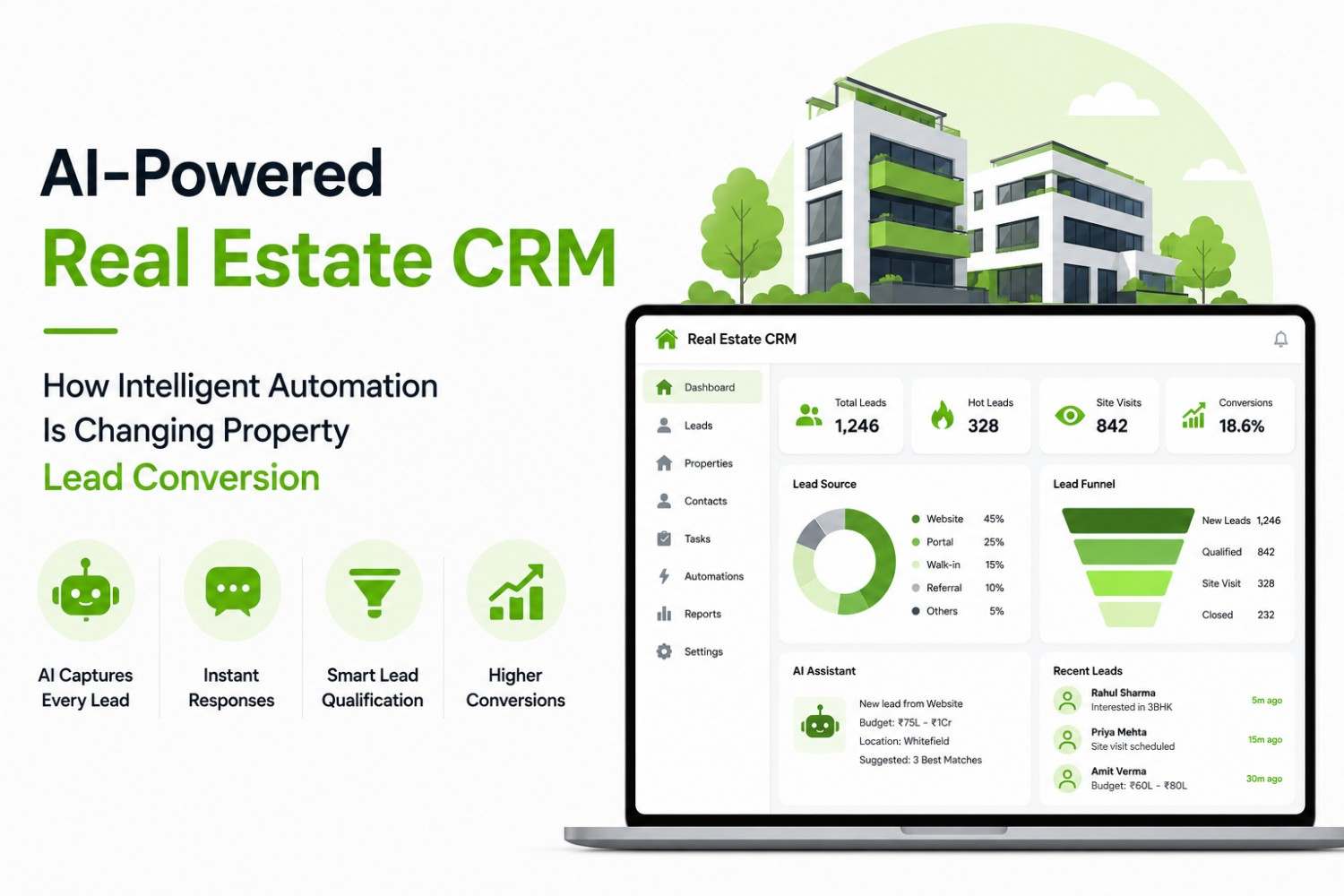
Choosing the best real estate CRM software in 2026 is no longer about finding a digital address book for leads.
Real estate sales involve multiple lead sources, property enquiries, calls, WhatsApp conversations, site visits, negotiations, channel partners and long sales cycles. When these activities are spread across spreadsheets, personal phones and disconnected tools, sales teams can easily lose track of opportunities.
The Indian residential market is also becoming more segmented. CBRE’s 2026 outlook highlights stable underlying housing demand along with continued premiumisation and changing buyer preferences across major markets. India Residential Market Outlook 2026
At the same time, CRM technology is becoming more important in real estate sales. The National Association of REALTORS®’ technology research identifies CRM as one of the leading technologies used by real estate professionals for generating leads, while time savings remains a major reason for technology adoption. NAR Technology Survey
For a real estate business, the right CRM should therefore do much more than store contact details.
It should help manage the complete journey:
Lead → Qualification → Property Matching → Follow-Up → Site Visit → Negotiation → Booking
This guide looks at 10 CRM platforms that businesses can consider in 2026 and explains what each one is best suited for.
Note: This is a practical comparison, not an official industry ranking. Features, pricing and integrations can change, so businesses should verify current details directly with each vendor before making a purchase.
A real estate CRM is software that helps property businesses manage prospects, customers, properties and sales activities throughout the customer journey.
A typical real estate CRM can bring together:
Modern platforms are also adding automation and AI to help sales teams qualify leads, prioritise opportunities and manage repetitive activities.
Data management is another important consideration. Since CRM platforms can contain names, phone numbers, preferences and other customer information, businesses operating in India should also consider applicable data-protection requirements, including the Digital Personal Data Protection Act, 2023.
The best CRM for one property business may not be the best option for another.
A small brokerage may prioritise simplicity and calling.
A property developer may need inventory, project management, channel-partner management and site-visit workflows.
A large real estate enterprise may need advanced integrations, analytics, automation and scalability.
Before comparing products, evaluate them on these areas:
| Feature | Why It Matters in Real Estate |
|---|---|
| Lead Management | Keeps property enquiries organised |
| Lead Qualification | Helps understand buyer requirements |
| Lead Scoring | Helps prioritise high-intent prospects |
| Property Inventory | Connects buyers with relevant properties |
| Lead Assignment | Routes enquiries to the right salesperson |
| Site Visit Management | Tracks a critical sales milestone |
| Follow-Up Automation | Reduces missed follow-ups |
| Communication Management | Keeps customer conversations accessible |
| Sales Pipeline | Shows where every opportunity stands |
| AI & Automation | Reduces repetitive sales work |
| Reporting | Helps managers monitor performance |
| Scalability | Supports growing teams and lead volumes |
Top 10 Best Real Estate CRM Software in 2026
Groweon CRM is designed to help real estate businesses manage leads, property sales activities, follow-ups and customer interactions through a connected CRM environment.
Its real estate CRM capabilities cover important sales processes such as:
Groweon also brings AI-powered capabilities into the sales process through its AION ecosystem.
For real estate businesses, this can support areas such as AI-assisted lead qualification, lead scoring, communication, lead analysis and follow-up automation.
Best suited for:
Real estate developers, brokers and sales teams looking for CRM, automation and AI capabilities together.
Why consider it?
Groweon is particularly relevant for businesses that want to move beyond basic lead tracking and introduce AI into day-to-day sales workflows.
Sell.Do is purpose-built for the real estate industry and focuses on the complete property revenue journey.
Its platform covers areas including marketing automation, pre-sales, sales management, inventory, channel partners, communication and post-sales. Its current platform also includes AI capabilities through Jarvis AI.
This makes it particularly relevant for developers managing multiple projects, units, sales teams and channel partners.
Best suited for:
Real estate developers and larger property sales organisations.
Key strength:
Its industry-specific approach means real estate workflows such as inventory, site visits, channel partners and project-based sales can be handled within the same ecosystem.
LeadSquared is a broader sales and marketing automation platform that supports businesses managing large volumes of leads.
Its platform focuses on areas such as lead capture, sales automation, marketing automation, engagement and reporting. LeadSquared also positions its platform around AI-powered sales and marketing operations.
For real estate businesses generating large numbers of enquiries from advertising campaigns, websites and other channels, lead distribution and follow-up automation can be particularly important.
Best suited for:
Large sales teams and businesses handling high enquiry volumes.
Key strength:
Lead management and automation across a structured sales process.
Zoho CRM is a general-purpose CRM platform that can be configured for different industries and sales processes.
Its capabilities include workflow automation, sales pipelines, analytics, customer engagement, customisation and AI assistance through Zia.
For a real estate business, the flexibility can be useful when CRM requirements extend beyond standard property-sales workflows.
Best suited for:
Growing businesses looking for a flexible and highly configurable CRM.
Key strength:
Customisation and a broad CRM ecosystem.
Salesforce CRM is an enterprise CRM platform used across industries.
Rather than being designed exclusively for real estate, Salesforce provides a broad ecosystem covering sales, service, marketing, commerce, data and AI.
Its current CRM platform also includes AI capabilities and autonomous-agent functionality.
For large property organisations, this can be useful when CRM needs to connect with wider enterprise systems and complex business processes.
Best suited for:
Large real estate organisations with complex CRM requirements and dedicated implementation resources.
Key strength:
Enterprise scalability, customisation and ecosystem depth.
HubSpot CRM combines CRM functionality with marketing, sales and customer-service capabilities.
Its Smart CRM acts as a central system for business data, while its wider platform connects marketing and sales activities.
For property businesses where digital marketing, website enquiries, content and lead nurturing are important parts of the acquisition strategy, this approach can be useful.
Best suited for:
Marketing-led real estate businesses that want marketing and sales data connected.
Key strength:
Strong connection between marketing activities and CRM.
Propertybase is positioned around real estate brokerage technology and combines CRM capabilities with property-related workflows.
Its platform focuses on areas including contacts, listings, lead management, transaction management, marketing automation and reporting.
This makes it particularly relevant for property professionals who need CRM functionality closely connected with listings and brokerage operations.
Best suited for:
Real estate brokerages and property-focused sales organisations.
Key strength:
Property-centric CRM and brokerage workflows.
TeleCRM focuses heavily on lead management, calling, WhatsApp communication and sales automation.
Its platform supports features such as automatic lead capture, calling, call recording, WhatsApp integration, follow-up automation, sales pipelines and reporting.
For real estate businesses where telecalling is central to lead conversion, these capabilities can be valuable.
Best suited for:
Real estate sales and telecalling teams that rely heavily on phone and WhatsApp communication.
Key strength:
Calling, WhatsApp and sales follow-up workflows.
PropSpace is a real estate CRM and business-management platform focused on brokers, agents and property managers.
Its platform covers areas such as listings, leads, deals, contacts, viewings, reporting and property-management workflows.
This makes it more property-centric than a conventional general-purpose CRM.
Best suited for:
Real estate agencies, brokers and property managers.
Key strength:
Connecting property listings and management activities with customer and sales workflows.
Cratio positions itself as a lead-engagement CRM for Indian sales teams, combining CRM, mobile call tracking and WhatsApp Business capabilities.
Its platform supports lead capture, automated assignment, sales pipelines, call tracking, WhatsApp automation and follow-up workflows. It also has a specific real estate solution for builders, brokers and property sales teams.
Best suited for:
Indian real estate sales teams that want CRM, calling and WhatsApp capabilities in one platform.
Key strength:
Lead engagement across calling, WhatsApp and sales workflows.
| CRM | Best For | Real Estate Focus | AI / Automation | Ideal Business |
|---|---|---|---|---|
| Groweon CRM | AI-powered sales automation | High | AI + Automation | Developers, brokers & sales teams |
| Sell.Do | Developer workflows | Very High | AI + Automation | Developers & large teams |
| LeadSquared | High-volume sales | High | Strong automation | Large sales operations |
| Zoho CRM | Customisation | Configurable | AI + Automation | Growing businesses |
| Salesforce | Enterprise CRM | Configurable | Advanced AI | Large enterprises |
| HubSpot CRM | Marketing + sales | Configurable | AI + Automation | Marketing-led businesses |
| Propertybase | Brokerage operations | High | Automation | Agencies & brokerages |
| TeleCRM | Calling + WhatsApp | Sales-focused | Automation | Telecalling teams |
| PropSpace | Property management | Very High | Automation | Agencies & property managers |
| Cratio | Lead engagement | High | Automation | Indian sales teams |
Choosing a CRM simply because it has a long feature list can be misleading.
The better question is:
Can the CRM support the actual way your property sales team works?
Real estate enquiries can come from:
A CRM should bring these enquiries into one system so salespeople do not have to manually collect leads from multiple sources.
When several salespeople handle enquiries, manual lead distribution can create delays and uneven workloads.
A good real estate CRM should allow businesses to assign leads based on factors such as:
The objective is simple:
The right lead should reach the right salesperson quickly.
Not every property enquiry represents the same level of buying intent.
A CRM should help sales teams capture details such as:
This gives salespeople context before they start the next conversation.
Lead scoring can help teams prioritise their sales efforts.
For example:
High Intent
Budget shared + property selected + site visit requested
Medium Intent
Property interest + pricing discussion
Low / Unknown Intent
General enquiry + limited requirement information
AI-powered systems can take this further by analysing available customer interactions and signals.
Real estate CRM and property inventory should work together.
Salespeople need to know:
Connecting buyer requirements with inventory can make property recommendations more relevant.
A site visit is one of the most important stages in a property sales journey.
A CRM should help manage:
Lead → Site Visit Scheduled → Visit Completed → Feedback → Follow-Up → Negotiation
Without structured post-visit follow-up, an important sales opportunity can lose momentum.
Real estate buying decisions can take weeks or months.
Customers may need several conversations before they are ready to move forward.
CRM automation can help sales teams manage follow-ups after:
This reduces the risk of relying entirely on individual salesperson memory.
WhatsApp has become an important communication channel for many sales teams.
A CRM should ideally connect customer communication with the lead record so salespeople can see relevant conversation history without depending on one employee’s personal phone.
This is especially important when:
AI is becoming a bigger part of CRM technology.
Useful AI capabilities for real estate can include:
However, businesses should evaluate what the AI actually does, rather than choosing a CRM simply because it uses the word “AI” in its marketing.
Excel can be useful for maintaining basic lists.
The problem begins when a business needs to manage thousands of leads, multiple salespeople, property inventory, calls, site visits and follow-ups simultaneously.
| Requirement | Excel | Real Estate CRM |
|---|---|---|
| Lead database | ✓ | ✓ |
| Automatic lead capture | Limited | ✓ |
| Lead assignment | Manual | Automated |
| Follow-up reminders | Manual | Automated |
| Site visit tracking | Manual | Structured |
| Customer interaction history | Limited | Centralised |
| Property matching | Manual | CRM-based |
| Team visibility | Limited | Real-time |
| Lead scoring | Manual | Automated / AI-assisted |
| Sales reporting | Manual | Automated |
| AI assistance | ✗ | Available in modern platforms |
Excel is not a bad tool.
It simply was not designed to manage a complex, multi-stage property sales operation.
How AI Is Changing Real Estate CRM in 2026
Traditional CRM mainly answers:
“What happened with this lead?”
Modern AI-powered CRM increasingly tries to answer:
“What should happen next?”
Consider a buyer who:
A traditional CRM can store these activities.
An AI-powered CRM can help identify the opportunity, summarise the buyer’s requirement and suggest the next action.
This is an important shift:
CRM is moving from record keeping toward sales intelligence.
How Much Does Real Estate CRM Software Cost?
There is no universal price for real estate CRM software.
Pricing may depend on:
A low monthly subscription is not automatically the cheapest option if the business later needs multiple add-ons or expensive implementation.
Instead, evaluate the total cost of ownership:
Software + Implementation + Integrations + Training + Support + Communication/AI Costs
Then compare that cost against the operational value the CRM can provide.
For Real Estate Developers
Prioritise:
For Real Estate Brokers
Prioritise:
For High-Volume Sales Teams
Prioritise:
For AI-First Sales Teams
Prioritise:
Questions to Ask Before Buying Real Estate CRM Software
Before selecting a platform, ask:
These questions will give you a much better basis for comparison than simply choosing the CRM with the longest feature list.
There is no universal answer.
The best real estate CRM depends on the business model, sales process, team size, property portfolio, lead volume and level of automation required.
Groweon CRM is a strong option for businesses looking to combine real estate CRM with AI-powered sales automation.
Sell.Do is particularly relevant for developers and organisations that need deep real estate-specific workflows.
LeadSquared can suit businesses managing high volumes of leads and structured sales operations.
Zoho CRM is relevant for organisations that value flexibility and customisation.
Salesforce is better suited to complex enterprise CRM environments.
HubSpot CRM can be a good fit for marketing-led sales operations.
Propertybase focuses strongly on property and brokerage workflows.
TeleCRM is particularly relevant for calling and WhatsApp-heavy sales teams.
PropSpace is focused on real estate agencies, brokers and property managers.
Cratio combines CRM, calling and WhatsApp capabilities for Indian sales teams.
So rather than asking:
“Which CRM is number one?”
ask:
“Which CRM fits our real estate sales process best?”
Final Takeaway
The role of a real estate CRM has changed significantly.
A CRM is no longer simply a place to store:
Name + Phone Number + Follow-Up Date
A modern real estate CRM needs to connect:
Lead Capture → Qualification → Property Matching → Communication → Site Visit → Follow-Up → Negotiation → Booking
And AI is taking this one step further.
The goal is no longer just to know where a lead is.
It is to understand:
Who is the buyer?
What property do they need?
How strong is their intent?
What happened previously?
What should the salesperson do next?
That is where CRM, automation and AI come together.
For real estate businesses evaluating the best CRM software in 2026, the right platform should ultimately be the one that helps the team respond faster, manage every opportunity, reduce lead leakage and move more qualified buyers toward conversion.
In real estate, the best CRM isn’t the one with the most features. It’s the one that makes your sales process work better.

05 Oct, 2026
Summary (TL;DR): Most CRM buying mistakes trace back to a...

01 Oct, 2026
Summary (TL;DR): Lead management software captures, scores, routes, and nurtures...

01 Oct, 2026
Summary (TL;DR): CRM pricing in India typically runs ₹250 to...

30 Sep, 2026
Summary (TL;DR): A CRM with native Meta Conversions API integration...

29 Sep, 2026
Summary (TL;DR): The best choice depends on whether you want...