

Best Order Management Solution for Distributors: A Complete 2027 Buyer’s…
13 Nov, 2026
Summary Choosing the right order management solution helps distributors organize...
Updated: 13th November, 2026
Are you frequently dealing with stock mismatches, unexpected stockouts, excess inventory, or delayed order fulfilment?
These problems can affect business profitability, customer satisfaction, and daily operations. As businesses expand, managing inventory through spreadsheets and manual records becomes increasingly difficult.
This is why investing in the right Inventory Management Software is becoming an important business decision in 2026.
Modern inventory systems are evolving beyond basic stock recording. AI-assisted forecasting, real-time inventory visibility, automated replenishment, and multi-location stock management are changing how businesses manage their products. Industry trend reports also highlight the growing importance of these capabilities.
But with so many solutions available, how do you identify the right software for your business?
Let’s explore.
Inventory is directly connected to purchasing, sales, warehousing, and customer fulfilment. Even a small stock management mistake can create unnecessary expenses.
Here are some common problems businesses want to solve:
An inventory management system helps centralise stock information and establish more organised inventory processes.
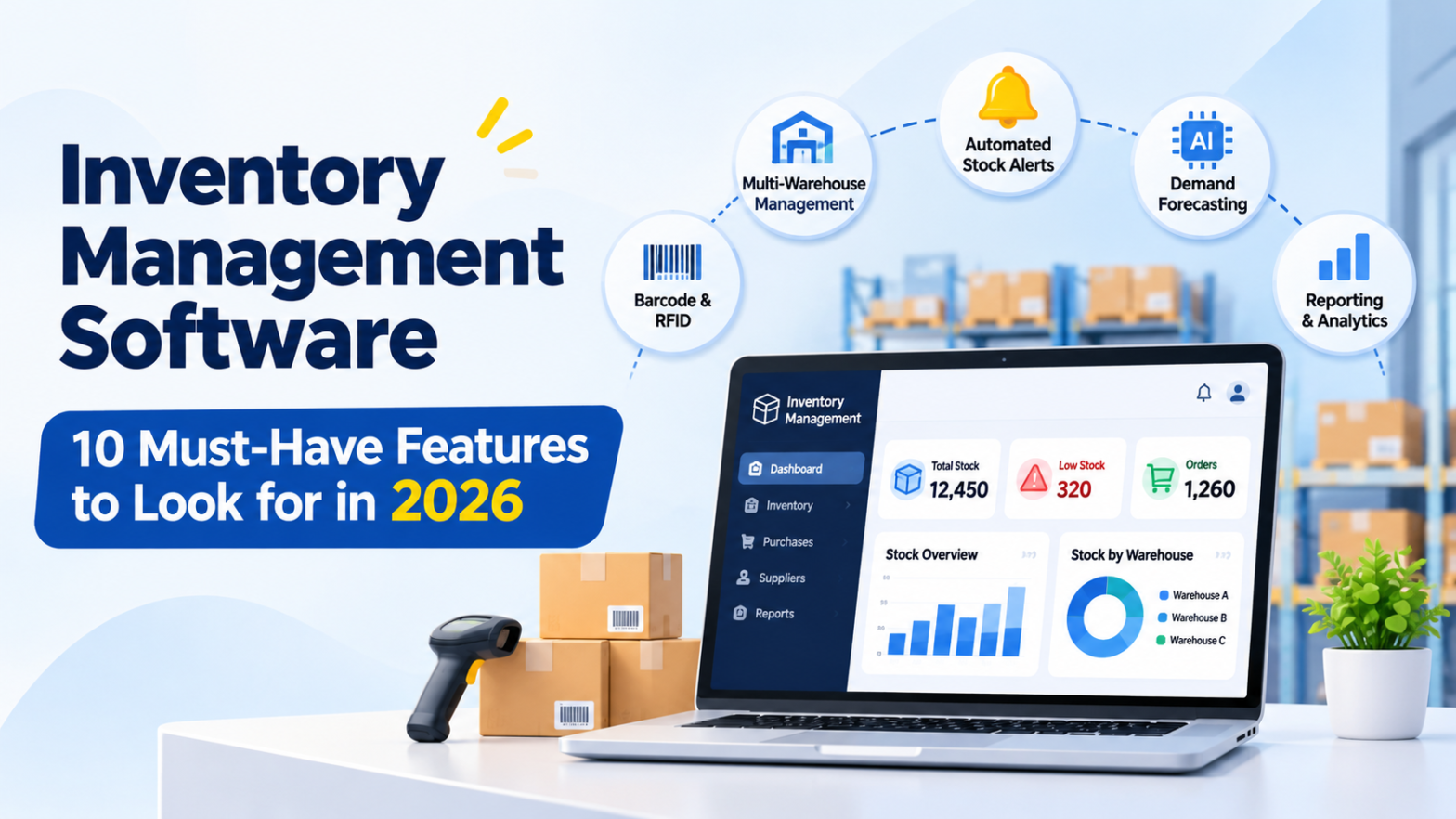
Before purchasing an inventory solution, evaluate these important capabilities.
Businesses need accurate information about available stock. Real-time or timely inventory updates help teams understand product availability and reduce confusion during sales and purchasing activities.
If your business operates from multiple warehouses, you need visibility into stock quantities at different locations.
Look for features that support warehouse-wise stock records, stock transfers, and location-based reporting.
Manual stock checking can delay purchasing decisions. Automated alerts can notify users when products reach predefined minimum stock levels.
This helps purchasing teams plan replenishment before stock runs out.
AI-assisted forecasting can analyse historical sales, seasonal demand, and other relevant signals to support purchasing decisions.
Instead of relying entirely on assumptions, businesses can use data-driven insights to plan inventory requirements.
Inventory operations depend heavily on supplier coordination.
Look for capabilities to manage supplier information, purchase orders, purchase history, and incoming stock records.
Barcode scanning and RFID technology can improve the speed and accuracy of stock-related activities.
These technologies are particularly useful for businesses managing large product catalogues and frequent inventory movements.
Businesses dealing with food, pharmaceuticals, cosmetics, and other time-sensitive products may need batch numbers, manufacturing dates, expiry dates, and traceability features.
Always confirm whether these capabilities are supported by the software.
A good system should provide reports that help managers understand stock movement, product performance, inventory valuation, and slow-moving products.
Inventory should not operate independently from other business functions.
Integration with accounting, sales, purchasing, and order management systems helps reduce duplicate data entry and improve operational coordination.
Mobile access can help authorised employees check product information and perform relevant inventory activities while working outside their desks.
Not every business requires the same inventory capabilities. A small distributor may need basic stock tracking, while a manufacturing business may require more advanced warehouse and material management.
Consider these factors before purchasing:
|
|---|
Request a product demonstration and test the most important workflows before making your final decision.
Excel can work for businesses with a small product catalogue and limited stock movement.
However, as transaction volumes increase, maintaining accurate records becomes more complicated.
|
|---|
For growing businesses, dedicated inventory software can provide more structured control than disconnected spreadsheets.
Inventory management and CRM software solve different but connected business problems.
An inventory management system focuses on stock quantities, warehouse operations, and product movement.
A CRM focuses on customer information, lead management, sales activities, and customer relationships.
When CRM and inventory or order management systems are properly integrated, sales teams can coordinate customer enquiries and order-related activities more effectively.
For example, a sales representative can manage a customer enquiry through a sales CRM platform, while connected inventory systems provide relevant stock information.
Businesses can also explore order management solutions to organise order-related workflows.
Managing stock is only one part of running a successful business. Companies also need organised customer information, lead tracking, sales coordination, and order management.
Groweon CRM helps businesses manage sales and customer-related workflows through capabilities such as lead management, sales automation, and customer activity tracking.
For businesses looking to improve coordination between sales activities and order workflows, exploring Groweon’s order management solution can be a useful starting point.
Evaluate the required inventory functionality separately and confirm integration compatibility before selecting your technology stack.
1. What is inventory management software?
Inventory management software helps businesses record, monitor, and manage product stock, inventory movements, and related operations through a centralised system.
2. Which businesses need inventory management software?
Retailers, wholesalers, distributors, manufacturers, ecommerce businesses, and other organisations managing physical products can benefit from inventory management software.
3. Can inventory management software prevent stockouts?
It can help reduce stockout risks through stock-level monitoring, low-stock alerts, demand forecasting, and replenishment planning.
4. Is inventory management software better than Excel?
For businesses with growing product catalogues, frequent transactions, or multiple warehouses, dedicated inventory software generally provides more structured tracking and automation than manual spreadsheets.
5. What is the difference between inventory management and order management?
Inventory management focuses on stock quantities, storage, and movement. Order management focuses on processing and tracking customer orders through their fulfilment lifecycle.
6. What should businesses check before buying inventory software?
Businesses should evaluate stock tracking, warehouse management, purchasing workflows, integrations, reporting, automation, scalability, and pricing.
Choosing the right Inventory Management Software is not simply about tracking how many products are available in a warehouse. It is about improving stock accuracy, reducing operational inefficiencies, and making better purchasing and fulfilment decisions.
In 2026, businesses should look beyond basic stock records and evaluate solutions that support automation, intelligent forecasting, multi-location visibility, and integration with other business systems.
The best software is ultimately the one that fits your operational requirements today while supporting your business as it grows.
13 Nov, 2026
Summary Choosing the right order management solution helps distributors organize...

13 Nov, 2026
Summary Service Ticket Management helps businesses capture, assign, track, and...
13 Nov, 2026
Summary Choosing the right inventory management software can help businesses...
12 Nov, 2026
Summary AI CRM Software helps businesses manage customer relationships through...

12 Nov, 2026
Summary Pharmaceutical companies manage complex relationships with doctors, medical representatives,...