

Best Order Management Solution for Distributors: A Complete 2027 Buyer’s…
13 Nov, 2026
Summary Choosing the right order management solution helps distributors organize...
Updated: 12th November, 2026
Indian businesses receive sales enquiries through websites, advertisements, WhatsApp, marketplaces and other channels.
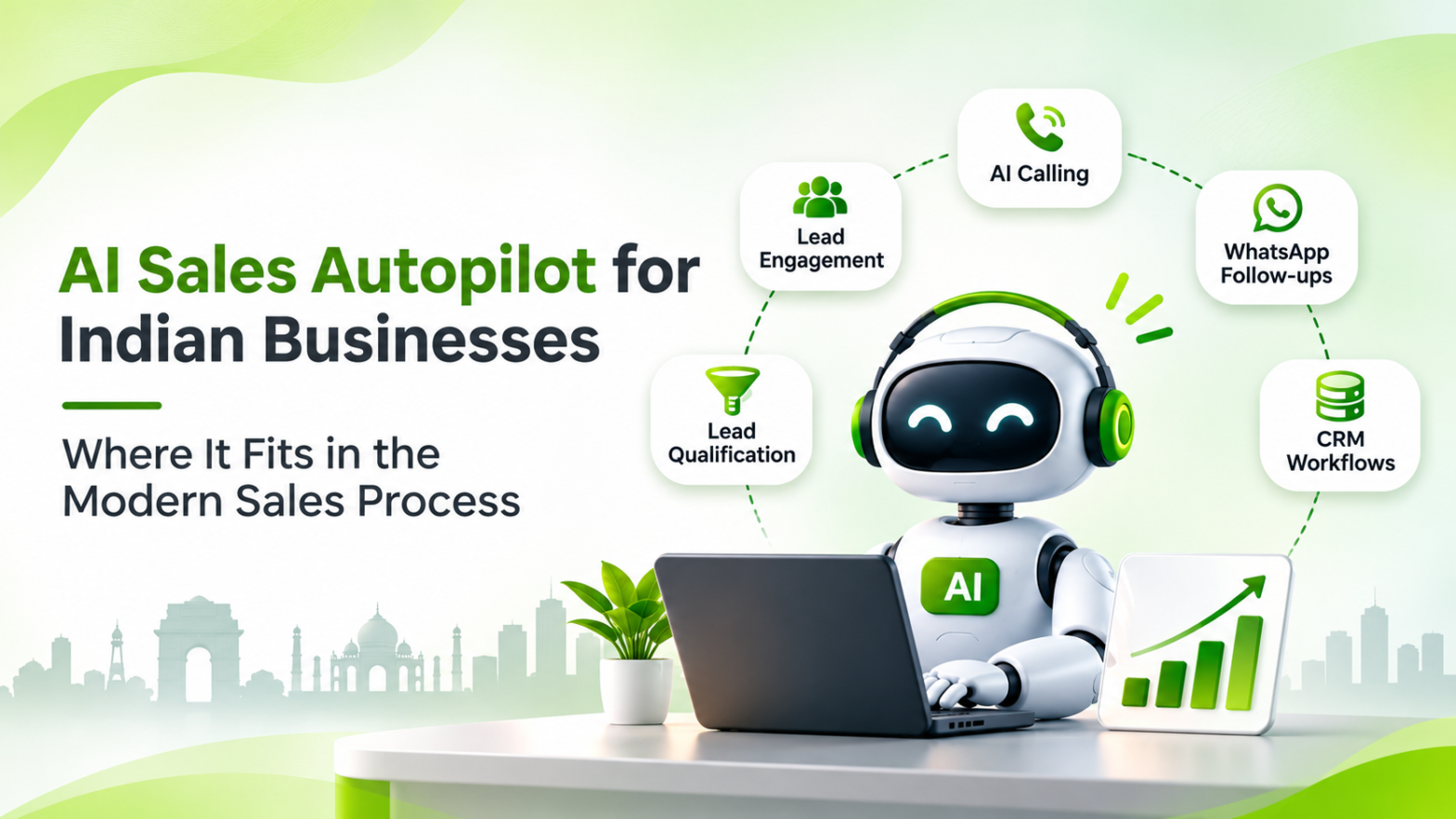
AI Sales Autopilot connects lead engagement, qualification, follow-ups and CRM updates through intelligent automated workflows.
It helps sales teams respond consistently, identify promising prospects and reduce repetitive administrative work.
By combining AI agents with human sales expertise, businesses can build a faster and more organised sales process.
A customer submits an enquiry through a website at 10 PM. Another prospect responds to a WhatsApp advertisement during a busy sales meeting. A third customer requests a quotation but does not receive a follow-up for two days. These situations are common in businesses that generate enquiries through multiple channels but depend on sales representatives to manage every interaction manually.
The problem is not always a shortage of leads. Often, the challenge is what happens after a lead enters the business.
Who contacts the prospect? How quickly does the first response happen? Has the requirement been understood? Is the lead genuinely interested? Who is responsible for the next follow-up?
Traditional sales automation can handle predefined tasks, but more advanced AI-driven systems can coordinate multiple steps based on customer responses, engagement and business rules.
This is where AI Sales Autopilot fits into the modern sales process. It connects different stages of lead management, allowing AI agents to engage prospects, collect relevant information, qualify opportunities, initiate follow-ups and hand over suitable leads to human representatives.
For Indian businesses managing high enquiry volumes across multiple channels, this approach can make sales operations more consistent while allowing salespeople to concentrate on conversations that require human judgement.
Sales processes have become increasingly fragmented. A business may receive leads from Google Ads, Meta Ads, IndiaMART, Justdial, its website, WhatsApp and referral networks.
Each channel generates enquiries, but the challenge is maintaining consistent engagement after those enquiries arrive.
Consider a business receiving 200 enquiries in a day. Its sales team must identify new leads, contact prospects, understand requirements, update CRM records, schedule follow-ups and prioritise opportunities.
When these activities depend entirely on manual effort, some enquiries may receive delayed responses or incomplete follow-ups.
AI-driven sales systems can help coordinate these activities through connected workflows.
According to McKinsey B2B research, businesses are increasingly exploring agentic AI to redesign commercial workflows rather than simply automate isolated tasks.
Lead generation brings potential customers into the business. Lead management determines how effectively those enquiries are handled.
For example:
If the process stops after lead generation, businesses may accumulate enquiries without creating enough meaningful sales conversations.
An effective AI sales workflow connects lead generation with the activities that follow.
Traditional automation generally follows predefined conditions.
For example, when a new lead enters the CRM, the system sends an automatic email. When the lead changes stages, it creates a follow-up task.
These actions are useful, but they may not fully account for what the prospect actually says or does.
Modern agentic systems can interpret available context, choose from permitted actions and coordinate multi-step workflows.
The Salesforce agentic CRM overview explains the distinction between conventional rule-based automation and AI agents that can plan and execute tasks within defined boundaries.
The biggest advantage of an AI-driven sales workflow is that it connects activities that are often handled separately.
Instead of treating lead capture, calling, qualification and follow-ups as independent tasks, an AI sales system can coordinate them as part of one journey.
The process starts when a prospect submits an enquiry.
A connected system can capture lead information from supported sources and create a CRM record.
Typical lead sources include:
The CRM record can preserve relevant information such as contact details, enquiry source, campaign context and product or service interest.
This gives the AI agent the initial context required for the next interaction.
The next challenge is contacting the prospect at an appropriate time.
A traditional sales team may need to wait until a representative becomes available. An AI sales agent can initiate configured engagement workflows when an enquiry arrives.
Depending on the system setup, this may involve an automated voice call, WhatsApp conversation or another supported communication channel.
The AI guided selling approach discussed by Salesforce highlights how AI can support different stages of the sales pipeline, including prospecting, qualification and discovery.
Not every enquiry represents the same level of buying interest.
Some prospects are ready to purchase, while others are researching options, comparing prices or gathering information.
AI Lead Qualification helps businesses collect relevant information before assigning the opportunity to a salesperson.
An AI agent may ask questions about:
For example, a machinery supplier may receive an enquiry from a customer looking for 50 units within the next month.
The AI agent can capture the quantity, expected timeline and location, then make this information available to the responsible salesperson.
This helps the representative begin the conversation with more context instead of repeating basic discovery questions.
Once relevant information is collected, businesses need to decide which opportunities deserve immediate attention.
AI-supported lead scoring can use available customer information and engagement signals to help prioritise prospects.
For example, a lead that has confirmed its requirement, budget and purchase timeline may receive a higher priority than an enquiry with incomplete information.
However, businesses should understand the scoring logic and regularly review its accuracy. An AI-generated score is a decision-support signal, not a guarantee that a prospect will purchase.
Follow-up is one of the most repetitive activities in sales management.
Representatives may have to remember hundreds of pending conversations, revisit older enquiries and decide when to contact each prospect.
When this process depends entirely on memory, opportunities can be overlooked.
AI Sales Autopilot can help coordinate follow-up activities using lead stage, customer responses, engagement signals and configured business rules.
Not every prospect should receive the same message at the same time.
Consider these situations:
|
|---|
This approach makes follow-ups more contextual instead of relying entirely on fixed daily reminders.
The AI lead nurturing guide discusses how AI can support personalised engagement, lead scoring and follow-up timing.
Indian businesses frequently use WhatsApp and phone calls to communicate with customers.
An AI sales system can coordinate these channels through supported integrations.
For example, if a prospect does not answer an initial call, the system may initiate an approved WhatsApp follow-up. If the prospect responds with a question, the next action can depend on the conversation and configured workflow.
Businesses should ensure that communication follows applicable consent, privacy and messaging requirements.
Not every lead converts during the first interaction.
Some customers postpone purchases, wait for budgets or revisit a requirement after several weeks.
AI-supported re-engagement workflows can identify eligible inactive leads and initiate relevant follow-ups according to business rules.
This helps sales teams revisit existing opportunities instead of depending only on newly generated enquiries.
Understanding the difference between conventional automation and AI agents is important when selecting a sales technology platform.
Traditional automation executes predefined instructions. AI agents can interpret context and coordinate multiple permitted actions to achieve a defined objective.
The IBM agentic enterprise overview describes how AI agents can plan and execute multi-step business tasks alongside human employees.
|
|---|
The IBM agentic workflows discussion explains how agentic AI can coordinate activities across a workflow rather than automate only individual steps.
This does not mean every AI agent should be allowed to make unrestricted business decisions. Its actions should remain within clearly defined permissions and operational boundaries.
The usefulness of an AI sales workflow depends on the type of business, its enquiry volume and the complexity of its sales process.
Manufacturers frequently receive enquiries about product specifications, quantities, quotations, delivery schedules and technical requirements.
An AI agent can collect initial information, identify the enquiry category and route it to the relevant sales representative.
For example, an industrial equipment manufacturer may use AI to capture product requirements and expected order quantities before a sales engineer takes over.
Real estate companies receive enquiries about property types, budgets, preferred locations and site visits.
AI can collect initial preferences, qualify interest and help schedule an appropriate interaction with the sales team.
Human representatives remain important for property discussions, negotiations, documentation and final decisions.
Educational institutions and admission teams often manage enquiries about courses, eligibility, fees, admission timelines and available batches.
AI can collect basic requirements, answer approved questions and route qualified enquiries to admission counsellors.
B2B businesses may receive enquiries from retailers, dealers, distributors and institutional buyers.
AI can collect product interest, order requirements, territory details and expected timelines before transferring the opportunity to the relevant sales team.
For these businesses, structured lead qualification can help reduce repetitive information gathering.
An AI sales agent becomes more useful when it operates with access to relevant CRM information.
Without proper integration, customer conversations, call outcomes and follow-up records may remain disconnected from the sales pipeline.
A connected CRM environment can help maintain continuity across different interactions.
After an interaction, the system may record available information such as:
This reduces the need for repetitive manual data entry.
When a prospect is ready for a detailed sales conversation, the AI agent should transfer the opportunity to an appropriate human representative.
The representative should receive useful context, such as the prospect’s requirements, previous interactions, objections and next action.
This avoids making customers repeat information they have already shared.
Sales managers can use CRM dashboards to review lead status, follow-up activity, qualification outcomes and team performance.
The Salesforce sales automation overview provides additional context on how connected sales workflows can support pipeline management.
For broader CRM context, businesses can review the Salesforce CRM overview.
AI automation should not be treated as a complete replacement for human sales expertise.
Many important sales activities require understanding, trust, negotiation and business judgement.
A customer may have a complicated requirement, request a customised quotation or raise an objection that needs expert attention.
In these situations, the AI agent should recognise its limitations and involve the appropriate representative.
AI agents can support repetitive and structured activities, such as:
Human representatives should remain responsible for activities requiring deeper judgement, including:
The McKinsey GenAI analysis discusses the potential of generative AI across business functions, including marketing and sales.
The opportunity is to combine automation with human expertise, not remove the human relationship from the sales process.
Implementing an AI-driven sales system requires more than activating a calling or messaging feature.
Businesses should first understand their existing sales workflow and identify where automation can create measurable value.
Document how leads currently move through the business.
Identify the stages from enquiry capture to first contact, qualification, follow-up, quotation and conversion.
Find tasks that consume significant employee time but follow relatively consistent processes.
Examples include initial calling, basic qualification, reminder scheduling and CRM updates.
Decide what makes a lead relevant to the business.
Define the information required, qualification thresholds and conditions under which an opportunity should be transferred to a salesperson.
Select the appropriate channels and define when the system can call, message, retry or escalate an enquiry.
Communication templates, business rules and consent requirements should be reviewed before deployment.
Ensure that lead information, conversation outcomes, qualification details and follow-up actions are recorded correctly.
Start with a controlled group of leads or a specific sales workflow.
Review conversation quality, qualification accuracy, response handling and human handovers before expanding deployment.
Track business outcomes and refine workflows based on actual performance.
The NIST AI framework provides guidance for organisations seeking to manage AI-related risks throughout the system lifecycle.
The NIST GenAI profile offers additional guidance for identifying and managing risks associated with generative AI.
Businesses can also refer to NIST risk guidance when developing responsible AI practices.
Sales automation involves customer contact details, communication histories, buying preferences and other business information.
Therefore, organisations should consider privacy, security and governance before deploying autonomous sales workflows.
Businesses should specify which actions can happen automatically and which require human approval.
For example, an AI agent may be permitted to collect basic requirements and schedule a follow-up, while commercial discounts and contractual commitments require authorised employee approval.
Businesses should review applicable requirements before initiating automated voice calls, WhatsApp messages or promotional communication.
They should also provide suitable opt-out and escalation mechanisms where required.
Access to customer data should be limited according to employee responsibilities.
Businesses should review data storage, retention, encryption, access controls and vendor security practices.
AI-generated conversations should be tested for accuracy, relevance, inappropriate responses and escalation behaviour.
The OpenAI AI agents guide provides technical context on building agent-based workflows, while the Microsoft AI agents overview introduces the broader role of AI agents in business operations.
A successful implementation needs both automation capability and responsible operational oversight.
Groweon’s AION Autopilot is designed as an AI-powered sales execution layer within its CRM ecosystem. It helps businesses engage, qualify and follow up with leads through connected sales workflows.
The platform brings together multiple AI-enabled capabilities that support different stages of the sales journey.
The Groweon AI Calling Agent can initiate automated calls when new enquiries arrive through supported lead sources.
It can conduct voice conversations, collect relevant requirements, capture customer intent and update the corresponding CRM record.
The Groweon Auto Lead Qualifier supports qualification workflows by collecting relevant lead information and identifying sales-ready opportunities.
This helps representatives begin conversations with better context.
The Groweon Auto AI Follow-Up capability supports follow-up workflows based on lead activity, responses, pipeline stages and configured business rules.
This can help businesses reduce dependence on manual follow-up reminders.
The Groweon AION Autopilot platform connects AI calling, WhatsApp engagement, qualification, follow-ups and CRM updates through an integrated sales workflow.
Its broader AION sales ecosystem is designed to support AI-powered sales engagement and lead management.
While AION Autopilot focuses on execution, AION AI+ supports AI-assisted sales tasks such as lead analysis and communication drafting.
Businesses can explore the Groweon AION AI+ capabilities as part of the broader CRM ecosystem.
AI workflows become more effective when sales representatives can access customer history, lead status and follow-up information in one place.
Businesses can explore Groweon sales CRM and its wider Groweon CRM platform to understand how sales management and AI capabilities work together.
For a deeper look at the concept, read AION Autopilot explained.
Automation should be evaluated through measurable business outcomes rather than the number of AI actions performed.
Businesses should monitor indicators that show whether the sales process is becoming more efficient and customer engagement is improving.
|
|---|
A system that makes hundreds of calls but produces poor-quality conversations may not improve business outcomes.
Similarly, a high number of automated follow-ups does not necessarily indicate better customer engagement.
Businesses should evaluate whether AI is helping prospects receive relevant information, whether representatives are receiving better-qualified opportunities and whether the overall sales process is improving.
1. What does AI Sales Autopilot do in a business?
AI Sales Autopilot coordinates sales activities such as lead engagement, qualification, follow-ups, CRM updates and human handovers through connected AI-driven workflows.
2. How is AI Sales Autopilot different from traditional sales automation?
Traditional automation generally follows predefined rules. AI Sales Autopilot can use available context and customer responses to coordinate multiple permitted actions across the sales process.
3. Can AI Sales Autopilot automatically call new leads?
Yes. Platforms with AI calling capabilities can initiate configured calls when enquiries arrive through supported sources. Calling behaviour depends on system configuration and applicable communication requirements.
4. Can AI Sales Autopilot qualify leads?
Yes. It can ask predefined or context-based questions, collect information about customer requirements and help classify leads according to configured qualification criteria.
5. Does AI Sales Autopilot support WhatsApp follow-ups?
Platforms with WhatsApp integration can support automated conversations and follow-ups, subject to available features, business configuration and applicable messaging policies.
6. Can AI Sales Autopilot replace a sales team?
It is better understood as a sales productivity system. It can handle selected repetitive tasks, while human representatives remain important for negotiation, complex requirements and relationship building.
7. Is AI Sales Autopilot suitable for small Indian businesses?
It can be useful for small businesses that receive regular enquiries and need more consistent lead engagement. The value depends on enquiry volume, sales complexity and implementation cost.
8. Does AI Sales Autopilot require CRM integration?
CRM integration is highly useful because it allows lead information, conversation outcomes, qualification details and follow-up activities to remain connected with the sales pipeline.
9. How can businesses measure AI sales automation performance?
Businesses can track response time, contact rate, qualification rate, follow-up completion, lead-to-demo conversion, lead-to-sale conversion and sales cycle duration.
10. What should businesses check before implementing AI Sales Autopilot?
They should evaluate integration capabilities, conversation quality, qualification accuracy, workflow controls, data security, communication consent, reporting and human escalation mechanisms.
Modern sales teams need more than a system that stores customer information. They need a process that helps them respond to enquiries, understand customer requirements and maintain consistent engagement.
AI Sales Autopilot brings these activities together by connecting lead capture, AI engagement, qualification, follow-ups and CRM updates.
For Indian businesses receiving enquiries across multiple channels, this can help reduce repetitive work and give sales representatives more time for meaningful customer conversations.
The most effective approach is not to automate every sales decision. It is to automate repetitive, structured activities while keeping human expertise involved wherever judgement, negotiation and trust matter.
By combining AI agents with a well-organised CRM and clearly defined business workflows, companies can build a more responsive, measurable and scalable sales operation.
13 Nov, 2026
Summary Choosing the right order management solution helps distributors organize...

13 Nov, 2026
Summary Service Ticket Management helps businesses capture, assign, track, and...
13 Nov, 2026
Summary Choosing the right inventory management software can help businesses...
12 Nov, 2026
Summary AI CRM Software helps businesses manage customer relationships through...

12 Nov, 2026
Summary Pharmaceutical companies manage complex relationships with doctors, medical representatives,...