

AION vs Other AI Sales Agents: What Makes Groweon’s Agentic…
09 Sep, 2026
Summary AI sales agents are now part of every major...
Updated: 23rd July, 2026
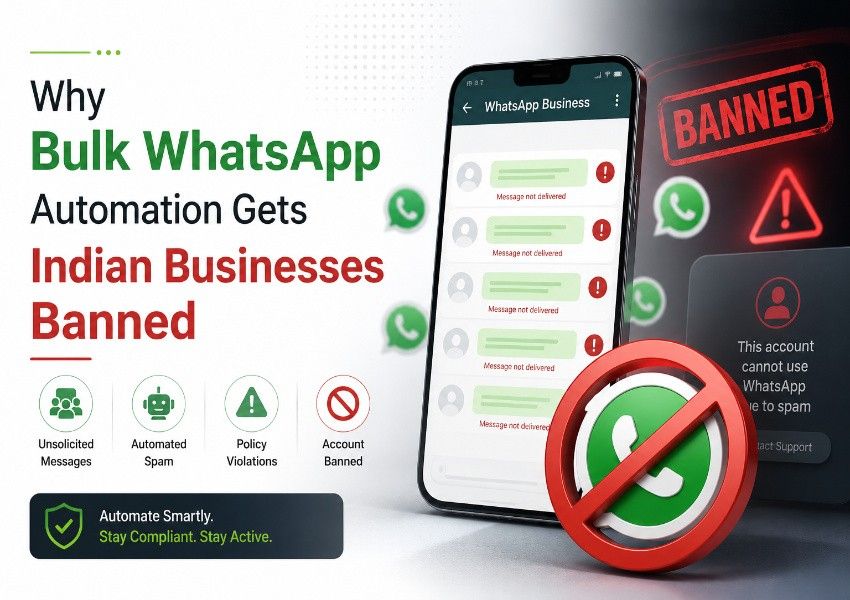
Bulk WhatsApp automation gets Indian businesses banned because most teams treat WhatsApp like an email list instead of a permission-based channel. They import a contact sheet, send a promotional blast through a cheap third-party sender, and the account gets flagged before the campaign even finishes going out. The tool usually gets blamed, but the tool is only ever the delivery mechanism. The real cause is almost always one of a small set of policy violations that Meta’s detection systems are specifically built to catch. Here’s what actually triggers a ban, and what compliant bulk automation looks like instead.
According to On Cloud API, Meta scores every business number on how recipients react to it: messages that get opened and replied to keep a number healthy, while messages that get ignored, blocked, or reported as spam quietly throttle that number’s reach, often before any formal violation shows up. By the time an account gets fully banned, the quality score has usually already been dropping for a while.
This is why two businesses can send the exact same message volume and get completely different outcomes. One built its list from people who opted in and expect to hear from it. The other bought or scraped a number list and is sending to strangers who have never interacted with the brand. Meta’s systems are built to tell the difference.
Grey-market bulk senders, browser extensions that automate WhatsApp Web, and modified WhatsApp clients are the fastest route to a ban, and Meta’s detection catches them quickly because they operate outside the Business API entirely. On Cloud API lists these unofficial tools alongside sudden volume spikes and purchased contact lists as the most common triggers seen in 2026.
The risk isn’t limited to marketing sends either. Acefone points out that Meta’s messaging policy prohibits sending OTPs or bulk messages from a personal WhatsApp number altogether, regardless of intent, and that businesses need a Meta-verified Tech Service Provider to send transactional messages compliantly at scale. A business that routes OTP delivery or order updates through an unofficial sender isn’t just risking a marketing ban. It’s risking every message type running through that number.
AI chatbots add a newer wrinkle. Chatboq reports that Meta now prohibits third-party AI tools where the primary function is general-purpose conversation.
Automation tied to actual business workflows — customer service, orders, notifications, bookings — remains permitted through the official API. The distinction matters in practice: an unofficial ChatGPT integration bolted onto a personal WhatsApp number sits squarely in the banned category, even if the business never intended to spam anyone.
Two India-specific requirements catch businesses that would otherwise be doing everything right. First, sending transactional or promotional messages at scale requires registration on TRAI’s Distributed Ledger Technology platform, a rule that Acefone notes applies across messaging channels, not just SMS — skipping it can block delivery outright rather than just risking a fine. Second, the Digital Personal Data Protection Act requires explicit, revocable consent before storing or processing a contact’s phone number and message history, which means businesses need to track consent status per contact, not just avoid sending unwanted content.
Opt-in itself is the rule most businesses get wrong even without realizing it. RichAutomate is direct about this: a person has to actively agree to receive WhatsApp messages from a specific business, through a clear channel like a website checkbox or a “message us” click, with the business name visible at the point of consent. Messaging a scraped or purchased list has no legal basis, no matter which tool sends it.
| Factor | Unofficial Bulk-Sender Tools | Official WhatsApp Business API |
|---|---|---|
| Sending Limits | No Enforced Limits, Easily Flagged as Spam | Tiered Limits (250 to Unlimited) That Scale with Verification |
| Consent Tracking | Usually None | Opt-In and Opt-Out Tracked Per Contact |
| Template Approval | Not Required, Higher Content Risk | Meta Reviews and Approves Message Templates |
| DLT / DPDP Compliance | Rarely Built In | Required and Typically Supported by Verified Providers |
| Ban Risk | High, Detected Quickly | Low, When Opt-In and Volume Rules Are Followed |
| Recovery After a Flag | Low Success Rate, Often Needs a New Number | Formal Appeal Process Through Meta |
Say a real estate developer wants to notify 5,000 past inquiries about a new project launch. Sent through a cheap bulk-sender app or a modified WhatsApp client, that blast looks identical to spam from Meta’s side: a sudden volume spike from a number with no verified business profile, going out to contacts who never explicitly opted in to this specific campaign. The account gets throttled within hours, and the same number that was handling customer support and order updates goes down with it.
Sent through the official WhatsApp Business API, the same campaign runs as an approved marketing template, goes only to contacts with recorded consent, and respects the account’s current messaging tier. If a contact opts out, that’s tracked and respected automatically. The message volume looks the same to the recipient. To Meta’s systems, it’s a completely different signal.
Doing bulk WhatsApp automation correctly in India comes down to three things holding at once: sending exclusively through the official Business API via a verified provider, keeping opt-in records for every contact rather than assuming consent, and registering on TRAI’s DLT platform before sending at any real volume. None of these steps slow a compliant business down in practice — they’re built into the API workflow rather than added on top of it.
This is the layer Groweon’s AION WhatsApp AI Chatbot runs on for admissions and real estate teams sending high-volume WhatsApp campaigns and automated replies. Because it’s built on Meta’s official API rather than a workaround, consent tracking, template approval, and rate limits are part of how a message gets sent, not a compliance step a marketing team has to remember separately.
Bulk WhatsApp automation doesn’t get Indian businesses banned because the volume itself is the problem. It gets them banned because the volume is going out through a channel Meta’s systems are specifically built to detect as unauthorized, to contacts who never opted in, or without the DLT and consent tracking Indian regulation requires. None of that is optional once a business is sending at scale, and none of it is hard to fix once a business moves onto the official API. The businesses that keep growing on WhatsApp without interruption are the ones that treated compliance as the starting point, not the thing they fix after the first ban.
Book a free demo and see how Groweon’s AION WhatsApp AI Chatbot sends and automates WhatsApp conversations on Meta’s official Business API.
Why does bulk WhatsApp automation get Indian businesses banned?
Most bans come from sending through unofficial tools, messaging contacts who never opted in, or exceeding the volume the standard WhatsApp Business app is built to handle.
Is bulk WhatsApp messaging legal in India?
Yes, but only through the official WhatsApp Business API with prior opt-in consent from every contact, along with TRAI DLT registration for messaging at scale.
What’s the fastest way to get a WhatsApp Business account banned?
Using grey-market bulk-sender apps, browser extensions, or modified WhatsApp clients gets detected and banned the fastest, since these tools operate entirely outside Meta’s official API.
Can a banned WhatsApp Business account be recovered?
Temporary blocks often resolve within 24 hours. Permanent bans require a formal appeal to Meta, and success rates are low, so most businesses end up starting fresh on a new number through the official API.
How does Groweon’s AION avoid the risks that come with bulk WhatsApp sending?
AION runs its WhatsApp AI Chatbot on Meta’s official Business API, so consent tracking, template approval, and messaging tiers are built into every campaign rather than added afterward.
[wpforms id=”535″]
09 Sep, 2026
Summary AI sales agents are now part of every major...

09 Sep, 2026
Summary Agentic AI is turning CRM from a system that...

08 Sep, 2026
Summary The biggest AI CRM trends in 2026 are moving...

08 Sep, 2026
Summary Lead Response Time helps sales teams capture active buying...

07 Sep, 2026
Summary The move from traditional CRM to AI CRM is...