

How Field Sales Teams Can Reduce Manual Reporting With FMCG…
14 Sep, 2026
Summary FMCG CRM Software reduces manual reporting by capturing field...
Updated: 24th July, 2026
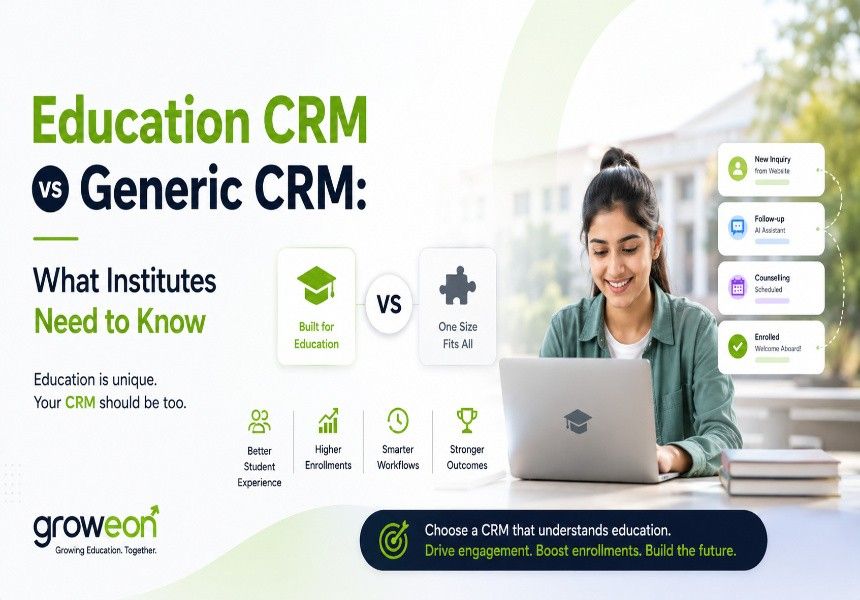
An education CRM for institutes exists because admissions isn’t a sales funnel with a different label on it. A student inquiry can take weeks or months to become an enrollment, it usually involves a parent as a second decision-maker, and it moves through stages — inquiry, counselling, application, document verification, offer, enrollment — that a generic sales CRM was never designed to model. Institutes that try to force this journey into a platform built for closing B2B deals end up patching the gaps with spreadsheets, WhatsApp groups, and manual reminders. Here’s what actually separates a purpose-built admissions platform from a generic CRM, and why the difference shows up in enrollment numbers, not just software features.
A generic CRM organizes everything around leads, deals, and contacts, because it was built to help sales teams close transactions. A student-lifecycle platform organizes everything around the student record itself: enquiries, applicants, offers, enrollments, programmes, and intake batches, all tied to one identity. Full Fabric frames this as more than a cosmetic difference — when the same person exists as a lead in one system, an applicant in another, and a student in a third, every handoff between marketing, admissions, and registry becomes a manual reconciliation problem, and conversion reporting stops being trustworthy.
An education-focused CRM avoids that fragmentation by design. Marketing sees the same record admissions works from, counsellors see the same record marketing nurtured, and finance sees the same record registry enrolled.
Generic CRMs assume a buyer who makes a fast, individual decision. Admissions rarely works that way. Parents want reassurance, documentation clarity, and multiple conversations before a family commits, and a platform built for quick B2B closes has no native concept of that pattern, a gap Sensation CRM points to directly when comparing education-focused platforms against traditional sales CRMs. Traditional systems optimize for closing deals quickly, with little built-in support for the longer, multi-touch relationship an admissions cycle actually requires.
This shows up in reporting, too. A generic CRM can tell an institute how many leads turned into sales, but it can rarely break that down by course, batch, gender, or branch, the kind of segmentation admissions teams need to know where applicants are actually dropping off, as ExtraaEdge notes when contrasting the two categories of software.
Where a generic CRM stops at “lead” and “won” or “lost,” a purpose-built admissions CRM tracks the entire funnel as its native data model: inquiry source, counsellor assigned, application status, document checklist, offer stage, fee payment, and eventual enrollment. LeadSquared describes this as functioning like the central nervous system of enrollment operations, giving institutes end-to-end visibility from first inquiry through graduation that a sales-oriented platform was never built to provide.
That native modeling is also why education-focused platforms tend to include features a generic CRM simply doesn’t have: automated GDPI (group discussion and personal interview) scheduling, document management, and integrated online application forms, all inside the same dashboard counsellors already work from.
| Factor | Generic CRM | Education CRM for Institutes |
|---|---|---|
| Data Model | Leads, Deals, Contacts | Enquiries, Applicants, Offers, Enrollments |
| Reporting Depth | Basic Lead-to-Sale Conversion | Course-wise, Batch-wise, and Source-wise Reporting |
| Decision Cycle Fit | Built for Fast, Individual Buyers | Designed for Long, Multi-touch, Parent-Involved Admission Decisions |
| Admissions-Specific Tools | Requires Heavy Customization | Native GDPI Scheduling, Document Tracking, and Online Application Forms |
| Handoffs Between Teams | Manual Reconciliation Across Multiple Systems | One Student Record Shared Across Marketing, Admissions, and Finance |
| Best Use | General Sales Pipelines | Managing the Complete Student Journey from Inquiry to Enrollment and Alumni |
Say a parent fills out an inquiry form for their child’s admission at 8 PM on a weekday. On a generic CRM, that inquiry lands as a lead with a name and phone number, and a counsellor has to manually check which programme it relates to, whether the family has been contacted before, and what stage of the admissions process to route it to. On a student-lifecycle CRM, the same inquiry arrives already tagged to a programme and intake batch, checked against the student’s existing record if one exists, and routed to the right counsellor with the admissions stage already set. The counsellor opens one record instead of stitching one together across a spreadsheet, a call log, and a WhatsApp thread.
This is the gap Groweon’s AION platform is built to close for admissions and education teams: one student record that carries through inquiry, counselling, application, and enrollment, instead of a generic pipeline that treats every admission like a one-off sale.
A generic CRM isn’t a bad product — it’s simply built for a different job. For institutes that also run B2B sales motions, such as corporate training tie-ups or vendor relationships, a generic CRM can still be the right tool for that side of the business. The mistake is using it as the system of record for admissions, where the sales-pipeline data model has to be stretched and customized to approximate something a purpose-built admissions platform already does natively.
The choice between a generic CRM and an education CRM for institutes isn’t really about which software has more features. It’s about whether the underlying data model matches how admissions actually works. A sales pipeline can be bent into an approximation of a student journey, but it takes constant customization, and the reporting gaps show up exactly when an institute needs them least, during peak admission cycles. A student-lifecycle CRM starts from the student journey instead of the sales funnel, which is why institutes that switch tend to stop rebuilding their CRM every admission season and start using it.
Book a free demo and see how Groweon’s AION platform manages inquiries, counselling, and enrollment inside a single student record.
What makes an education CRM for institutes different from a generic CRM?
It’s built around the student lifecycle — inquiry, counselling, application, offer, enrollment — while a generic CRM is built around a sales pipeline of leads and deals.
Can a generic CRM be customized to work for admissions?
To an extent, yes, but institutes typically end up rebuilding admissions-specific workflows like GDPI scheduling and document tracking that a purpose-built admissions platform already includes natively.
Does an education-focused CRM help with reporting?
Yes. It typically supports course-wise, batch-wise, and source-wise reporting, compared to the basic lead-versus-conversion view most generic CRMs offer.
Is a student-lifecycle CRM only for large universities?
No. Schools, colleges, and coaching institutes of any size use education CRMs to manage inquiries and admissions, not just large universities.
How does Groweon’s AION fit as an education CRM for institutes?
AION runs as a native student-lifecycle platform, keeping inquiry, counselling, and enrollment data in one student record instead of splitting it across separate marketing and sales tools.
[wpforms id=”535″]

14 Sep, 2026
Summary FMCG CRM Software reduces manual reporting by capturing field...
14 Sep, 2026
Summary Generative AI is transforming CRM into an intelligent platform...

14 Sep, 2026
CRM Software Guide 2026: Types, Features, Pricing & How to...
12 Sep, 2026
Summary AI agents are transforming CRM platforms from passive systems...
12 Sep, 2026
Summary The right CRM for IndiaMART leads captures enquiries quickly,...