

10 Must-Have Features in AI CRM Software for Modern Businesses
12 Nov, 2026
Summary AI CRM Software helps businesses manage customer relationships through...
Updated: 12th November, 2026
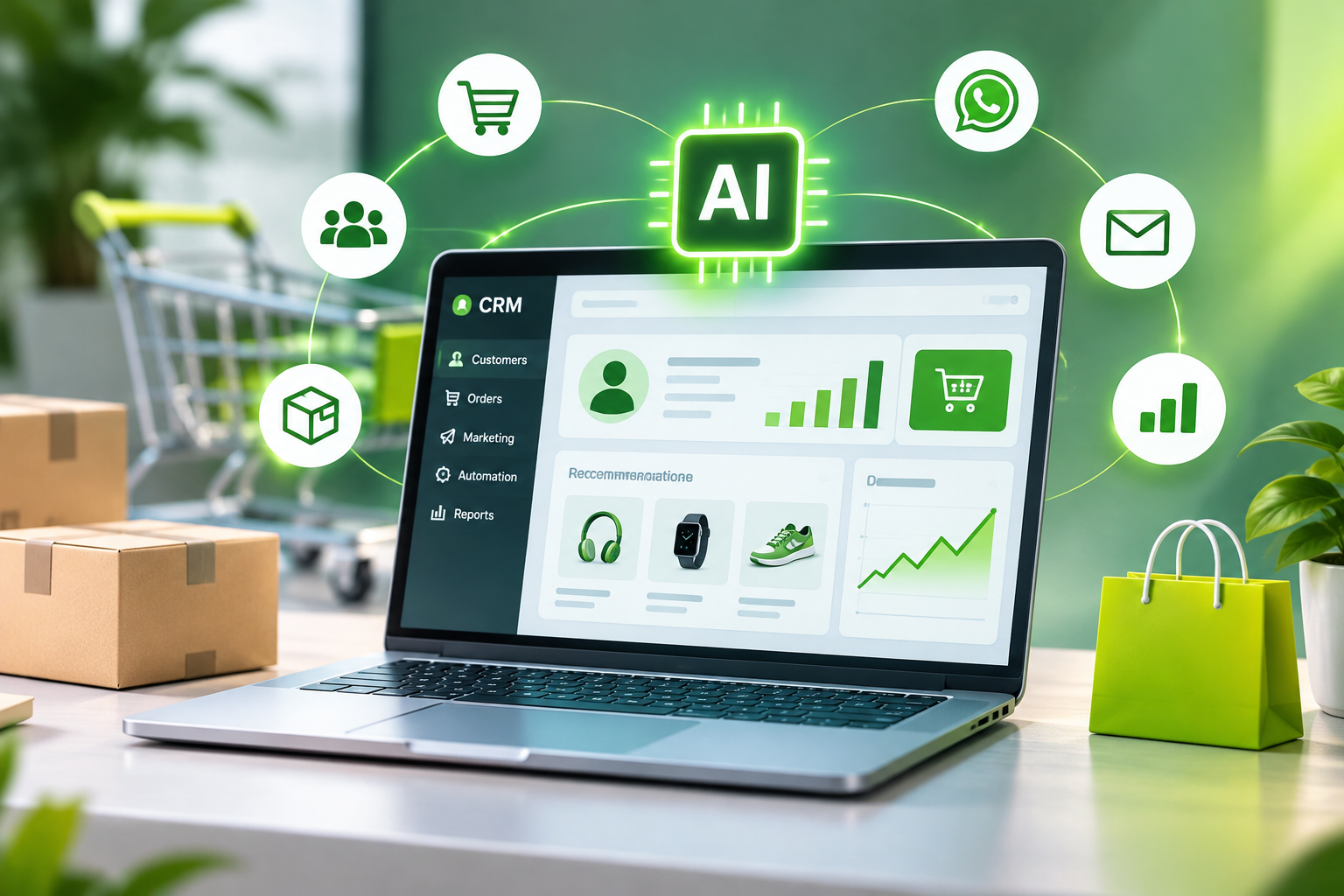
E-commerce businesses interact with customers across websites, marketplaces, mobile apps, WhatsApp and social media.
AI CRM for E-commerce connects customer data, shopping behaviour and purchase history to create more personalised experiences.
It helps businesses improve product recommendations, recover abandoned carts, automate communication and strengthen customer retention.
By connecting customer intelligence with sales and order operations, businesses can build more relevant and consistent shopping journeys.
An online customer visits an e-commerce website, explores a few products, adds an item to the cart and leaves without completing the purchase. Another customer buys regularly but receives the same promotional messages as someone who has never purchased from the store. A third customer contacts support to ask about an order, but the support team cannot immediately access the customer’s purchase history.
These situations highlight a common challenge in e-commerce: businesses collect customer information across multiple touchpoints, but that information is not always used effectively.
A customer may interact with a brand through product pages, advertisements, email campaigns, WhatsApp conversations, checkout pages and post-purchase support. If these interactions remain disconnected, businesses struggle to understand the complete customer journey.
This is where AI CRM for E-commerce becomes valuable. It brings customer information, shopping behaviour, purchase history and communication records into a connected environment. AI can then help businesses interpret available data and support more relevant recommendations, customer engagement and sales workflows.
The goal is not simply to send more marketing messages. It is to understand customer needs better, make interactions more relevant and create a consistent experience from product discovery to repeat purchase.
E-commerce competition is no longer limited to product pricing or website design. Businesses must also compete through product discovery, convenience, communication, fulfilment and customer experience.
Customers expect brands to understand their preferences and provide relevant information without making every interaction feel repetitive.
A traditional CRM can store customer details and purchase-related information. An AI-powered CRM can go further by helping businesses identify behavioural patterns, organise customer segments and support personalised engagement.
According to Salesforce ecommerce personalization, personalisation can include product recommendations, tailored emails, dynamic content, personalised search results and behaviour-based offers.
An e-commerce business may collect customer information from:
When these records are maintained in separate systems, teams may have an incomplete understanding of customer behaviour.
An integrated CRM can help bring relevant customer information together, subject to the available integrations and data permissions.
A purchase record tells a business what a customer bought. A broader customer profile can help explain the relationship behind that purchase.
For example, a customer who repeatedly buys skincare products may respond differently to product recommendations than someone who purchased a single gift item.
A unified customer profile can help businesses understand order history, average order value and lifetime purchase information. Salesforce explains this through its unified ecommerce profile.
This information can support better customer segmentation and more relevant communication.
Personalisation means making the shopping experience more relevant to an individual customer based on available preferences, behaviour and context.
It can influence multiple stages of the customer journey, including product discovery, promotional communication, website content and post-purchase engagement.
An AI-powered recommendation system can analyse relevant customer interactions and product information to suggest items that may interest a shopper.
For example:
The Adobe product recommendation guide explains how AI-powered recommendations can use visitor behaviour and product catalogue information to create more relevant product suggestions.
However, recommendations should be evaluated against actual customer needs. A recommendation is useful only when it improves product discovery rather than distracting the shopper.
Different customers may respond to different website content.
A first-time visitor may need information about product quality, delivery and returns. A returning customer may be more interested in new arrivals or complementary products.
An AI-enabled commerce platform can support dynamic content and offers based on customer segments and relevant behavioural signals.
The Adobe personalization features documentation describes how product discovery, dynamic content and promotions can be tailored to shopper preferences.
A customer who has recently purchased a product should not necessarily receive the same message as someone who has abandoned a cart.
A CRM can help businesses organise communication based on customer status, purchase history and interaction records.
This supports more relevant communication across email, WhatsApp and other connected channels.
Not every online customer has the same purchase intent, budget, preferences or relationship with a brand.
Customer segmentation helps businesses group customers according to shared characteristics and behaviours.
AI can support this process by identifying patterns in available customer data and helping businesses understand different customer groups.
Common e-commerce segments include:
|
The Shopify customer segmentation guide discusses how purchase history, browsing behaviour, location, email engagement and lifecycle stage can be used to create customer segments.
Customer behaviour changes over time. A first-time buyer may become a repeat customer, while an active customer may become inactive.
Dynamic segmentation helps businesses update customer groups as relevant information changes.
The Shopify segmentation documentation explains how rule-based customer segments can automatically include or remove customers according to defined criteria.
For businesses building custom integrations, the Shopify segment developer guide provides technical information about customer segmentation and its use in marketing and analytics.
Predictive analytics can help businesses estimate future customer behaviour using historical and available behavioural data.
Possible applications include:
These predictions should be treated as estimates, not certain outcomes. Their reliability depends on data quality, model design and continuous evaluation.
Shopify’s customer analytics metrics include information such as order frequency, total customer spending, predicted spend tier and customer lifecycle indicators.
Cart abandonment is one of the most important operational challenges for online retailers.
A customer may add products to a shopping cart but leave before completing the purchase. This can happen because of unexpected shipping costs, complicated checkout steps, payment concerns, comparison shopping or simply a change in buying intention.
The Baymard Institute’s checkout usability research reports a global average cart abandonment rate of approximately 70%. The exact rate varies by business, device, market and measurement methodology.
An e-commerce system can record events such as:
These events help businesses understand where customers leave the purchase journey.
Google Analytics explains these activities through its ecommerce measurement guide, which covers product views, cart additions, checkout events, purchases and refunds.
When a customer leaves a cart without purchasing, the CRM can help trigger an appropriate reminder through a supported communication channel.
For example:
Google Analytics also explains how to create a cart abandoner audience for users who added products to their carts without completing a purchase.
Not every abandoned cart needs a discount.
Some customers may be comparing products, checking delivery availability or waiting for a suitable time to purchase.
Businesses should analyse checkout behaviour and customer feedback before deciding which recovery action to use.
The Baymard checkout findings provide further insight into usability issues that can influence purchase completion.
A CRM can support communication and follow-up, but the checkout experience itself must also be simple, transparent and reliable.
Acquiring a new customer is only one part of e-commerce growth. Businesses also need to build relationships that encourage customers to return.
Customer retention involves understanding previous purchases, customer preferences, product usage and engagement patterns.
A CRM can help identify customers who regularly purchase specific products or categories.
For example, a customer who purchases household essentials every month may be interested in a relevant replenishment reminder.
The timing should be based on genuine purchase patterns rather than sending reminders at arbitrary intervals.
Different lifecycle stages require different communication strategies.
|
Customer Lifetime Value (CLV) helps businesses estimate the value of a customer relationship over time.
It can support decisions about retention investments, loyalty programmes and customer acquisition costs.
A CRM with reporting and analytics can help businesses understand customer purchase frequency, average order value and repeat purchase patterns.
The NRF agentic commerce study discusses how AI-assisted shopping is changing the customer journey and why retailers need to maintain consistent experiences across channels.
Customers do not always interact with a brand through a single channel.
They may discover a product on Instagram, visit the website, ask a question on WhatsApp, complete an order through an app and later contact customer support.
An omnichannel customer experience aims to maintain consistency across these interactions.
A connected CRM can help businesses maintain customer records and interaction histories across supported channels.
For example, if a customer asks about a product on WhatsApp and later contacts the support team, authorised employees should be able to access relevant conversation history.
Businesses can explore Groweon’s WhatsApp CRM capabilities to understand how messaging and customer records can work together.
WhatsApp is an important communication channel for many Indian businesses.
It can support order-related updates, customer enquiries, product information and approved promotional communication.
A structured implementation should connect conversations with customer records rather than leave important business interactions inside individual employee accounts.
The WhatsApp CRM setup guide explains how businesses can organise conversations, leads and follow-ups through a CRM-connected approach.
A connected customer profile helps reduce repetitive questions and improve service continuity.
For example, when a customer contacts support about an existing order, the support team should be able to access the relevant order information without asking the customer to repeat every detail.
The Adobe customer experience blueprint describes how real-time customer data can support personalised experiences across multiple touchpoints.
The customer journey does not end when payment is completed.
After placing an order, customers expect accurate updates, reliable delivery and accessible support.
A connected CRM and order management environment can help businesses maintain continuity between sales, fulfilment and customer communication.
Customer service teams need access to relevant order information when responding to delivery-related enquiries.
A connected system can help employees review order status, processing updates and available shipment information.
Businesses can configure suitable notifications for important order stages, such as:
The actual notifications depend on the order management system, logistics integrations and communication setup.
Product availability influences the shopping experience.
When inventory information is disconnected from the order process, customers may place orders for items that are unavailable or experience fulfilment delays.
A connected system can help sales, inventory and fulfilment teams work with more consistent information.
Businesses can explore Groweon order management for connected order processing and fulfilment workflows.
For stock operations, Groweon inventory management provides information about warehouse, product and stock management capabilities.
Marketing automation helps businesses deliver relevant communication according to customer activity and lifecycle stage.
AI can support this process by helping identify customer segments, analyse engagement and assist with message creation.
Instead of sending the same promotional email to every customer, businesses can organise campaigns around product interests, previous purchases and customer lifecycle stages.
For example, customers who have purchased a particular product category may receive relevant updates about new arrivals in that category.
Businesses can configure campaigns around events such as:
These triggers should be based on reliable tracking and appropriate customer permissions.
AI tools can help marketing teams draft product descriptions, promotional messages, email content and customer responses.
Human review remains important to ensure that communication is accurate, appropriate and consistent with the brand.
Selecting the right platform requires understanding how the business manages customer information, orders, marketing and customer support.
A suitable system should support the organisation’s current processes while allowing room for future growth.
Check whether the platform can maintain customer profiles, purchase information, communication records and relevant interaction histories.
Evaluate whether customer groups can be created using purchase history, customer activity and other relevant data.
Review product recommendation, campaign personalisation and customer engagement features.
Check whether the CRM connects with the website, WhatsApp, email, marketplaces and other relevant communication channels.
Confirm whether customer and order information can be connected with inventory and fulfilment systems.
Understand what AI actually does. Evaluate whether it supports customer analysis, recommendations, communication, workflow automation or other specific tasks.
The platform should help businesses understand customer behaviour, campaign performance, repeat purchases and order-related activity.
Review access permissions, customer consent, data retention, security controls and the vendor’s privacy practices.
Ensure the CRM can accommodate growing customer databases, additional channels and changing operational requirements.
Ask the vendor to demonstrate a real customer journey, from initial enquiry and purchase to order updates and post-purchase support.
The best CRM is not necessarily the one with the most AI features. It is the one that connects customer information and business workflows effectively.
E-commerce businesses need more than a customer database. They need connected processes for managing enquiries, communication, orders, stock and customer relationships.
Groweon CRM brings together CRM and business management capabilities designed to help growing businesses organise sales and operational workflows.
Its relevant capabilities include:
Businesses can organise enquiries, maintain customer information and track follow-up activities through structured CRM workflows.
WhatsApp integration can help teams manage customer communication and maintain relevant interaction records.
Order management capabilities can help connect order capture, processing, approvals, logistics and customer updates.
Inventory capabilities support product, warehouse and stock-related operations, helping businesses coordinate stock information with sales and order processes.
Groweon’s AION Autopilot supports AI-enabled lead engagement, qualification and follow-up workflows.
Its AION AI+ assistant provides AI-assisted capabilities such as lead analysis and communication drafting.
These capabilities are relevant to sales and customer engagement workflows. Businesses should separately evaluate their requirements for e-commerce product recommendations, browsing-based personalisation, customer segmentation and marketing campaign orchestration. These should not be assumed to be native Groweon features unless confirmed in the current product documentation.
For a broader view of e-commerce CRM workflows, read Groweon ecommerce CRM.
Implementing an AI-powered CRM is only useful when businesses can measure whether it improves customer experience and commercial performance.
The following metrics can help evaluate the impact.
Measure Personalisation PerformanceCompare personalised campaigns and recommendations against suitable baseline experiences. For example, businesses can compare conversion rates for customers receiving relevant product recommendations with those receiving generic product suggestions. Evaluate Customer RetentionReview repeat purchase frequency, customer inactivity and retention across different segments. Track the Complete Purchase JourneyGoogle Analytics provides ecommerce event measurement for product views, cart additions, checkout activity and purchases. Businesses can use the Google ecommerce validation guidance to check whether their ecommerce tracking is implemented correctly. The Google purchase event documentation explains how completed purchases can be recorded and reported. The Google Analytics event reference provides additional information about standard ecommerce events. These measurements help businesses identify where customers engage, where they leave and which experiences contribute to completed purchases. Privacy, Customer Trust and Responsible AI PersonalisationPersonalisation depends on customer information, which makes data privacy and transparency important parts of any AI CRM strategy. Customers may appreciate relevant recommendations, but they may become uncomfortable when brands use information in unexpected or intrusive ways. A 2026 review published in Discover Artificial Intelligence examines the relationship between AI-driven personalisation, customer segmentation, privacy and consumer trust. The AI personalisation research highlights the need to balance commercial benefits with responsible data practices. Another study in the Journal of Retailing and Consumer Services discusses the relationship between personalisation and privacy in AI-driven e-commerce. Research published in Information also examines how AI ecommerce experiences relate to customer trust, engagement and satisfaction. Use Customer Data TransparentlyBusinesses should explain how customer information is collected and used, and provide appropriate controls where required. Avoid Excessive PersonalisationNot every customer interaction needs to use every available data point. Personalisation should improve the shopping experience rather than make customers feel constantly monitored. Maintain Human OversightAI-generated recommendations and automated messages should be monitored for relevance, fairness and accuracy. Protect Customer InformationBusinesses should apply appropriate access controls, security practices and data retention policies. A strong e-commerce CRM strategy balances personalisation with customer trust. Frequently Asked Questions1. How does AI CRM for E-commerce improve customer experience? It helps businesses organise customer information, understand shopping behaviour and support more relevant product recommendations, communication and customer service. 2. Can AI CRM for E-commerce personalise product recommendations? AI-enabled commerce systems can analyse customer behaviour and product information to suggest relevant products. The exact capability depends on the CRM, recommendation engine and integrations. 3. How does an e-commerce CRM help recover abandoned carts? It can connect customer and cart information with automated communication workflows, allowing businesses to send appropriate reminders to eligible customers. 4. Can AI CRM improve customer retention? Yes. It can help identify repeat buyers, inactive customers and relevant customer segments, supporting more targeted retention and re-engagement activities. 5. What is the difference between an e-commerce CRM and a traditional CRM? An e-commerce CRM focuses on customer relationships connected with online shopping activities, including purchase history, order interactions, customer support and marketing engagement. 6. Does AI CRM for E-commerce support WhatsApp integration? Some CRM platforms support WhatsApp integrations for customer enquiries, order communication and follow-ups. Businesses should verify the available integration and messaging capabilities. 7. Can AI CRM connect with inventory and order management systems? Yes, where supported integrations or APIs are available. This can help connect customer information with product availability, order status and fulfilment workflows. 8. How does customer segmentation help e-commerce businesses? It groups customers according to shared characteristics or behaviours, helping businesses organise more relevant campaigns, recommendations and retention activities. 9. Is AI CRM suitable for small e-commerce businesses? Yes. Small online businesses can use CRM capabilities to organise customer records, automate follow-ups and manage communication. The selected solution should match their operational needs and budget. 10. What should businesses check before selecting an AI CRM for E-commerce? They should evaluate customer data management, segmentation, personalisation, integrations, order workflows, reporting, security, scalability and the actual capabilities of the AI features. Conclusion: Build More Personalised and Connected E-commerce ExperiencesE-commerce growth depends on more than attracting visitors and generating orders. Businesses must understand customer behaviour, deliver relevant experiences, manage orders efficiently and build relationships that encourage repeat purchases. AI CRM for E-commerce brings customer intelligence and business operations closer together. It can support customer segmentation, personalised engagement, cart recovery, purchase analysis and more consistent communication across channels. However, effective personalisation requires accurate data, appropriate integrations and respect for customer preferences. For growing online businesses, the right approach is to combine AI-powered customer insights with connected CRM, order and inventory workflows. By doing so, businesses can move beyond isolated transactions and build more relevant, reliable and customer-focused shopping experiences. |

12 Nov, 2026
Summary AI CRM Software helps businesses manage customer relationships through...

12 Nov, 2026
Summary Pharmaceutical companies manage complex relationships with doctors, medical representatives,...
12 Nov, 2026
Summary Indian businesses receive sales enquiries through websites, advertisements, WhatsApp,...

12 Nov, 2026
Summary E-commerce businesses interact with customers across websites, marketplaces, mobile...

11 Nov, 2026
Summary Real estate businesses receive enquiries from property portals, websites,...