

Top 10 Field Service Management Software in India for 2026
23 Oct, 2026
Summary Compare 10 field service and field workforce software options...
Updated: 7th September, 2026
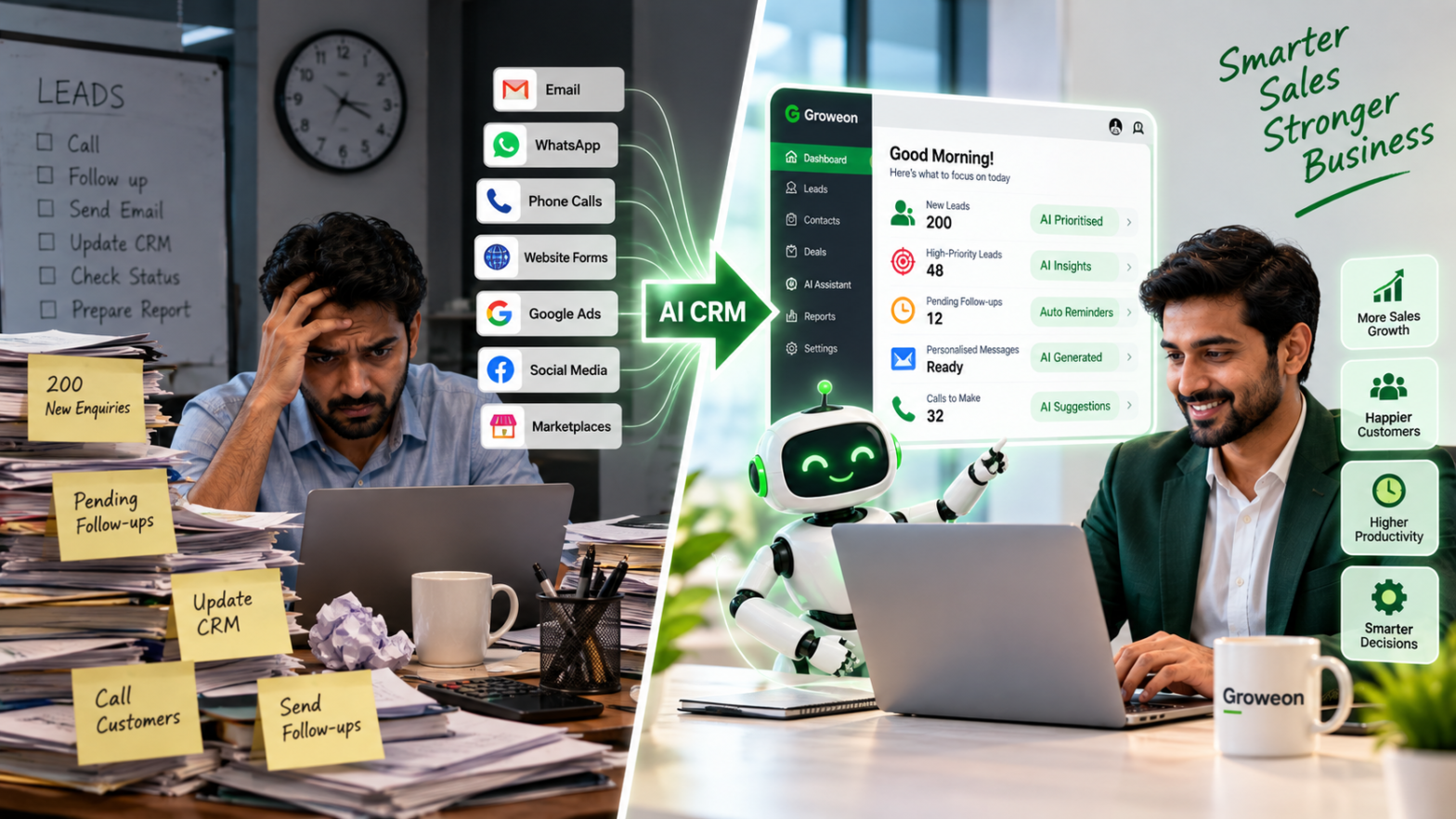
The move from traditional CRM to AI CRM is not simply a technology upgrade. It reflects a fundamental change in how Indian SMEs approach sales.
Traditional CRM helped businesses organise customer information. AI CRM can help businesses understand that information and turn it into action.
The emergence of AI Powered CRM, AI Driven CRM, and Agentic CRM shows where sales technology is heading next: from recording activities to actively assisting with them.
For Indian SMEs, the right AI CRM in India should therefore be practical, scalable, easy to use, connected to existing workflows, and capable of delivering measurable improvements in sales productivity.
Imagine a sales manager starting the day with 200 new enquiries, dozens of pending follow-ups, salespeople asking for customer details, and a spreadsheet that nobody has updated since yesterday.
The problem isn’t a lack of data.
The problem is knowing what to do with that data next.
This is one of the reasons Indian SMEs are moving from traditional CRM systems to AI CRM solutions. A traditional CRM helped businesses move away from scattered spreadsheets and customer records. But today’s sales teams need more than a place to store information. They need technology that can help them understand customers, prioritise opportunities, automate repetitive work, and act faster.
The shift is happening as businesses generate more digital leads, customers expect quicker responses, and sales teams are under pressure to achieve more without increasing administrative work.
For an SME, this can make the difference between having a CRM that simply records sales activity and having an intelligent system that actively supports the sales process.
An AI CRM combines the core functions of customer relationship management with artificial intelligence.
A traditional CRM generally helps businesses store and organise information such as:
An AI CRM Software goes a step further.
It can analyse customer and sales information and assist with tasks such as lead qualification, prioritisation, follow-ups, communication, sales insights, call analysis, content creation, and CRM updates.
The important difference is simple:
Traditional CRM stores information. AI CRM helps teams use that information.
For businesses exploring this shift, understand modern CRM capabilities to see how CRM, automation, and intelligent workflows can work together.
For years, CRM adoption was mainly about getting customer information into one system.
That was a major improvement.
But once businesses started generating hundreds or thousands of leads, another problem appeared: someone still had to manually manage all that information.
Salespeople still had to decide which lead to call first. Managers still had to check whether follow-ups were completed. Teams still had to write repetitive messages and update records.
That’s where the next generation of CRM comes in.
A customer enquiry can now arrive from a website, Google search, social media advertisement, WhatsApp, marketplace, phone call, or landing page.
For a small sales team, handling this manually can become chaotic very quickly.
A lead comes in at 10 AM.
Someone notices it at 11 AM.
The salesperson calls at 2 PM.
The customer has already spoken to another company.
This is exactly where an AI CRM in India can add value. AI can help organise incoming enquiries, identify important opportunities, support lead qualification, and help sales teams prioritise their next actions.
Research on Indian SMB sales teams has also highlighted the importance of response speed in converting leads, reinforcing why businesses are looking for systems that can reduce delays in the sales process. Read the latest SMB CRM research.
Customers have become less patient.
When someone fills out a form or sends a WhatsApp enquiry, they generally expect the business to respond quickly. They may also be contacting several businesses at the same time.
This changes the role of CRM.
It is no longer enough to know that a lead exists. Sales teams need to know:
An AI CRM Platform can help organise these decisions and automate parts of the response and follow-up process.
This can be particularly useful for SMEs that have small sales teams but receive a high volume of enquiries.
Ask most salespeople what they would rather do: spend 30 minutes updating records or spend 30 minutes speaking with potential customers.
The answer is obvious.
Yet sales teams routinely spend time on administrative activities such as entering customer details, writing repetitive follow-up messages, checking previous interactions, creating reminders, and preparing updates for managers.
An AI Powered CRM can take some of this repetitive work away from salespeople.
AI can assist with:
The goal isn’t to replace salespeople.
The goal is to give them more time to do the work where human judgement actually matters.
Customers don’t want to feel like just another entry in a database.
If someone has already discussed pricing with a salesperson, sending them a generic introductory message makes little sense.
An AI Driven CRM can use customer information and previous interactions to help sales teams create more relevant communication.
For example, instead of reminding a salesperson simply that “follow-up required,” an intelligent system could help surface the customer’s previous interaction, identify the current stage of the opportunity, and suggest an appropriate next action.
This makes communication more contextual rather than purely repetitive.
The growing importance of personalised engagement is also reflected in India’s broader digital marketing landscape, where businesses are increasingly using AI to understand customers and improve engagement. Explore India’s AI marketing trends.
This is perhaps the biggest difference between traditional CRM and AI CRM.
A traditional CRM can tell a manager:
“This salesperson has 80 open leads.”
But an intelligent CRM can potentially help answer:
“Which of these 80 leads should receive attention first?”
That distinction matters.
AI can analyse available sales information and help identify:
Instead of forcing salespeople to search through hundreds of records, the system can help bring important information to their attention.
This changes CRM from a record-keeping tool into a decision-support system.
For many SMEs, sales forecasting is still based on spreadsheets and salesperson estimates.
A salesperson may say:
“We should close this deal this month.”
But how confident should the manager be?
An AI CRM Software can use available sales data, pipeline activity, historical patterns, and engagement information to provide additional context around opportunities.
AI-assisted forecasting can help managers identify:
It doesn’t eliminate uncertainty.
Instead, it gives managers more information to make better decisions.
Automation isn’t new.
Businesses have been using rules such as:
New lead → assign salesperson → send notification.
But Agentic CRM takes the idea further.
AI agents can potentially understand context, determine an appropriate action, and execute multiple steps within defined rules and permissions.
For example, instead of simply creating a reminder, an agent could potentially identify an overdue opportunity, review its history, prepare a follow-up, and trigger the next approved action.
This is why Agentic Sales CRM is emerging as an important development in sales technology.
The broader adoption of AI agents is accelerating in India as businesses move from AI experimentation toward practical business applications. Salesforce’s 2026 India research reported that 91% of surveyed sales professionals considered AI agents mission-critical to business success. See India’s AI agent findings.
An SME can often manage sales manually when the business is small.
Twenty leads a week? Easy.
One salesperson? Manageable.
A few customers? No problem.
But then growth happens.
Twenty leads become 200.
One salesperson becomes ten.
A few customers become thousands.
Suddenly, the same manual processes that worked earlier start creating bottlenecks.
This is where CRM software with AI capabilities can become valuable.
Instead of increasing administrative work at the same pace as sales volume, businesses can automate parts of the workflow and help sales teams focus on higher-value activities.
Salespeople can focus attention on opportunities that appear more relevant instead of treating every lead equally.
Automated reminders and intelligent workflows reduce the chances of opportunities being forgotten.
Routine data entry, communication, summaries, and task management can be partially automated.
Managers can get a clearer picture of what is happening across the pipeline and sales team.
AI-assisted communication can help teams maintain timely and contextual interactions.
Choosing an Artificial Intelligent CRM should not be about selecting the platform with the longest list of AI features.
The better question is:
Can this system solve our actual sales problems?
Businesses should evaluate the following.
Can the platform capture, organise, qualify, and prioritise leads effectively?
Can repetitive follow-ups, tasks, notifications, and communication be automated?
Can the system identify patterns, risks, opportunities, and useful next actions?
Does it work with the communication channels your customers already use?
Can customer information remain accurate, structured, and accessible?
Can businesses define what AI can and cannot do?
This last point is particularly important. AI should operate within clear business rules, permissions, and approval processes rather than acting without appropriate controls.
Groweon combines CRM, sales automation, AI capabilities, communication, and workflow management to help businesses move beyond a traditional customer database.
The platform can support areas such as:
This means sales teams can move from simply entering information into a CRM toward using that information to drive their next action.
Businesses can explore Groweon’s AI CRM solution to understand how AI-powered sales workflows can support lead management, communication, follow-ups, and sales productivity.
Groweon also provides broader sales capabilities through its Groweon Sales CRM platform, bringing lead management, sales workflows, automation, communication, and reporting together.
The difference isn’t that traditional CRM has become useless.
Rather, AI CRM builds intelligence on top of the CRM foundation.
What is an AI CRM?
An AI CRM combines traditional customer relationship management with artificial intelligence. It can help businesses analyse customer data, prioritise leads, automate follow-ups, assist with communication, identify sales patterns, and support sales teams with next actions.
Why are Indian SMEs switching to AI CRM?
Indian SMEs are dealing with increasing digital lead volumes, faster customer expectations, growing sales workloads, and the need for personalised engagement. AI can help businesses manage these challenges while reducing repetitive administrative work.
How is AI CRM different from traditional CRM?
Traditional CRM primarily stores and organises customer and sales information. AI CRM can analyse that information and assist with prioritisation, recommendations, communication, forecasting, automation, and defined sales actions.
What is Agentic CRM?
Agentic CRM uses AI agents to analyse information and perform defined tasks within specific business rules and permissions. It goes beyond basic workflow automation by enabling AI to handle multiple connected steps in a sales process.
Is AI CRM suitable for small businesses?
Yes. An AI CRM can be particularly useful for SMEs because it can automate repetitive sales activities, help prioritise leads, improve follow-ups, and give small teams better sales visibility without requiring the same increase in administrative effort.

23 Oct, 2026
Summary Compare 10 field service and field workforce software options...

23 Oct, 2026
Summary Agentic AI enables systems to plan and execute tasks...

23 Oct, 2026
Summary Traditional CRM helps businesses organise customer data, manage leads,...

22 Oct, 2026
Summary (TL;DR) AI calling agents help businesses engage prospects, qualify...

22 Oct, 2026
Summary (TL;DR) A delayed quotation can cost a business a...