

Best Lead Management Software in India: What to Check Before…
01 Oct, 2026
Summary (TL;DR): Lead management software captures, scores, routes, and nurtures...
Updated: 1st October, 2026
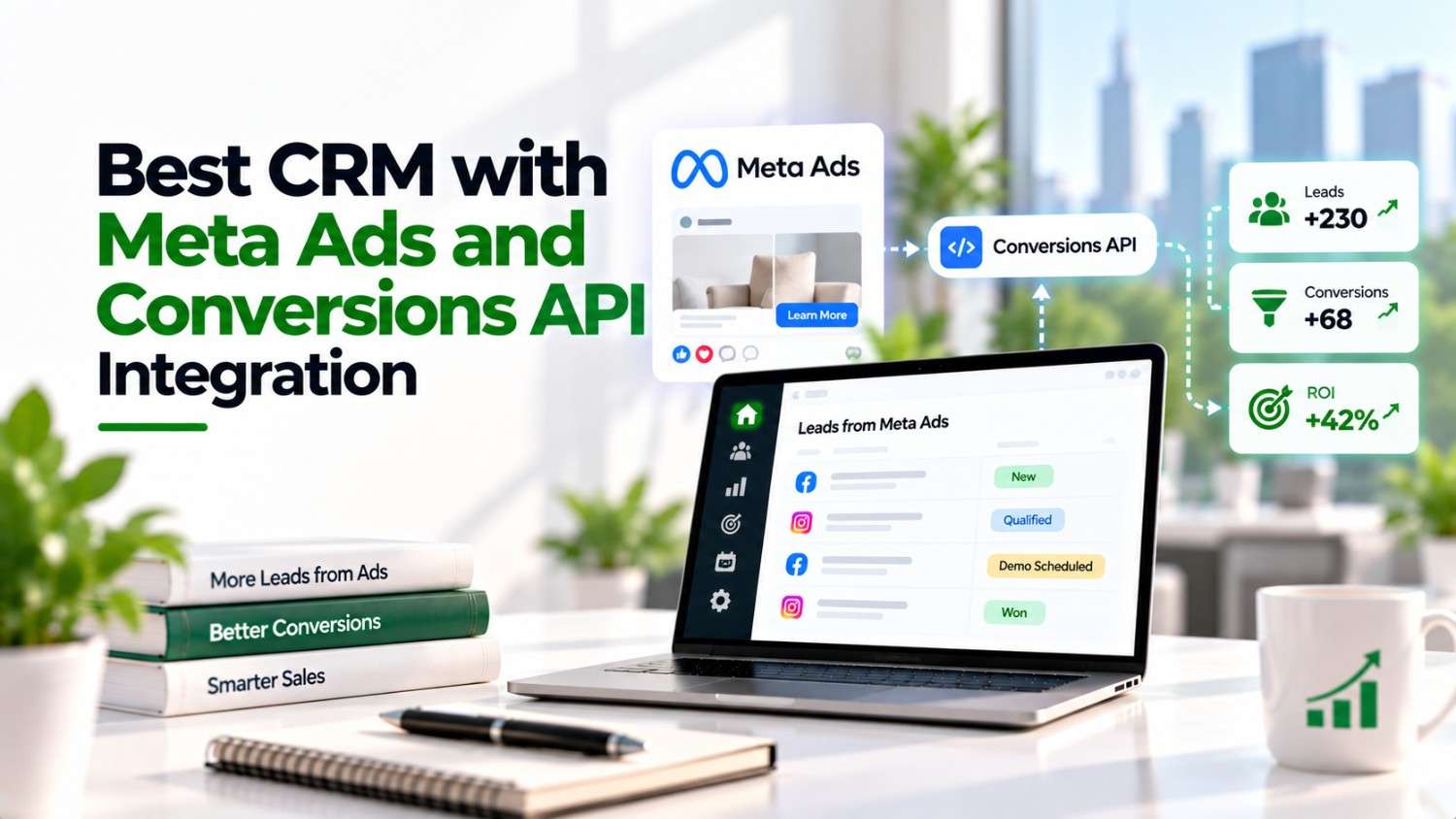
Summary (TL;DR): A CRM with native Meta Conversions API integration sends your actual sales outcomes back to Meta’s ad algorithm. Not just form fills. That single change typically lifts ROAS by 15 to 20%. Meta starts optimizing toward real buyers instead of raw leads. Most CRMs need a third-party connector such as Stape or LeadsBridge to achieve this. Groweon connects to Meta CAPI natively. It sends a Won or Sale deal back as a Purchase event without a middleman tool.
This guide explains what CAPI actually does, why lead-stage tracking alone under-delivers, and how to evaluate a CRM’s Meta integration. Every figure was reviewed against public information on 21 September 2026.
Note: We publish this guide, so we state our bias upfront. Groweon is one of the CRMs discussed. Every figure links to its source, so you can verify each claim before you decide.
In practice, the Meta Pixel tracks conversions from inside a user’s browser. However, iOS privacy restrictions increasingly block that browser-based signal. So do ad blockers on 42% of desktop browsers, and consent banners. So, the Conversions API, or CAPI, closes that gap. Instead, it sends the same conversion data directly from your server, or your CRM, to Meta, bypassing the browser entirely.
For a CRM specifically, however, CAPI unlocks something the Pixel alone cannot do. Instead, it lets you send an event when a deal actually closes, not just when a form gets filled. That distinction changes what Meta’s algorithm learns to optimize for.
In fact, most businesses running Meta ads only send Meta a “Lead” event, fired the moment someone submits a form. So, Meta then optimizes ad delivery to find more people who fill forms. However, a form fill is still not a sale. Consequently, without a deal-outcome event, Meta spends your budget chasing form fills, some of which never become real customers.
ROAS improves when Meta sees real outcomes
Implementations that pass real deal outcomes back to Meta typically see 15 to 20% ROAS improvement. This holds once Event Match Quality is properly optimized. In effect, Meta’s algorithm starts bidding on people who resemble your actual closed customers, not just your form-fillers.
Match quality decides how well the signal actually works
In practice, Meta scores every event on an Event Match Quality metric out of 10. A Purchase event should target 8.8 to 9.3 for strong optimization. Sending a hashed email address with every event can raise that score by up to 4 points on its own.
Most CRMs need a third-party connector to make this work
For platforms such as Salesforce or Pipedrive, sending CRM events to Meta typically requires a third-party connector like Stape or LeadsBridge. Otherwise, it needs a custom webhook built by a developer. That adds a paid tool, an extra point of failure, and ongoing maintenance. A straightforward data flow should not need any of that.
Not every CRM that claims “Meta integration” sends the same data. These five checks reveal the real depth.
Groweon connects to Meta Conversions API natively, without requiring a third-party connector tool. On the inbound side, a Meta Lead Form submission flows straight into Groweon as a new lead. On the outbound side, a deal moving to Won or Sale triggers something automatic. The CRM sends a Purchase event back to Meta, so the ad algorithm learns from real revenue outcomes, not just form fills. AION Autopilot then qualifies that same Meta-sourced lead through its AI calling agent. The entire loop, from ad click to qualified call to closed deal to CAPI event, runs inside one platform. Sales Automation costs ₹2,999 a month for three users.
Consider a real estate developer running a Meta lead ad for a new project. Here is how a single lead moves through the full loop.
Without step 4, Meta would keep optimizing toward the original, broader form-fill audience indefinitely. It never learns which leads actually converted.
This sounds like it requires a developer
Instead, Groweon’s native integration removes the custom webhook work a developer would otherwise need to build and maintain. Still, confirm your specific setup requirements during a demo.
Sending customer data to Meta raises privacy concerns
Meta requires personal identifiers such as email and phone to be SHA-256 hashed before transmission. Meta itself never receives raw, readable contact details.
We already send Lead events, so this may not matter much
So, a Lead event alone tells Meta who filled a form. However, it does not say who actually bought. Adding a Purchase or Won-deal event is the specific change behind the 15 to 20% ROAS improvements documented above.
Setup may take too long
So, Groweon’s standard deployment takes 60 to 120 minutes, with free support, training, and guides.
Results may take a while to show
Meaningful performance improvements, such as lower CPA and higher ROAS, typically appear within 2 to 4 weeks. That is how long Meta’s algorithm needs to adapt to the improved signal.
A CRM with genuine Meta Conversions API integration changes what Meta’s algorithm actually optimizes for. The shift moves from form fills to real revenue. Most platforms, however, need a third-party connector to close that loop. Groweon sends Won and Sale deals back to Meta natively. Ad spend gets directed toward people who resemble your actual customers, not just your leads.
To understand the AI layer that qualifies those leads before they close, read our explainer on agentic CRM.
Share your current Meta ad setup with the Groweon team. See how native CAPI integration would connect your closed deals back to your campaigns. Book your Groweon walkthrough today.
It sends conversion events, such as a closed deal, directly from your CRM’s server to Meta, bypassing browser-based tracking limits. This lets Meta’s ad algorithm optimize toward real revenue outcomes, not just form submissions.
Yes. Groweon connects to Meta CAPI natively. It captures Meta Lead Form submissions inbound. It also sends Won or Sale deals back to Meta as Purchase events outbound, without a third-party connector tool.
Businesses that implement CAPI properly, with strong Event Match Quality, typically see 15 to 20% ROAS improvement. Meta’s algorithm learns from real conversion outcomes instead of raw lead volume.
No. Many CRMs, including Salesforce and Pipedrive, require a third-party connector such as Stape or LeadsBridge. Others need a custom developer-built webhook to send data to Meta CAPI.
Yes, when implemented correctly. Personal identifiers such as email, phone, and name must be SHA-256 hashed before Meta receives them. Meta never sees raw, readable contact details.
Event Match Quality scores update roughly every 48 hours. However, meaningful performance improvements, such as lower cost per lead and higher ROAS, typically take 2 to 4 weeks to appear as Meta’s algorithm adapts.

01 Oct, 2026
Summary (TL;DR): Lead management software captures, scores, routes, and nurtures...

01 Oct, 2026
Summary (TL;DR): CRM pricing in India typically runs ₹250 to...

30 Sep, 2026
Summary (TL;DR): A CRM with native Meta Conversions API integration...

29 Sep, 2026
Summary (TL;DR): The best choice depends on whether you want...

28 Sep, 2026
Summary (TL;DR): So, a B2B CRM has moved from a...