

Top 10 Field Service Management Software in India for 2026
23 Oct, 2026
Summary Compare 10 field service and field workforce software options...
Updated: 23rd October, 2026
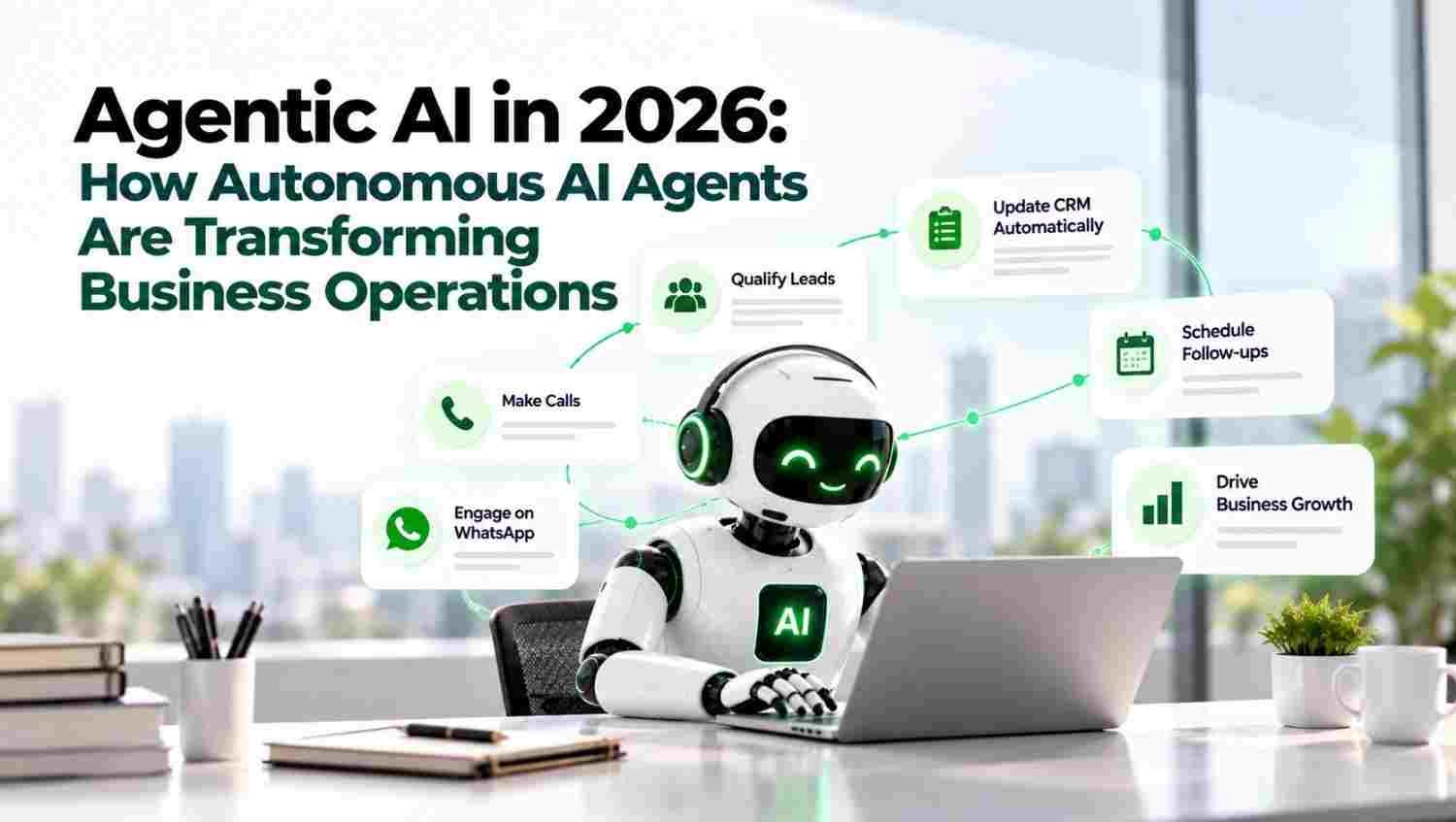
Artificial intelligence is moving beyond generating answers and creating content. Businesses are increasingly exploring systems that can understand objectives, select appropriate actions, and execute connected tasks with limited human intervention.
This shift makes Agentic AI in 2026 an important development in business technology. Instead of requiring instructions at every step, AI agents can work towards defined goals, use connected tools, and manage multi-step processes within established boundaries.
Recent McKinsey AI research highlights the growing organisational focus on deploying AI and translating its capabilities into measurable business value. However, adoption alone does not guarantee results. Businesses need clear objectives, appropriate workflows, and reliable systems.
For organisations, the opportunity is practical: reduce repetitive work, improve response times, and allow employees to focus on activities that require judgement and relationship-building.
Agentic AI combines reasoning, planning, tool usage, and feedback to accomplish defined tasks. Depending on the system, an agent may complete a workflow independently or request human approval before taking a consequential action.
Consider a sales enquiry. Traditional automation might send a standard reminder after two days. An autonomous agent could review available interaction history, identify the next permitted action, initiate an appropriate follow-up, and update the lead record.
The difference is flexibility, not unlimited independence. Effective agents operate within defined permissions and escalation rules.
Google Cloud’s agentic AI insights and IBM’s guide to AI agents explain the capabilities and considerations involved in building these systems.
Business processes often involve collecting information, checking records, sending communications, updating systems, and notifying colleagues. Managing every step manually creates delays and additional work.
AI business automation can coordinate these activities when suitable integrations and permissions are available. Businesses should begin with repetitive workflows where completion and errors can be measured.
Explore McKinsey’s blueprint for scaling agentic AI for guidance on redesigning processes before expanding AI deployment.
Customers expect timely responses across telephone, email, websites, and messaging channels. Delays can affect customer experience and sales opportunities.
AI agents can initiate configured conversations, answer approved questions, collect requirements, and route complex enquiries to employees. Microsoft’s Work Trend Index explores how agent-based systems may change the way people and AI work together.
Sales teams spend considerable time contacting enquiries, qualifying prospects, recording conversations, and scheduling follow-ups.
Agentic AI for business can connect these activities into a coordinated process. An agent may initiate contact, ask predefined qualification questions, record responses, and alert a representative when a prospect meets established criteria.
Businesses can explore Groweon CRM’s sales platform to understand how lead management and sales workflows can work together.
AI agents can classify requests, retrieve relevant information, suggest resolutions, and route cases according to urgency or complexity. With suitable permissions, they may also update tickets or send status notifications.
The AWS guide to AI agents explains how agents can use tools to complete tasks. Sensitive cases and uncertain decisions should still be escalated to human employees.
AI agents in business operations can collect information from connected systems, identify exceptions, summarise patterns, and recommend next steps.
However, AI-generated recommendations are not guaranteed to be accurate. Financial commitments, compliance decisions, and other high-impact actions require appropriate controls and human accountability.
The Gartner analysis of agentic AI ROI highlights the importance of focusing on specialised business processes rather than pursuing autonomy without a defined outcome.
Traditional automation generally follows predefined rules. Agentic systems can use context to select among permitted actions and manage more flexible, multi-step tasks.
For example, a fixed workflow may send the same follow-up after two days. An agent could consider the available conversation history and select an appropriate configured response or escalate the case.
Neither approach is universally better. Predictable processes may benefit from conventional automation, while context-dependent tasks may benefit from autonomous AI agents.
The LangChain State of Agent Engineering report provides further insight into how organisations are approaching agent deployment and reliability.
Agentic AI use cases vary according to business requirements, available data, and operational risks.
The OECD AI Policy Observatory provides additional context on AI adoption and responsible deployment.
For businesses exploring industry-specific applications, Groweon’s automobile CRM and real estate CRM illustrate how workflows can be organised around different industry requirements.
Groweon AION Autopilot brings agentic AI into sales operations by helping businesses coordinate lead engagement and qualification workflows.
Its capabilities include an AI Calling Agent, WhatsApp AI Chatbot, Auto Lead Qualifier, rule-based calling, bulk calling, and qualified lead alerts. Depending on configuration, these capabilities can help teams initiate conversations, collect prospect information, and route qualified opportunities to sales representatives.
Explore Groweon AION Autopilot to learn how these capabilities support sales workflow execution. Businesses can also explore AI calling agent workflows and AI agents in CRM for more specific applications.
The objective is not to remove salespeople from the process. It is to reduce repetitive administration so representatives can concentrate on customer needs, negotiations, and closing opportunities.
Agentic AI in 2026 offers opportunities for greater efficiency, but autonomous systems introduce operational risks. Agents may misunderstand instructions, rely on incomplete information, or take inappropriate actions when permissions are too broad.
Businesses should follow these implementation practices:
The NIST AI Risk Management Framework provides guidance for managing AI risks. Organisations operating in applicable jurisdictions should also review the European Union AI Act.
Additional resources include Anthropic’s guide to effective AI agents, Stanford’s Human-Centered AI research, Microsoft’s AI agent documentation, Deloitte’s enterprise AI research, Gartner’s AI research, the World Economic Forum’s AI resources, UNESCO’s AI ethics guidance, the European Commission’s AI policy resources, OpenAI’s research publications, and Google DeepMind’s research.
How is Agentic AI in 2026 different from earlier AI systems?
Agentic systems can coordinate multiple steps towards a defined objective, use connected tools, and take permitted actions. Earlier AI applications often focused primarily on generating content, predictions, or recommendations.
Can Agentic AI automate business operations?
Yes. It can support customer engagement, lead qualification, information retrieval, workflow coordination, and routine updates. The level of automation depends on integrations, permissions, and task complexity.
Is Agentic AI suitable for small businesses?
It can be useful for businesses with repetitive workflows and limited operational capacity. Starting with one measurable use case is often more practical than attempting to automate every process.
Does Agentic AI replace employees?
Not necessarily. AI agents can handle selected repetitive tasks, while employees remain essential for complex decisions, customer relationships, negotiation, and accountability.
How can businesses measure Agentic AI ROI?
Businesses can compare implementation and operating costs against improvements in processing time, productivity, accuracy, response times, and conversion rates. Results should be measured against an established baseline.
Agentic AI in 2026 represents a shift from AI that primarily generates information to AI that can execute defined business tasks. Its potential lies in connecting activities into reliable workflows while keeping people responsible for important decisions.
Businesses should begin with a clearly defined operational problem, reliable data, appropriate permissions, and measurable outcomes.
With Groweon AION Autopilot, organisations can explore agentic AI for lead engagement, qualification, and sales workflow execution. The long-term opportunity is to build operations that are more responsive, consistent, and efficient without losing human judgement and accountability.
Agentic AI helps businesses move beyond isolated AI responses towards goal-oriented workflows. Applications include sales engagement, customer support, and operational coordination. Successful adoption depends on reliable data, clear permissions, human oversight, and measurable outcomes. Businesses can explore Groweon AION Autopilot to understand how agentic capabilities can support sales execution.

23 Oct, 2026
Summary Compare 10 field service and field workforce software options...

23 Oct, 2026
Summary Agentic AI enables systems to plan and execute tasks...

23 Oct, 2026
Summary Traditional CRM helps businesses organise customer data, manage leads,...

22 Oct, 2026
Summary (TL;DR) AI calling agents help businesses engage prospects, qualify...

22 Oct, 2026
Summary (TL;DR) A delayed quotation can cost a business a...