

10 Must-Have Features in AI CRM Software for Modern Businesses
12 Nov, 2026
Summary AI CRM Software helps businesses manage customer relationships through...
Updated: 12th November, 2026
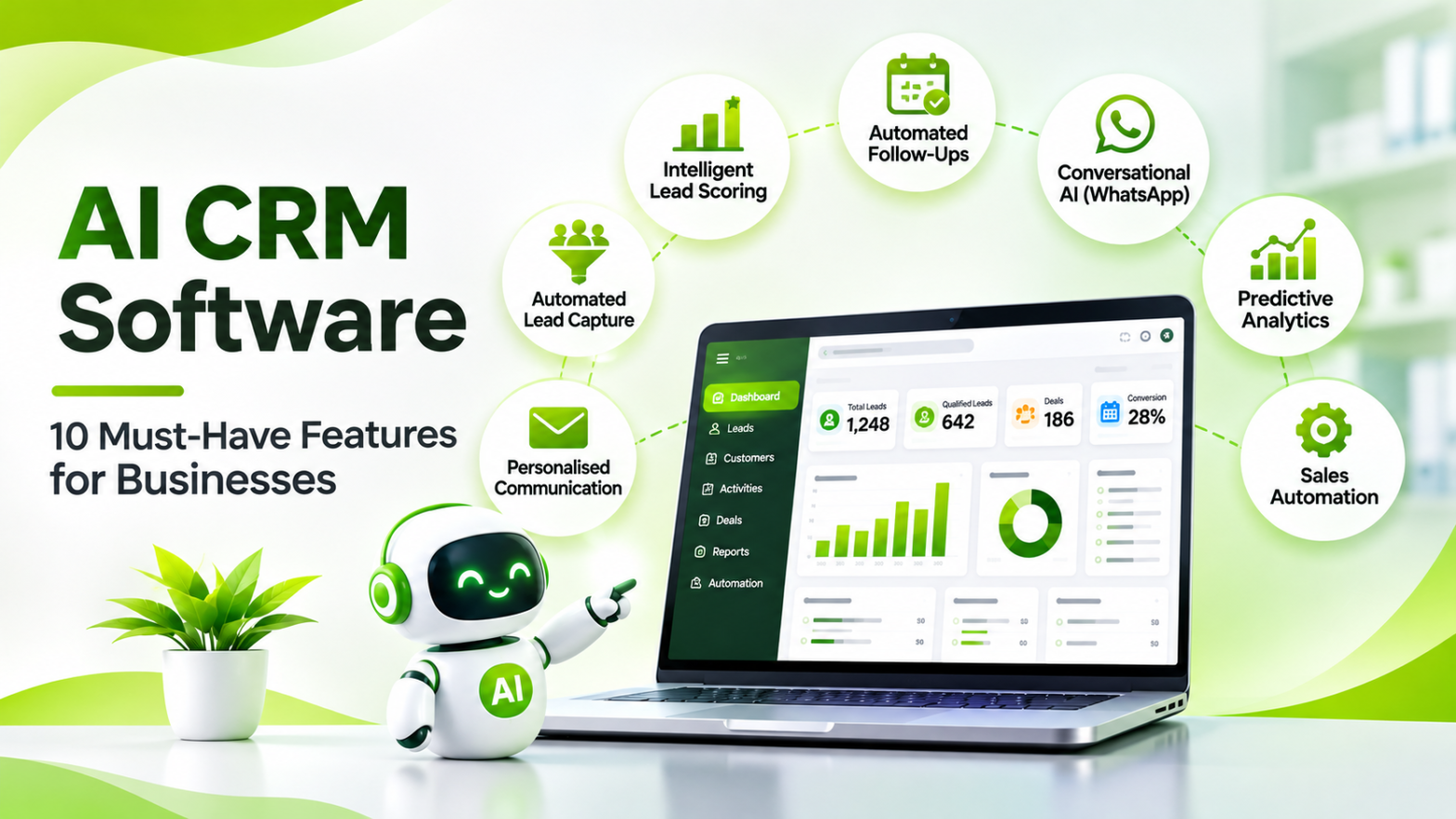
Customer relationship management has evolved beyond storing contact details, maintaining spreadsheets and tracking sales activities. Modern businesses need more than a digital database. They need intelligent systems that can understand customer behaviour, identify potential opportunities and help sales teams take timely action.
This is where AI CRM Software becomes valuable.
Traditional CRM systems primarily depend on employees to enter information, analyse reports, schedule follow-ups and decide the next course of action. An AI-powered CRM adds intelligence to these activities by analysing customer information, identifying patterns, prioritising leads and supporting personalised communication.
According to IBM’s overview of AI in CRM, artificial intelligence can help automate business processes, improve customer personalisation and generate useful insights from CRM data.
However, not every CRM platform offering an AI feature delivers meaningful business value. Businesses need practical capabilities that address real sales and customer management challenges.
Let’s explore the 10 must-have features that make AI CRM Software useful for modern businesses.
Not every enquiry has the same probability of converting. Some prospects are actively evaluating products or services, while others are only exploring available options.
AI CRM Software with intelligent lead scoring helps sales teams identify which prospects deserve immediate attention.
Instead of depending entirely on manual lead prioritisation, AI can analyse available customer information, engagement history, lead sources and behavioural signals to identify potential buying intent.
Essential lead scoring capabilities include:
For example, a prospect who requests a quotation, responds to a sales message and schedules a product demonstration may receive a higher priority than someone who has only submitted a basic enquiry.
Salesforce’s AI for CRM guide explains how smart scoring and predictive intelligence can support customer prioritisation and personalised engagement.
Businesses receive enquiries from several sources, including websites, social media advertisements, online marketplaces, WhatsApp and telephone calls.
Manually collecting information from every channel can create delays, duplicate records and missed opportunities.
AI CRM Software should make lead capture and organisation easier by connecting multiple enquiry sources with a centralised CRM database.
Important lead capture capabilities include:
For example, when a potential customer submits an enquiry through a website form, the CRM should capture the details, create a lead record and assign it to the appropriate sales representative based on predefined rules.
This reduces manual data entry and helps businesses maintain a more organised lead management process.
Explore Groweon’s lead management CRM to understand how lead capture, assignment and sales workflows can work together.
A lead may show strong buying interest, but delayed communication can reduce the chances of conversion.
Sales representatives often manage multiple prospects simultaneously. Remembering every callback, quotation discussion and pending response becomes difficult as lead volume increases.
AI CRM Software should help businesses maintain consistent communication through automated follow-up workflows.
Look for these follow-up capabilities:
For instance, if a prospect receives a quotation but does not respond, the CRM can trigger a reminder or an approved follow-up message after a predefined period.
Advanced AI systems can also analyse conversation context and recommend the next action. This helps sales representatives avoid random follow-ups and maintain more relevant communication.
Customers expect businesses to respond through familiar communication channels. In India, WhatsApp is particularly important for product enquiries, quotation discussions, customer support and sales follow-ups.
AI CRM Software should connect customer conversations with the relevant CRM records instead of keeping communication scattered across different applications.
Important conversational AI capabilities include:
For example, when a customer asks about product availability through WhatsApp, an AI chatbot can respond using approved business information and collect additional requirements. If the enquiry needs personal attention, it can be routed to a sales representative.
The Microsoft Dynamics 365 customer insights platform illustrates how connected customer data can support more coordinated and personalised customer experiences.
Traditional sales reports generally explain what has already happened. Predictive analytics helps businesses identify patterns that may influence future sales performance.
AI CRM Software can analyse historical sales information, pipeline activity, lead engagement and conversion patterns to generate insights for business planning.
Useful predictive analytics capabilities include:
For example, a sales manager may identify several deals that have remained inactive at the quotation stage. The CRM can highlight these opportunities so the team can review the reasons for delays and decide the next action.
Predictive analytics should support business decisions rather than be treated as a guarantee of future revenue.
Customer conversations contain valuable information beyond basic contact details. The language customers use, their objections, concerns and responses can provide useful insights into their buying experience.
AI CRM Software with sentiment analysis can help businesses interpret communication data and identify potential customer concerns.
This feature can help businesses:
For example, if a customer repeatedly expresses dissatisfaction about delayed delivery, the CRM can help highlight the concern for the relevant team.
Sentiment analysis should be treated as a decision-support feature. Human review remains important because customer language can be subjective and context-dependent.
Sales representatives spend a significant amount of time on repetitive administrative activities such as updating lead records, assigning tasks, preparing quotations and sending reminders.
AI CRM Software should connect these activities through intelligent workflows so employees can focus more on customer conversations and revenue opportunities.
Essential sales automation features include:
More advanced AI CRM platforms may also support agentic workflows. These systems can interpret defined goals, select approved actions and execute multiple connected tasks while following business rules and permission controls.
For example, after a lead is qualified, an automated workflow may notify the assigned representative, create a follow-up task and prepare relevant customer information for the next interaction.
Generic messages do not address the individual requirements of every customer. Different prospects may have different budgets, product preferences, buying stages and communication expectations.
AI CRM Software should use available customer context to help sales teams create relevant and personalised communication.
Look for these AI communication features:
For example, a prospect who has requested product pricing may need a quotation-focused follow-up, while someone still comparing product specifications may need additional product information.
Personalised communication helps sales teams make interactions more relevant, provided the information used is accurate and customer preferences are respected.
AI capabilities are valuable only when businesses can trust how their customer information is collected, processed and protected.
An AI CRM platform may handle contact details, business documents, sales conversations, customer records and other confidential information. Therefore, security should be a major consideration during CRM selection.
The NIST AI Risk Management Framework provides guidance for identifying and managing risks associated with artificial intelligence systems.
Important security considerations include:
Businesses should verify the actual security certifications, privacy policies and compliance capabilities of a CRM provider instead of relying only on general security claims.
A CRM should connect with the applications employees already use. Disconnected systems create duplicate data, manual work and inconsistent customer information.
AI CRM Software should provide integration capabilities and mobile accessibility so employees can manage business activities from different locations.
Useful integration and mobile features include:
For field sales teams, mobile accessibility is especially valuable. Representatives can access customer details, update lead status, manage meetings and record follow-up activities while travelling.
Selecting AI CRM Software should begin with your business requirements rather than simply comparing the number of AI features offered by different platforms.
A suitable CRM should solve existing operational problems, fit your sales process and support future business growth.
Consider these five evaluation areas before making a decision:
|
|---|
Businesses should also evaluate implementation requirements, customer support, mobile functionality and total cost of ownership.
The most suitable AI CRM platform is not necessarily the one with the largest feature list. It is the one that helps employees complete important business activities more efficiently.
Groweon combines CRM workflows, sales automation and AI-powered capabilities to help businesses manage customer interactions and sales activities through a connected platform.
Its AION ecosystem brings intelligent capabilities into everyday sales operations through two key layers.
AION Autopilot is designed to support sales execution through intelligent engagement, qualification and workflow automation.
Its capabilities include:
Learn more about Groweon AION Autopilot.
AION AI+ supports sales teams with AI-powered tools that help analyse lead information, generate communication and organise CRM updates.
Its capabilities include:
Explore Groweon AION AI+ features.
Together, these capabilities help businesses reduce repetitive sales activities, understand customer requirements and give sales representatives better context for customer interactions.
The objective is not simply to add AI to CRM software. It is to connect customer information with meaningful sales actions while keeping people involved in important business decisions.
1. What is AI CRM Software?
AI CRM Software is a customer relationship management platform that uses artificial intelligence to analyse customer data, prioritise leads, automate workflows, personalise communication and support sales decisions.
2. How is AI CRM Software different from traditional CRM software?
Traditional CRM software primarily stores customer information and tracks sales activities. AI CRM Software adds capabilities such as predictive analytics, intelligent lead scoring, automated communication and AI-assisted decision-making.
3. What are the most important features of AI CRM Software?
Important features include AI lead scoring, automated lead capture, intelligent follow-ups, conversational AI, predictive sales analytics, sentiment analysis, sales automation, personalised communication, data security and third-party integrations.
4. Is AI CRM Software suitable for small businesses?
Yes. Small businesses can use AI CRM Software to organise enquiries, automate repetitive activities and manage customer follow-ups more efficiently. The right platform can help growing teams establish consistent sales processes.
5. Can AI CRM Software automate sales follow-ups?
Yes. Depending on the platform, it can schedule reminders, trigger communication workflows, identify inactive leads and support automated follow-ups through channels such as email and WhatsApp.
6. What is AI lead scoring in CRM?
AI lead scoring analyses available lead information, engagement and behavioural patterns to help sales teams prioritise prospects based on their potential to convert.
7. Is AI CRM Software secure?
Security depends on the platform’s architecture, policies and implementation. Businesses should evaluate access controls, encryption, privacy practices, consent management and compliance documentation before selecting a CRM.
8. What is the difference between AI CRM and Agentic CRM?
AI CRM is a broad category of CRM platforms that use artificial intelligence for insights, predictions and automation. Agentic CRM goes further by using AI agents to execute defined multi-step tasks and workflows with appropriate permissions and human oversight.
AI CRM Software is changing how businesses manage customer relationships, sales activities and daily operations.
From intelligent lead scoring and predictive analytics to conversational AI and automated workflows, the right features can help businesses improve customer engagement and organise their sales processes.
However, selecting a CRM should not be based on AI capabilities alone. Businesses should also consider data security, integrations, ease of use, mobile accessibility and scalability.
A well-implemented AI CRM platform can help sales teams spend less time on repetitive administrative work and more time building customer relationships.
Ready to make your sales process smarter? Explore Groweon CRM and book a free demo to discover how AI-powered sales automation can support your business.
12 Nov, 2026
Summary AI CRM Software helps businesses manage customer relationships through...

12 Nov, 2026
Summary Pharmaceutical companies manage complex relationships with doctors, medical representatives,...
12 Nov, 2026
Summary Indian businesses receive sales enquiries through websites, advertisements, WhatsApp,...

12 Nov, 2026
Summary E-commerce businesses interact with customers across websites, marketplaces, mobile...

11 Nov, 2026
Summary Real estate businesses receive enquiries from property portals, websites,...