

What Is Agentic CRM? A Complete Guide for Business Owners
05 Nov, 2026
Summary Agentic CRM is an emerging approach to customer relationship...
Updated: 5th November, 2026
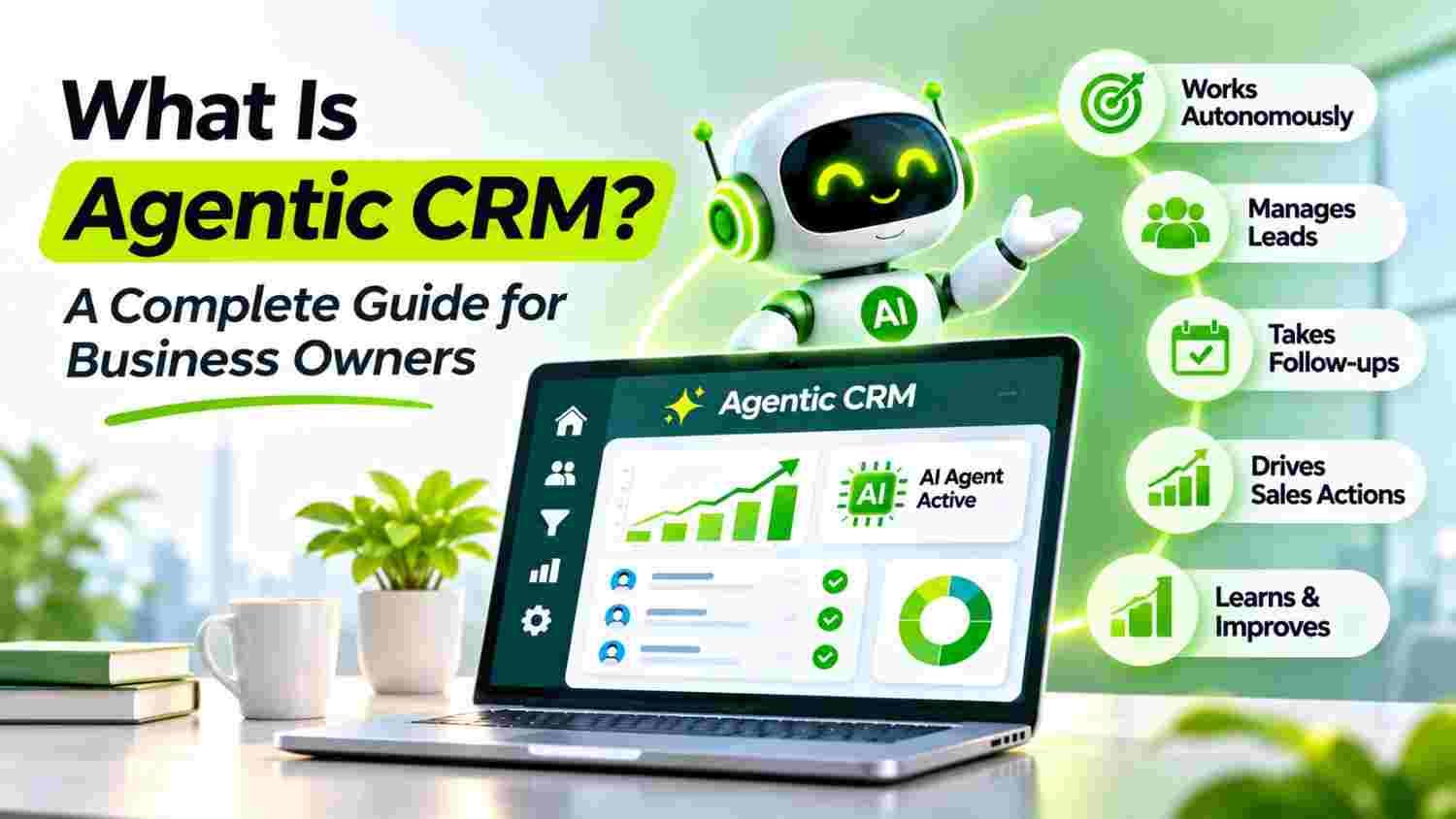
Agentic CRM is an emerging approach to customer relationship management in which AI agents can interpret information, plan actions, and execute selected business workflows within defined permissions.
Unlike traditional CRM systems that primarily store customer data or follow fixed automation rules, agentic CRM aims to help businesses move from recording activities toward taking intelligent action.
For Indian businesses, agentic CRM may support lead qualification, follow-up coordination, customer communication, sales operations, and service workflows when implemented with reliable data and appropriate human oversight.
This guide explains how agentic CRM works, its benefits, limitations, business applications, implementation strategy, and what business owners should evaluate before adopting it.
Customer Relationship Management (CRM) software has traditionally helped businesses store customer information, track sales activities, manage leads, and monitor customer interactions.
But businesses today face a different challenge.
Sales teams receive enquiries from websites, WhatsApp, phone calls, advertisements, business directories, and field representatives. Managers need visibility into customer conversations, follow-ups, sales pipelines, and revenue opportunities.
Even when businesses use CRM software, employees may still spend considerable time updating records, preparing messages, assigning tasks, and coordinating follow-ups.
This creates an important question:
What if CRM could do more than store information and remind employees what to do next?
This is where Agentic CRM enters the conversation.
Agentic CRM represents an emerging approach in which AI agents can interpret business context, determine appropriate actions, and execute multi-step workflows within predefined permissions.
For Indian businesses exploring this transformation, platforms such as Groweon CRM software provide a starting point for evaluating CRM, sales automation, and AI-assisted workflows.
The important point is that agentic CRM is not simply another name for AI-powered CRM. It involves a different level of workflow execution, decision-making, and automation.
Agentic CRM is a customer relationship management system that incorporates AI agents capable of pursuing defined goals, interpreting information, and performing selected tasks with limited human intervention.
An agentic CRM can combine:
Traditional CRM systems generally require employees to interpret customer information and decide what action to take.
Agentic CRM aims to help perform some of those activities.
For example, a traditional CRM may remind a sales representative to follow up with a customer.
An agentic workflow could potentially analyze the customer’s recent interactions, identify the appropriate follow-up, prepare a communication, update relevant records, and schedule the next action according to its permissions.
The exact level of autonomy depends on the CRM platform, integrations, configuration, and safeguards.
For a broader technical explanation, businesses can explore Salesforce Agentic CRM and IBM Agentic AI.
These three terms are related, but they are not interchangeable.
Traditional CRM primarily helps businesses record and organize customer information.
Typical capabilities include:
Traditional CRM relies heavily on employees to interpret information and take action.
AI-powered CRM adds artificial intelligence to existing CRM activities.
Examples may include:
AI-powered CRM may recommend actions without necessarily executing them independently.
Agentic CRM aims to go beyond recommendations and execute selected actions.
Depending on its permissions and capabilities, an AI agent may:
| Capability | Traditional CRM | AI CRM | Agentic CRM |
|---|---|---|---|
| Store customer information | Yes | Yes | Yes |
| Track leads | Yes | Yes | Yes |
| Generate communication | Usually manually | AI-assisted | May prepare and execute approved communication |
| Recommend next action | Rule-based or manual | AI-assisted | Context-based planning |
| Execute multi-step workflows | Fixed automation | Depends on capabilities | Designed for goal-oriented execution |
| Adapt to changing context | Limited | Depends on AI features | May adapt within defined boundaries |
| Human oversight | Usually direct | Varies | Essential for governance and sensitive actions |
Important: Not every product marketed as an AI CRM or agentic CRM offers autonomous multi-step execution. Businesses should verify actual capabilities rather than relying on terminology alone.
For further reading, explore Microsoft AI agents and Google Cloud AI agents.
Agentic CRM generally combines customer data, AI reasoning, business workflows, connected tools, and execution permissions.
A simplified workflow looks like this:
The agent receives a goal or trigger.
Examples:
The goal should be specific and measurable.
The agent retrieves information from approved sources.
This could include:
The agent’s quality depends significantly on the accuracy and accessibility of this information.
The AI evaluates the information to understand the situation.
For example, a lead who requested a product demonstration may require a different follow-up from someone who only downloaded a brochure.
The agent should consider the available context instead of applying the same action to every lead.
Based on the goal and context, the agent determines an appropriate action.
Possible actions include:
The agent performs actions it is authorized to take.
Sensitive activities—such as sending contractual commitments, issuing refunds, changing pricing, or sharing confidential information—may require human approval.
The system records what happened.
The business can evaluate:
This feedback can help teams improve agent instructions, workflow design, and business rules.
For additional technical context, explore Microsoft agent architecture and Salesforce agent building blocks.
The practical value of agentic CRM becomes clearer when applied to everyday business situations.
Imagine a manufacturing company receives enquiries from its website, IndiaMART, WhatsApp, and advertisements.
A conventional CRM records the enquiry and may assign it to a salesperson.
An AI-assisted workflow can analyze the information and suggest a lead category.
An agentic workflow, if appropriately configured, could potentially:
The agent should not invent missing information or make unsupported assumptions about a customer.
Sales teams frequently struggle with follow-up consistency.
A lead may receive a quotation but remain inactive for several days.
An agentic CRM workflow could:
Businesses should establish communication limits, customer preferences, consent requirements, and approval rules before enabling automated outreach.
Before a sales meeting, an agent could collect:
It could then prepare a meeting brief for the salesperson.
This can reduce the time employees spend searching across multiple systems.
Customer service teams may receive requests about order status, product information, appointments, or service issues.
An agentic CRM workflow could identify the request, retrieve relevant information, and provide an approved response.
More complicated cases could be routed to a human representative.
Automobile dealerships often manage:
An agentic workflow could help identify upcoming service or renewal dates and prepare appropriate reminders.
However, customer communication should respect consent, business policies, and approved message templates.
For distributors and manufacturers, an agentic CRM may help coordinate:
The goal is to reduce coordination effort while keeping managers informed.
For businesses exploring these workflows, Groweon FieldTrack CRM and Groweon Order Management are relevant areas to evaluate.
Agentic CRM can offer several potential benefits when implemented appropriately.
Sales representatives often spend time updating records, preparing messages, and managing reminders.
Agentic workflows may help automate selected administrative activities.
This can allow employees to focus more on customer conversations and sales opportunities.
Businesses can use agentic workflows to identify pending activities and coordinate follow-ups.
Consistency depends on accurate customer data, properly configured workflows, and reliable communication integrations.
When CRM activities are updated consistently, managers may gain a clearer view of:
An agent may coordinate multiple tasks that would otherwise require manual handoffs.
For example, a qualified lead could be routed to a salesperson, accompanied by relevant customer context and a suggested next action.
When customer information is available and workflows are coordinated properly, businesses can respond more consistently.
However, automation should not replace personal attention where customers require human judgment, empathy, or negotiation.
Agentic CRM may help businesses handle increasing volumes of enquiries and routine activities.
The benefit depends on whether the workflows are reliable, well-designed, and suitable for the business.
For wider AI context, businesses can explore AWS AI agents and Google Vertex AI agents.
Indian SMBs operate across diverse industries and customer communication channels.
Businesses may use:
Managing these activities manually can become difficult as the business grows.
Agentic CRM may help businesses coordinate customer information and workflow execution across connected systems.
An agentic workflow may help classify enquiries, organize customer information, and route leads according to business rules.
Businesses may use agents to assist with repetitive sales tasks, such as preparing communication and organizing follow-up activities.
AI agents can potentially support communication workflows across approved channels.
However, customer consent, messaging policies, and privacy requirements must be considered.
CRM agents may help coordinate customer enquiries with order management, service, and support systems when appropriate integrations are available.
For Indian businesses, the important consideration is whether the CRM can support their actual processes—not simply whether it offers AI features.
Explore Groweon Inventory Management, Groweon Service Ticket Management, and Groweon Mobile CRM when evaluating connected operational workflows.
This is one of the most important distinctions business owners should understand.
Rule-based automation follows predefined conditions.
For example:
If a lead is assigned, create a follow-up task.
This workflow is useful because it is predictable and easy to test.
Agentic CRM introduces a different approach.
An agent may interpret customer context, identify a suitable action, and coordinate multiple steps toward a goal.
| Rule-Based Automation | Agentic Workflow |
|---|---|
| Follows predefined conditions | Interprets context and goals |
| Executes fixed actions | May select from approved actions |
| Requires rules for specific scenarios | Can handle some variations |
| Usually predictable | Requires testing and monitoring |
| Suitable for repeatable processes | Suitable for selected context-dependent workflows |
For many business processes, fixed automation is more reliable, affordable, and easier to maintain.
Businesses should use agentic AI where context and flexibility add value—not replace every existing workflow with AI.
An AI assistant helps a person perform a task.
For example, it may:
An AI agent may go further by performing a sequence of actions.
For example:
The difference is not simply intelligence.
It is the ability to execute connected actions toward a defined objective.
However, some AI assistants also support tool use and multi-step actions. Therefore, the distinction depends on the product’s actual capabilities rather than its marketing label.
Businesses can explore Google AI agent concepts and Microsoft Copilot agents for related information.
Agentic CRM can introduce new risks alongside its potential benefits.
Businesses should understand these challenges before implementation.
AI agents depend on the information they can access.
If CRM records are outdated, incomplete, or duplicated, an agent may make incorrect decisions.
Businesses should prioritize:
An agent may misunderstand instructions or take an action that does not match business expectations.
This is especially important for customer-facing communication, financial decisions, and contractual commitments.
Businesses should establish permissions, approval requirements, and action limits.
CRM systems contain sensitive customer and business information.
Businesses should review:
Useful resources include the NIST AI Risk Management Framework, OWASP LLM security, and OECD AI principles.
Agentic workflows may require access to CRM, email, messaging, ERP, order management, and other applications.
Businesses should verify whether integrations are supported, secure, and reliable.
Sales representatives may be uncertain about AI-driven workflows.
Businesses should explain:
Agentic CRM may involve subscription fees, AI usage charges, integration expenses, and ongoing maintenance.
Businesses should estimate the total cost before implementation.
AI agents should not receive unlimited access to business systems.
A responsible implementation should include clear governance.
Specify which records and systems an agent can access.
Identify which activities can happen automatically and which require approval.
Record important actions, decisions, and workflow results.
Agents should escalate sensitive, unusual, or uncertain situations.
Evaluate:
Businesses can explore EU AI Act information and Microsoft responsible AI for broader governance considerations.
The right level of oversight depends on the workflow, industry, and potential consequences of an incorrect action.
Businesses should not attempt to automate every process immediately.
A phased approach is generally more practical.
Start with one repetitive workflow.
Examples:
Choose a process that is frequent, measurable, and relatively low-risk.
Document:
Clean customer records and establish consistent data fields.
The agent should have access to reliable information.
Specify the agent’s goal, permitted actions, restrictions, and escalation conditions.
Avoid vague instructions such as “manage all sales activities.”
Use clearly defined objectives and boundaries.
Initially, let the agent prepare recommendations or actions for review.
Once accuracy and reliability are established, consider allowing selected low-risk actions to execute automatically.
Track:
After the first workflow performs reliably, evaluate additional use cases.
Businesses should expand based on measurable results rather than simply increasing automation.
For technical implementation context, explore Google Cloud agent development, Microsoft agent development, and Salesforce agent architecture.
Before choosing a CRM, evaluate the following capabilities.
Can the agent access the customer information required for its workflow?
Can it perform actions, or does it only provide recommendations?
Can administrators control which actions the agent is allowed to perform?
Can sensitive actions require approval?
Can managers review the actions performed by the agent?
Can it connect with existing business systems?
Are AI usage, integrations, and automation charges clearly defined?
Can the workflow be tested before it is deployed to customers?
Can the solution support increasing volumes of customer interactions?
Does the workflow solve a measurable business problem?
Businesses should prioritize practical capabilities over marketing terminology.
Groweon focuses on CRM, lead management, sales automation, and business workflows for Indian businesses.
Its AI ecosystem includes AION AI+ and AION Autopilot.
These initiatives reflect the growing interest in using AI to support sales activities and intelligent workflows.
Businesses evaluating Groweon should review the available product capabilities, integrations, and permissions to determine which workflows can be supported today.
Potential areas to explore include:
Learn more about Groweon AI WhatsApp Writer and Groweon AI Email Writer.
The important consideration is to match the technology with an actual business requirement.
CRM software is evolving from systems that primarily store customer information into platforms that can assist with decision-making and workflow execution.
Agentic AI may influence how businesses manage:
However, agentic CRM will not eliminate the need for human employees.
Sales negotiations, customer relationships, complex decisions, and business strategy still require human judgment.
The likely direction is collaboration between employees and AI agents.
Businesses that establish reliable data, clear processes, and responsible governance may be better prepared to adopt these capabilities.
For more industry context, explore Gartner CRM research and Microsoft Dynamics 365.
1. What is Agentic CRM in simple words?
Agentic CRM is a CRM system that uses AI agents to interpret business information, plan actions, and perform selected tasks within defined permissions. It aims to move CRM beyond storing customer data and toward intelligent workflow execution.
2. How is Agentic CRM different from traditional CRM?
Traditional CRM mainly records customer information and sales activities. Agentic CRM aims to use AI agents to analyze context, plan actions, and execute multi-step workflows with limited human intervention.
3. Is Agentic CRM the same as AI CRM?
No. AI CRM can include features such as message generation, lead scoring, and recommendations. Agentic CRM focuses more on AI agents that can perform connected actions toward a defined goal.
4. Can Agentic CRM automate sales follow-ups?
Agentic CRM may support follow-up workflows by reviewing customer context, preparing communication, updating records, and scheduling tasks. Automated customer communication should follow consent, business policies, and approval rules.
5. Is Agentic CRM suitable for small businesses?
It may be suitable for small businesses that have repetitive workflows and reliable CRM data. SMBs should begin with simple, measurable, low-risk use cases before expanding automation.
6. Can Agentic CRM replace sales representatives?
Agentic CRM is designed to support and automate selected activities, not replace every aspect of sales. Human employees remain important for negotiation, relationship building, complex decisions, and customer trust.
7. What are the risks of Agentic CRM?
Potential risks include inaccurate data, unintended actions, privacy concerns, integration complexity, employee adoption challenges, and unexpected costs. Permissions, monitoring, and human approval can help manage these risks.
8. What is the difference between Agentic CRM and rule-based automation?
Rule-based automation follows predefined conditions and actions. Agentic CRM uses AI agents to interpret context and select from permitted actions. Rule-based automation remains useful for predictable, repeatable processes.
9. Does Agentic CRM require clean data?
Yes. AI agents rely on the data they can access. Incomplete, outdated, or inconsistent customer information can lead to inaccurate outputs and decisions.
10. How should a business start implementing Agentic CRM?
Start by identifying a repetitive business workflow, documenting its steps, preparing the CRM data, defining agent permissions, and testing with human approval. Expand automation only after measuring reliability and business value.
Agentic CRM represents an emerging shift in how businesses use customer information.
Traditional CRM helps businesses organize customer data. AI CRM adds intelligence and recommendations. Agentic CRM aims to take the next step by allowing AI agents to execute selected workflows and coordinate business activities.
For Indian businesses, potential applications include lead qualification, sales follow-ups, customer communication, service coordination, and sales operations.
However, successful adoption requires more than AI technology.
Businesses need accurate data, clearly defined workflows, appropriate permissions, reliable integrations, and human oversight.
The best approach is to start small, measure results, and expand gradually.
The future of CRM is not just about collecting customer information. It is about turning that information into responsible, useful business action.
Explore Groweon CRM software and Groweon AION Autopilot to learn more about CRM, sales automation, and AI-assisted business workflows.

05 Nov, 2026
Summary Agentic CRM is an emerging approach to customer relationship...

05 Nov, 2026
Summary Groweon, Salesforce, and Zoho CRM offer different capabilities for...

04 Nov, 2026
Summary This blog explores the best AI CRM software in...

04 Nov, 2026
Summary AI CRM in India is changing how businesses manage...

03 Nov, 2026
Summary AION Autopilot represents a new approach to AI-powered sales...