

Why B2B CRM Is a Must for Every B2B Business…
28 Sep, 2026
Summary (TL;DR): So, a B2B CRM has moved from a...
Updated: 14th August, 2026
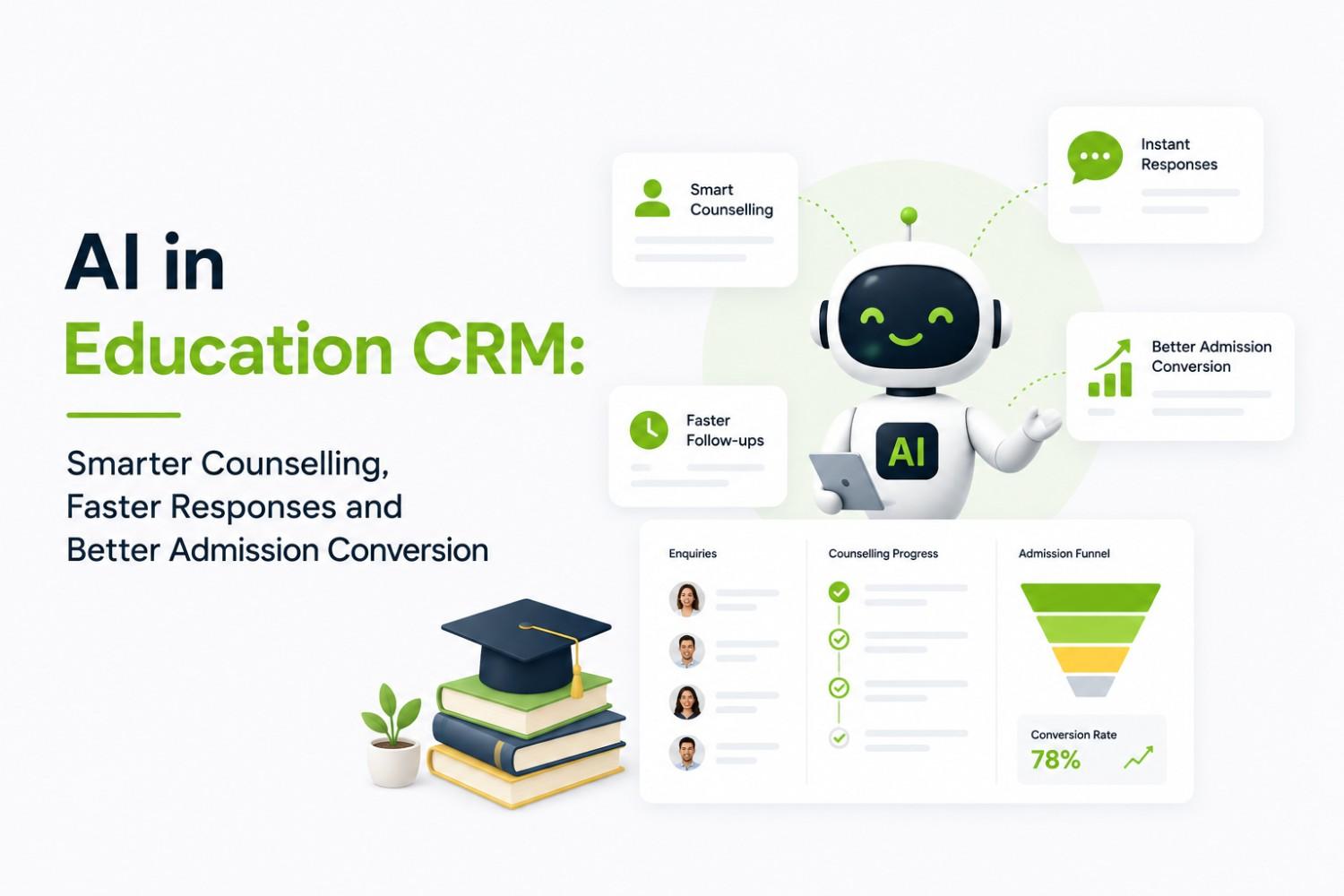
For an educational institution, getting an enquiry is only the beginning of the admission journey.
A student may discover a college through Google, social media, an education portal, a website, a webinar, or a campaign. After that, the student may ask about courses, eligibility, fees, scholarships, placements, accommodation, or application deadlines before deciding whether to apply.
For admission teams, managing all these conversations manually can quickly become difficult.
This is where AI Education CRM software is changing the way institutions manage admissions.
A traditional education CRM helps institutions capture enquiries, assign counsellors, track applications, schedule follow-ups, and manage student information. An AI-powered education CRM adds another layer by helping teams understand enquiries, prioritise prospects, personalise communication, automate repetitive tasks, and support counsellors throughout the admission journey.
The need for this kind of system is becoming more relevant as student acquisition becomes increasingly digital. According to data reported by IBEF from the Enrolment Index 2025, digital channels accounted for 61.55% of student enrolments, while digital platforms contributed 71.78% of student leads and 77.96% of applications in the study.
That means institutions are no longer managing only “admission enquiries”.
They are managing a large, multi-channel digital student journey.
AI Education CRM software is a customer relationship management system designed for educational institutions with artificial intelligence capabilities built into the admission and student engagement workflow.
A standard Education CRM may help with:
An AI-powered system can extend these capabilities by helping teams with:
The difference can be understood simply:
Traditional Education CRM:
Enquiry → Assign → Follow Up → Track
AI Education CRM:
Enquiry → Understand → Qualify → Prioritise → Engage → Follow Up → Convert
The objective is not to replace admission counsellors.
It is to help counsellors spend less time on repetitive work and more time on meaningful student conversations.
Admissions teams often handle large numbers of enquiries during peak admission periods.
One student may ask for course details.
Another may want to know about eligibility.
Another may be ready for an application.
Another may have submitted documents but not completed the next step.
Treating all these students in the same way can result in missed opportunities.
An AI-powered CRM can help institutions identify where each student is in the admission journey and what action may be appropriate.
For example:
| Student Situation | Possible CRM Action |
|---|---|
| New course enquiry | Initial response |
| Asked about fees | Fee-related information |
| Interested but undecided | Counsellor follow-up |
| Requested a call | Counsellor assignment |
| Application started | Application follow-up |
| Documents pending | Document reminder |
| Application completed | Next admission step |
| No response | Follow-up workflow |
This creates a more organised student lead management process.
Digital Admissions Are Creating More Student Data
The admission journey is increasingly digital.
Students may interact with an institution through:
NITI Aayog’s 2025 report on higher education specifically recommends adopting digital platforms for admissions and student life-cycle management to streamline institutional operations and improve efficiency.
This makes the role of education CRM software more important.
Instead of maintaining separate spreadsheets for enquiries, applications, counsellor assignments and follow-ups, institutions can create one connected system.
AI can then work with that information to support admission teams.
Not every student enquiry has the same level of admission intent.
Consider these two enquiries:
Student A:
“Please send me the course brochure.”
Student B:
“I have completed Class 12 and want to apply for BBA. What is the last date and can I speak to a counsellor today?”
Both are enquiries.
But the second student is showing stronger buying—or in this case, admission—intent.
An AI-powered education CRM can help identify signals such as:
This information can help counsellors understand the student before starting the next conversation.
During admission season, counsellors may have hundreds of active leads.
Manually deciding which student should be contacted first can consume valuable time.
AI lead scoring can help prioritise enquiries based on available engagement and qualification signals.
For example:
| Signal | Possible Indication |
|---|---|
| Requested a counsellor call | Stronger intent |
| Asked about application deadline | Immediate interest |
| Requested fee details | Commercial consideration |
| Started application | High engagement |
| Submitted documents | Advanced admission stage |
| Repeated interaction | Continued interest |
| No response for several days | Requires re-engagement |
The score should not be treated as a final admission decision.
It is a way to help counsellors answer a practical question:
Which student should I focus on first?
Students may contact institutions outside normal counselling hours.
If the enquiry remains unanswered until the next working day, the student may continue researching other institutions.
An AI-powered CRM can support faster initial communication by helping automate responses to common questions.
For example:
Student:
“What are the eligibility criteria for BCA?”
AI:
Provides the approved information available in the system and guides the student towards the next step.
For complex questions, the conversation can be routed to a counsellor.
This creates a useful model:
AI handles routine questions → Counsellor handles complex conversations.
The result is not simply faster response.
It is a more structured admission experience.
Admission decisions are rarely made after one interaction.
A student may say:
These are not lost leads.
They are leads requiring a different follow-up strategy.
An AI-powered education CRM can help create follow-up workflows based on the student’s stage.
Course Enquiry
↓
Counsellor Conversation
↓
Interested
↓
Parent Discussion Pending
↓
Follow-Up Reminder
↓
Student Responds
↓
Application Link
↓
Application Started
↓
Documents Pending
↓
Admission
This is much more useful than simply marking a lead as “Interested”.
One of the biggest problems with large-scale admission campaigns is repetitive communication.
A student who asked about BBA should not receive the same message as a student interested in MBA.
AI can help counsellors create more contextual communication based on available CRM information.
For example:
Generic:
“Dear Student, please let us know if you are interested in admission.”
Context-based:
“You had enquired about our BBA programme and asked about the admission process. If you have decided to apply, we can help you with the next application step.”
The second message reflects the student’s previous interaction.
That is where AI can make CRM communication more relevant.
Admission teams communicate with students through calls, WhatsApp, email and other channels.
A counsellor may handle dozens of conversations every day.
AI can help summarise important information from those interactions.
For example:
Course: MBA
Preferred Campus: Delhi
Main Concern: Fees
Interest Level: High
Next Step: Parent discussion
Follow-Up: Friday
Instead of reading the entire conversation again, the counsellor gets a quick summary.
This can save time while keeping the student context visible.
A good CRM should not only tell counsellors what happened.
It should help them understand what needs attention next.
For example:
Application started + documents incomplete
→ Document follow-up
Course enquiry + high engagement + no counsellor conversation
→ Counsellor call
Fee discussion + no response
→ Re-engagement
Application completed
→ Next admission-stage communication
This moves CRM from simple record-keeping towards action-oriented admission management.
An education CRM should ideally manage the entire student journey instead of focusing only on the first enquiry.
Student Acquisition
Campaign → Enquiry → Qualification
Counselling
Requirement → Course Discussion → Counsellor Follow-Up
Application
Application → Documents → Verification
Admission
Selection → Admission → Fee Payment
Student Communication → Support → Future Engagement
NITI Aayog’s higher education policy report recommends digital platforms for admissions and student life-cycle management, reflecting the need for connected digital processes across higher education institutions.
This is why the best CRM software for education should not be evaluated only on lead capture.
It should be evaluated on how well it connects the complete admission journey.
AI Education CRM vs Traditional Education CRM
| Capability | Traditional Education CRM | AI Education CRM |
| Lead Capture | ✓ | ✓ |
| Counsellor Assignment | ✓ | ✓ |
| Admission Pipeline | ✓ | ✓ |
| Follow-Up Reminders | ✓ | ✓ |
| Lead Qualification | Manual / Rule-based | AI-assisted |
| Lead Scoring | Rule-based | AI-assisted |
| Student Communication | Templates | Context-based AI assistance |
| Conversation Summary | Manual | AI-assisted |
| Next Action | Manual | AI recommendations |
| CRM Updates | Manual | AI-assisted |
| Reporting | ✓ | AI-assisted insights |
The right choice depends on the institution’s needs, lead volume and admission process.
But for institutions managing large-scale digital enquiries, AI can significantly extend what an education CRM can do.
What Should Institutions Look for in the Best CRM Software for Education?
Choosing the best CRM software for an educational institution should not be about choosing the system with the longest feature list.
The better question is:
Can the CRM handle the actual admission journey of the institution?
Look for:
Can the CRM capture enquiries from websites, campaigns, WhatsApp, calls and other channels?
Lead Qualification
Can counsellors quickly understand student requirements?
AI Lead Scoring
Can the system help identify students requiring faster attention?
Counsellor Assignment
Can enquiries be automatically assigned according to course, campus, location or other business rules?
Follow-Up Automation
Can the CRM manage reminders and admission follow-up journeys?
Application Tracking
Can the institution track the journey from enquiry to application and admission?
Communication Management
Can calls, WhatsApp, email and other interactions be connected with the student record?
AI Assistance
Can AI help counsellors with summaries, responses, qualification and next actions?
Analytics
Can management understand lead sources, counsellor performance, admission funnel and conversion?
Security and Access Control
Can student information be managed with appropriate permissions and controls?
These factors matter more than simply choosing a CRM because it claims to be “AI-powered”.
A Smarter Admission Workflow With AI
Consider a student who clicks an advertisement and submits an enquiry.
Step 1: Lead Capture
The enquiry automatically enters the CRM.
Step 2: AI Qualification
The system identifies available information such as course interest and admission requirements.
Step 3: Lead Scoring
The enquiry receives a priority based on defined signals.
Step 4: Counsellor Assignment
The appropriate counsellor receives the lead.
Step 5: Student Communication
AI can support the initial response or answer routine questions.
Step 6: Counselling
The counsellor handles the detailed conversation.
Step 7: Follow-Up
The CRM tracks the next action.
Step 8: Application
The student’s application progress is recorded.
Step 9: Admission
The institution tracks the final outcome.
The workflow becomes:
Enquiry → Qualification → Counselling → Follow-Up → Application → Admission
That is the real value of an AI Education CRM.
Education is different from many other sales environments because students and parents often need guidance before making a decision.
Questions can involve:
AI can handle repetitive and information-based interactions.
But counsellors remain important when the conversation requires empathy, explanation, judgement or detailed guidance.
The strongest model is therefore:
AI for speed + CRM for organisation + Counsellors for human guidance
The Future of Education CRM Is Intelligent Admission Management
Education institutions are dealing with an increasingly digital student acquisition journey.
Students can discover courses online, enquire through multiple channels, communicate digitally, start applications and complete admission processes without visiting the campus during the early stages.
This creates more data—and more opportunities to improve the admission process.
An AI-powered education CRM can help institutions move from:
Lead Capture → Lead Understanding → Lead Prioritisation → Personalised Counselling → Automated Follow-Up → Admission Conversion
The goal is not to automate the student.
The goal is to remove unnecessary manual work around the student.
Groweon Education CRM helps educational institutions manage enquiries, counsellors, admission pipelines, follow-ups, applications, communication and student information through a connected CRM environment.
With AI-powered capabilities, Groweon can support teams with intelligent lead qualification, lead scoring, AI-assisted communication, automated follow-ups and sales/admission workflows.
For institutions looking for the best CRM software for managing modern admissions, the focus should be on one connected question:
Can the CRM help your team respond faster, follow up consistently and move more qualified enquiries towards admission?
That is where an AI-powered education CRM software can create practical value.
From the first student enquiry to the final admission, Groweon helps teams manage every important interaction in one connected workflow.

28 Sep, 2026
Summary (TL;DR): So, a B2B CRM has moved from a...

28 Sep, 2026
Summary (TL;DR): The best CRM with AI lead scoring for...

28 Sep, 2026
A B2B CRM buying checklist needs to cover lead capture...

25 Sep, 2026
Summary (TL;DR): An AI CRM pays back $8.71 for every...

24 Sep, 2026
Summary (TL;DR): An agentic CRM is a system where AI...