

AI CRM ROI: What Indian SMBs Should Actually Expect in…
25 Sep, 2026
Summary (TL;DR): An AI CRM pays back $8.71 for every...
Updated: 12th August, 2026
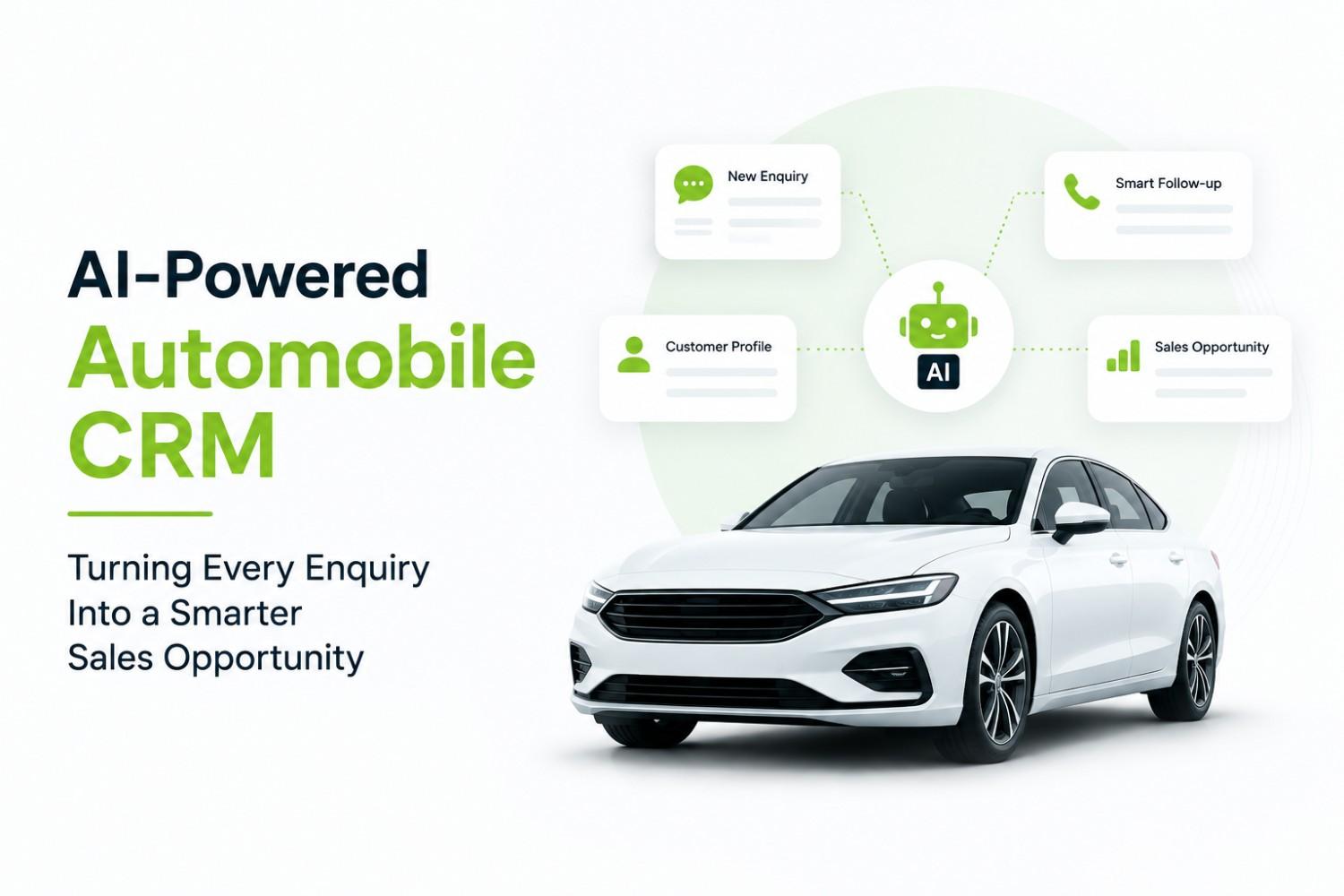
For an automobile dealership, generating a vehicle enquiry is only the beginning of the sales process.
A customer may enquire about a model today, ask about pricing tomorrow, compare variants, request a test drive, visit the showroom, discuss finance, negotiate, and still take time before making the final decision.
Every interaction creates another sales opportunity.
But it also creates another opportunity to lose the customer.
A delayed response, missed follow-up, forgotten test-drive reminder, or incomplete customer history can affect the buying journey.
This is where automobile CRM software plays an important role.
And with AI, automobile CRM is moving beyond basic lead tracking.
An AI-powered automobile CRM can help dealerships qualify enquiries, identify high-intent buyers, automate follow-ups, support customer communication, and give sales teams better visibility into the complete customer journey.
Today’s vehicle buyer may interact with a dealership through multiple channels:
This creates a simple challenge:
The dealership needs to connect all these interactions into one customer journey.
Cox Automotive’s 2025 Digitization of Automotive Retail study found that dealerships are continuing to accelerate digital retailing and AI adoption, while also highlighting gaps in connecting online and in-store experiences.
For automobile dealerships, this means CRM needs to do more than store contact details.
It needs to connect:
Enquiry → Customer Requirement → Vehicle → Test Drive → Follow-Up → Purchase
A traditional automotive CRM can help with:
AI adds another layer.
Capture → Store → Track
Capture → Understand → Qualify → Prioritise → Engage → Follow Up → Convert
The purpose is not to automate every dealership interaction.
It is to make the information available to the sales team more useful and actionable.
Not every vehicle enquiry has the same level of buying intent.
Consider two customers.
Customer A
“Price for this model?”
Customer B
“I want the automatic variant within ₹15 lakh. Can I schedule a test drive this Saturday?”
Both are leads.
But their buying signals are different.
An AI-powered automobile lead management workflow can help identify information such as:
This gives salespeople better context before they make the next call.
A dealership may have hundreds of active vehicle enquiries.
The challenge is deciding:
Which customers should receive attention first?
AI-powered lead scoring can consider available signals such as:
| Customer Signal | Possible Indication |
|---|---|
| Specific model selected | Clear product interest |
| Variant selected | Stronger requirement |
| Test-drive request | Higher buying intent |
| Pricing enquiry | Commercial interest |
| Finance enquiry | Purchase consideration |
| Repeated engagement | Active interest |
| No recent activity | Lower immediate priority |
This can help sales teams focus their time on opportunities with stronger buying signals.
The score should support salesperson judgement—not replace it.
Vehicle purchases rarely happen after a single conversation.
The journey may look like:
Enquiry → Information → Price → Test Drive → Follow-Up → Negotiation → Purchase
A traditional CRM can create reminders for each stage.
An AI-powered CRM can help make those follow-ups more context-aware.
For example:
Test Drive Completed → Customer Feedback → AI-Assisted Follow-Up → Salesperson Notification
Or:
Price Shared → No Response → Follow-Up → Customer Reply → Next Action
This helps dealerships maintain consistent follow-up without relying entirely on salesperson memory.
Automobile customers ask different questions depending on where they are in the buying journey.
They may ask about:
AI can help sales teams prepare responses using the customer’s existing context.
Instead of:
“Are you still interested?”
a context-based follow-up could be:
“You had enquired about the automatic variant and requested a test drive. Would you like us to schedule one this weekend?”
The difference is:
Generic follow-up → Context-based follow-up
The test drive is an important stage in vehicle sales.
A dealership needs to know:
A connected automobile CRM system can bring these activities together.
Workflow
Lead → Vehicle → Test Drive → Feedback → Follow-Up → Sales Opportunity
AI can then help identify the appropriate next action based on the information recorded.
A customer who enquires online should not have to repeat their entire story when they arrive at the dealership.
Ideally, the salesperson should already know:
Vehicle Interested In → Previous Conversation → Requirement → Test Drive → Customer Concern
This creates a connected digital-to-showroom experience.
Cox Automotive’s research shows that digital retailing and AI are becoming increasingly important in automotive sales, while connecting digital and physical experiences remains an important challenge.
This is where an automobile CRM becomes valuable—not simply as a lead database, but as a customer journey system.
AI is moving beyond experimentation in the automotive dealership industry.
Cox Automotive’s 2025 AI Readiness in Auto Retail Study found that:
| Finding | Result |
|---|---|
| Dealers who believe AI is here to stay | 81% |
| Dealers who say investing in AI now is critical for long-term success | 63% |
| Dealers beginning to test AI tools | 60% |
| Dealers embedding AI into workflows and decision-making | Nearly 15% |
The study surveyed dealership leaders and found that dealers were particularly interested in measurable outcomes such as revenue and operational efficiency.
That distinction is important. Dealerships do not need AI simply because it is a new technology.
They need AI that can improve real sales and customer processes.
| Area | Basic Automobile CRM | AI-Powered Automobile CRM |
|---|---|---|
| Lead capture | Records enquiry | Captures and interprets information |
| Qualification | Manual | AI-assisted |
| Lead priority | Salesperson judgement | AI-assisted scoring |
| Follow-up | Reminders | Intelligent workflow support |
| Communication | Templates | Context-based assistance |
| Test drives | Scheduled and tracked | Connected with customer context |
| Customer history | Stored | Used for insights |
| Opportunity management | Manual monitoring | AI can flag attention areas |
| Reporting | Historical data | AI-assisted insights |
The goal is not to remove the salesperson.
The goal is to help the salesperson work with better information and fewer repetitive tasks.
Consider a customer who submits an enquiry for an SUV.
Step 1: Lead Capture
The enquiry enters the CRM with the source and available customer details.
Step 2: AI Qualification
The system helps identify the model, variant, budget, location, purchase timeline and requirements.
Step 3: Lead Scoring
Available customer signals are used to help prioritise the opportunity.
Step 4: Customer Response
The customer receives an appropriate response.
Step 5: Sales Engagement
The salesperson receives the relevant customer context.
Step 6: Test Drive
The test drive is scheduled and tracked.
Step 7: Post-Test-Drive Follow-Up
Customer feedback is recorded and the next activity is created.
Step 8: Negotiation
The opportunity moves through the sales pipeline.
Step 9: Purchase
The final outcome is recorded for future customer engagement.
The complete workflow becomes:
Enquiry → Qualification → Test Drive → Follow-Up → Negotiation → Purchase
That is how AI can turn a basic enquiry into a smarter sales opportunity.
The customer relationship does not end at vehicle delivery.
Dealerships can continue engaging customers around:
This makes customer history valuable long after the original sale.
An automobile CRM can connect:
Vehicle Purchase → Service Engagement → Customer Relationship → Upgrade Opportunity
This can help dealerships build a more continuous customer journey rather than treating every interaction as a separate lead.
Before choosing an AI-powered automobile CRM, dealerships should look at the complete sales journey.
Lead Management
Can it capture enquiries from websites, advertising platforms, portals, calls and messaging channels?
Vehicle Requirement Management
Can the team record model, variant, budget and customer preferences?
AI Lead Qualification
Can the system help identify stronger sales opportunities?
AI Lead Scoring
Can it help salespeople prioritise high-intent customers?
Follow-Up Automation
Can it automate reminders and repetitive follow-up activities?
Test Drive Management
Can the dealership manage test-drive scheduling, completion and follow-up?
Customer Communication
Can salespeople access relevant interaction history?
Sales Pipeline
Can managers track the opportunity from enquiry to purchase?
AI Capabilities
Can AI support qualification, communication, prioritisation and sales workflows?
After-Sales Engagement
Can the system continue managing customer relationships after the vehicle sale?
Automobile sales are becoming increasingly connected.
Customers research online, compare vehicles, enquire digitally, communicate with dealerships, schedule test drives and move between online and showroom experiences before making a purchase.
A basic lead tracker cannot provide enough context for this entire journey.
An AI-powered automobile CRM can help dealerships move from:
Lead Tracking → Lead Understanding → Lead Prioritisation → Intelligent Follow-Up → Better Opportunity Management
The objective is not simply to generate more enquiries.
It is to make sure every important enquiry receives the right attention at the right stage.
Groweon Automobile CRM helps dealerships manage leads, customer information, sales activities, follow-ups, vehicle-related requirements and customer engagement through a connected CRM platform.
With AI-powered capabilities, dealerships can move beyond basic lead tracking and support smarter lead qualification, prioritisation, communication and follow-up workflows.
From the first vehicle enquiry to the test drive, purchase and future customer engagement, Groweon helps keep the sales journey organised and visible.
Turn every vehicle enquiry into a smarter sales opportunity with Groweon Automobile CRM.
What is AI-powered automobile CRM software?
AI-powered automobile CRM software combines dealership CRM capabilities such as lead management, sales pipeline tracking, follow-ups and customer management with AI-powered qualification, prioritisation, communication and workflow support.
How can AI help automobile dealerships manage leads?
AI can help dealerships qualify enquiries, identify buying signals, prioritise opportunities, support customer communication and automate defined follow-up workflows.
Can AI-powered CRM automate automobile lead follow-ups?
Yes. AI-powered CRM workflows can support reminders, follow-up sequences, customer communication and next-action recommendations based on lead activity.
How does automobile CRM help with test drives?
It can connect customer enquiries with vehicle details, test-drive scheduling, salesperson assignment, visit status, feedback and post-test-drive follow-up.
Can an automobile CRM manage customers after vehicle sales?
Yes. A connected CRM can support service reminders, warranty follow-ups, insurance renewal, maintenance engagement, upgrade opportunities and repeat customer interactions.
Why is AI becoming important for automobile CRM?
AI can help dealerships handle large volumes of enquiries, prioritise stronger opportunities, reduce repetitive work and make customer interactions more relevant.

25 Sep, 2026
Summary (TL;DR): An AI CRM pays back $8.71 for every...

24 Sep, 2026
Summary (TL;DR): An agentic CRM is a system where AI...

23 Sep, 2026
Summary (TL;DR): The best CRM for car dealerships in India...

23 Sep, 2026
Summary (TL;DR): The best CRM for B2B sales teams in...

23 Sep, 2026
Summary (TL;DR): The best WhatsApp CRM in India combines the...