

Agentic CRM in India: What It Actually Costs and How…
24 Sep, 2026
Summary (TL;DR): An agentic CRM is a system where AI...
Updated: 12th August, 2026
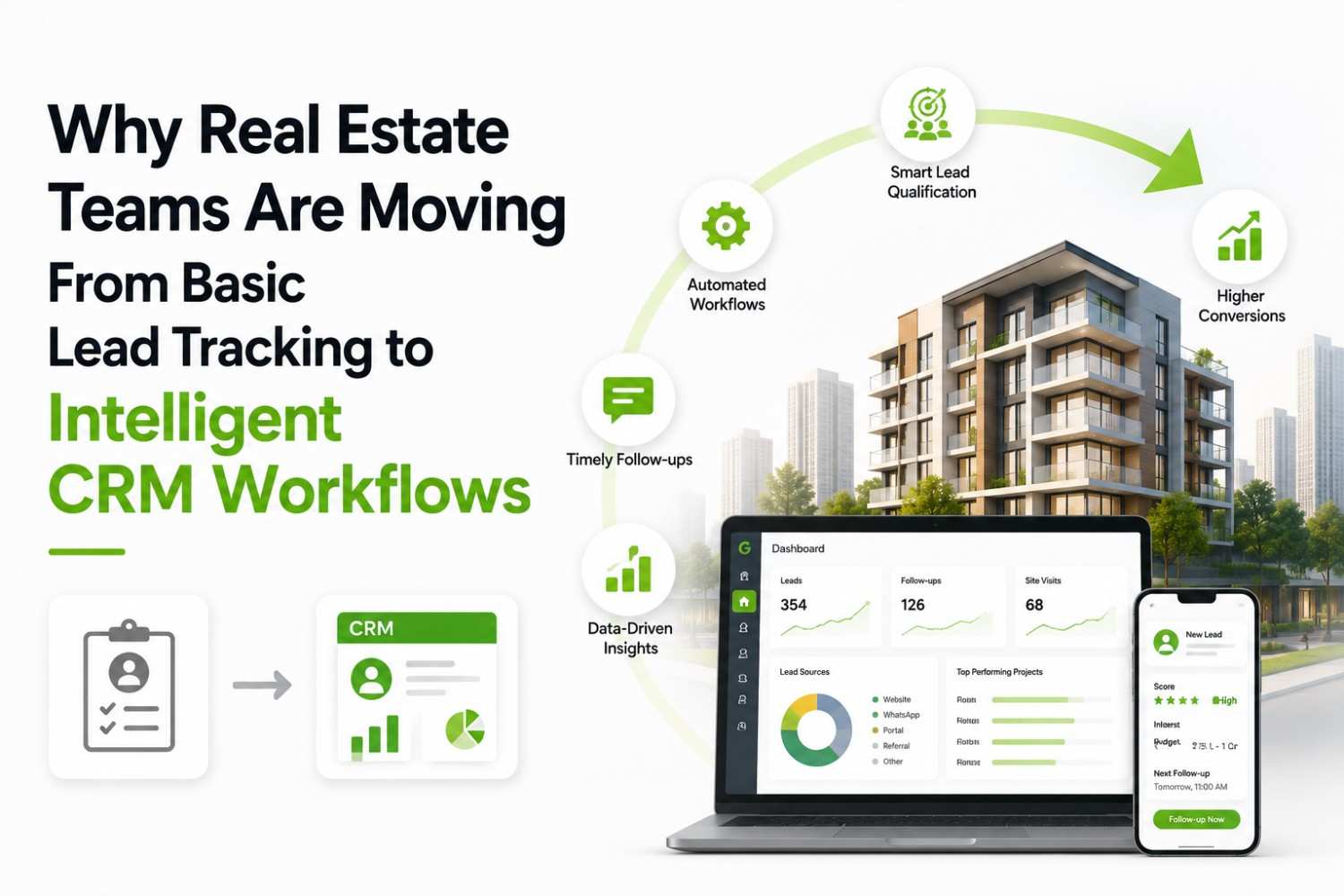
Real estate sales rarely depend on a single interaction. A buyer may enquire about a property today, respond to a WhatsApp message tomorrow, visit a site next week, and take several more conversations before making a decision.
For real estate teams handling dozens or hundreds of enquiries at a time, simply recording lead details is not enough. Sales teams need to know which property a prospect is interested in, what their budget is, whether a site visit has been completed, when the next follow-up is due, and how likely the lead is to convert.
This is where real estate CRM software is becoming more important.
Modern CRM for real estate businesses is moving beyond basic lead tracking. Instead of simply storing names, phone numbers, and enquiry details, it can connect lead management, property requirements, sales pipelines, follow-ups, site visits, communication, automation, and reporting into a single workflow.
Basic Lead Tracking → Structured Lead Management → Automated Workflows → Intelligent Sales Management
Many real estate businesses still manage leads through spreadsheets, WhatsApp conversations, phone records, or separate property portals.
This may work when enquiry volume is low. But as the business grows, the process becomes difficult to control.
A typical real estate team may receive enquiries from:
The challenge is not just capturing these enquiries. The challenge is managing what happens after the enquiry is received.
A salesperson needs to know:
Basic lead tracking can record some of this information, but it does not necessarily create a connected process around it.
That is where real estate lead management becomes different from simple lead tracking.
A real estate CRM should give sales teams a complete view of the prospect and their property requirement.
Instead of maintaining only:
Name + Phone Number + Lead Source
the system can maintain information such as:
Buyer Requirement + Budget + Location + Property Type + Preferred Project + Communication History + Site Visit + Follow-Up + Sales Stage
This gives salespeople the context they need before contacting a prospect.
For example, if a buyer is looking for a 3BHK property within a specific budget and has already visited one project, the salesperson should not have to ask for the same information again.
A centralised property lead management system keeps that information available throughout the sales journey.
The biggest difference between basic tracking and an intelligent CRM workflow is what happens after a lead enters the system.
Consider a simple example.
A prospect submits an enquiry for a residential project.
With basic lead tracking:
Lead Received → Salesperson Records Lead → Manual Follow-Up
With an intelligent workflow:
Lead Received → Lead Captured → Automatically Assigned → Requirement Recorded → Initial Response → Lead Qualified → Property Shared → Site Visit Scheduled → Reminder Sent → Follow-Up Created → Sales Stage Updated
The second approach creates a defined process instead of leaving every step to individual salesperson memory.
This is the real value of real estate CRM automation.
A new enquiry should reach the right salesperson quickly.
A CRM can assign leads based on rules such as:
For example, an enquiry for a specific project can automatically be assigned to the salesperson responsible for that project.
This reduces manual distribution and helps prevent leads from sitting unattended.
For businesses running multiple projects or sales teams, automated assignment becomes an important part of real estate lead management software.
A real estate sale can involve many stages before the final booking.
A CRM can represent this journey through a structured real estate sales pipeline.
For example:
New Enquiry → Contacted → Qualified → Property Shared → Site Visit Scheduled → Site Visit Completed → Negotiation → Booking → Closed
The exact stages can vary by business, but the principle remains the same.
Every lead should have a clear current status.
This helps sales managers identify:
Instead of asking the sales team for manual updates, managers can use the CRM to see the pipeline more clearly.
Real estate deals often require multiple follow-ups.
A buyer may say:
“I will discuss it with my family.”
Another may say:
“I want to visit the property first.”
Someone else may be interested but not ready to purchase immediately.
If these conversations are managed manually, follow-ups can easily be delayed or forgotten.
A real estate CRM can create reminders and automated workflows based on the lead’s status.
For example:
Site Visit Completed → Follow-Up Task Created → WhatsApp Message → Salesperson Reminder → Next Follow-Up
Similarly:
No Response → Follow-Up Reminder → Second Attempt → Re-engagement Task
This makes follow-up a defined process rather than an activity dependent on individual memory.
For many real estate businesses, a site visit is one of the most important stages between enquiry and booking.
However, scheduling the visit is only one part of the process.
Teams also need to track:
With real estate site visit management, the visit becomes part of the complete sales record.
For example:
Qualified Lead → Site Visit Scheduled → Reminder → Site Visit Completed → Feedback Recorded → Follow-Up → Negotiation
This gives the sales team a clearer picture of what happened and what should happen next.
Real estate sales involve continuous communication.
A salesperson may call a buyer, send property details on WhatsApp, share pricing information by email, and later discuss a site visit.
When these conversations remain scattered across different platforms, important context can be lost.
A real estate WhatsApp CRM and connected communication history can help sales teams keep customer interactions organised around the lead record.
Before the next call, the salesperson can review previous conversations, property requirements, follow-ups, and sales activity.
This helps create a more consistent customer experience.
Not every real estate enquiry has the same buying intent.
One person may only be exploring properties.
Another may have a confirmed budget, preferred location, specific property requirement, and an upcoming site visit.
A CRM with real estate lead scoring can help sales teams prioritise such opportunities.
Lead scoring can consider factors such as:
The purpose is not simply to assign a number to a lead.
The real purpose is to help salespeople understand which opportunities deserve attention first.
Real estate companies often invest heavily in lead generation.
But the number of enquiries alone does not show whether a campaign is successful.
A CRM can connect the lead source with the eventual sales outcome.
For example:
Google Ads → Enquiry → Qualified Lead → Site Visit → Booking
or:
Meta Ads → Enquiry → No Response → Follow-Up → Lost
This gives businesses a better understanding of which marketing sources are generating actual sales opportunities.
With real estate CRM reporting, managers can compare lead volume, qualification, site visits, conversions, and sales performance across different sources.
This creates a stronger connection between marketing spend and sales results.
Automation follows rules.
AI can go further by analysing information and helping teams decide what should happen next.
An AI real estate CRM can support sales teams with capabilities such as:
For example, if a prospect has repeatedly engaged with property information, responded to messages, and completed a site visit, AI can help identify that lead as a potentially high-intent opportunity.
This allows sales teams to spend more time on promising opportunities instead of treating every enquiry in exactly the same way.
The real difference becomes clearer when the complete workflow is viewed together.
Imagine a prospect enquires about a residential project through a website form.
Step 1: Lead Capture
The enquiry automatically enters the CRM with the available customer and source information.
Step 2: Lead Assignment
The system assigns the enquiry to the appropriate salesperson.
Step 3: Lead Qualification
The salesperson records or verifies the buyer’s budget, preferred location, property type, and requirement.
Step 4: Initial Communication
The customer receives the required information through the appropriate communication channel.
Step 5: Property Recommendation
The salesperson shares suitable properties or projects based on the requirement.
Step 6: Site Visit
Once the buyer shows interest, a site visit is scheduled and tracked.
Step 7: Automated Reminder
The customer and salesperson receive the required reminders.
Step 8: Post-Visit Follow-Up
The salesperson records feedback and schedules the next action.
Step 9: Negotiation
The opportunity moves into the relevant sales stage.
Step 10: Booking or Closure
The final outcome is recorded, giving the business a complete view of the lead journey.
This is what makes an intelligent workflow different from basic lead tracking.
The CRM is not simply recording what happened.
It is helping the team manage what happens next.
A real estate business should evaluate CRM software based on its actual sales process rather than simply counting features.
Important capabilities include:
Centralised Lead Management
Can the CRM capture and organise leads from websites, advertising platforms, portals, calls, WhatsApp, and other sources?
Property and Requirement Management
Can salespeople connect customer requirements with relevant properties or projects?
Sales Pipeline Management
Can the team track leads from enquiry through site visit, negotiation, booking, and closure?
Follow-Up Automation
Can the system create reminders and workflows based on lead activity and sales stages?
Site Visit Management
Can teams schedule, track, and follow up on property visits?
Communication Management
Can salespeople access relevant call, WhatsApp, email, and customer interaction history?
Lead Scoring
Can the CRM help identify high-intent buyers?
Reporting and Analytics
Can managers measure lead sources, salesperson performance, conversion rates, and pipeline movement?
AI Capabilities
Can AI help with lead qualification, prioritisation, recommendations, and sales automation?
A CRM should support the complete sales process rather than simply becoming another place to store contact details.
The real estate industry does not have a shortage of enquiries alone. The bigger challenge is often what happens after an enquiry is received.
A lead can be missed.
A follow-up can be delayed.
A site visit can go untracked.
A high-intent buyer can receive the same attention as a low-intent enquiry.
A sales manager can lack visibility into where opportunities are getting stuck.
Intelligent CRM workflows address these gaps by connecting real estate lead management, sales pipeline management, follow-up automation, site visit management, communication, lead scoring, reporting, and AI in one system.
This changes the role of CRM software.
It is no longer just a digital record of leads.
It becomes a system for managing the movement of opportunities from the first enquiry to the final booking.
Groweon Real Estate CRM is designed to bring key sales activities into one connected platform, including lead management, property inventory, site visit management, sales pipeline, follow-ups, document management, call management, and CRM dashboards.
With automation and AI-powered capabilities, real estate teams can move beyond manually tracking enquiries and build more structured workflows around qualification, follow-up, customer engagement, and conversion.
The goal is simple: give sales teams better visibility into every opportunity while reducing the manual work involved in managing the sales process.
Ready to move beyond basic lead tracking? Explore Groweon Real Estate CRM and build a more organised, automated, and intelligent real estate sales process.
What is a real estate CRM?
A real estate CRM is software that helps property businesses manage leads, customer requirements, sales pipelines, follow-ups, site visits, communication, and sales activities from one system.
How does CRM help real estate teams manage leads?
A CRM centralises enquiries from different sources, assigns leads to salespeople, tracks lead status, records customer interactions, schedules follow-ups, and provides visibility into the sales pipeline.
Can real estate CRM automate follow-ups?
Yes. Real estate CRM software can create reminders and automated workflows based on lead status, customer activity, site visits, and other predefined conditions.
How does CRM help with site visit management?
CRM software can help teams schedule site visits, assign them to salespeople, track visit status, record feedback, and create follow-up activities after the visit.
What is AI real estate CRM?
AI real estate CRM combines traditional CRM capabilities with AI features such as lead scoring, qualification, recommendations, customer insights, and sales automation to help teams prioritise and manage opportunities more effectively.

24 Sep, 2026
Summary (TL;DR): An agentic CRM is a system where AI...

23 Sep, 2026
Summary (TL;DR): The best CRM for car dealerships in India...

23 Sep, 2026
Summary (TL;DR): The best CRM for B2B sales teams in...

23 Sep, 2026
Summary (TL;DR): The best WhatsApp CRM in India combines the...

22 Sep, 2026
Summary (TL;DR): The best CRM for coaching institutes and colleges...