

Best Lead Management Software in India: What to Check Before…
01 Oct, 2026
Summary (TL;DR): Lead management software captures, scores, routes, and nurtures...
Updated: 1st July, 2026
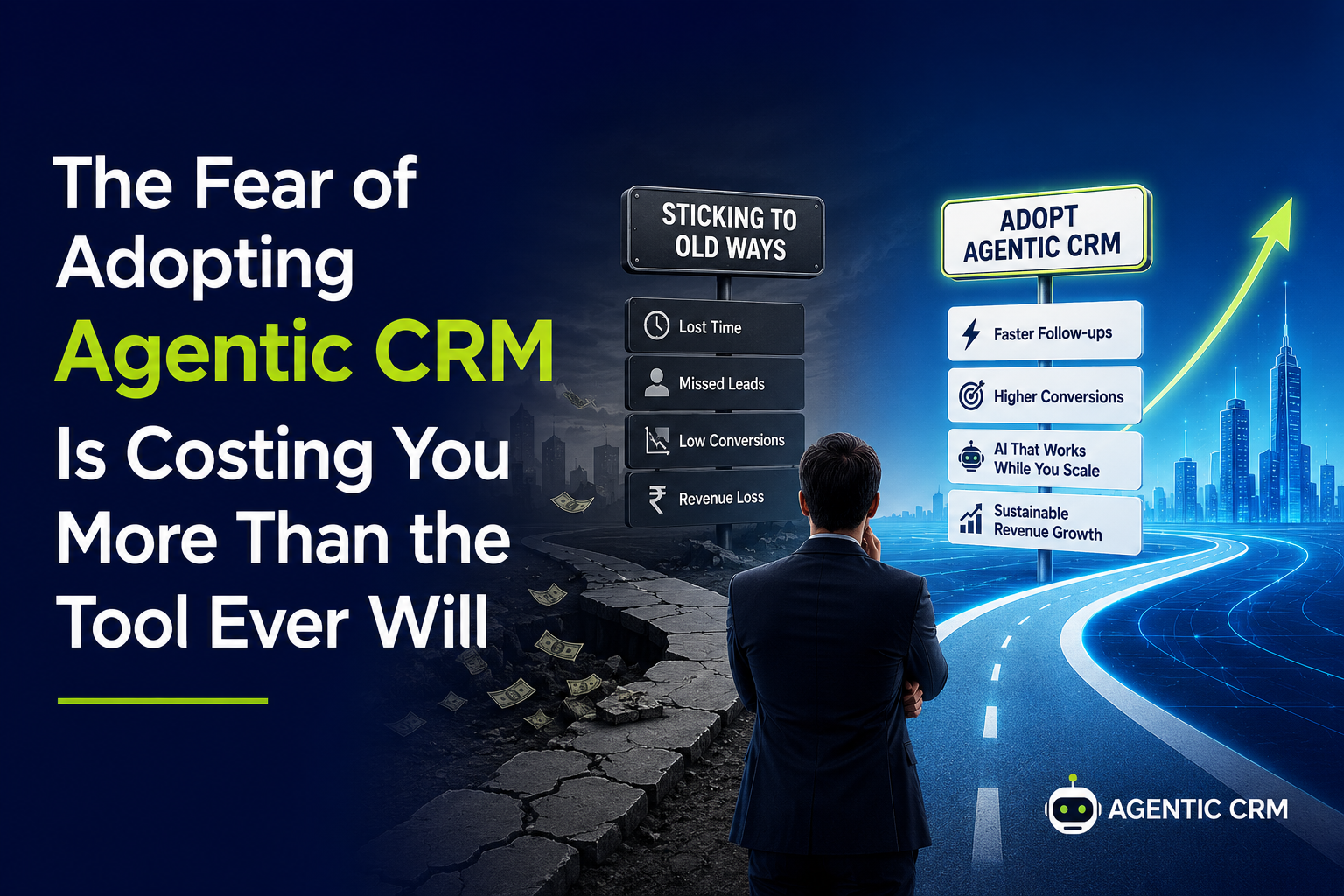
Summary: Agentic CRM adoption is no longer a luxury for large enterprises. For Indian SMBs in Education, Automobile, and Real Estate, the real cost is not the tool. It is every lead that went cold, every follow-up that never happened, and every deal that walked out the door while your team was busy with admin.
Most SMB owners who hesitate on agentic CRM adoption ask the same question: “Is this worth the cost?”
The better question is: “How much is not adopting it already costing me?”
Because the math is not in your favour. Every hour your sales team spends updating records, chasing cold leads, and manually drafting follow-ups is revenue your competitor with an agentic CRM is quietly collecting.
Agentic CRM is a customer relationship management system powered by autonomous AI agents. Unlike traditional CRM, which stores data and waits for your team to act on it, an agentic CRM takes action on its own. It calls leads, qualifies them, scores them, follows up over WhatsApp, and updates records, without a human triggering each step.
Traditional CRM is a filing cabinet. Agentic CRM is a sales rep who never needs a break.
The shift matters now because Indian SMBs are operating in a market where lead response time directly determines conversion. A student enquiring about an MBA programme at 10 PM does not wait until your counsellor arrives at 9 AM. A car buyer who fills a test drive form on Sunday afternoon has already visited three other dealerships by Monday morning.
Agentic CRM adoption closes that gap. It responds, qualifies, and follows up the moment a lead comes in, regardless of the time.
Here is what slow adoption actually looks like on a balance sheet.
Lead decay is immediate
Research consistently shows that lead conversion drops by over 80% if the first response takes longer than five minutes. Most SMB sales teams respond within hours, not minutes. That gap is not a process problem. It is a revenue leak.
For an Education CRM managing 500 enquiries a month, even a 20% improvement in first-response speed can translate to dozens of additional enrolments. At an average course fee of Rs. 50,000, that is lakhs sitting in your response time alone.
Your team is selling for only 30% of the day
Sales reps spend roughly 70% of their working hours on tasks that do not directly generate revenue. Updating CRM fields, writing follow-up messages, sorting lead lists, pulling reports. These are necessary tasks. However, they are not sales.
Agentic CRM adoption hands those 70% of tasks to AI. Your team wakes up to qualified leads, updated records, and scheduled callbacks. They spend the day closing, not administering.
The cost of one missed follow-up compounds
A lead that does not hear from you within 24 hours is statistically unlikely to convert. However, the cost does not stop there. That same lead may leave a poor review, choose a competitor, or simply become a lost referral. In verticals like Real Estate and Automobile, where a single deal can be worth Rs. 5 lakh to Rs. 1 crore, one missed follow-up is not a small error. It is a significant revenue event.
Take an automobile dealership in Pune running paid campaigns on Meta and Google. Leads come in through the day and through the night. The sales team works standard hours. By the time they call a lead from the previous evening, that prospect has already spoken to two other dealerships.
With agentic CRM adoption, the moment a lead fills a form, the AI Calling Agent dials them within seconds. It asks qualification questions, records the answers, and tags the lead based on intent. High-intent leads get a callback reminder pushed to the sales rep. Low-intent leads enter a WhatsApp follow-up sequence automatically. The sales team arrives in the morning with a clean, prioritised list and zero cold leads sitting uncontacted.
Now take an education institute in Delhi running admissions for three programmes simultaneously. Enquiries come from students, parents, and working professionals at completely different hours. The counselling team is stretched thin during peak season.
Agentic CRM adoption means the AI handles first contact for every enquiry. It identifies whether the lead is a student or a parent, which programme they enquired about, and what their urgency level is. It routes urgent leads to counsellors immediately and nurtures lower-priority leads through WhatsApp sequences. The counselling team focuses entirely on converting the leads that are already warm.
“It is too expensive for our size.”
The cost of agentic CRM adoption is fixed and predictable. The cost of missed leads, slow follow-ups, and manual errors is not. For most SMBs, one recovered deal per month covers the tool cost entirely. Everything after that is margin.
“Our team will not use it.”
Agentic CRM does not require your team to change how they sell. It changes what lands on their plate. Reps who previously spent mornings calling unqualified leads now receive a list of prospects who have already been contacted, qualified, and categorised. Adoption resistance drops when the tool makes the team’s job easier, not more complicated.
“We are not ready for AI yet.”
Readiness is not a technology problem. It is a mindset problem. Indian SMBs that waited to adopt mobile CRM in 2015 lost ground to competitors who moved early. Agentic CRM adoption is the same inflection point. The businesses moving now are building a compounding advantage in lead response, qualification accuracy, and sales efficiency that will be very difficult to close later.
The data makes the case clearly.
Businesses using CRM report a 29% increase in sales revenue on average. Sales productivity improves by 34%. Forecast accuracy improves by 42%. These are baseline CRM numbers. Agentic CRM, because it removes the human delay from every step, pushes those numbers further.
Companies deploying agentic AI report an average ROI of 171%, which is three times higher than traditional automation. Additionally, 79% of organisations that have adopted agentic AI are already planning to expand usage, which signals that the results are real and repeatable, not experimental.
For SMBs specifically, the return concentrates in three areas: faster lead response, reduced manual workload, and higher conversion rates from existing lead volumes. You do not need more leads. You need your current leads handled better.
Groweon AION is built specifically for Indian SMBs. It is not a global enterprise tool adapted for the Indian market. It is designed from the ground up for the way Indian businesses handle leads, manage sales teams, and operate across Education, Automobile, and Real Estate verticals.
AION’s AI Calling Agent contacts leads the moment they come in, asks the right qualification questions, and hands off to the Auto Lead Qualifier, which tags and categorises each lead based on the call outcome. The Lead Analyser then gives your sales manager a real-time view of lead quality, pipeline health, and team performance, without anyone pulling a report manually.
WhatsApp-based follow-up sequences run automatically for leads that need nurturing. Your team picks up where the AI leaves off, focusing entirely on conversations that have a real chance of converting.
This is what agentic CRM adoption looks like when it is built for your market.
The fear of agentic CRM adoption is understandable. Any new system feels like a risk. However, the risk of not adopting is now measurably larger than the risk of adopting. Every lead your team misses, every follow-up that comes too late, and every hour spent on admin instead of selling is a cost you are already paying. You are just not seeing it on an invoice.
Agentic CRM adoption does not replace your sales team. It removes everything that was slowing them down.
If your team is losing leads to slow response times and manual follow-up, Groweon AION can fix that within days of going live. Book a free demo and see exactly how agentic CRM works for your vertical.
What is agentic CRM adoption?
Agentic CRM adoption refers to the process of implementing a CRM system powered by autonomous AI agents that can independently contact leads, qualify them, follow up, and update records without requiring manual triggers from your sales team.
How is agentic CRM different from regular CRM?
A regular CRM stores and organises data but depends on your team to act on it. An agentic CRM acts on the data itself. It calls leads, scores them, routes them, and follows up automatically, reducing the gap between a lead coming in and your team responding.
Is agentic CRM adoption suitable for small businesses in India?
Yes. Agentic CRM adoption is particularly valuable for Indian SMBs because lead volumes are high, sales teams are lean, and response speed directly impacts conversion. Tools like Groweon AION are built specifically for Indian SMB verticals including Education, Automobile, and Real Estate.
What does agentic CRM cost compared to the revenue it recovers?
The cost of agentic CRM adoption is fixed and predictable. For most SMBs, recovering one additional deal per month from faster response and better follow-up covers the tool cost entirely. Companies deploying agentic AI report an average ROI of 171%.
How long does it take to see results from agentic CRM adoption?
Most businesses see measurable improvements in lead response time and follow-up consistency within the first 30 days. Revenue impact typically becomes visible within 60 to 90 days as conversion rates from existing lead volumes improve.
[wpforms id=”535″]

01 Oct, 2026
Summary (TL;DR): Lead management software captures, scores, routes, and nurtures...

01 Oct, 2026
Summary (TL;DR): CRM pricing in India typically runs ₹250 to...

30 Sep, 2026
Summary (TL;DR): A CRM with native Meta Conversions API integration...

29 Sep, 2026
Summary (TL;DR): The best choice depends on whether you want...

28 Sep, 2026
Summary (TL;DR): So, a B2B CRM has moved from a...