

Best CRM for Rubber and Tyre Manufacturers
16 Oct, 2026
Summary (TL;DR) The best CRM for rubber and tyre manufacturers...
Updated: 25th August, 2026
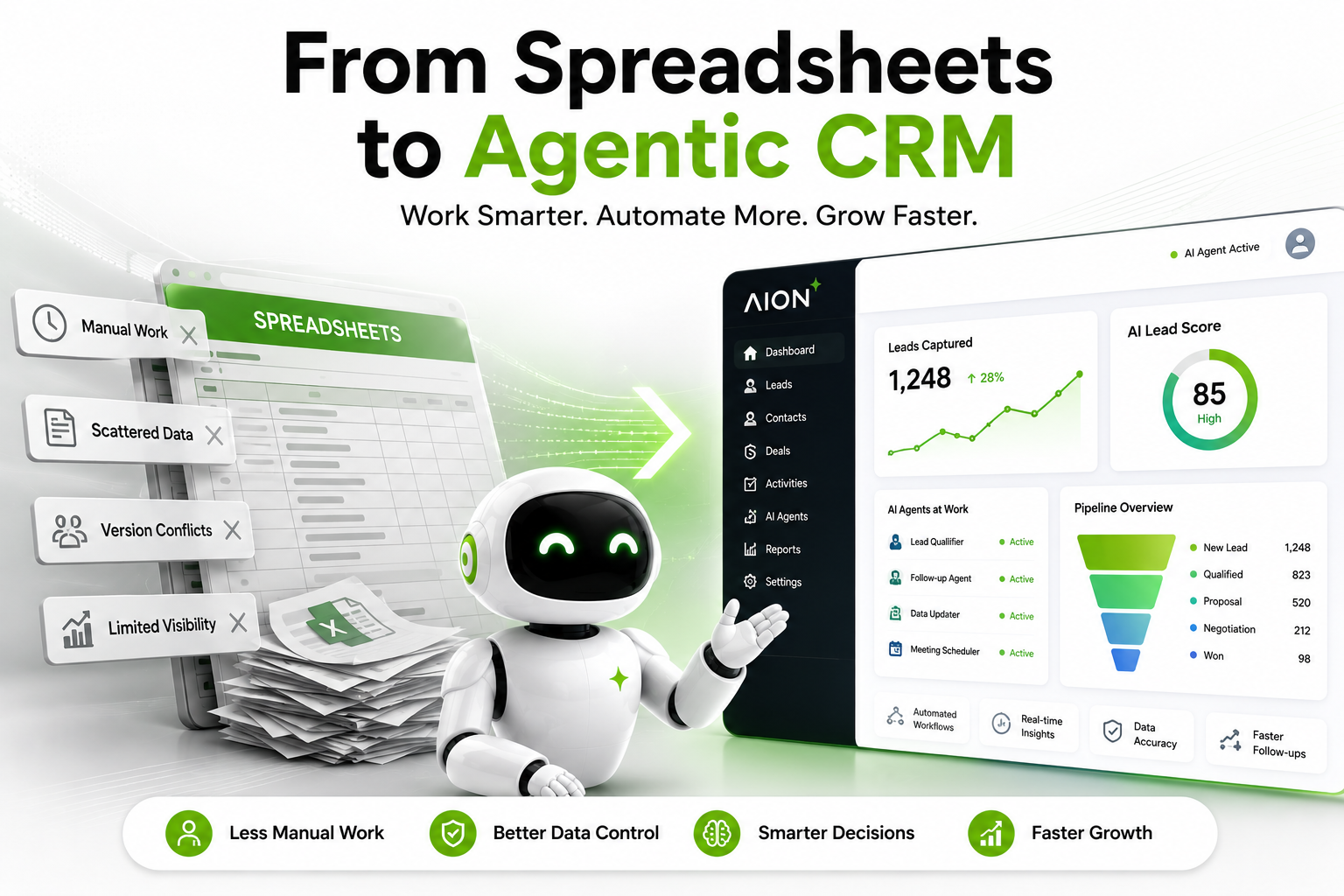
Spreadsheets create friction in the Agentic CRM era. They slow data entry, limit automation, and become harder to govern as your business grows. Groweon’s AION agents reduce repetitive manual work, helping your team respond faster and maintain more consistent customer records.
The move from spreadsheets to Agentic CRM is not about removing spreadsheets entirely. It’s about building your CRM on a platform designed for coordinated, automated, auditable workflows. That foundation lets your team work faster and smarter.
Spreadsheets become difficult to manage when customer relationships require shared records, automated workflows, current updates, and coordinated follow-up. In the age of Agentic CRM, where AI agents interpret customer data, recommend actions, and execute workflows under defined rules, spreadsheets create friction that slows your team. Groweon’s AION engine powers autonomous AI agents that capture interactions, score leads, and coordinate follow-ups 24/7. Spreadsheets were never designed for this workflow. It’s time to modernize.
Agentic CRM is a platform approach where AI agents can read customer and pipeline data, recommend or execute actions, and support workflows within defined permissions and business rules. Unlike traditional CRM, agents work continuously in the background, reducing repetitive manual data entry and accelerating routine decisions. Groweon’s AION is positioned as an autonomous AI sales partner for lead qualification, follow-up creation, record updates, and similar routine workflows. Learn more about agentic CRM.
Spreadsheets force your team into a cycle of manual entry, isolated data, and delayed insights. When your CRM agents generate actionable data in real time, but your team is still copy-pasting into Excel, you lose momentum. Additionally, spreadsheets create data silos. One person updates offline, another version exists in email, and your agents lack access to a single source of truth.
This fragmentation can reduce the quality and timeliness of the data available to your agents.
Consider the time cost. Sales teams often spend significant time on CRM administration, manual data entry, and follow-up coordination. Estimated benchmarks suggest 2-5 hours per person per week. At this rate, a 10-person team could spend approximately 87-217 hours per month on this work, assuming 4.33 weeks per month. Treat this as an illustrative benchmark rather than a guaranteed outcome. Groweon’s AION is designed to reduce repetitive work by capturing activity, scoring leads, and coordinating configured follow-ups.
Current data integration
Your AION agents analyze customer behavior and trigger workflows based on current or near-real-time information, depending on integrations and sync settings. Delayed updates can prevent agents and team members from acting on the latest customer information.
Centralized records and governance
A suitable Agentic CRM should provide configurable permissions, change tracking, and workflow controls to reduce conflicting updates. Spreadsheets lack these capabilities and become harder to govern as your team grows.
Support for higher volumes
Spreadsheets become harder to coordinate as lead volume and customer complexity grow. Agentic CRM platforms are designed to coordinate larger volumes and multiple workflows, subject to plan limits and integrations.
| Factor | Spreadsheet workflow | Agentic CRM |
|---|---|---|
| Data entry | Manual updates | Automated capture and workflow-based checks, where configured |
| Lead qualification | Often requires manual review | Can be automated or accelerated based on defined criteria |
| Data governance | Depends heavily on user discipline | Centralized permissions, controls, and change tracking, where supported |
| Follow-up orchestration | Manual scheduling or templates | Automated and event-driven workflows, where configured |
| Customer insights | Periodic or manually generated reports | Near-real-time insights, depending on integrations and sync settings |
| Scalability with team growth | Becomes harder to coordinate and govern | Designed to coordinate larger volumes and multiple workflows |
| Decision speed | Often hours to days | Potentially faster for defined workflows |
Actual outcomes depend on data quality, integration coverage, workflow design, plan limits, and user adoption.
Automation can reduce administrative delays and give sales representatives more time for customer-facing work. Reported productivity gains vary widely by workflow, baseline process, data quality, and implementation. Teams using CRM automation often see improvements in lead response time, data completeness, and follow-up consistency. Measure your own results using response time, qualification cycle length, data completeness, follow-up completion, and administrative hours saved.
Your competitors using Agentic CRM platforms may be spending less time on routine data work and responding to leads more quickly. Over time, faster responses and more consistent follow-up can improve the efficiency of your revenue operation.
Moving to Groweon means rethinking how your team captures and acts on customer data. Instead of managing spreadsheets, your governed CRM records become the foundation for action, while agents capture activity, identify signals, and execute approved workflows.
For SMBs in Education, Automobile, Real Estate, Insurance, FMCG Distribution, and B2B Sales, this shift can reduce response delays, improve record consistency, and make follow-up easier to manage. Groweon’s AION can be configured to handle lead nurturing, customer follow-up, and pipeline management workflows specific to your industry. It works within your CRM ecosystem, not alongside it.
Identify which sheets hold critical data. Who owns each? What fields are essential? Are there duplicates across sheets?
Remove duplicate records. Standardize field formats (dates, phone numbers, company names). Fix missing or incomplete records. This is the single most important step.
Define your CRM’s required fields and lifecycle stages. Map each spreadsheet column to a CRM field. Decide what stays in CRM versus what can be archived.
Migrate 100-200 records first. Validate that they imported correctly. Confirm that critical workflows still work.
Run the new system and your spreadsheet workflow in parallel for 2-4 weeks. Let your team get comfortable with the new process. Gather feedback on missing integrations or workflows.
Set a defined date to move entirely to Groweon. Archive your original spreadsheets securely. Communicate the change to the team.
Your AION agents and workflows may need tuning based on real usage. Initial configuration happens quickly, but optimization depends on your data, processes, feedback, and integrations.
Implementation timelines vary widely depending on data quality, team size, integrations needed, and workflow complexity. What works for a 3-person team will look different from a 50-person organization.
Spreadsheets represent a functional but limited approach to CRM. They lack the integration, automation, governance, and current responsiveness that agentic systems require. Groweon’s AION platform provides always-on intelligent automation and uses customer and workflow data to support better lead qualification, follow-up, and decision-making.
The choice is not about eliminating spreadsheets entirely. Many teams will export data for analysis or historical archiving. The choice is about whether your day-to-day CRM operations depend on spreadsheet updates or on a platform designed for coordinated, automated, auditable workflows.
See how Groweon’s AION can help automate lead qualification, follow-up, and CRM data entry. Book a demo to explore the right workflow for your team, or contact Groweon to discuss your use case.
What is Agentic CRM, and how is it different from traditional CRM?
Traditional CRM primarily helps teams store, organize, and access customer data. Agentic CRM adds AI agents that can interpret context, recommend next steps, and execute approved routine workflows such as lead qualification, follow-up creation, or record updates. These agents operate within defined permissions and escalation rules. Groweon’s AION is positioned as an autonomous AI sales partner for these types of workflows.
Can we still use spreadsheets after moving to Groweon?
Yes. Many teams export data from Groweon for analysis, forecasting, or specialized reporting. The difference is that spreadsheets become tools for analysis, not the foundation of your CRM operations.
How long does it take to migrate our data?
Migration speed depends on data quality, spreadsheet structure, record volume, deduplication requirements, permissions, and integrations. Clean data with simple workflows may be migrated quickly, while multiple files and complex integrations can require more preparation. Confirm the migration scope and timeline with Groweon before implementation.
How quickly can we start seeing results?
Initial agent workflows may be configured quickly. However, optimization depends on your data quality, business processes, integrations, user feedback, and how well your team adopts new workflows. Early wins often show up in reduced data-entry burden within the first 1-2 weeks.
Will AION agents learn and improve over time?
Groweon’s workflows can use interaction history, performance feedback, and business rules to improve recommendations and automation. Your team defines rules and feedback loops that guide agent behavior. As your processes stabilize and you gather data on what works, you can refine agent configuration for better results.
What if our team is hesitant to move away from spreadsheets?
Adoption tends to accelerate because agents do the hard work. Your team uses simpler dashboards and focuses on customer-facing activities instead of data entry. Training requirements depend on team size, workflow complexity, and existing processes. A short hands-on onboarding period, supported by a parallel run, can help teams build confidence.
Groweon offers workflows and use cases for sectors including Education, Automobile, Real Estate, Insurance, FMCG Distribution, and B2B Sales. Availability and configuration may vary by use case. Contact Groweon to confirm support for your industry.
How do we measure whether Agentic CRM is working?
Track these metrics before and after:
Results vary based on workflow design and your baseline, so focus on trend over time rather than absolute benchmarks.
What happens to our data if we stop using Groweon?Before signing up, review Groweon’s contractual terms, data-retention policy, privacy policy, and export capabilities. Ask which records can be exported, in what formats, and how data is handled after account termination. These details should match your data governance requirements.
[wpforms id=”535″ title=”true” description=”true”]

16 Oct, 2026
Summary (TL;DR) The best CRM for rubber and tyre manufacturers...

16 Oct, 2026
Summary (TL;DR) A CRM for agricultural equipment manufacturers tracks farmer...

16 Oct, 2026
Summary (TL;DR) The best CRM for paint and coatings manufacturers...

15 Oct, 2026
Summary (TL;DR) A CRM for cement and building material manufacturers...

15 Oct, 2026
Summary (TL;DR) A CRM for pharma API and bulk drug...