
Sales Automation Tools: 13 Best Platforms to Streamline Sales in…
19 Nov, 2026
Summary Sales teams handle multiple activities, from capturing enquiries to...
Updated: 19th November, 2026
Summary (TL;DR):
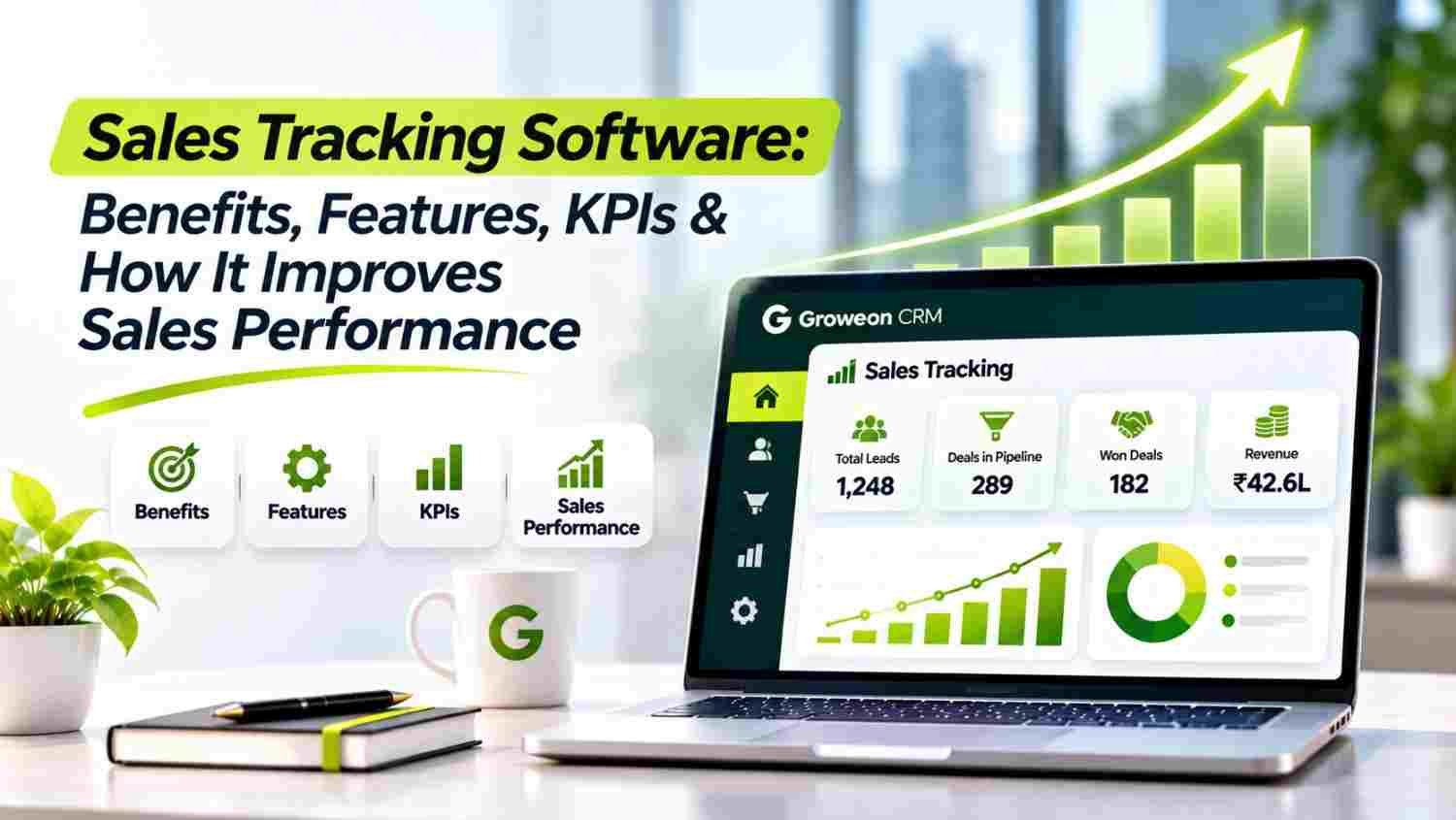
Sales Tracking Software helps businesses monitor sales activities, pipeline movement and team performance.
It turns everyday sales data into useful insights for managers and business owners.
From lead response time to conversion rates, tracking the right KPIs helps identify opportunities and performance gaps.
This guide explains its importance, benefits, essential features and how businesses can improve sales visibility with Groweon CRM.
Sales can sometimes feel like a process of trial and error. A team may generate hundreds of enquiries, conduct customer meetings and send quotations, yet still struggle to understand why monthly targets are not being achieved.
The answers often exist in the sales data. Every lead, call, meeting, follow-up and closed deal provides information about how the sales process is performing.
Sales Tracking Software helps businesses capture, monitor and analyse this information throughout the sales cycle. It gives managers a clearer view of individual performance, pipeline health and business results, making it easier to identify trends and take corrective action.
Instead of waiting until the end of the month to discover a problem, businesses can use sales data to understand what is happening and respond earlier.
Sales Tracking Software is a digital solution that helps businesses record, monitor and analyse sales activities and performance. It provides visibility into the complete sales process, from the first customer enquiry to the final deal closure.
A sales tracking system can help monitor:
For example, imagine a business receives 250 enquiries in a month. Its sales manager wants to know how many were contacted, how many received quotations, how many are awaiting follow-up and how many became customers.
Without a centralised tracking system, this information may be scattered across spreadsheets, phone records and individual reports.
With the right Sales CRM Software, businesses can connect customer records, sales activities and pipeline information in one place.
A well-organised tracking process also creates a foundation for sales data analytics, helping managers understand performance instead of relying on assumptions.
Sales leaders are responsible for setting targets, managing representatives and ensuring that opportunities move through the sales pipeline. However, achieving these goals becomes difficult when managers cannot see what is happening across the team.
Sales Tracking Software provides a more complete view of sales operations. It helps managers identify performance gaps, monitor progress and make adjustments before small problems affect larger business targets.
Consider a sales team that is meeting its current monthly target but has very few qualified opportunities for the next month. Without pipeline visibility, management may discover the problem too late.
By reviewing pipeline activity regularly, the manager can identify the shortage early, improve prospecting efforts and redistribute sales responsibilities where required.
This is why sales pipeline management and performance tracking should work together.
Sales tracking helps managers evaluate how effectively representatives are generating leads, contacting prospects and converting opportunities.
Instead of looking only at revenue, businesses can review the activities that contribute to sales results. This gives managers a better understanding of individual and team performance.
A decline in new opportunities, delayed follow-ups or stalled deals can indicate problems within the sales process.
Regular tracking helps managers identify these patterns and take corrective action before the end of a reporting period.
When leads, tasks and opportunities have clear ownership, representatives understand their responsibilities.
Managers can review completed activities, pending follow-ups and deal progress without depending entirely on verbal updates.
Historical sales data helps businesses understand performance trends and plan future activities.
Managers can use pipeline information, previous conversion rates and current opportunities to support more realistic sales planning. A structured sales forecasting process can help connect current pipeline conditions with expected revenue.
Tracking customer interactions helps representatives understand what was discussed previously and what needs to happen next.
This creates continuity across calls, meetings, quotations and follow-ups, reducing the risk of missed commitments.
Sales Tracking Software offers benefits beyond maintaining records. When sales information is captured consistently and reviewed regularly, it can improve decision-making, productivity and customer management.
Sales reports are only useful when the underlying information is accurate and complete.
Manual records can contain missing details, duplicate entries or outdated information. These problems can affect performance reports and create an incomplete picture of business activity.
A CRM-integrated tracking system can help maintain more consistent records through centralised data and supported automation.
For more context, explore CRM data quality.
Sales representatives often spend considerable time updating spreadsheets, searching for customer information and preparing activity reports.
A centralised system reduces the need to manage information across disconnected tools. Representatives can access customer details, review pending activities and update opportunities from one platform.
Businesses can also use sales productivity insights to identify repetitive tasks and improve the way their teams work.
Customer relationships require timely communication and a clear understanding of previous interactions.
Sales tracking helps representatives review customer history, record requirements and plan relevant follow-ups. This makes conversations more consistent and helps teams avoid asking customers for the same information repeatedly.
A connected customer relationship system can bring lead records, customer details and sales activities together.
Sales managers need to understand not only who is meeting targets, but also why certain representatives are performing differently.
For example, one representative may generate enough enquiries but struggle to convert them into meetings. Another may successfully arrange meetings but lose opportunities during negotiation.
Sales tracking helps managers identify these patterns and provide more relevant coaching.
The sales performance metrics used for evaluation should reflect each representative’s role and responsibilities.
As businesses grow, sales data comes from different sources, teams and customer interactions.
Sales analytics can help identify patterns across lead sources, sales representatives, territories and pipeline stages. Managers can use these insights to understand which activities are producing results and where improvements may be needed.
Platforms offering sales analytics capabilities can help transform sales information into reports and visual dashboards.
Before implementing sales tracking, businesses should identify the performance indicators that matter most to their objectives.
Key Performance Indicators (KPIs) help managers measure progress and understand whether sales activities are producing the expected outcomes.
However, every business does not need to track the same metrics. A company focused on acquiring new customers may prioritise lead response time and conversion rate, while a business with an established customer base may focus more on repeat purchases and customer lifetime value.
The following KPIs can help businesses understand different aspects of sales performance.
Lead response time measures how quickly a sales representative contacts a new enquiry.
A long delay can reduce the opportunity to engage a prospect while their interest is high. Monitoring this metric helps businesses evaluate lead assignment and response processes.
Lead conversion rate measures the percentage of leads that become customers.
Formula:
Lead Conversion Rate = (Number of Converted Leads ÷ Total Leads) × 100
For example, if a business receives 200 leads and converts 20 into customers, its lead conversion rate is 10%.
This metric helps managers evaluate lead quality, follow-up consistency and sales effectiveness.
Sales activity measures the actions completed by representatives, such as calls, emails, meetings and follow-ups.
It helps managers understand how teams are spending their time. However, activity volume should be evaluated alongside results rather than treated as a direct measure of sales success.
Pipeline value represents the estimated value of active sales opportunities.
Managers can review the total value of open deals, their current stages and expected closing dates to understand potential revenue.
For more detailed pipeline analysis, businesses can explore pipeline tracking metrics.
Win rate measures the percentage of closed opportunities that resulted in successful sales.
Formula:
Win Rate = (Number of Won Deals ÷ Total Closed Opportunities) × 100
For example, if a team closes 30 deals out of 100 completed opportunities, its win rate is 30%.
Average deal size measures the average revenue generated from closed deals.
Formula:
Average Deal Size = Total Revenue from Closed Deals ÷ Number of Closed Deals
This metric helps businesses understand the value of their sales and identify opportunities to improve deal quality.
Sales cycle length measures the time taken to convert an opportunity into a closed deal.
Tracking this metric can help managers identify stages where opportunities remain inactive for longer than expected.
This KPI compares actual sales revenue with the assigned target for a specific period.
It helps managers understand whether individuals and teams are progressing towards their business objectives.
A useful sales performance dashboard can bring these indicators together for regular review.
All sales tracking platforms are not designed in the same way. Some focus on reporting and analytics, while others combine tracking with lead management, communication and workflow automation.
Before selecting a solution, businesses should evaluate the features that support their actual sales process.
Manually recording every call, meeting and customer interaction can take time and may lead to incomplete records.
Look for software that supports automatic activity capture wherever available. This can help improve data consistency and reduce administrative work.
For example, CRM activity tracking can connect sales interactions with customer records and provide better visibility into ongoing activities.
When customer details, calls, leads and reports are maintained in separate applications, information can become difficult to reconcile.
A CRM-integrated solution provides a central place for sales teams and managers to access relevant information.
This also helps avoid fragmented reporting and unnecessary data duplication.
The software should provide a clear view of opportunities at different sales stages.
Managers should be able to identify new enquiries, qualified leads, active negotiations, pending quotations and closed deals.
A properly configured sales pipeline process helps teams understand where each opportunity stands and what action is required next.
Sales tracking software should provide reports that help managers understand lead movement, representative performance, conversion rates and revenue.
Customisable dashboards are useful because different users need different information. Sales representatives may need pending tasks, while managers may need team performance and pipeline health.
AI-powered capabilities can help sales teams analyse information, prioritise opportunities and identify patterns in customer interactions.
Depending on the platform, AI may support lead scoring, sales recommendations, forecasting and communication assistance.
Businesses should evaluate these features based on their actual requirements and the quality of available sales data.
For an overview of AI sales insights, refer to Microsoft’s documentation.
Sales representatives often work outside the office, attend customer meetings and visit different locations.
Mobile CRM access helps them view customer records, update activities and manage follow-ups while travelling.
A dedicated mobile CRM application can keep field representatives connected with the wider sales team.
Businesses can choose from several types of platforms depending on their sales operations. Some solutions provide advanced enterprise analytics, while others combine CRM, sales tracking and automation.
For example, Zoho CRM analytics supports sales performance analysis, pipeline visibility and forecasting. Microsoft Dynamics 365 provides sales forecasting tools for reviewing pipeline performance and expected outcomes.
Salesforce offers pipeline visibility features to help teams review deal progress and identify risks. Businesses can also explore Pipedrive sales analytics for sales dashboards, performance analysis and forecasting.
For Indian SMBs, the selection should also consider ease of use, local business requirements, communication channels, mobile access and overall cost.
Groweon CRM brings lead management, sales activities, pipeline visibility and reporting together in one connected environment.
Its Sales CRM is designed to help businesses organise customer information, monitor sales opportunities and manage daily sales operations.
Key capabilities include:
Businesses with field sales teams can also explore field sales management capabilities for tracking visits, meetings and customer activities across territories.
For representatives who need access while travelling, Groweon Lite Mobile provides mobile CRM capabilities for managing leads, customers, meetings and sales activities.
Groweon’s industry-focused solutions also support businesses with different sales processes, including pharma sales management.
To understand how the platform connects sales operations with broader business requirements, explore Groweon CRM Platform.
Implementing software alone does not guarantee better sales performance. Businesses also need a clear process for recording information, reviewing reports and acting on insights.
The following steps can help establish a practical tracking system.
Identify what the business wants to improve. Objectives may include increasing conversion rates, improving response time, reducing missed follow-ups or achieving monthly revenue targets.
Choose metrics that directly relate to these objectives. Avoid tracking too many numbers without a clear purpose.
Define the stages through which opportunities move, from initial enquiry to final closure. Ensure that all representatives follow the same definitions.
Bring customer records, interactions, activities and opportunity updates into one system. This creates a more consistent foundation for reporting.
Review activity reports regularly and evaluate broader performance metrics at suitable intervals. Daily or weekly reviews can help identify operational gaps, while monthly reviews can support strategic planning.
Use the information to improve actual sales processes. If response times are increasing, review lead assignment. If deals are getting stuck during negotiation, examine the reasons and provide targeted coaching.
Sales processes change as teams grow and customer requirements evolve. Revisit KPIs, pipeline stages and reporting requirements periodically to keep the system useful.
Sales Tracking Software helps businesses monitor leads, customer interactions, sales activities, pipeline movement and revenue performance. It provides organised information that managers can use to evaluate progress and improve sales operations.
It gives managers visibility into representative activities, lead progress and conversion results. This helps identify delays, stalled opportunities and areas where additional coaching or process improvements may be required.
Common KPIs include lead response time, lead conversion rate, sales activity, pipeline value, win rate, average deal size, sales cycle length and revenue against target. The right combination depends on business objectives and team responsibilities.
Yes. Depending on the platform, managers can review assigned leads, calls, meetings, completed tasks, follow-ups and closed deals. Performance should be evaluated using relevant metrics rather than activity volume alone.
Sales tracking records and monitors actual activities, opportunities and results. Sales forecasting estimates future revenue using pipeline information, historical performance and business assumptions. Reliable tracking helps provide the data needed for more informed forecasting.
Yes. CRM software can connect customer information, lead history, sales activities, opportunities and reports in one system. This makes it useful for businesses that want to monitor the complete sales process.
Yes. Depending on the software, businesses can automate selected activities such as call logging, lead assignment, follow-up reminders, notifications and reporting workflows.
Yes. Platforms with mobile CRM capabilities allow field representatives to access customer records, update activities and manage meetings while working outside the office.
Operational activities and pending follow-ups can be reviewed daily or weekly. Broader metrics such as revenue, conversion rates and sales cycle length can be evaluated weekly or monthly, depending on the business’s sales cycle.
Groweon CRM provides lead management, sales pipeline tracking, meeting management, activity tracking and MIS reporting capabilities. These features help businesses organise sales information and monitor team performance through a connected CRM environment.
Sales growth depends on understanding what happens throughout the sales process, not just measuring the final revenue.
When businesses track leads, customer interactions, representative activities and pipeline movement, they gain a clearer understanding of their sales performance. This information helps managers identify problems earlier, support their teams and make better business decisions.
The right Sales Tracking Software brings these details together, reduces dependence on scattered records and creates a more structured approach to sales management.
For businesses looking to connect lead management, sales activities, customer communication and reporting, Groweon CRM offers a platform worth exploring. The goal is simple: give every sales team better visibility into its work and help managers make decisions based on meaningful data.

19 Nov, 2026
Summary Sales teams handle multiple activities, from capturing enquiries to...

19 Nov, 2026
Summary (TL;DR): A Sales CRM helps businesses organise customer information,...
19 Nov, 2026
Summary (TL;DR): Sales Tracking Software helps businesses monitor sales activities,...
18 Nov, 2026
Inventory Automation helps businesses maintain accurate stock records, monitor product...

18 Nov, 2026
Service Ticket Management Software helps businesses organise customer requests, assign...