

How Businesses Can Use QR Codes to Improve Customer Engagement
26 Oct, 2026
It’s easier to scan a QR code than to type...
Updated: 5th October, 2026
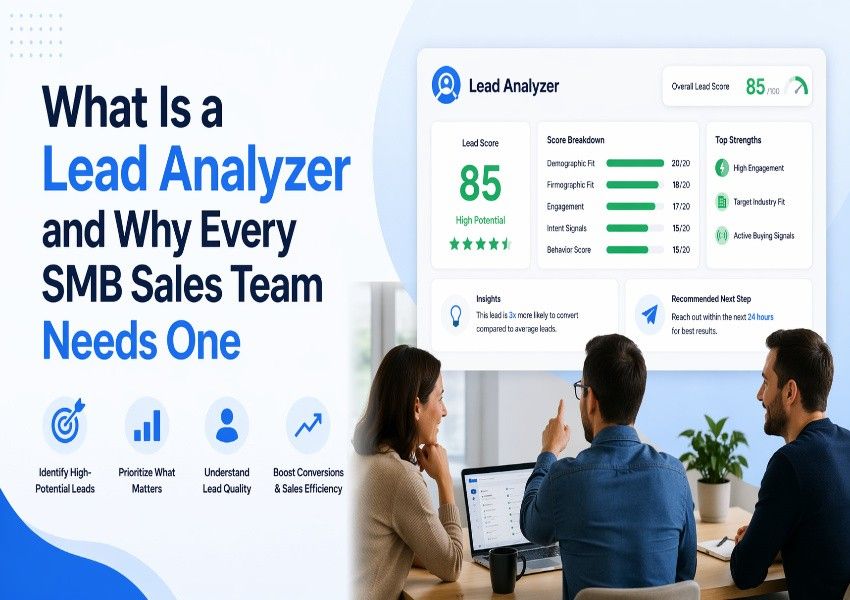
If your sales team is spending hours chasing leads that never convert, the problem is rarely effort. It is almost always a lack of clarity. Without a structured way to evaluate incoming leads, even the best sales reps end up treating every prospect the same, wasting time, losing momentum, and missing the leads that actually matter.
That is exactly the gap a Lead Analyzer fills. And for small and mid-sized businesses in India, where sales teams are lean and every hour counts, this tool is becoming less of a luxury and more of a necessity.
A Lead Analyzer is an AI-assisted feature within a CRM that evaluates each lead based on key attributes, provides a structured summary of the lead’s profile and potential, and helps sales reps understand where to focus their attention.
Unlike manual lead review, where a rep reads through a form submission or call note and makes a gut-based judgment, a Lead Analyzer surfaces meaningful context instantly. It considers factors such as the lead’s industry, company size, intent signals, past interactions, and stated requirements to give your team a clearer picture of who they are dealing with before the first call is even made.
Think of it as a pre-call briefing that your CRM generates automatically, so your reps walk into every conversation informed and prepared.
When a new lead enters your CRM, whether through a web form, a WhatsApp inquiry, an inbound call, or a referral, the Lead Analyzer processes the available information and generates a structured analysis. This typically includes:
This happens in seconds, without the rep needing to do any manual data analysis or research.
In Groweon CRM, the Lead Analyzer is one of seven AI features built directly into the platform. It works based on the information available in the lead record and helps sales reps create structured, context-aware notes and follow-up plans, so no lead is approached blind.
The reality of SMB sales in India is that most teams are stretched. A sales rep at a small business is often managing 50 to 100 active leads at a time across multiple stages of the funnel. With no structured way to differentiate between these leads, the follow-up approach becomes generic: same pitch, same timing, same message for everyone.
This creates several compounding problems.
Wasted time on low-potential leads: Without analysis, reps spend equal time on leads that are nowhere near ready to buy as they do on leads that are ready to convert today. The challenge is that not all leads bring equal value, and without data-driven prioritization, sales reps end up focusing their time and effort on prospects that are less likely to convert.
Missed context before conversations: When a rep does not know what the lead has asked for, what industry they belong to, or what problem they are trying to solve, the first call becomes a discovery call that could have been a closing call.
Inconsistent sales quality: Different reps interpret the same lead data differently. Without a standardized analysis layer, lead evaluation becomes dependent on individual experience and intuition, which creates uneven outcomes across the team.
Slow response times: When lead qualification requires manual review, the time between a lead entering the CRM and a rep acting on it stretches. In a competitive market, that delay costs deals.
The shift toward AI-assisted lead management is accelerating across markets. Advanced AI algorithms can now predict lead conversion probabilities with up to 87% accuracy, enabling sales teams to prioritize high-value prospects more effectively. For SMBs that cannot afford to experiment with large pipelines or high-volume outreach, this kind of precision is critical.
A Lead Analyzer directly impacts three things every SMB sales leader cares about:
Conversion rate: When reps approach leads with context, their conversations are more relevant, and relevant conversations convert at a higher rate. A rep who knows that a lead runs a 15-person logistics company and is looking to replace a manual tracking process will open very differently from a rep who only knows a name and a phone number.
Sales cycle length: Informed reps move faster. When the analysis is done before the call, the call itself becomes more focused. Fewer cycles are wasted on generic discovery, and decisions move faster on both sides.
Rep productivity: Automation and AI-driven analysis frees up sales teams to concentrate on relationship-building and closing deals rather than routine administrative work. When your reps are not spending time manually reviewing lead records before every call, they get more calls done in less time.
Not all lead analysis tools are built the same. When evaluating whether a CRM’s Lead Analyzer is actually useful for your team, look for these qualities.
It should work with the data you already have. A Lead Analyzer should not require extensive setup or third-party integrations to function. It should generate useful insights based on the information your team captures through your existing lead forms and CRM fields.
It should surface actionable output. A summary that just restates the lead’s name and phone number is not useful. The analysis should tell the rep something they would not immediately know from scanning the form, whether that is a likely objection, a relevant talking point, or a suggested next step.
It should be fast and frictionless. If the tool adds steps to the rep’s workflow rather than removing them, adoption will be low. The best Lead Analyzers are built into the CRM interface itself and generate analysis with a single click or automatically on lead entry.
It should support consistency across the team. The output should be standardized enough that every rep, regardless of experience level, gets the same quality of lead context before their calls.
This is a common point of confusion, and worth clarifying.
Lead Scoring assigns a numerical value to a lead based on predefined criteria. A lead from a large company gets a higher score than a lead from an individual buyer. A lead who visited your pricing page twice scores higher than one who only read a blog post. Lead Scoring tells you how much to prioritize a lead.
A Lead Analyzer goes a step further. It does not just rank the lead; it explains the lead. It gives your rep context about who this person is, what they likely need, and how to approach them. Lead Scoring answers the question “which lead should I call first?” A Lead Analyzer answers the question “what should I know before I make that call?”
In a well-designed CRM, both work together. Groweon CRM, for example, includes both AI Lead Scoring and a Lead Analyzer as separate but complementary features, so your team gets both prioritization and context in one place.
Consider a mid-size real estate consultancy in Pune with a team of eight sales executives. Every day, 30 to 40 new leads come in through the website, property portals, and walk-ins. Without a Lead Analyzer, each executive scans the lead record manually before calling, a process that takes several minutes per lead and produces inconsistent results.
With a Lead Analyzer built into the CRM, the moment a lead is added, the system generates a brief profile: the lead’s stated budget, the property type they inquired about, how they found the consultancy, and any specific requirements they mentioned. The executive picks up the phone knowing this context. The call is focused. The conversation moves faster. And the lead feels heard from the first minute because the rep is not asking questions whose answers are already in the system.
This is the compounding advantage of AI-assisted analysis at the SMB level. It does not replace the sales rep. It makes every rep perform like your best one.
Groweon CRM’s Lead Analyzer is designed specifically for Indian SMBs operating in competitive, fast-moving sales environments. It helps your team:
The Lead Analyzer works alongside Groweon’s AI Lead Scoring, Smart Suggestions, and AI Email Writer features, giving your sales team a complete AI-powered toolkit within a single CRM built for the Indian market.
Conclusion
Your sales team does not need more leads. They need better context about the leads they already have. A Lead Analyzer gives them exactly that: a clear, structured picture of every prospect before the first conversation begins. For SMBs competing in fast-moving markets, that context is not a feature. It is a competitive advantage.
Ready to see how Groweon’s Lead Analyzer can sharpen your sales team’s performance? Explore Groweon CRM and discover the full suite of AI features built for Indian SMBs.
What is a Lead Analyzer in a CRM?
A Lead Analyzer is an AI-assisted feature that evaluates lead information and generates a structured summary to help sales reps understand a lead’s profile, requirements, and potential before initiating contact.
Is a Lead Analyzer the same as Lead Scoring?
No. Lead Scoring assigns a priority rank to a lead. A Lead Analyzer provides context and insights about the lead’s profile and needs. Both serve different purposes, and the most effective CRMs include both features.
Do SMBs really need a Lead Analyzer?
Yes, especially teams managing high lead volumes with limited sales headcount. A Lead Analyzer ensures every lead is approached with relevant context, which directly improves conversion rates and reduces wasted effort.
How does Groweon’s Lead Analyzer work?
Groweon’s Lead Analyzer processes the information captured in your lead records and generates structured, AI-assisted summaries and talking points based on that data. It is designed to be fast, intuitive, and immediately useful for sales reps without any complex setup.
Can a Lead Analyzer work for any industry?
Yes. Whether you are in real estate, financial services, education, automotive, or any other sector with an active sales pipeline, a Lead Analyzer helps your team engage more intelligently with incoming leads.

26 Oct, 2026
It’s easier to scan a QR code than to type...

26 Oct, 2026
Summary FMCG CRM Software connects field sales teams, distributors, retailers...

26 Oct, 2026
A supplier emails you a price sheet. But there is...

26 Oct, 2026
Summary Choose CRM Software according to your sales process, business...

23 Oct, 2026
Summary Compare 10 field service and field workforce software options...