

Agentic CRM in India: What It Actually Costs and How…
24 Sep, 2026
Summary (TL;DR): An agentic CRM is a system where AI...
Updated: 14th May, 2026
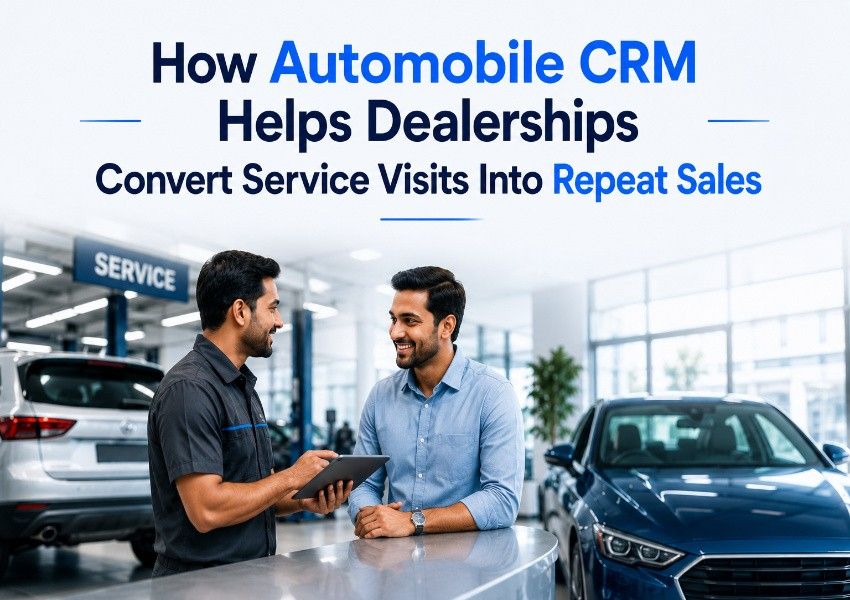
Every time a customer drives into your service bay, they are handing you a second sales opportunity. Most dealerships miss it entirely.
The numbers are unambiguous. According to Cox Automotive research, 74% of customers who service their vehicles at the selling dealership are likely to purchase their next vehicle from the same place. Yet 70% of customers who bought a new car from a dealer did not return for service — and without service engagement, that repeat sale almost certainly goes to a competitor.
This is exactly the gap that automobile CRM is built to close. A purpose-built automotive CRM does not just manage leads and showroom pipelines. It turns your service drive into a revenue engine — capturing intent signals, automating follow-ups, and rebuilding customer relationships that dealerships typically let lapse after handover.
Before getting into how automobile CRM works, it is worth understanding why the service visit is so commercially important.
The service department contributes up to 49% of a dealership’s total gross profits, according to NADA’s 2024 Data Report. Despite this, dealerships now handle 12% fewer service visits than they did in 2018, with independent repair shops steadily gaining market share.
The financial implication is severe. Customer lifetime value for a retained automotive customer can reach $47,700 — yet only 43.9% of customers return to purchase from the same brand. Every service customer who slips away quietly is not just a lost oil change — it is a lost vehicle purchase, lost trade-in, and lost referral.
An automobile CRM system gives dealerships the infrastructure to stop this bleed at the source.
Standard CRM platforms are designed for linear sales pipelines. Automotive retail does not work that way. A customer’s relationship with a dealership is cyclical — purchase, service, repeat — and the signals that predict the next sale often come from the service department, not the showroom.
According to a Cox Automotive Sales Tracking Study, a staggering 92% of automotive sales are untraceable in conventional CRM systems, representing buyers who never submitted inquiry forms but still completed purchases. This data gap is what an automotive CRM resolves. By integrating service history, repair orders, mileage data, and communication logs into a single customer profile, automobile CRM software gives your team a complete, real-time picture of every customer’s journey — not just their last purchase.
Unlike traditional CRMs, automotive dealership CRM systems are uniquely built to track detailed customer interactions specific to car sales, financing, trade-ins, and service histories — making them far better suited to the dealership environment.
The single biggest reason dealerships lose post-service customers is the absence of follow-up. A service advisor closes the job card, hands back the keys, and the conversation ends. With an automotive CRM, it does not.
Automobile CRM software automatically triggers personalised follow-up messages — via WhatsApp, SMS, or email — after every service visit. These can include satisfaction check-ins, feedback requests, upcoming maintenance reminders, and targeted trade-in offers based on the vehicle’s age and mileage. Every interaction is logged, every follow-up is tracked, and nothing falls through the cracks.
For Indian dealerships managing hundreds of service repair orders monthly, this automation is not a luxury — it is the only scalable way to stay in contact with every customer.
One of the most powerful features of a modern automobile CRM is the ability to set automated reminders tied to a vehicle’s actual service interval — not a generic calendar date.
When a customer’s vehicle approaches its next scheduled service based on mileage or last visit date, the CRM fires an outreach automatically. This keeps the dealership top-of-mind at the exact moment the customer is making a servicing decision — and competing against independent garages for that booking.
The 74% repurchase stat cited earlier is not passive. It is the result of consistent engagement. Mileage-based reminders via automotive CRM are what make it actionable rather than aspirational.
Not every service customer is equally close to buying. An automobile CRM equipped with AI lead scoring can analyse a customer’s service history, vehicle age, mileage, previous purchase behaviour, and engagement signals to identify who is most likely to be in the market for a new vehicle.
This means your sales team is not cold-calling every service customer indiscriminately — they are reaching out to the right people, at the right time, with the right offer. Groweon’s AI Lead Scoring feature, built natively into the platform’s automobile CRM, does exactly this — automatically surfacing high-intent service customers for your sales team to act on.
One of the most damaging disconnects in dealerships is when sales and service operate as two separate teams with two separate systems. A customer who bought from you three years ago walks in for a routine service, and the service advisor has no idea who they are, what they bought, or when their next upgrade window opens.
Automotive CRM eliminates this by centralising the full customer profile — purchase date, model, financing status, service visits, complaint history, and communication logs — in one place. Every team member who interacts with a customer can see the complete picture. Customers introduced to service during the sales process are 1.5 times more likely to return for both service and future purchases — and automobile CRM ensures that connection is never lost.
Here is a powerful but underutilised use case of automobile CRM: conquest selling. A large portion of the customers visiting your service department never bought their vehicle from you. They came in because you are convenient, cheaper, or better rated.
Industry data shows that 63% of service customers did not purchase their vehicle from the dealership currently servicing it — these customers represent prime conquest opportunities already walking through your doors. With an automotive CRM, every service repair order for a non-purchaser can automatically enter a nurture sequence — introducing them to your sales offers, financing options, and trade-in valuations. What was a one-time service visit becomes the start of a new customer relationship.
In the Indian market specifically, WhatsApp is the dominant communication channel for customer engagement. A well-configured automobile CRM integrates WhatsApp outreach directly into post-service workflows — sending service summaries, next visit reminders, and upgrade offers in the channel customers actually respond to.
Groweon’s automotive CRM includes a built-in AI WhatsApp Writer that auto-generates personalised WhatsApp messages for post-service follow-up — reducing the time your team spends on manual outreach while maintaining a personalised tone at scale.
The business case for investing in automobile CRM comes down to one simple truth: retaining a customer costs far less than acquiring one. Acquiring new customers costs 7–10 times more than retaining existing ones.
According to Kimoby’s dealership retention benchmarks, increasing retention by just 5% can increase profits by 25–95%, and repeat customers spend 31% more on average.
Meanwhile, Auto Remarketing’s VehicleLyfe analysis found that the rate of customers returning to a dealership for repeat purchases or service dropped 12% in 2024, with just around 20% of dealership sales coming from repeat customers — far below the one-third benchmark considered healthy for long-term sustainability.
This is the retention crisis facing Indian dealerships today. An automotive CRM system with automated service follow-ups, AI lead scoring, and multi-channel outreach is the most direct lever available to reverse that trend.
When evaluating automotive CRM software for your dealership, prioritise the following capabilities:
Service-to-sales pipeline integration — The CRM should bridge service repair orders with your sales pipeline automatically, flagging high-potential service customers for follow-up.
Automated multi-channel follow-up — WhatsApp, SMS, and email outreach should trigger without manual input from your team.
AI lead scoring — The system should rank service customers by purchase likelihood so your sales team focuses effort intelligently.
Mileage and time-based reminders — Service reminders should fire based on vehicle data, not generic intervals.
Centralised customer profiles — Full purchase, financing, and service history in one view, accessible by both sales and service teams.
Real-time dashboards — Management should have visibility into service-to-sale conversion rates, follow-up completion, and pipeline health at all times.
Groweon’s Automobile CRM is built with all of these capabilities and is designed specifically for Indian dealerships — handling the scale of multi-location operations, WhatsApp-first communication, and the specific sales cycles of the Indian auto market.
The service bay is not just a cost centre — it is your most consistent source of warm sales leads. Every customer who drives in for a service visit has already demonstrated trust in your dealership. The only question is whether your systems are set up to recognise that and act on it.
A purpose-built automobile CRM gives dealerships the automation, intelligence, and follow-up infrastructure to convert service visits into repeat sales consistently — not occasionally. With AI lead scoring identifying the highest-potential customers, WhatsApp automation maintaining contact, and centralised profiles ensuring no relationship falls through the cracks, automotive CRM software transforms post-sales from an afterthought into a structured revenue channel.
The dealerships that win long-term are not the ones with the biggest showrooms. They are the ones with the best systems for keeping customers coming back.
If your dealership is losing repeat business to independent garages and competitors, the fix starts with the right automotive CRM. Groweon’s Automobile CRM is built for Indian dealerships — with AI lead scoring, WhatsApp automation, service follow-up workflows, and real-time dashboards that connect your service drive directly to your sales pipeline.
Book a free demo and see how Groweon helps dealerships turn every service visit into a sales opportunity.
FAQs
What is an automobile CRM and how is it different from a regular CRM?
An automobile CRM is a customer relationship management platform built specifically for automotive dealerships, with features like service history tracking, mileage-based reminders, trade-in alerts, and sales-service pipeline integration that generic CRMs do not offer.
How does automotive CRM help convert service visits into repeat sales?
Automotive CRM software tracks every service visit, scores customers by purchase likelihood using AI, and automatically triggers personalised follow-up messages via WhatsApp, SMS, or email — keeping the dealership top-of-mind when a customer is ready to buy again.
Can automobile CRM help with customers who didn’t buy from my dealership?
Yes. A good automobile CRM identifies service customers with no purchase history at your dealership and automatically enters them into conquest nurture sequences — turning one-time service visitors into future sales prospects.
Is automotive CRM relevant for Indian dealerships?
Absolutely. Indian dealerships face the same retention challenges as global markets, with the added complexity of WhatsApp-first customer communication and multi-location operations. Groweon’s Automobile CRM is purpose-built for this context.
[wpforms id=”535″]

24 Sep, 2026
Summary (TL;DR): An agentic CRM is a system where AI...

23 Sep, 2026
Summary (TL;DR): The best CRM for car dealerships in India...

23 Sep, 2026
Summary (TL;DR): The best CRM for B2B sales teams in...

23 Sep, 2026
Summary (TL;DR): The best WhatsApp CRM in India combines the...

22 Sep, 2026
Summary (TL;DR): The best CRM for coaching institutes and colleges...