Lead Nurturing Strategy: How to Convert Cold Leads into Paying…
31 Mar, 2026
Most businesses are sitting on a goldmine they’ve stopped mining....


Auto Capturing, nurturing, and converting potential customer leads.

Manage AMC contracts, track service requests, ensure timely renewals.

Tracks, resolves, manages issues, and gathers customer feedback.

Manage purchases, expenses, vendors, and POs efficiently with CRM.

Manages order lifecycle from placement to delivery completion.

Generates invoices and manages sales transactions and records efficiently.

Manages stock levels, tracks items, ensures efficient inventory control.

Manages dealer workflows, assigns leads, and tracks progress centrally.

WhatsApp CRM integration with bulk messaging, auto notifications, chatbots.

IVR enabled CRM integrates click-to-call, bulk dialling, recording features.

Achieves optimum productivity of tele-sales team with auto dialler.

Updated: 30th March, 2026
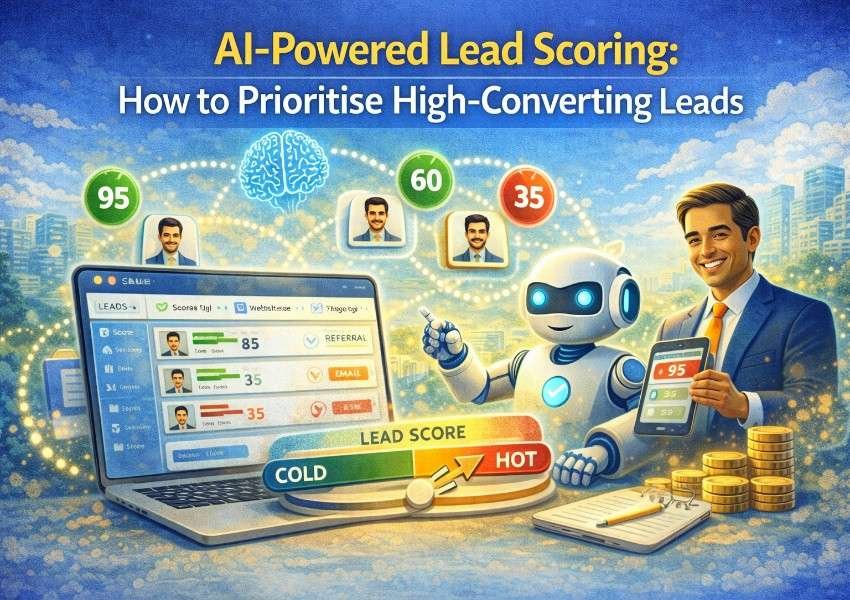
Not every lead in your pipeline deserves equal attention. Some are ready to buy. Others are just browsing. The challenge for most sales teams is figuring out which is which — fast enough to act on it.
That’s exactly what AI-powered lead scoring is built to solve. Instead of relying on gut instinct or outdated point systems, AI evaluates hundreds of data signals in real time to tell your team exactly who to call first. The result: less time wasted on cold leads, more time spent closing deals that actually move.
In this guide, we’ll break down how AI lead scoring works, what signals it analyses, and how to set it up in a way that genuinely improves conversion rates.
Traditional lead scoring assigns fixed point values to actions, a form fill gets 10 points, an email open gets 5, a demo request gets 20 — and ranks leads by total score. It sounds logical, but in practice, it’s brittle. The rules are set manually, they go stale quickly, and they miss the nuance of what actually drives a conversion.
AI lead scoring takes a fundamentally different approach. Instead of static rules, it uses machine learning models trained on your historical CRM data: closed deals, lost deals, conversion timelines, lead sources, to learn what a high-converting lead actually looks like for your business. Once trained, the model continuously scores incoming leads based on real patterns, not assumptions.
According to Monday.com’s guide on AI lead scoring, teams using AI-powered scoring spend up to 80% of their time with qualified leads, compared to just 30% when using manual methods. That’s not a marginal improvement — it’s a structural shift in how sales effort is allocated.
At its core, AI-powered lead scoring follows a clear process:
The signals feeding into the score typically fall into a few categories: demographic data (job title, company size, geography), behavioural data (page visits, email engagement, demo requests), intent data (competitor research activity, pricing page visits), and CRM history (lead source, previous interactions, deal stage progression).
| Traditional Scoring | AI-Powered Scoring | |
| Rule setup | Manual, static | Automated, dynamic |
| Data sources | Limited | Multi-source, real-time |
| Accuracy | Degrades over time | Improves over time |
| Explainability | Simple point logic | Predictive with reasoning |
| Maintenance | Requires regular manual review | Self-updating |
The gap becomes most visible at scale. If you’re handling 50 leads a month, manual scoring is workable. At 500 or 5,000 leads, it breaks down — and so does your team’s ability to focus on what matters.
Sharper prioritisation
Your sales reps know immediately which leads to pursue. High-scoring leads get contacted first, when interest is at its peak. Lower-scoring leads go into nurturing workflows until they’re ready.
Better marketing-sales alignment
When both teams operate from the same AI-generated lead quality signal, there’s less friction over lead handoffs. Marketing knows what makes a qualified lead; sales trusts the pipeline they’re receiving.
Faster sales cycles
Leads that are correctly identified as high-intent close faster because outreach is timely and contextually relevant. You’re not chasing cold leads for weeks before realising they were never serious buyers.
Improved forecasting
When your scoring model is trained on actual conversion data, pipeline forecasting becomes more reliable. You can predict with greater confidence which deals will close and in what timeframe.
Reduced churn risk
AI doesn’t just score new leads — it can also flag at-risk accounts based on behavioural signals, giving your team the chance to intervene before a customer disengages.
Not all data points are equally predictive. The signals your AI model weighs most heavily will depend on your specific business, but across most B2B contexts, a few stand out.
Pricing page visits consistently rank as one of the strongest intent signals. A lead who visits your pricing page multiple times in a week is far more sales-ready than one who downloaded a whitepaper and went quiet.
Demo or trial requests are high-confidence signals regardless of industry. Any lead who raises their hand for a live demonstration has cleared a significant psychological threshold.
Job title and decision-making authority matter enormously in B2B contexts. A lead from a relevant industry who holds purchasing authority scores very differently from someone in a similar company with no budget control.
Email engagement patterns — not just opens, but click-through rates, responses, and content consumption — indicate active interest rather than passive receipt.
Time between interactions is often underweighted in manual systems. A lead who engages three times in 48 hours is behaving differently from one who has three interactions spread over three months.
AI picks up on these combinations and their recency in ways that rule-based systems simply cannot.
Getting started with AI lead scoring doesn’t require a data science team. Here’s a practical framework:
Step 1: Audit your data
Before any model can perform, your CRM data needs to be reasonably clean and complete. Missing fields, duplicate records, and inconsistent lead sources all reduce model accuracy. Start with a data hygiene pass.
Step 2: Define your Ideal Customer Profile (ICP)
AI scoring works best when the model has a clear benchmark. Document the firmographic and behavioural traits of your best customers — the ones who converted quickly, retained well, and delivered high lifetime value.
Step 3: Connect your data sources
Link your CRM, email platform, website analytics, and any enrichment tools. The AI needs a complete view of each lead across channels to score effectively.
Step 4: Train on historical data
Feed the model your closed-won and closed-lost deals. The more historical data available, the more accurate the initial scoring will be.
Step 5: Set lead routing rules
Decide what happens at each score threshold. High scores might trigger immediate sales outreach; mid-range leads might enter a nurture sequence; low scores might go into a longer-term drip campaign.
Step 6: Create a feedback loop
The model improves when it receives outcome data. Make sure your team is marking deals as won or lost in the CRM consistently — that’s the signal the AI uses to keep refining its predictions.
For a detailed look at how AI qualifies and routes leads through modern sales funnels, Qualimero’s guide on AI lead scoring is a useful reference, covering how intent detection has evolved beyond click-based signals.
Skipping data preparation
AI is only as good as the data it learns from. A model trained on incomplete or poorly structured CRM data will produce unreliable scores. Don’t rush past this step.
Treating the score as the final word
Lead scores are predictive, not prescriptive. A high score means high probability — not a guaranteed close. Your sales team still needs to exercise judgement, especially in complex enterprise deals.
Not reviewing the model periodically
Markets shift, buyer behaviour changes, and your product evolves. Review scoring outputs quarterly to ensure the model’s predictions still align with actual conversion outcomes.
Ignoring negative signals
AI lead scoring isn’t only about identifying who’s ready to buy. It’s equally valuable for filtering out leads who are unlikely to convert — saving your team from spending weeks on prospects who were never going to close.
Groweon CRM is built specifically for Indian SMBs, and its AI capabilities are designed to solve exactly this problem: helping lean sales teams focus their limited time on leads that are most likely to convert.
With Groweon’s lead management module, you can track every lead interaction — from the first touchpoint to the final follow-up — and let the platform surface high-priority leads based on activity and engagement signals. As Groweon’s AI features continue to expand, automated scoring and intelligent lead prioritisation are becoming core parts of how the platform helps businesses grow without growing their team size proportionally.
If your sales team is currently managing lead follow-ups manually, or relying on instinct to decide who to call next, AI-powered lead scoring is the most direct upgrade available to you.
The question isn’t whether AI lead scoring works — the evidence across B2B sales contexts is clear that it does. The question is whether your business is set up to take advantage of it.
Start with clean data. Define your ICP. Connect your systems. And let the model do what it’s built for: cutting through the noise so your sales team can spend their energy exactly where it counts.
Ready to see how Groweon CRM can help you qualify and prioritise leads faster? Get in touch with the Groweon team to learn more.

31 Mar, 2026
Most businesses are sitting on a goldmine they’ve stopped mining....

30 Mar, 2026
Not every lead in your pipeline deserves equal attention. Some...

30 Mar, 2026
Let’s be honest. Not every lead is worth your time....

28 Mar, 2026
Small businesses do not need a CRM built for a...

28 Mar, 2026
If you run a small business in India, there is...