

Top 10 Field Service Management Software in India for 2026
23 Oct, 2026
Summary Compare 10 field service and field workforce software options...
Updated: 9th September, 2026
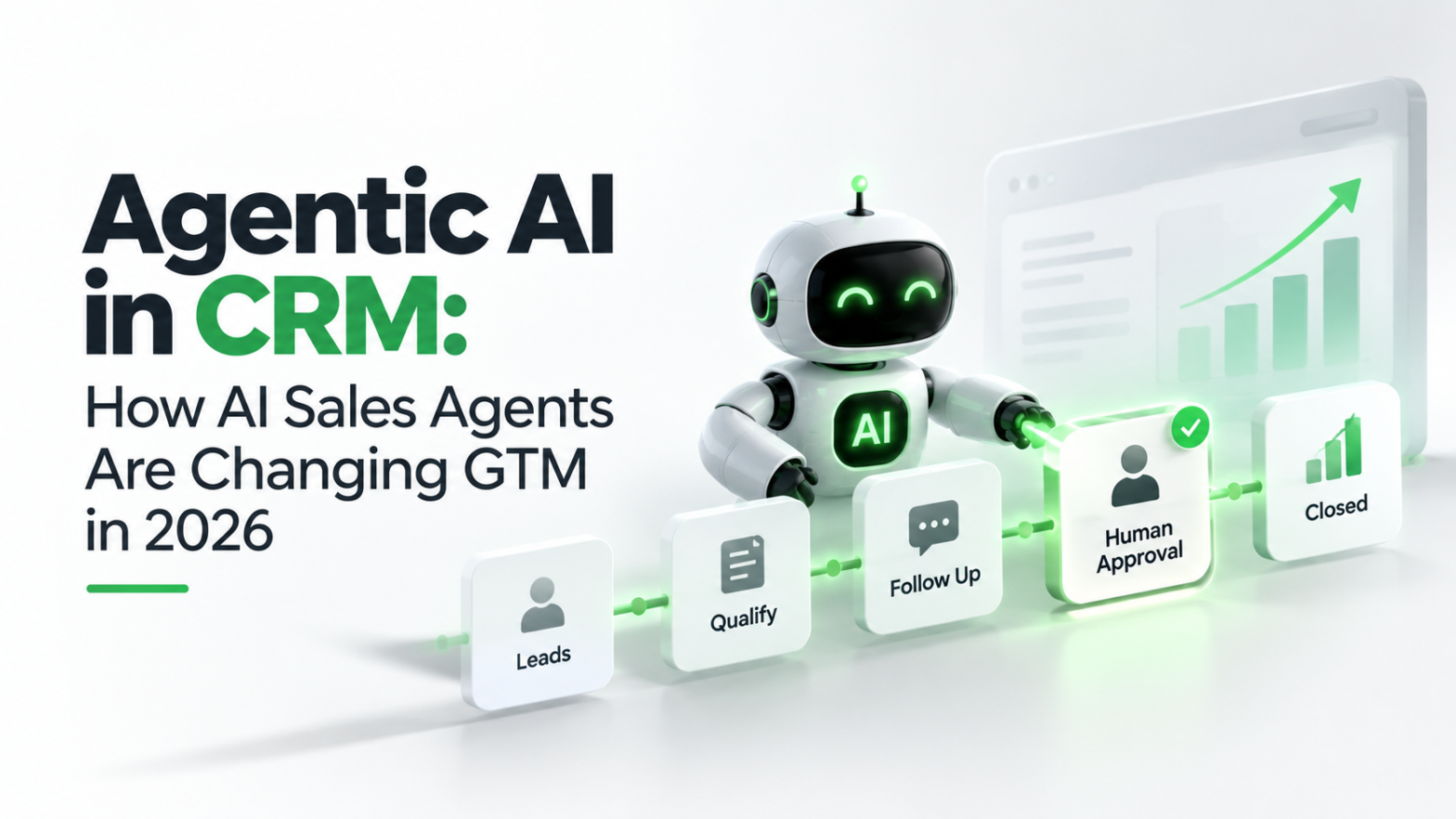
Agentic AI is turning CRM from a system that records sales activity into one that can actively execute approved GTM work. For Indian teams, AI sales agents can improve qualification, follow-ups, prioritisation, research, and CRM administration. The right strategy is not maximum autonomy, but the right combination of AI execution, reliable data, clear permissions, and human judgement. In 2026, the strongest GTM teams will use AI agents to make salespeople more focused, faster, and productive.
For years, CRM helped sales teams store customer information, manage pipelines, track activities, and follow up with prospects.
AI changed that by adding predictions, recommendations, content generation, and automation.
But in 2026, the shift is bigger. AI is moving from assisting salespeople to actively participating in sales workflows.
This is where Agentic AI in CRM enters the picture. Instead of simply suggesting what a salesperson should do, an AI sales agent can understand a goal, evaluate available context, take approved actions, and involve a human when judgement is required.
The timing is particularly relevant for Indian businesses. Deloitte’s 2026 India research found that marketing and sales had reached 55% at-scale AI deployment, showing that AI is moving into everyday business operations rather than remaining limited to experiments. Deloitte’s India AI adoption findings
So the important question for GTM leaders is not simply “What is an AI sales agent?”
It is: What should an AI sales agent actually do, and where should humans remain in control?
Traditional CRM automation follows predefined rules. For example: if a lead fills out a form, assign it to a salesperson and send a notification.
An agentic system can go further. It can evaluate the lead, consider previous interactions, determine the appropriate next step, perform permitted actions, and escalate when the situation requires human involvement.
For example, an AI sales agent could:
The difference is important. Traditional automation executes a workflow designed by humans. Agentic AI can make decisions within a defined workflow and act toward a business goal. That moves CRM closer to a system of action, rather than only a system of record.
The two approaches are related, but they are not the same.
This does not mean every CRM workflow should become autonomous. The real value comes from identifying tasks where AI can make decisions consistently while humans remain responsible for sensitive, strategic, or high-value situations.
Indian GTM teams often manage leads and customers across websites, advertising platforms, WhatsApp, phone calls, email, field sales, referrals, and other channels.
The challenge is not always generating demand. It is processing that demand quickly enough and consistently enough.
A salesperson may have to research a prospect, check previous conversations, qualify the lead, update CRM fields, send an initial message, schedule a meeting, and remember another follow-up. When every step depends on manual effort, good opportunities can easily get delayed.
This is where AI sales agents become useful. Instead of replacing salespeople, they can operate around them — handling repetitive work while salespeople focus on conversations that require judgement.
The strongest AI sales agents are not necessarily those that automate everything. They are the ones that solve specific GTM bottlenecks reliably.
An AI agent can review information such as industry, company size, location, requirement, product interest, and previous engagement, then classify leads according to predefined qualification criteria. Instead of salespeople manually reviewing every enquiry, the agent can help identify which opportunities deserve immediate attention.
Not every lead deserves the same urgency. An AI sales agent can analyse available signals and help determine which opportunities should reach a salesperson first. For example:
This is where AI becomes valuable: not by creating more activity, but by helping sales teams spend their limited time on the right opportunities.
Follow-ups are one of the easiest sales activities to delay. A prospect may have requested a proposal, asked for revised pricing, or said they would discuss the purchase internally — and each of these situations calls for a different follow-up.
An AI sales agent can use conversation history, engagement, sales stage, and previous actions to recommend or execute the appropriate next step. IBM’s research shows that AI sales agents can support lead qualification, prioritisation, personalised engagement, and follow-up while working with CRM data. IBM’s AI sales agent use cases
The shift is therefore: reminder-based follow-up → context-aware follow-up.
Salespeople often spend valuable time updating CRM records after calls, meetings, and emails. AI agents can help capture information from these interactions and update relevant records — which matters because better CRM data improves visibility for sales managers, marketing teams, customer support, and future AI workflows.
This is where businesses need to be careful. The objective should not be “how many sales activities can we automate?” The better question is “which activities can AI perform safely and reliably?”
The strongest Agentic AI in CRM strategy is therefore not maximum autonomy — it is appropriate autonomy, matched to how much judgement each activity actually requires.
Imagine an enterprise prospect asks for a major discount. An AI agent could review the account, check pricing rules, understand the customer’s history, and prepare a recommendation — but it should not automatically approve a decision outside its authority. Instead, it should escalate the situation to an authorised salesperson or manager.
The World Economic Forum’s 2026 guidance stresses the importance of authorization, monitoring, auditability, and accountability as organisations deploy AI agents at scale. WEF’s AI agent governance framework
For GTM teams, permissions and escalation rules should therefore be designed before agents receive broad access to customer workflows.
Agentic AI makes CRM data quality even more important. If customer records contain duplicates, outdated information, missing conversations, or incorrect sales stages, an AI agent may make decisions using an incomplete picture — poor data leads to poor context, which leads to poor decisions and poor actions.
This means businesses should strengthen:
The agent is only as effective as the context it can access.
Businesses do not need to deploy multiple autonomous agents immediately. A more practical approach is to start with one measurable bottleneck.
Look for a workflow that consumes significant sales time but follows relatively predictable logic. Lead qualification, routing, meeting scheduling, or follow-up management can be strong starting points.
Decide exactly what the agent can access, what it can change, what it can send, what requires approval, and when it must escalate.
Make sure the agent can access accurate customer and sales context.
Give the agent one responsibility instead of attempting to automate the entire sales process.
Track whether the agent actually improves response time, qualification rate, sales productivity, follow-up completion, conversion, and administrative time. This turns AI adoption into a business improvement project rather than simply a technology experiment.
The biggest change may be how salespeople spend their day. Instead of opening the CRM and asking “what should I work on today?”, they could increasingly receive: “these five opportunities need your attention.”
The system can explain why each opportunity matters, what happened previously, what action is recommended, and whether something is overdue. This does not remove the salesperson — it removes some of the searching, sorting, updating, and repetitive administration around the salesperson.
That distinction is important. CIO’s 2026 CRM analysis also points toward a broader shift from CRM platforms that primarily served as passive systems of record toward systems that can act on customer workflows in real time. CIO’s 2026 CRM trend analysis
AI sales agents should not be evaluated based on how impressive the technology looks. They should be evaluated on business outcomes.
Sales Productivity — Time saved per salesperson, administrative hours reduced, leads processed, activities completed automatically.
Lead Performance — Lead response time, qualification rate, lead-to-opportunity conversion, opportunity-to-customer conversion, lead leakage.
Agent Performance — Tasks completed successfully, human escalations, incorrect actions, follow-up completion, CRM data accuracy.
Revenue Impact — Pipeline generated, revenue influenced, conversion improvement, sales-cycle reduction, revenue per salesperson.
The goal is not to prove that an AI agent is working. The goal is to prove that the GTM system is working better because of it.
Before choosing an AI CRM platform, GTM leaders should ask:
Platforms like Groweon — which combines AI, customer data, and sales automation in one system — are built around these questions, and can be a useful reference point when evaluating vendors against this checklist.
The future is unlikely to be a sales organisation where AI does everything and humans simply approve its decisions. A more practical future is one where AI becomes an operational layer across the GTM process:
A new lead can trigger qualification. A qualified opportunity can trigger research. Research can inform outreach. A customer response can change the next action. A sales conversation can update the CRM. A stalled opportunity can trigger an escalation.
That creates a connected sales process where CRM does more than remember what happened — it helps the organisation understand what should happen next.
For Indian GTM teams, that can make Agentic AI particularly valuable where sales volume is high, customer journeys span multiple channels, and salespeople need to spend more time on high-value conversations.
The winners in 2026 will not necessarily be the companies with the most AI agents. They will be the companies that give AI agents the right work, the right data, the right permissions, and the right human oversight.
What is Agentic AI in CRM?
Agentic AI in CRM refers to AI systems that can understand goals, evaluate context, make decisions within defined boundaries, and execute CRM-related tasks instead of only providing recommendations.
What is an AI sales agent?
An AI sales agent is an AI-powered system designed to perform sales activities such as lead qualification, prospect research, follow-ups, appointment scheduling, prioritisation, outreach, and CRM updates.
Will AI sales agents replace salespeople?
AI sales agents are more likely to change how salespeople work than replace them completely. AI can handle repetitive and data-heavy activities while humans remain responsible for negotiation, relationships, strategic decisions, and complex customer situations.
What can AI sales agents do in CRM?
Depending on their permissions, AI sales agents can qualify leads, prioritise opportunities, research prospects, manage follow-ups, schedule meetings, update CRM records, support outreach, and escalate situations requiring human judgement.
Are AI sales agents useful for Indian businesses?
Yes. They can be particularly useful for businesses managing high lead volumes, multiple communication channels, distributed sales teams, and repetitive follow-up processes. Their value increases when they are connected to reliable CRM data and clearly defined workflows.
What is the biggest risk of Agentic AI in sales?
The main risks include incorrect actions, poor-quality data, excessive autonomy, privacy concerns, and insufficient human oversight. Businesses should establish permissions, escalation rules, monitoring, and auditability before deploying agents at scale.

23 Oct, 2026
Summary Compare 10 field service and field workforce software options...

23 Oct, 2026
Summary Agentic AI enables systems to plan and execute tasks...

23 Oct, 2026
Summary Traditional CRM helps businesses organise customer data, manage leads,...

22 Oct, 2026
Summary (TL;DR) AI calling agents help businesses engage prospects, qualify...

22 Oct, 2026
Summary (TL;DR) A delayed quotation can cost a business a...