

Top 10 Field Service Management Software in India for 2026
23 Oct, 2026
Summary Compare 10 field service and field workforce software options...
Updated: 23rd October, 2026
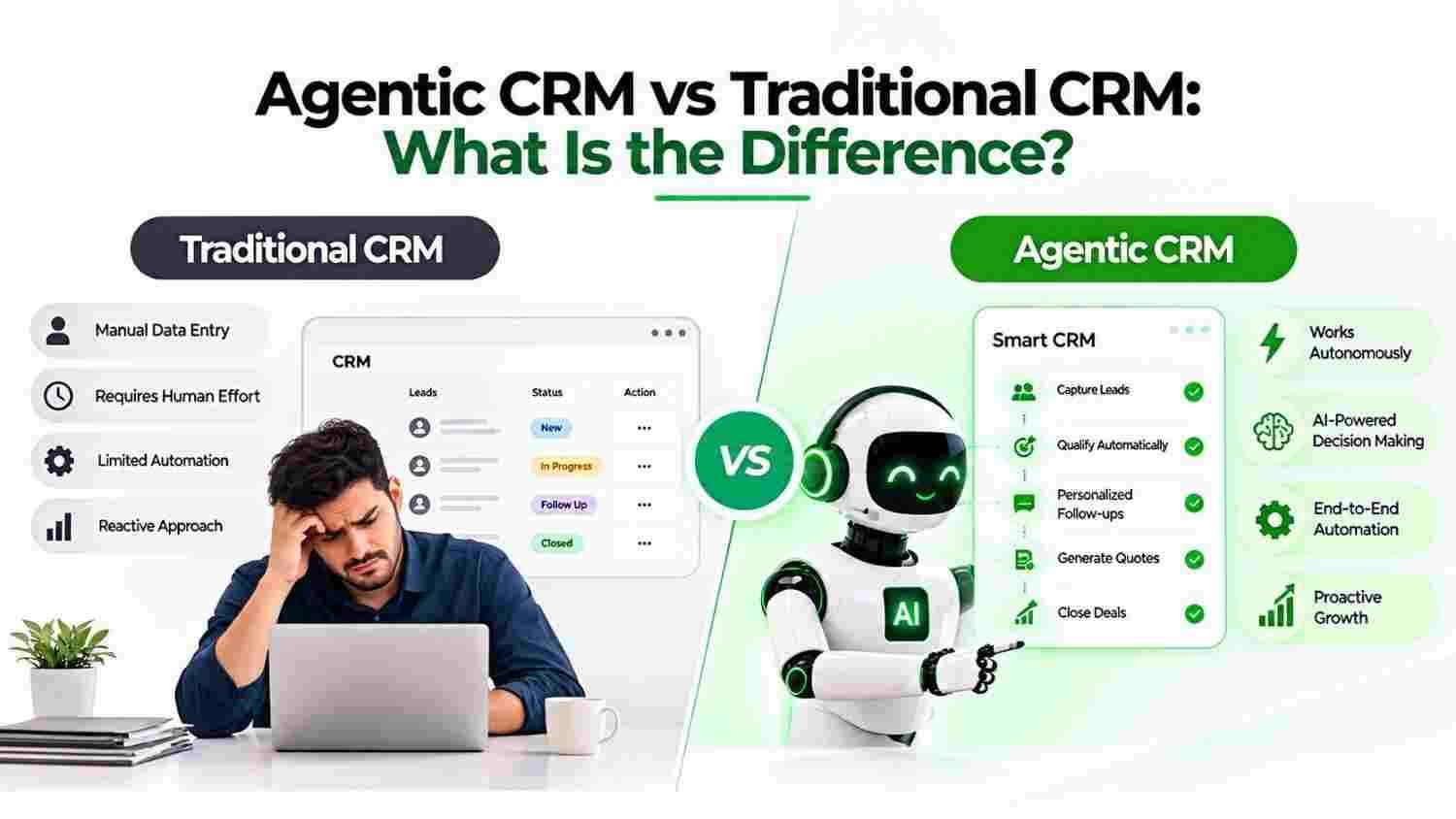
Traditional CRM helps businesses organise customer data, manage leads, and track sales activities.
Agentic CRM goes further by using AI agents to understand situations and take actions automatically.
It can help businesses respond to leads, qualify prospects, manage follow-ups, and alert sales representatives.
This blog explains the key differences between both CRM approaches and how Groweon AION Autopilot supports sales teams.
Imagine a potential customer fills out an enquiry form on your website at 8 PM.
Your CRM records the lead and sends a notification to the sales team. But if nobody checks the notification until the next morning, the customer may already have contacted another business.
This is a common challenge with traditional CRM workflows. The system stores information and helps teams organise their work, but people often need to take the next step.
Now imagine a different approach.
The moment the enquiry arrives, an AI agent contacts the prospect, asks relevant questions, records the responses, and alerts the right sales representative when the lead is ready for a conversation.
That is the difference between a traditional CRM workflow and an agentic CRM approach.
As businesses explore AI agents, CRM is evolving from a system that primarily manages customer information into a system that can also execute sales activities within defined rules.
A traditional Customer Relationship Management (CRM) system helps businesses manage customer information and sales activities in one place.
It allows teams to store contact details, track enquiries, maintain sales pipelines, schedule meetings, record conversations, and monitor opportunities.
For example, a sales representative can use a CRM to check which leads need attention, update a deal stage, and plan the next follow-up.
Many traditional CRMs also include automation. They can send reminders, assign leads, trigger emails, and update records when predefined conditions are met.
These capabilities are useful for keeping sales processes organised. However, when a workflow requires a conversation, a decision, or an action outside its configured rules, a person may still need to step in.
Businesses can explore the fundamentals of CRM software to understand how these systems support customer relationships and sales operations.
A typical traditional CRM workflow looks like this:
The CRM provides the structure. The sales representative usually drives the process forward.
An agentic CRM combines customer relationship management with AI agents that can interpret information, determine suitable next steps, and perform actions within their assigned permissions.
Instead of only recording that a lead has arrived, an agentic CRM can initiate the next step in a sales workflow.
Depending on its capabilities and configuration, it may contact a prospect, ask qualification questions, analyse responses, trigger a follow-up, update the CRM record, or notify a sales representative.
This approach builds on the wider development of agentic AI, where AI systems can work towards a goal by carrying out a sequence of tasks rather than simply generating a response.
The important distinction is that an agentic CRM does not just help people decide what to do. It can also perform selected actions on their behalf.
A typical agentic CRM workflow may look like this:
The exact workflow depends on the CRM platform, connected channels, business rules, and permissions.
For businesses exploring this approach, Microsoft’s AI agent guidance explains how organisations can plan, build, govern, and manage AI agents.
The biggest difference is how much of the sales process the system can execute without waiting for a person to initiate every step.
| Feature | Traditional CRM | Agentic CRM |
|---|---|---|
| Primary purpose | Organises customer data and sales activities | Manages data and executes selected sales actions |
| Lead response | Notifies a representative or triggers a configured response | Can initiate calls or conversations automatically |
| Lead qualification | Relies mainly on sales representatives and configured forms or rules | Can ask questions and qualify leads through AI-led interactions |
| Follow-ups | Uses reminders and predefined sequences | Can initiate follow-ups based on configured triggers and context |
| Decision-making | Primarily human-led, supported by CRM data | AI can select actions within defined goals and boundaries |
| CRM updates | Often entered manually or through standard automation | Can be updated automatically from supported interactions |
| Lead prioritisation | Uses filters, rules, scores, and manual judgement | Can combine available signals and AI-based analysis |
| Customer communication | Managed by representatives or predefined automation | AI agents can handle supported conversations |
| Workflow execution | Often follows predefined steps | Can coordinate multiple actions towards a defined outcome |
| Human involvement | Frequently needed to move tasks forward | Focuses human attention on exceptions, complex needs, and sales decisions |
| Reporting | Tracks activities, pipelines, and performance | Can combine reporting with visibility into agent activity |
| Best suited for | Businesses that need organised customer records and sales processes | Businesses looking to automate more of their sales execution |
Traditional CRM and agentic CRM are not necessarily competing categories. An agentic CRM can retain the core CRM functions businesses need while adding an AI-driven execution layer.
For a broader understanding of the sales processes that CRM supports, explore sales automation.
Lead management is one of the clearest areas where the difference becomes visible.
In a traditional CRM, incoming enquiries are captured, assigned, and displayed to the sales team. Depending on the setup, the system may send notifications or reminders.
The representative then decides when and how to contact the lead.
In an agentic CRM, the arrival of a lead can initiate an entire sequence of actions. An AI agent may start a conversation, collect requirements, record the responses, and alert the appropriate representative.
For example, a real estate company receiving enquiries about multiple properties could use an agentic workflow to ask prospects about their preferred location, budget, and purchase timeline before handing the lead to an agent.
Groweon’s Auto Lead Qualifier supports AI-led qualification, helping sales teams collect relevant information before a representative takes over.
The goal is not simply to capture more leads. It is to help businesses move each enquiry towards a useful next step.
Follow-ups are essential to sales, but they can become difficult to manage when a team handles hundreds or thousands of enquiries.
A traditional CRM can schedule reminders and automate follow-up messages according to predefined rules. These features help maintain consistency, although the workflow may still depend on fixed schedules and conditions.
An agentic CRM can connect follow-up actions to events and available context.
For example, if a prospect has not responded after the initial contact, the system may trigger a configured follow-up. If the prospect responds or asks for a human representative, the workflow can change according to the system’s instructions.
This approach can reduce the manual effort involved in remembering and initiating repetitive tasks.
Businesses using WhatsApp for customer communication can also explore the WhatsApp Business Platform to understand the messaging capabilities available for business interactions.
With Groweon, Rule-Based Calling helps teams configure calls around conditions such as lead source, pipeline stage, or inactivity.
The practical benefit is a more consistent follow-up process, with less dependence on someone remembering every next action.
Traditional CRM systems often use forms, dropdowns, lead scores, and qualification fields to help representatives understand prospects.
Sales representatives then ask questions about budget, requirements, urgency, and buying authority.
An agentic CRM can automate parts of this interaction through AI-led conversations.
The agent can ask relevant questions, collect responses, and record the information for the sales team. Depending on the configured workflow, it can also identify leads that meet the qualification criteria.
This can be particularly useful for businesses that receive enquiries across several channels or have limited time to contact every lead manually.
For example, an industrial supplier may need to know a buyer’s product specifications, quantity, delivery location, and purchase timeline. An AI agent can collect these details before passing the enquiry to a salesperson.
However, qualification quality depends on the questions, business rules, available data, and accuracy of the interaction. AI-generated outcomes should remain reviewable, especially when a decision has significant business consequences.
For guidance on managing lead-to-opportunity workflows, see Microsoft’s lead qualification guidance.
Incomplete CRM records can make it difficult for sales managers to understand what is happening across the pipeline.
In a traditional workflow, representatives may need to enter call outcomes, update lead statuses, record requirements, and schedule the next action after every interaction.
When the team is busy, some updates may be delayed or missed.
An agentic CRM can automate supported updates using information collected during calls, messages, or other connected interactions.
For example, after a qualification call, the system may record the outcome, capture key requirements, and update the lead record according to its configuration.
Groweon’s AI Calling Agent can conduct qualification conversations and write supported call outcomes and lead information into the CRM.
This helps sales representatives spend less time on repetitive data entry and more time understanding customer needs.
Traditional CRM helps sales teams organise their work. It makes customer information easier to find and helps managers monitor activities.
An agentic CRM can go a step further by taking on selected repetitive tasks that would otherwise occupy the sales team’s time.
These tasks may include initial outreach, routine qualification, follow-up calls, and lead updates.
The representative can then focus on conversations that require human judgement, such as discussing pricing, handling complex objections, negotiating terms, and building customer relationships.
For a business with a high volume of enquiries, this difference can affect how effectively the team handles incoming demand.
Research and analysis from McKinsey’s sales insights provide broader context on how technology and AI are changing sales and marketing operations.
The aim is not to remove the sales team from the process. It is to reduce unnecessary manual work so the team can concentrate on activities that need human expertise.
Traditional CRM platforms can already automate many activities. Automated emails, task reminders, lead assignment, and predefined workflows are not exclusive to agentic CRM.
The difference lies in the kind of work the system can perform.
Rule-based automation generally executes an action when a specified condition is met. Agentic AI can use a model to interpret available context, select from permitted actions, and work through multiple steps towards a goal.
Consider this example:
Traditional automation
If a lead submits a form, send an acknowledgement email and assign the lead to a representative.
Agentic CRM workflow
When a lead submits a form, initiate a configured conversation, collect qualification details, record the outcome, and alert the right representative when the lead meets the handoff criteria.
The second workflow involves several connected actions rather than a single trigger.
However, agentic systems still need defined permissions, reliable integrations, monitoring, and clear rules. Businesses should not assume that an AI agent can handle every situation without oversight.
For a practical overview of automated business processes, see workflow automation.
Groweon combines CRM capabilities with AION, its AI layer for sales intelligence and autonomous execution.
AION Autopilot is designed to help businesses automate parts of the lead engagement and qualification process, allowing the system to act on incoming enquiries instead of waiting for a representative to initiate every step.
Explore the AION Autopilot platform to understand how these capabilities work together.
The AI Calling Agent can initiate configured calls, engage prospects through voice conversations, ask qualification questions, and record supported outcomes in the CRM.
This is useful for businesses that receive enquiries throughout the day and want a more consistent first-contact process.
The WhatsApp AI Chatbot can engage prospects, answer configured questions, and collect information through supported messaging workflows.
It helps businesses maintain an additional communication channel without requiring a representative to manually initiate every interaction.
The Auto Lead Qualifier helps collect prospect requirements and identify leads that meet the business’s qualification criteria.
This gives representatives more context when they take over a conversation.
Rule-Based Calling allows businesses to configure calling actions around defined conditions. Bulk Calling supports high-volume outreach through automated calling workflows.
Together, these features can help sales teams manage repetitive outreach more systematically.
When a lead meets the configured qualification criteria, AION can alert the relevant representative so the team can take the next step.
The representative can focus on understanding the opportunity and progressing the sale rather than starting every interaction from scratch.
Alongside autonomous execution, Groweon’s AION AI+ supports tasks such as lead analysis, lead scoring, and drafting sales communications.
The combination allows businesses to use AI for both sales assistance and selected actions within the CRM workflow.
You can explore the wider Groweon Sales CRM to see how sales management and AION capabilities fit together.
Consider a company selling industrial equipment. It receives an enquiry from a buyer who wants a quotation for a specific product.
The process works, but several steps depend on the representative’s availability and timely updates.
The agent handles selected early-stage activities, while the representative remains responsible for decisions and conversations that need human expertise.
For businesses that need to contact many prospects, Bulk Calling can support high-volume outreach as part of a configured sales process.
Both approaches can be useful. The right choice depends on the way your business handles customers, the volume of enquiries it receives, and the level of automation it needs.
| Business requirement | Suitable approach |
|---|---|
| Store customer records and track deals | Traditional CRM or agentic CRM |
| Maintain a structured sales pipeline | Traditional CRM or agentic CRM |
| Send reminders and predefined notifications | Traditional CRM or agentic CRM |
| Automate initial calls and qualification | Agentic CRM with suitable capabilities |
| Reduce manual follow-up activities | Agentic CRM with configured workflows |
| Update CRM records from supported interactions | Agentic CRM with suitable integrations |
| Coordinate several sales actions from one trigger | Agentic CRM with multi-step execution |
| Keep people involved in complex sales decisions | Either approach, with appropriate workflow design |
>A traditional CRM may be enough if the main requirement is to organise customer information and track sales activities.
An agentic CRM becomes more relevant when the business wants AI to take responsibility for selected actions, coordinate workflows, and reduce dependence on manual execution.
Businesses can also adopt these capabilities gradually rather than changing every process at once.
Agentic CRM can improve the way sales work gets done, but a successful implementation needs clear planning.
Start with repetitive, well-defined tasks such as first contact, basic qualification, and follow-up reminders.
Set clear conditions for when the AI should stop and hand the conversation to a person.
AI agents need relevant and reliable information to perform their assigned tasks. Maintain accurate lead records, qualification criteria, product information, and communication guidelines.
Decide which actions the AI can perform independently and which require approval.
For example, initiating a permitted follow-up may be automated, while approving a special discount or making a binding commercial commitment may require a human decision.
Track metrics such as response time, qualification accuracy, handoff quality, follow-up completion, and conversion rates.
Use these results to improve the workflow rather than assuming automation will automatically improve every outcome.
AI systems that access customer records and communication channels need suitable access controls, privacy safeguards, and oversight.
The NIST AI Risk Management Framework offers guidance for organisations working to identify and manage risks associated with AI systems.
Businesses operating in India should also consider applicable privacy requirements and the rules relevant to their communication channels. The MeitY data protection framework is a useful starting point for understanding India’s data protection framework.
For organisations operating across jurisdictions, the OECD AI Principles provide a broader reference for trustworthy AI practices.
AI agents should not be expected to resolve every objection, complaint, or unusual customer request.
Define escalation rules so that representatives can take over when a situation needs negotiation, specialist knowledge, or human judgement.
Businesses using automated calling should also review applicable communication and consent requirements, including relevant guidance from TRAI regulations.
CRM has traditionally helped businesses organise customer information, track opportunities, and maintain a clear view of the sales pipeline.
Agentic CRM adds another layer: the ability to use AI agents to perform selected tasks and coordinate actions across the customer journey.
This shift can help businesses respond more consistently, collect qualification details, reduce repetitive work, and direct human attention towards promising opportunities.
The value does not come from using AI for its own sake. It comes from choosing the right tasks, setting clear boundaries, and connecting automation to the outcomes the business wants to achieve.
Groweon AION Autopilot brings these capabilities into the sales workflow through AI calling, WhatsApp engagement, lead qualification, configured calling rules, and qualified lead alerts.
For businesses looking to move beyond a CRM that mainly records activity, agentic CRM offers a practical way to make sales processes more action-oriented.
1. What is the main difference between agentic CRM and traditional CRM?
Traditional CRM primarily helps businesses store customer information, organise sales activities, and track leads. Agentic CRM adds AI agents that can interpret context and perform selected actions, such as contacting leads, collecting qualification details, and updating records.
2. Is agentic CRM the same as CRM automation?
No. CRM automation generally executes predefined actions when certain conditions are met. Agentic CRM can use AI to interpret information and coordinate multiple actions towards a goal, within its configured permissions. Agentic CRM may still use traditional automation as part of its workflow.
3. Can agentic CRM replace sales representatives?
Agentic CRM can handle selected repetitive activities, but it does not remove the need for human sales professionals. Representatives remain important for negotiation, relationship-building, complex questions, commercial decisions, and situations that require judgement.
4. How does agentic CRM improve lead management?
It can initiate contact, ask qualification questions, capture responses, update supported CRM fields, and notify representatives when leads meet configured criteria. These capabilities can help reduce manual work and improve consistency across the lead management process.
5. Is agentic CRM suitable for small and medium-sized businesses?
Yes, it can be useful for small and medium-sized businesses that receive regular enquiries but have limited time for manual outreach and follow-ups. The best starting point is usually a clearly defined, repetitive workflow with measurable outcomes.
6. What is Groweon AION Autopilot?
Groweon AION Autopilot is an AI-powered sales execution layer integrated with Groweon CRM. It supports capabilities such as AI calling, WhatsApp engagement, automatic lead qualification, configured calling workflows, and qualified lead alerts.
7. Does an agentic CRM need human supervision?
Yes. Businesses should define what the AI can do, what information it can access, and when it must hand a task to a human. Monitoring, access controls, and escalation rules are important parts of a responsible implementation.
8. How can a business start using agentic CRM?
Start by identifying a repetitive sales task, defining the desired outcome, setting qualification criteria and permissions, and measuring the results. Once the workflow is working reliably, the business can gradually extend AI execution to other suitable activities.
If your sales team spends too much time initiating calls, qualifying enquiries, and managing repetitive follow-ups, it may be time to explore a more action-oriented CRM.
Discover how Groweon AION can help connect CRM data with AI-powered sales execution.
Book a demo to see how agentic CRM can fit into your sales workflow.

23 Oct, 2026
Summary Compare 10 field service and field workforce software options...

23 Oct, 2026
Summary Agentic AI enables systems to plan and execute tasks...

23 Oct, 2026
Summary Traditional CRM helps businesses organise customer data, manage leads,...

22 Oct, 2026
Summary (TL;DR) AI calling agents help businesses engage prospects, qualify...
22 Oct, 2026
Summary (TL;DR) A delayed quotation can cost a business a...