

CRM for Cement and Building Material Manufacturers
15 Oct, 2026
Summary (TL;DR) A CRM for cement and building material manufacturers...
Updated: 14th October, 2026
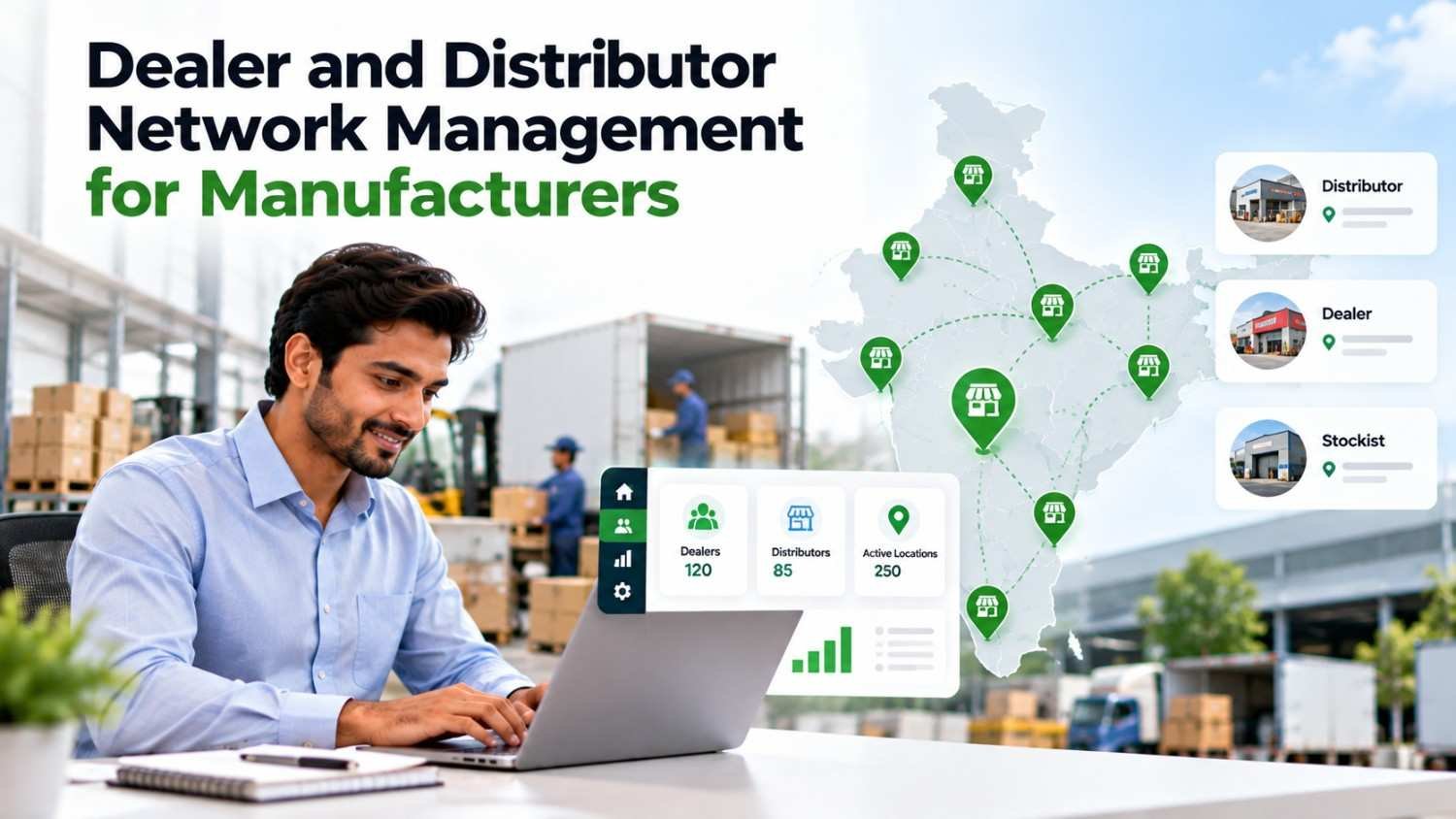
Summary (TL;DR): Manufacturers manage dealer and distributor networks well when they onboard partners with documents, set tier pricing, let partners order through a portal, and watch stock and payments in one place. Meanwhile, lead sharing keeps enquiries from stalling at the channel. Groweon’s Dealer Management System and AION Autopilot support each of these steps.
Dealer and distributor management means running your whole sales channel from one system. You onboard partners, assign price tiers and schemes, take orders, track dispatch, and watch outstanding payments. Without it, orders arrive by phone, schemes live in spreadsheets, and nobody sees how much stock sits with each partner. A manufacturer with fifty dealers struggles to manage that by memory. Therefore, a CRM with a dealer layer gives the sales head one view of every partner, order, and balance.
Before you pick a tool, name the problems you want to remove.
Phone and WhatsApp orders
Orders placed by call or chat get mistyped, missed, or duplicated. Consequently, dispatch ships the wrong quantity.
Scheme confusion
Seasonal discounts differ by dealer tier. When rules live in scattered files, partners dispute invoices.
Stock blind spots
Sales cannot see which dealer holds what stock. As a result, the plant overproduces some items and runs short of others.
Payment drift
Outstanding balances grow quietly until a large dealer crosses a comfortable limit.
Orphaned leads
End-customer enquiries reach the manufacturer, but nobody forwards them to the right dealer fast enough.
The table below shows how the two roles differ inside a manufacturing CRM.
| Aspect | Distributor | Dealer |
|---|---|---|
| Role | Buys in bulk and supplies dealers in a region | Sells to end customers or contractors |
| Order pattern | Large, scheduled orders | Smaller, frequent orders |
| Pricing | Tier price with volume schemes | Tier price with seasonal offers |
| What the CRM tracks | Stock held, territory coverage, payment terms | Orders, local leads, service requests |
| Key risk | Large outstanding balances | Slow reordering and lost local leads |
| Best metric | Sell-through by territory | Order frequency and lead conversion |
Test any vendor against these five capabilities.
Dealer portal
Partners should place orders, view catalogues, and check previous orders without calling your office. Fewer calls mean fewer errors.
Tier pricing and schemes
The system should apply the right price, tax, and scheme automatically. Moreover, finance should see exactly why a dealer received a given rate.
Order and dispatch tracking
Dealers want status updates: processing, dispatched, delivered. Automated email, SMS, or WhatsApp notifications cut follow-up calls.
Stock and payment visibility
Sales should see inventory across plants, warehouses, and partners, along with each dealer’s outstanding payments.
Lead sharing
End-customer enquiries should route to the nearest or best-fit dealer automatically, with reminders until someone responds.
Picture a hypothetical switchgear manufacturer with three distributors and forty dealers across one state. It signs a new dealer in a district. Here is how a CRM-led team handles the first month.
By the end of the month, the manufacturer has a complete record of documents, prices, orders, and balances for that dealer. Moreover, the same process scales to the next dealer without extra spreadsheets.
A dealer scorecard turns opinions into evidence. Review it monthly with your area managers, and compare each partner with their own territory average.
Order frequency
Dealers who reorder regularly signal healthy local demand. A sudden drop often shows a competitor winning the shelf, so call early instead of waiting for the quarter to close.
Outstanding balance and ageing
Review balances by age, not only by total. Moreover, compare each dealer’s balance with recent order volume before you approve more stock.
Lead response time
Measure how fast each dealer contacts forwarded leads. Slow responders lose enquiries that your marketing spend already paid to generate.
Sell-through by territory
Compare what distributors buy with what dealers reorder. If stock piles up at the distributor, scheme support or a dealer visit may help.
Scheme uptake
Track which dealers use each scheme and what they order afterward. As a result, you can retire schemes that discount without lifting volume.
Partners dislike disruption, so roll out the system in three waves.
Wave one: your top ten dealers
Choose partners with the highest volume and the most patience. Train them in short sessions, collect feedback, and fix friction fast.
Wave two: one full region
Extend the portal to a single region, and keep phone ordering as a fallback for a few weeks while habits change.
Wave three: the whole network
Retire manual orders once the portal proves reliable. Share a one-page guide with every dealer, and keep a support number visible.
Groweon’s Dealer Management System centralises inventory visibility across plants, warehouses, dealers, and distributors. It offers a dealer portal for placing orders, viewing catalogues, and tracking past orders. Manufacturers can set dealer-specific pricing, schemes, and seasonal discounts. The platform also tracks order status from processing to delivery and sends notifications by email, SMS, or WhatsApp.
On the finance side, Groweon connects with payment gateways and ERP systems, generates GST-compliant invoices, and shows dealers their outstanding payments. Dashboards report revenue growth, dealer performance, and payment delays.
The Lead Management Solution distributes leads from sources such as Facebook Ads, WhatsApp, email, and websites to the right dealers or salespeople automatically. Meanwhile, AION Autopilot adds Auto AI Follow-up for stalled leads and an AI calling agent that qualifies enquiries before a dealer spends time on them.
Groweon also builds CRMs for FMCG distributor networks, Pharma, Automobile, Real Estate, Education, Insurance, and Travel, alongside the B2B CRM for manufacturers.
Spam concern
Dealers do not want constant pings. Therefore, notify only on events that matter: order confirmed, dispatched, payment due. Use approved templates through Groweon’s WhatsApp module, and let dealers choose their channel.
AI accuracy
AI qualification can miss local context. Hence, treat AI scores as a ranking signal, and let a regional manager override any assignment.
Setup time
Do not onboard every dealer at once. Start with your top ten partners by volume, prove the portal, and then add the rest in batches.
Human replacement
Area managers still build relationships, resolve disputes, and negotiate schemes. Automation simply removes the order-entry work that crowds out those visits.
A dealer network grows faster when the manufacturer gives partners a clear process. Onboard with documents, price by tier, take orders in a portal, and watch stock and payments in one place. Consequently, your area managers spend less time chasing and more time selling. Start small, measure monthly, and widen the rollout only after your top partners confirm that the portal saves them time.
Share your dealer list and price tiers with the team in a Groweon demo, and watch the portal and order flow run on your own data.
What is a dealer management system for manufacturers?
It is software that manages dealer onboarding, tier pricing, orders, stock visibility, payments, and performance reporting from one platform, usually with a partner portal.
How is a distributor different from a dealer in a CRM?
Distributors buy in bulk and supply dealers, so you track stock, territory, and payment terms. Dealers sell to end customers, so you track orders, leads, and service requests.
Can dealers place orders without calling us?
Yes, with a dealer portal. Partners browse catalogues, place orders, and check status, which reduces phone orders and entry errors.
How do we share leads with dealers fairly?
Set routing rules by territory, product line, or round-robin, and add reminders so unanswered leads escalate. Review conversion by dealer monthly.
Which dealer metrics matter most?
Track order frequency, outstanding balance, lead response time, and sell-through by territory. Together, they show who needs support and who needs a scheme review.
Manufacturers manage channel networks best when they centralise onboarding, tier pricing, portal ordering, stock visibility, and payment tracking. Lead sharing then keeps end-customer enquiries from stalling. Groweon’s Dealer Management System, Lead Management Solution, and AION Autopilot support that flow in one CRM.

15 Oct, 2026
Summary (TL;DR) A CRM for cement and building material manufacturers...

15 Oct, 2026
Summary (TL;DR) A CRM for pharma API and bulk drug...

14 Oct, 2026
Summary (TL;DR): AMC tracking for equipment manufacturers records each machine,...

14 Oct, 2026
Summary (TL;DR): Salesforce Manufacturing Cloud lists $250 per user per...

14 Oct, 2026
Summary (TL;DR): Manufacturers manage dealer and distributor networks well when...