

Best CRM for Rubber and Tyre Manufacturers
16 Oct, 2026
Summary (TL;DR) The best CRM for rubber and tyre manufacturers...
Updated: 13th October, 2026
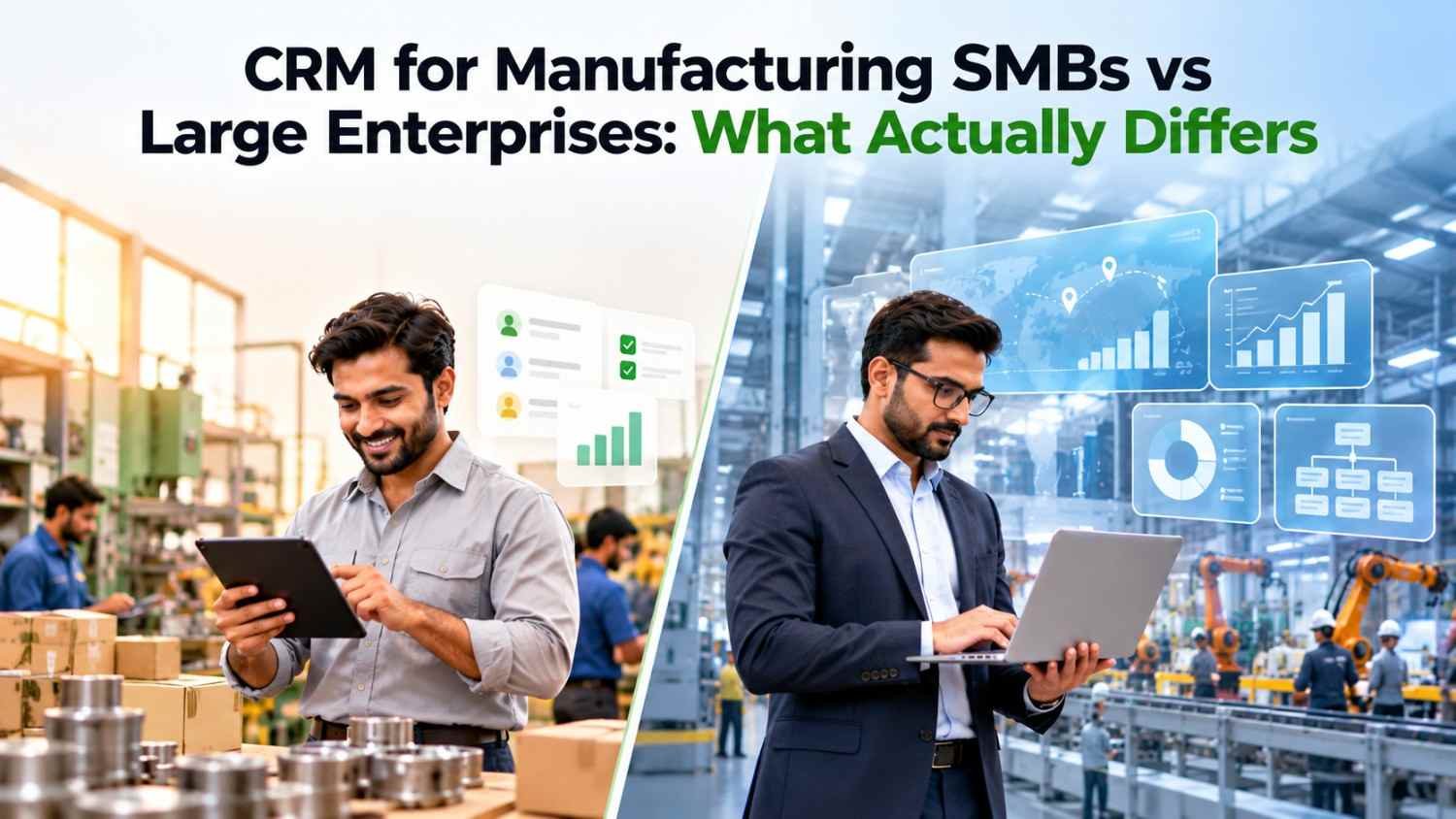
Summary (TL;DR): Manufacturing SMBs and large enterprises ask a CRM to do the same four jobs: capture enquiries, build quotations, manage dealers, and service installed machines. However, they differ on rollout speed, integration depth, governance, and cost. SMBs should start lean with leads and quotes, while enterprises should lock down roles and ERP links first. Groweon, with its AION AI layer, covers both ends.
A manufacturing CRM does four jobs for most plants. It captures enquiries, builds quotations, manages dealers and distributors, and tracks service after delivery. Size changes how much structure surrounds those jobs. A ten-person sales team needs speed and simple fields, whereas a multi-plant enterprise needs approval chains, role-based access, and ERP integration. Therefore, the best CRM for your factory depends less on feature count and more on how much process your team can absorb at once. This guide compares both profiles so you can pick a starting point with confidence.
Small and mid-sized manufacturers usually run sales from spreadsheets, WhatsApp groups, and the owner’s memory. As a result, the first CRM win is simply getting every enquiry into one place. Three priorities matter most.
Lean data model
Keep fields to what a salesperson fills in during a call: company, product, quantity, target price, and next follow-up date. Extra fields slow adoption, and a CRM that nobody updates produces nothing useful.
Quotation first
Most SMB deals live or die on how fast the quote leaves the building. Therefore, a quotation builder that pulls product and price data should come before advanced analytics.
Low admin load
An SMB rarely has a dedicated CRM administrator. Consequently, the sales head must be able to rename a stage or add a field without calling a vendor.
A large manufacturer faces a different risk. Several plants, regional sales offices, and hundreds of dealers can create data chaos faster than any team can clean it. For that reason, governance leads the buying criteria.
Multi-plant visibility
Leadership wants one view of enquiries, orders, and service tickets across plants. Meanwhile, each plant manager should see only their own region.
Approval chains and access control
Discounts above a threshold need sign-off, and pricing data needs protection. Role-based permissions solve both problems, and an audit trail answers later questions.
ERP and accounting integration
Enterprises already run an ERP for production and finance. Hence, the CRM must exchange customer, order, and invoice data with it instead of creating a parallel record.
The table below summarises the differences that matter most during vendor selection.
| Factor | SMB manufacturer | Large enterprise |
|---|---|---|
| Main goal | Stop enquiry leakage and quote faster | Standardise process across plants and regions |
| Rollout | Weeks, one team first | Phased, plant by plant |
| Integrations | Email, WhatsApp, accounting tool | ERP, finance, dealer portals, B2B marketplaces |
| Roles and access | Few roles, owner-led | Many roles, approval matrices, audit logs |
| Dealer network | Dozens of dealers | Hundreds of dealers with tiered pricing |
| Reporting | Pipeline and follow-up dashboards | Forecasting, territory and plant-level analytics |
| Admin model | Sales head configures | Central team with change control |
| Cost pattern | Per-user licence, low setup effort | Licence plus integration and support budget |
Notice that cost sits at the bottom for a reason. The licence fee is the smaller number in both columns, so weigh the price of one silent enquiry before you haggle over the price of one seat.
Consider a hypothetical pump manufacturer with 40 employees and six salespeople. The owner wants fewer lost enquiries and faster quotes. Here is a realistic rollout, step by step.
By week four, the team should stop asking where an enquiry went, because every enquiry has an owner and a next date. An enterprise would run the same six steps, but it would add role design, approval rules, and ERP mapping before step one.
Whatever your size, a phased plan beats a big-bang launch. Each phase should end with a visible result that the team can use the next morning. Enterprises repeat these phases plant by plant, while SMBs usually complete all three within one team.
Phase one: leads and quotes
Load contacts, connect enquiry sources, and switch on quote templates. Success looks like every enquiry with an owner and every quote with a follow-up date.
Phase two: dealers and service
Add partner onboarding, tier pricing, and service tickets. Meanwhile, keep reviewing adoption weekly so that gaps surface early instead of hardening into habits.
Phase three: integrations and AI
Connect your ERP or accounting tool, then add automated follow-ups and AI calling. By this stage, your data is clean enough that automation helps instead of amplifying mistakes.
Groweon builds its CRM around exactly this split. The Sales CRM covers multi-source lead capture, pipeline tracking, quotes and pricing management, and order conversion, so an SMB can launch the core workflow first. Larger teams then add user and role management, field meeting management, and API integrations with their existing systems.
Dealer-heavy manufacturers can layer on the Dealer Management System, which adds a dealer portal, dealer-specific pricing, and order tracking. Equipment makers can add Groweon Care for service tickets and the AMC and warranty module for renewals.
AION Autopilot, Groweon’s agentic AI layer, adds an AI calling agent that calls and qualifies leads. Meanwhile, Auto AI Follow-up nudges stalled quotes and hands off to a person when the conversation needs one. AION AI+ scores leads and drafts WhatsApp messages and emails.
Beyond the B2B CRM, Groweon also publishes industry CRMs for Automobile, FMCG, Pharma, Real Estate, Education, Insurance, and Travel.
Spam concern
Manufacturers worry that automated messages will annoy dealers. However, you control the volume. Use approved templates on the WhatsApp Business API, segment by dealer tier, and message only contacts who expect updates. Groweon’s WhatsApp module supports templates and segmentation.
AI accuracy
An AI agent can mishear a part number or a quantity. Therefore, treat AI output as a first pass, review call summaries, and keep a human sign-off on prices and quotes.
Setup time
Nobody wants a six-month project. Start with leads and quotes only, then add dealers, service, and integrations in later phases.
Human replacement
AI does not replace your salespeople. Instead, it removes data entry and chasing, so engineers and reps spend more time on technical selling.
Both profiles need the same four jobs done well, but they should sequence the work differently. SMBs win by capturing enquiries and speeding up quotes. Enterprises win by adding governance and integration before they scale. In short, pick the CRM that lets you start where you are and grow into the rest.
Bring one real quotation and one dealer list to a free Groweon demo, and the team will map them to your pipeline.
What is the biggest difference between SMB and enterprise manufacturing CRM?
Governance and integration depth. SMBs prioritise fast enquiry capture and quoting, while enterprises prioritise role-based access, approval chains, and ERP connections across several plants.
Should a small manufacturer buy an enterprise CRM?
Usually not at the start. Heavy configuration can stall adoption, so begin with leads, quotes, and follow-ups, then add modules as the team grows.
Can one CRM serve both SMB and enterprise needs?
Yes, if it scales by module and by role. Groweon, for example, lets a team begin with Sales CRM and add dealer, service, and procurement modules later.
How long does a manufacturing CRM rollout take?
It depends on scope. A focused leads-and-quotes setup moves faster than a multi-plant rollout with ERP integration, so phase the work and confirm timelines in a demo.
What should we measure first after launch?
Track enquiry response time, quotes sent, quote-to-order conversion, and overdue follow-ups. These four numbers show quickly whether the team uses the system.
Manufacturing SMBs and large enterprises share the same core CRM jobs, but they sequence them differently. SMBs start with enquiry capture and quotations. Enterprises start with governance and ERP integration. Groweon, with its Sales CRM, dealer, service, procurement, and AION AI modules, supports both paths.
16 Oct, 2026
Summary (TL;DR) The best CRM for rubber and tyre manufacturers...

16 Oct, 2026
Summary (TL;DR) A CRM for agricultural equipment manufacturers tracks farmer...

16 Oct, 2026
Summary (TL;DR) The best CRM for paint and coatings manufacturers...

15 Oct, 2026
Summary (TL;DR) A CRM for cement and building material manufacturers...

15 Oct, 2026
Summary (TL;DR) A CRM for pharma API and bulk drug...