

How Businesses Can Use QR Codes to Improve Customer Engagement
26 Oct, 2026
It’s easier to scan a QR code than to type...
Updated: 8th September, 2026
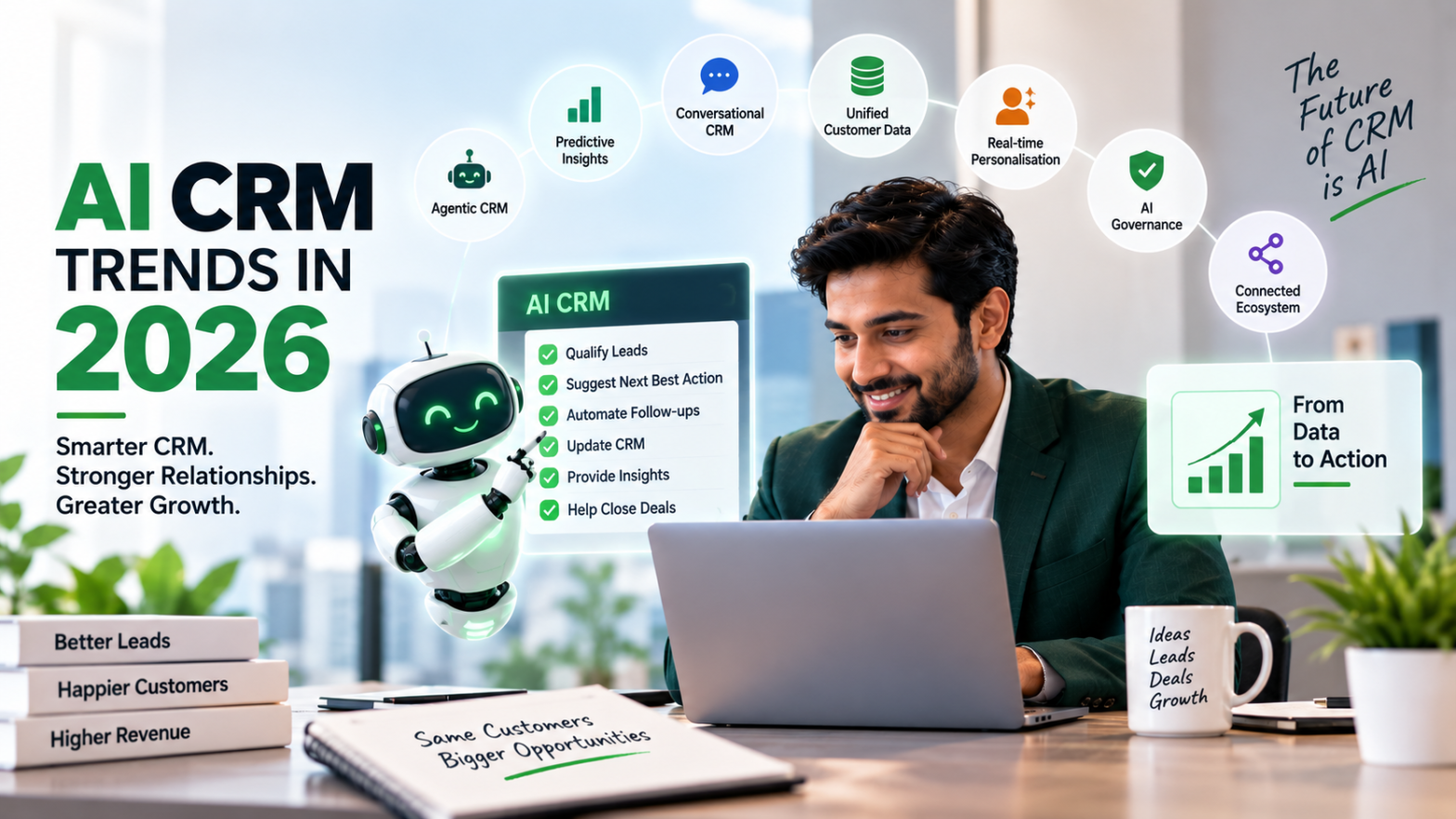
The biggest AI CRM trends in 2026 are moving CRM from a system of record toward a system of intelligence and action.
Agentic AI, predictive insights, conversational CRM, unified data, real-time personalisation, and stronger governance will shape the next phase of CRM.
Businesses should adopt these capabilities based on measurable sales and customer outcomes rather than AI hype.
CRM is changing.
For years, businesses used CRM systems mainly to store customer information, manage pipelines, track sales activities, and create reports. AI changed that model by adding recommendations, predictions, content generation, and automation.
But in 2026, the bigger shift is happening.
AI is moving from assisting CRM users to actively participating in customer and sales workflows.
Indian enterprises are already moving beyond AI experimentation. Deloitte’s 2026 India research found that marketing and sales reached 55% at-scale AI deployment, showing that AI is increasingly becoming part of day-to-day business operations rather than remaining a pilot project. The research also found that 40% of Indian respondents reported significant or full AI usage across their organisations.
So, what should businesses actually watch?
The important AI CRM trends in 2026 are not simply about adding more AI features to a CRM. They are about changing how customer data is interpreted, how sales decisions are made, and how much of the customer journey software can handle.
One of the biggest AI CRM trends 2026 is the rise of Agentic CRM.
Traditional CRM automation follows predefined instructions.
For example:
If a lead fills out a form, assign it to a salesperson.
Agentic CRM aims to go further.
An AI agent can analyse the lead, consider its context, determine the appropriate next step, perform permitted actions, and escalate the situation when human involvement is required.
This means CRM can move from being a system of record to becoming a system of action.
Recent CRM research describes this as a structural shift, with agentic AI moving CRM beyond recording and recommending toward taking action across customer workflows.
For businesses exploring this shift, Groweon’s AI CRM capabilities can help illustrate how AI can become part of sales and customer workflows rather than remaining a separate layer.
For businesses evaluating an AI CRM platform, the practical question is no longer only what the AI can tell your team. It is what the AI can safely do.
The next trend is closely connected to agentic CRM: AI agents will take on increasingly specific sales responsibilities.
Instead of one general chatbot trying to do everything, businesses can use specialised agents for specific jobs.
For example:
This is important because the best AI workflow isn’t necessarily the one with the most autonomous agent.
It is the one with the right level of autonomy for the task.
A lead qualification agent may be allowed to evaluate and categorise leads automatically. A pricing negotiation may still require human approval.
This distinction will become increasingly important as companies move from AI experimentation toward production deployment. IBM’s research shows that AI agents can already support lead qualification, lead scoring, prioritisation, outreach, and sales forecasting. IBM’s sales agent research also highlights how these systems can work with CRM data to support sales teams.
Traditional analytics tells sales managers what happened.
AI-powered analytics increasingly aims to tell them what is likely to happen next.
That means predictive capabilities will become an important part of modern AI CRM software.
Instead of simply showing:
an intelligent CRM can help identify:
This changes the purpose of the dashboard.
It becomes less about reading numbers and more about deciding where the sales team should focus.
Salespeople don’t necessarily want to click through ten CRM screens to find one answer.
They want to ask:
“Which deals are at risk this month?”
Or:
“Show me leads that haven’t been contacted in three days.”
Or:
“Summarise my last conversation with this customer.”
This is driving the growth of conversational interfaces within CRM software.
Instead of learning every menu and reporting function, users can increasingly interact with CRM using natural language.
The 2026 CRM trend landscape identifies conversational interfaces as a major shift, alongside agentic execution and real-time customer data.
For sales teams, this could make CRM adoption easier because the interface starts behaving more like an intelligent colleague and less like a database application.
This may be the least glamorous trend on the list—and one of the most important.
AI cannot make reliable recommendations from unreliable information.
If customer data is scattered across spreadsheets, WhatsApp conversations, email, sales tools, support systems, and disconnected databases, an AI system may only see part of the picture.
That creates a simple problem:
Bad data → bad context → bad recommendation → bad action.
This is why unified customer data is becoming a central requirement for AI CRM.
Recent CRM research specifically highlights unified, accurate, real-time customer context as a foundation for reliable agentic CRM.
For businesses, this means CRM selection should increasingly include questions such as:
The companies that invest in data foundations now will be in a much stronger position to use more advanced AI later.
Personalisation used to mean:
“Hi Rahul, here is an offer for you.”
That’s no longer enough.
The next generation of AI-powered CRM will increasingly use real-time behaviour and customer context to decide:
This creates a move from static segmentation to dynamic personalisation.
For example, instead of placing a customer into a “high-value customer” segment once a month, an AI system can continuously evaluate interactions and identify changing intent.
That can make customer engagement more timely and relevant.
For many businesses, customer conversations don’t happen inside the CRM.
They happen on WhatsApp, phone calls, email, websites, social platforms, and increasingly through AI interfaces.
That means the future of AI CRM in India will be strongly connected to omnichannel communication.
The CRM should not simply record that a conversation happened.
It should ideally understand the conversation and use that information in the next sales or service action.
For example, if a customer asks about pricing on WhatsApp, the relevant sales context should not disappear into a separate communication tool.
It should become part of the customer’s CRM history.
For businesses with field or inside-sales teams, this can significantly reduce the gap between communication and CRM data.
“Follow up tomorrow.”
That’s basic automation.
But what if the system could understand why the customer needs a follow-up?
For example, the prospect may have requested a proposal. They might have opened the proposal several times without responding. In another case, a revised price may have been requested. The customer could also have mentioned that they would discuss the purchase internally.
These signals create very different follow-up situations.
An AI CRM platform can potentially use conversation history, engagement, previous actions, and sales-stage information to make follow-up recommendations more contextual.
AI agents are increasingly being used to support lead qualification, prioritisation, outreach, and follow-up activities. IBM’s research on AI sales agent use cases shows how agents can work with CRM data to score leads, prioritise follow-ups, and support personalised customer engagement.
The trend, therefore, is moving from:
Reminder-based follow-up → Context-aware follow-up.
More autonomy creates more responsibility.
If AI only drafts an email, the risk is relatively limited.
But if an AI agent can update CRM records, send customer messages, qualify leads, change priorities, or initiate workflows, businesses need stronger controls.
This makes AI governance an important 2026 CRM trend.
Companies will need to define:
The World Economic Forum’s 2026 guidance focuses on authorization, monitoring, auditability, enforceability, and human accountability as organisations scale AI agents. The WEF governance framework specifically addresses how organisations can move from AI pilots to governed agent deployment.
This is particularly important for customer-facing AI.
A small mistake in an internal recommendation is one thing.
An incorrect message sent automatically to thousands of customers is something else entirely.
The most useful way to think about AI CRM is not:
AI versus salesperson.
It is:
AI + salesperson.
AI can handle repetitive, data-heavy, and high-volume activities.
Salespeople can focus on:
This shift is less about replacing salespeople and more about redesigning how people and AI work together.
AI can take care of repetitive administration, data analysis, lead prioritisation, and routine follow-ups while salespeople spend more time on situations where judgement and relationships matter.
AI cannot operate effectively if CRM exists as an isolated island.
Sales information may need to connect with:
This is why integration will become a major part of CRM trends 2026.
Consider a simple example.
A salesperson sees that a customer wants to reorder.
If the CRM is disconnected from inventory, the salesperson may promise something that isn’t available.
If the systems are connected, the CRM can provide a more complete picture before the salesperson responds.
The result is not just better automation.
It is better decision-making.
For businesses that want to bring customer information, automation, and sales processes into one foundation, Groweon’s CRM software provides a broader view of how these workflows can be connected.
In earlier years, businesses could justify AI investment with phrases such as “future-ready” or “digital transformation.”
That won’t be enough anymore.
In 2026, businesses will increasingly ask:
What did the AI actually improve?
Possible measurements include:
This shift toward measurable ROI is healthy.
AI CRM should not be purchased because it sounds innovative.
It should be adopted where it can improve a measurable business outcome.
The smartest CRM buyers will look beyond feature lists.
Before choosing an AI CRM, ask:
A chatbot isn’t automatically useful just because it uses AI.
Recommendations are useful, but businesses should understand whether the platform can execute approved tasks.
AI performance depends heavily on data quality and context.
Autonomy should come with permissions, escalation rules, and auditability.
AI should reduce friction rather than create another tool employees have to manage.
Every AI capability should ideally connect to a business outcome.
For Indian businesses, these trends are particularly relevant because sales and customer engagement often span multiple channels, large customer volumes, distributed teams, and highly competitive markets.
The opportunity is not to adopt every new AI capability at once.
A better strategy is to start with the areas where AI can produce an obvious operational improvement.
For example:
High lead volume? Start with AI qualification and prioritisation.
Too many missed follow-ups? Automate follow-up intelligence.
Large field-sales team? Use AI for activity capture and sales assistance.
High customer-support volume? Explore AI-led resolution and routing.
Disconnected customer data? Fix the data foundation first.
For companies already building AI into their sales operations, Groweon’s Sales CRM can help bring lead management, sales automation, communication, and reporting into one connected workflow.
What is the biggest AI CRM trend in 2026?
One of the biggest trends is the shift from assistive AI to agentic CRM, where AI can not only analyse information or make recommendations but also execute defined tasks within business rules and permissions.
How is AI changing CRM in 2026?
AI is making CRM more predictive, conversational, automated, and action-oriented. Modern systems can help with lead qualification, follow-ups, forecasting, personalisation, customer communication, data updates, and increasingly autonomous workflows.
Why is data quality important for AI CRM?
AI relies on customer and business data to generate recommendations and take actions. Incomplete, outdated, or fragmented data can produce unreliable insights and poor decisions, making data quality a fundamental part of AI CRM adoption.
Will AI replace salespeople?
AI is more likely to change the role of salespeople than eliminate it completely. AI can handle repetitive and data-heavy activities while salespeople focus on relationships, negotiation, strategic accounts, and complex customer decisions.
What should businesses consider before adopting AI CRM?
Businesses should evaluate the quality of their data, AI capabilities, integrations, security, governance, human-approval controls, usability, scalability, and measurable ROI. The best AI CRM is the one that solves real business problems rather than simply offering the most AI features.

26 Oct, 2026
It’s easier to scan a QR code than to type...

26 Oct, 2026
Summary FMCG CRM Software connects field sales teams, distributors, retailers...

26 Oct, 2026
A supplier emails you a price sheet. But there is...

26 Oct, 2026
Summary Choose CRM Software according to your sales process, business...

23 Oct, 2026
Summary Compare 10 field service and field workforce software options...