

Best Lead Management Software in India: What to Check Before…
01 Oct, 2026
Summary (TL;DR): Lead management software captures, scores, routes, and nurtures...
Updated: 17th August, 2026
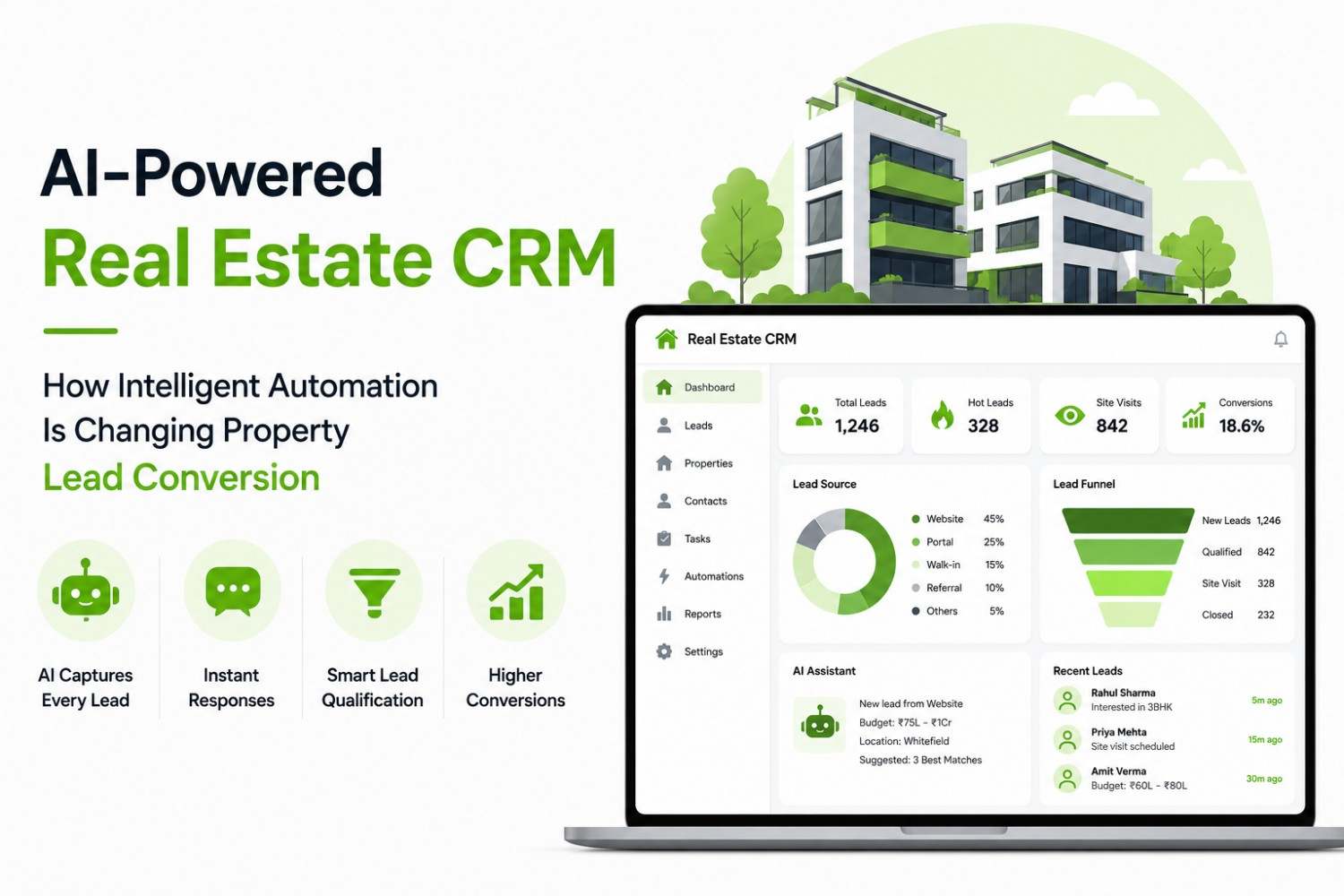
Real estate businesses rarely struggle because they have no enquiries.
The bigger challenge is managing those enquiries properly.
A property buyer may enquire about a project today, ask about pricing tomorrow, request floor plans later, schedule a site visit, compare another property and still take weeks or months before making a decision.
For developers, brokers and property sales teams, every stage needs consistent follow-up.
A missed call can become a missed site visit.
A delayed response can become a lost prospect.
An enquiry sitting untouched in an Excel sheet can eventually become a lost sales opportunity.
This is where real estate CRM software becomes important.
And with artificial intelligence, the role of CRM is changing further.
An AI-powered real estate CRM can help teams capture property enquiries, qualify buyers, prioritise leads, automate follow-ups, manage site visits, personalise communication and identify opportunities that need attention.
The Indian real estate market also continues to show strong activity. According to CBRE’s India Market Monitor Q1 2026, residential market activity remained stable during January–March 2026, with steady end-user demand across key cities and continued traction in high-end and luxury housing.
For property businesses operating across competitive markets, managing every enquiry effectively becomes increasingly important.
An AI-powered real estate CRM combines customer relationship management with artificial intelligence and workflow automation.
A conventional real estate CRM may help teams manage:
AI can extend these capabilities through:
In simple terms:
Traditional Real Estate CRM:
Lead → Assign → Follow Up → Site Visit → Close
AI Real Estate CRM:
Lead → Understand → Qualify → Prioritise → Engage → Site Visit → Follow Up → Convert
The goal is not to remove salespeople from the process.
It is to help them work with better information and greater consistency.
Property enquiries can come from:
A real estate company may generate hundreds or thousands of enquiries for a project.
But not every enquiry represents the same level of buying intent.
One person may only be browsing.
Another may already have a defined budget.
Another may be comparing properties.
Someone else may already be ready for a site visit.
The CRM needs to help the sales team understand these differences.
A property enquiry can contain valuable information.
For example:
Property Type: 3 BHK
Location: Gurgaon
Budget: ₹1.5 crore
Purpose: End use
Timeline: 3 months
Site Visit: Requested
Compare that with:
Property Type: 3 BHK
Budget: Unknown
Timeline: Not decided
Requirement: Just checking
Both are leads.
But their next actions may be different.
AI can help organise information such as:
This gives the salesperson a clearer starting point.
Real estate sales teams often manage large numbers of active prospects.
The challenge is simple:
Which buyer should the salesperson contact first?
AI lead scoring can help prioritise leads using available signals.
| Buyer Signal | Possible Indication |
|---|---|
| Specific property selected | Stronger interest |
| Budget shared | Defined requirement |
| Site visit requested | Higher intent |
| Asked about possession | Purchase consideration |
| Asked about payment plan | Commercial interest |
| Repeated engagement | Active interest |
| No recent response | Re-engagement required |
A score should not be treated as a guarantee that a customer will buy.
It is a way of helping the sales team organise attention.
Real estate sales cycles are rarely completed in one interaction.
A buyer may move through:
Enquiry → Qualification → Property Discussion → Site Visit → Follow-Up → Negotiation → Booking
A basic CRM can create reminders for these activities.
AI can make the workflow more context-aware.
For example:
Site Visit Completed → Feedback Recorded → Follow-Up Recommended
Or:
Price Shared → No Response → Re-Engagement
Or:
Buyer Asked for Payment Plan → Finance Follow-Up
The salesperson does not have to depend entirely on memory to determine what happens next.
Real estate buyers have specific requirements.
A family buyer may prioritise location and amenities.
An investor may focus on rental potential and appreciation.
A buyer looking for immediate possession may have very different requirements from someone considering an under-construction project.
AI can help sales teams use CRM information to create more relevant communication.
Generic Follow-Up:
“Are you still interested in the property?”
Context-Based Follow-Up:
“You had enquired about the 3 BHK option and mentioned that you were looking for possession within this year. Would you like to schedule a site visit?”
The second message is more useful because it reflects the buyer’s requirement.
A site visit is one of the most important stages in property sales.
A real estate CRM should connect:
Buyer → Property → Salesperson → Site Visit → Feedback → Follow-Up
Without this connection, a completed site visit can become an isolated activity.
An AI-powered workflow can help structure what happens afterwards.
Site Visit Completed
↓
Buyer Feedback Recorded
↓
Interest Level Identified
↓
Objection Identified
↓
Next Follow-Up
↓
Negotiation / Second Visit / Closure
This makes the site visit part of the sales pipeline rather than a separate calendar activity.
Property buyers may hesitate because of:
AI can help summarise these concerns from available conversation data.
For example:
Buyer Summary
Requirement: 3 BHK
Budget: ₹1.5–1.7 crore
Main Concern: Price
Alternative: Another project
Site Visit: Completed
Next Step: Pricing discussion
The salesperson can then enter the next conversation with better context.
A real estate manager may have hundreds of leads distributed across multiple salespeople.
Manually checking every record is difficult.
AI-powered CRM can help surface situations such as:
Instead of asking:
“What is happening with our leads?”
managers can focus on:
“Which opportunities need attention right now?”
The Indian housing market is not one uniform market.
Buyer preferences differ by:
CBRE’s latest residential market data shows that high-end and luxury housing continued to gain traction in Q1 2026, alongside stable end-user demand across key cities.
This makes customer context increasingly important.
A good real estate CRM software should therefore capture more than a name and phone number.
It should capture the requirement behind the enquiry.
| Area | Traditional Real Estate CRM | AI-Powered Real Estate CRM |
|---|---|---|
| Lead Capture | ✓ | ✓ |
| Property Inventory | ✓ | ✓ |
| Lead Assignment | ✓ | ✓ |
| Site Visit Management | ✓ | ✓ |
| Follow-Up | Reminders | Intelligent workflow support |
| Lead Qualification | Manual / Rules | AI-assisted |
| Lead Scoring | Rule-based | AI-assisted |
| Buyer Requirement | Manually recorded | AI-assisted extraction |
| Conversation Summary | Manual | AI-assisted |
| Communication | Templates | Context-based assistance |
| Next Action | Manual | AI recommendations |
| Opportunity Monitoring | Manual | AI-assisted alerts |
The right CRM depends on the organisation’s sales process.
For real estate businesses managing high enquiry volumes, however, AI can reduce repetitive work and help sales teams focus on the opportunities that require attention.
When evaluating the best CRM software, real estate businesses should look beyond basic lead management.
Multi-Channel Lead Capture
Can the CRM capture enquiries from portals, websites, campaigns, calls, WhatsApp and other sources?
Property Inventory Management
Can sales teams connect buyers with relevant properties?
Lead Qualification
Can the system capture budget, location, property type and purchase timeline?
AI Lead Scoring
Can the CRM help identify high-intent property buyers?
Site Visit Management
Can teams schedule and track site visits?
Follow-Up Automation
Can it manage follow-ups after enquiries, calls and site visits?
Communication Management
Can salespeople access previous customer conversations?
Sales Pipeline
Can managers track leads from enquiry to booking?
AI Assistance
Can AI support qualification, communication, summaries and next actions?
Analytics
Can management identify lead sources, sales performance, pipeline movement and conversion trends?
The best CRM software for real estate should fit the actual property sales process rather than simply offering the largest number of features.
One of the biggest advantages of an AI-powered real estate CRM is connecting customer activity with the sales pipeline.
Consider this workflow:
Advertisement
↓
Property Enquiry
↓
AI Lead Qualification
↓
Lead Scoring
↓
Salesperson Assignment
↓
Property Recommendation
↓
Site Visit
↓
Customer Feedback
↓
Follow-Up
↓
Negotiation
↓
Booking
This provides management with a connected view of the customer journey.
Instead of tracking individual activities separately, the business can understand how enquiries move through the pipeline.
Real estate companies may manage:
A buyer who enquires about one project may actually be suitable for another project in the same portfolio.
An intelligent CRM can help sales teams maintain customer context across properties.
For example:
Buyer Requirement:
3 BHK | Gurgaon | ₹1.5 crore | End Use
↓
Project A: Above budget
↓
Project B: Suitable
↓
Project C: Possession mismatch
This gives the salesperson an opportunity to recommend a more relevant property instead of treating the original enquiry as the only opportunity.
Real estate buyers may need:
Without a structured CRM workflow, salespeople can easily lose track of the next step.
Follow-up automation can help maintain continuity.
Example:
Day 1: Enquiry
Day 2: Requirement call
Day 5: Property details
Day 8: Site visit invitation
Day 10: Site visit
Day 11: Feedback call
Day 15: Pricing discussion
Day 20: Re-engagement
The exact workflow should depend on the property, buyer stage and business process.
A modern property business needs more than a database.
It needs a system connecting:
Leads
Properties
Salespeople
Site Visits
Communication
Follow-Ups
Negotiations
Documents
Bookings
Customer History
AI can make this connected system more proactive.
Instead of waiting for salespeople to check every record, the CRM can help surface:
Who needs attention?
Why do they need attention?
What happened previously?
What should happen next?
That is the difference between basic CRM and intelligent CRM.
The Indian real estate market continues to attract significant investment alongside steady residential demand.
CBRE reported that India’s real estate sector received USD 8.5 billion in equity capital inflows during H1 2026, the highest half-yearly figure recorded, with inflows increasing 32% year over year.
As the sector becomes more competitive and property segments become more specialised, customer understanding becomes increasingly important.
The future of real estate CRM software is therefore not simply about storing more leads.
It is about turning customer information into useful sales actions.
The journey is moving from:
Lead Capture → Lead Management → Intelligent Lead Conversion
Groweon Real Estate CRM helps property businesses manage enquiries, property inventory, sales pipelines, site visits, calls, follow-ups, documents and customer information through a connected CRM environment.
With AI-powered capabilities, teams can support smarter lead qualification, lead scoring, communication, follow-ups and sales workflows.
Instead of managing property enquiries across disconnected spreadsheets, messages and individual records, teams can bring the customer journey into one organised system.
For businesses evaluating the best CRM software for real estate, the key question should be simple:
Can your CRM help your team capture every enquiry, understand every buyer and follow up on every real opportunity?
With an AI-powered CRM, the answer can move beyond simple lead tracking.
It can become:
Understand the buyer → Prioritise the opportunity → Take the next action → Move closer to conversion.

01 Oct, 2026
Summary (TL;DR): Lead management software captures, scores, routes, and nurtures...

01 Oct, 2026
Summary (TL;DR): CRM pricing in India typically runs ₹250 to...

30 Sep, 2026
Summary (TL;DR): A CRM with native Meta Conversions API integration...

29 Sep, 2026
Summary (TL;DR): The best choice depends on whether you want...

28 Sep, 2026
Summary (TL;DR): So, a B2B CRM has moved from a...