

Best Zoho CRM Alternatives in India for Growing SMBs in…
21 Sep, 2026
Summary (TL;DR): The best Zoho CRM alternatives in India are...
Updated: 7th August, 2026
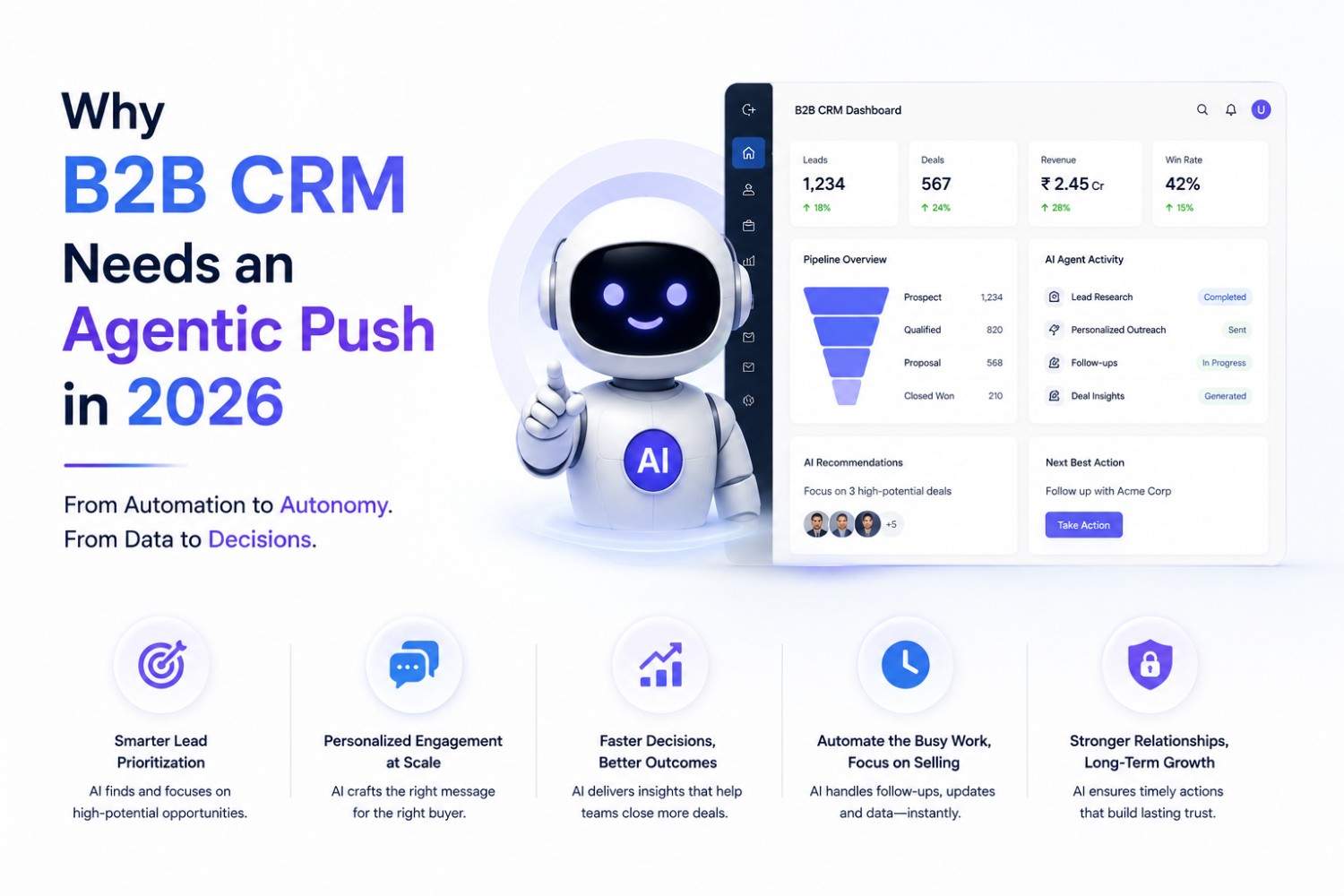
B2B CRM was designed to record work after it happened. In 2026, revenue teams need systems that can recognize buying signals, decide the next best action, and execute approved workflows before momentum is lost.
That is the shift from CRM as a system of record to CRM as a governed system of action. The question is no longer whether AI can draft an email or summarize a call. It is whether your CRM can safely coordinate research, qualification, routing, follow-up, and account intelligence across the buying committee—with humans retaining control where judgment matters most.
For two decades, CRM speed has been bounded by human availability. A prospect fills out a form. Hours later (or days later), a sales rep notices, reviews the context, decides whether to engage, and manually starts a sequence. Each step requires user login, data review, and human decision-making.
Meanwhile, your buyers are moving through their evaluation cycle without you.
79% of B2B buyers now use AI-driven search tools like ChatGPT and Perplexity to research solutions. By the time your rep notices a high-intent lead, that buyer has already evaluated your competitors, read your case studies, and formed initial opinions. The window for influence has narrowed.
Traditional CRM systems cannot close this gap because they wait for human action. A signal arrives. The system logs it. A notification appears. A human reviews it. A human decides. A human acts. Each handoff introduces latency.
Meanwhile, 38% of B2B buyers already use agentic AI on their side to evaluate vendors, synthesize research, and draft RFP responses. Your buyers are thinking and acting at machine speed. If your sellers are still working at human speed—researching manually, drafting by hand, logging information after the fact—you are competing with one hand tied behind your back.
[wpforms id=”535″ title=”true”]
Before positioning AION, we need to separate what agentic really is from what vendors claim it is.
Automation follows a predefined path. “If a lead fills out a form, send email template 1. If they click the email, send template 2. If they open the landing page, mark as qualified.” The workflow is scripted and identical for every lead.
Agentic AI observes signals, evaluates context, chooses among approved actions, executes within guardrails, records its reasoning, and escalates exceptions to a human.
For example:
The second approach requires five capabilities traditional CRM systems do not provide: signal ingestion, contextual reasoning, governed execution, reasoning transparency, and human-in-the-loop feedback loops.
Your CRM must ingest buying signals (website behavior, content engagement, technographic changes, career moves, news mentions) and trigger workflows instantly—not in a daily digest or weekly dashboard review. When a signal crosses a threshold you define, the agent evaluates whether other conditions are met (deal stage, contact role, account segment) and executes if approved. The signal-to-action time compresses from hours to seconds.
B2B buying committees now span 5 to 16 decision-makers. Traditional CRM treats each contact as an isolated row in a database. Agentic CRM understands the account as a unit: who the stakeholders are, what role each plays, when their engagement has gone cold, and how to coordinate personalized touches across personas without redundancy or contradiction.
When a procurement manager engages, the agent can flag it internally as a buying-committee expansion and prompt your sales team to map the new stakeholder into your strategy. When two committee members from the same account interact with your content on the same day, the system recognizes this as a buying-committee signal, not two independent leads.
Fixed lead scoring is obsolete. Agentic CRM updates prospect scores continuously based on new behavioral signals, committee composition changes, conversation sentiment, and buying-stage velocity. Machine learning models trained on your historical wins help agents dynamically rerank the pipeline so your team always works on the highest-probability deals first.
Agents should handle tasks that are repetitive and low-risk: scheduling follow-ups, writing initial outreach, routing leads to the right rep, updating deal stage, flagging stalled opportunities for re-engagement. Every action must be logged with full context and reasoning. Your team must be able to see exactly why the agent made a decision and reverse it if needed.
As agents execute more tasks, regulatory risk increases. Your CRM must enforce role-based permissions, maintain immutable audit logs, track all agent decisions, and provide compliance teams visibility into workflows. In regulated verticals (Insurance, Finance), this is non-negotiable.
Inbound lead qualification at scale
Your website attracts 500 inbound leads monthly. Today, a qualification specialist manually reviews each one, researches the company, checks the domain against your ICP, assigns a lead score, and routes it to the appropriate sales rep or nurture sequence. This takes 5-10 minutes per lead: 40 to 80 hours per month of manual work.
An agentic workflow: Lead arrives. System instantly enriches the contact (company size, industry, technographic profile, buying committee intel). Agent evaluates against your ICP and current deals. If qualified, agent drafts a personalized first touch, identifies the optimal next step (immediate outreach vs. nurture sequence), routes to the right rep, and logs the decision with confidence score. If not qualified, agent adds to nurture pool and sets a trigger for re-qualification in 90 days if engagement signals appear.
Result: 500 leads processed in minutes instead of 80 hours. Reps receive only qualified, enriched leads with context already loaded. Nurture sequences run on actual buying signals, not just calendar cadence.
Stalled-opportunity re-engagement
Your sales cycle is 90 days. But 35% of pipeline deals stall for 30+ days with no activity—not because the deal is dead, but because both sides got busy. Today, a sales manager manually scans the pipeline weekly, identifies stalled deals, and sends a Slack reminder to reps to “check in on the Acme deal.” Sometimes the rep follows up. Often they don’t.
An agentic workflow: System monitors deal activity (emails, calls, CRM updates, calendar events). When a deal has been stalled for 21 days, agent flags it internally and triggers a re-engagement sequence. Agent may research whether buying committee changes happened (career moves, company news) that could unblock the deal. Agent can also draft a check-in message personalized to the context of the stall (e.g., if budget approval was the blocker, the message references upcoming fiscal cycles). Agent routes this to the rep with one-click send, or sends it on the rep’s behalf with a record of the action.
Result: Stalled deals restart faster. No institutional knowledge is lost. Reps focus on deals that need judgment, not on scanning spreadsheets.
Buying committee orchestration
You are pursuing a school district deal. The buying committee includes the procurement director, IT director, curriculum lead, and superintendent. Each has different priorities and communication preferences. Today, your rep tracks this manually: who likes email, who prefers calls, what topics matter to each persona, when each stakeholder typically engages.
An agentic workflow: System maps the full committee in Groweon, tracks all interactions with all committee members, understands each role’s priorities (procurement cares about cost and risk, IT cares about integration and uptime, curriculum cares about adoption and outcomes). Agent coordinates personalized content to each persona, spaces out touches so the buying committee isn’t bombarded, detects when a new decision-maker joins or a known stakeholder goes silent, and alerts your team when external signals suggest a buying timeline is accelerating (e.g., district announces a digital transformation initiative). All activity is logged in the single source of truth so no context is lost when team members change.
Result: Multi-stakeholder deals close faster. No stakeholder is neglected. Your team maintains continuity even during turnover.
| Dimension | Traditional Automation | Agentic CRM |
|---|---|---|
| Triggering | Fixed Schedule or User Action | Real-Time Signal Detection |
| Decision-Making | Follows Predefined Rules (“If X, Then Y”) | Evaluates Context and Chooses the Best Approved Action |
| Personalization | Same Workflow for All Contacts | Tailored to Account Stage, Buyer Persona, and Buying Committee Status |
| Adaptability | Requires Manual Rule Updates | Continuously Improves Through Feedback and Learning |
| Transparency | Actions Are Logged but Reasons Are Often Unclear | Complete Audit Trail Explaining Every Agent Decision |
| Escalation | Limited; Workflow Runs Until Completion | Automatically Flags Complex Cases for Human Review |
| Compliance | Basic Activity Logging | Immutable Audit Records, Role-Based Access Control, and Compliance-Ready Audit Trails |
Groweon AION is built specifically for agentic B2B sales workflows. Rather than treating agents as an afterthought, AION integrates signal-driven automation, adaptive lead scoring, account orchestration, and governance into the core platform.
Signal-driven lead qualification
AION ingests real-time intent signals—website activity, content engagement, technographic shifts, career moves from LinkedIn, industry news, buying group changes. When a prospect profile matches your ICP and hits an engagement threshold, AION can automatically qualify the lead, enrich it with account and buying committee intel, and route it to the right rep. Your team sees high-signal inbound leads pre-qualified and contextualized, not raw form submissions.
Adaptive lead scoring and re-engagement
Rather than static scoring rules, AION continuously updates lead and opportunity scores based on behavioral signals and historical patterns. When a deal goes stale, AION detects it, surfaces re-engagement opportunities (new committee members, budget cycle changes), and can trigger an automated check-in with context. Your team spends less time on pipeline hygiene and more time on deals that need strategic input.
Buying committee mapping and coordination
AION maps the entire buying committee and tracks engagement across all personas. Multi-channel follow-ups via WhatsApp, voice, email, and SMS are orchestrated so no stakeholder is over-touched and each persona receives tailored content. When committee composition changes, AION flags it immediately. When engagement patterns suggest a decision is coming, your team gets advance notice.
Lead qualification and stage advancement
AION automates routine qualification tasks: checking company fit, verifying contact accuracy, confirming budget authority, assessing timeline. Leads advance through pipeline stages automatically when conditions are met. Deals don’t stay stuck in early stages because of manual review bottlenecks.
Follow-up orchestration and scheduling
AION coordinates multi-channel follow-up sequences (email, WhatsApp, voice, SMS) tailored to each contact’s engagement history and persona. Sequences adapt based on response—if a lead engages with WhatsApp but ignores email, future touches prioritize WhatsApp. Scheduling is intelligent, accounting for time zones and contact behavior patterns.
CRM write-back and action logging
Every agent action is logged in Groweon: qualification decisions, scoring changes, sequence starts, follow-up attempts, deal stage moves. Your team and compliance teams have full visibility. No work happens outside the CRM.
This is agentic CRM in practice: signals flow in, the system reasons about the next best action within your approved guardrails, actions execute, context is recorded, and your team maintains oversight and control.
“This feels like spam automation. Won’t it damage our brand?”
The difference between spam and relevance is context and consent. Agentic CRM orchestrates touches based on buying signals and committee role, not just “contact exists.” When AION detects that a prospect has visited your pricing page three times, reviewed your case study for their industry, and matches your ICP, an outreach is timely, not intrusive. You are engaging a buyer who is already evaluating you.
Further, because every action is logged and reversible, your team retains control. If an agent action doesn’t feel right, your rep can see the logic, override it, and provide feedback. You get the speed benefit of autonomous execution plus the judgment of human oversight.
“How accurate is the AI in qualifying leads?”
Agentic CRM does not replace human judgment—it accelerates it and removes routine friction. AION’s qualification logic is built on your historical data: what companies and contacts have converted, what signals typically precede a close, what industries and roles are in your ICP. The system is not guessing; it is applying your own patterns at scale.
And because every decision is logged with confidence scores and reasoning, your team can audit the system. If AION is routinely misclassifying a certain company type or contact role, your team can flag it, provide corrective examples, and the system recalibrates. This human-feedback loop is how agentic systems improve—they are not static.
“Won’t this break our current sales process?”
Agentic CRM augments your process, not replaces it. AION handles the work your team currently does manually (list building, initial outreach, lead qualification, follow-up scheduling, CRM hygiene). Your reps still own the relationship. They still run the negotiation. They still close the deal. They just spend less time on admin and more time on selling.
Rollout does not require a big-bang process redesign. Start with one workflow (inbound qualification, for example). Measure the impact (leads qualified faster, reps have more context). Expand to the next workflow (stalled-opportunity re-engagement). Build over time.
The core question in 2026 is not whether your team uses AI. 87% of sales organizations already use some form of AI. The question is whether your CRM enables autonomous, governed workflows that move deals forward while your team stays in control.
Only 24% of B2B suppliers run true agentic workflows that restructure how revenue is found, prioritized, and validated. The gap between hype and execution is wide. Most teams use point-tool AI—assisted email, basic enrichment, chatbots—without changing the underlying motion.
Agentic CRM requires both technology and mindset. Technology: a platform that ingests signals, reasons about context, executes within guardrails, and logs all decisions. Mindset: trust that machines can handle the structural, repetitive work while your team focuses on strategy and relationship-building.
The window to move from copilot to agent is now. Leaders will build agentic workflows in 2026. Everyone else will keep doing what their competitors automate.
Groweon AION transforms how B2B teams—across Education, Automobile, Real Estate, Insurance, FMCG Distribution, and B2B Sales verticals—find, prioritize, and close revenue. Built for signal-driven workflows, AION automates qualification, orchestrates buying committee engagement, and maintains full transparency and control.
See how AION powers agentic workflows for your vertical or reach out to discuss which workflow (inbound qualification, stalled-opportunity recovery, committee orchestration) would unlock the most value for your team first.
What is the difference between a copilot and an agent in CRM?
A copilot answers questions when you ask. A user prompts the copilot, reviews the answer, decides whether to act on it. An agent runs autonomously based on signals. It detects that conditions have been met (a prospect visited your site, a committee member joined, a deal has been stalled), evaluates the context, and executes an action (starts a sequence, routes a lead, flags an opportunity) without waiting for a human prompt. Agents operate at machine speed; copilots operate at human pace.
How is agentic workflow different from the automation we already have?
Existing automation runs the same workflow for every contact—”if form submitted, send template X.” Agentic workflows are adaptive. They ingest multiple signals simultaneously (company profile, contact role, buying committee state, deal stage, historical patterns), reason about what the next best action is for that specific contact in that specific context, choose from a range of approved actions (not just one scripted path), and improve over time based on outcomes and feedback.
What happens if the agent makes the wrong decision?
Every action is logged with full reasoning and context. Your team can see exactly why the agent chose to qualify a lead or trigger a sequence. If the decision was wrong, you reverse it with one click and provide feedback. Over time, as you review agent decisions and correct them, the system learns what works for your business and what doesn’t. This feedback loop is how agentic systems become more accurate and trustworthy.
Do agentic workflows require us to rebuild our sales process?
No. Start with one workflow—the one causing the most manual friction for your team (inbound qualification, stalled-deal recovery, or committee orchestration). Run it in parallel with your existing process for a few weeks. Measure impact. Once you see the value, expand to the next workflow. Groweon AION integrates with your current stack, so you do not need to rip and replace.
Will agents take over the selling?
Agents handle the work that is structural: initial research, qualification, routing, follow-up scheduling, and CRM logging. They free your reps to focus on work that requires judgment: understanding the buyer’s priorities, negotiating terms, building trust, closing deals. Agents move the deal forward faster. Your reps win it.
How do I know if my team is ready for agentic workflows?
You are ready if you have a repeatable process that your team executes manually and consistently (inbound lead qualification, lead scoring, opportunity re-engagement, follow-up scheduling). If the process is currently manual and time-consuming, an agent can likely improve it. Start small: identify the one workflow your team wishes was faster, automate it, measure the result, and expand.
B2B CRM needs to move from system of record to system of action. Agentic workflows—signal detection, adaptive decision-making, autonomous execution, and human oversight—are no longer differentiator; they are table stakes in 2026.
Groweon AION delivers five core capabilities: real-time signal ingestion, account-level buying committee orchestration, adaptive lead scoring, autonomous task execution with full audit trails, and governance controls for compliance. These capabilities power three high-impact workflows: inbound lead qualification, stalled-opportunity re-engagement, and buying committee coordination.
Most B2B organizations expect agentic AI to manage at least half of their customer interactions in the near future. But 72% cite skills gaps as a major barrier to deploying agentic AI effectively. The technology is available. The barrier is execution—knowing where to start and how to trust the system.
Agentic CRM is not coming in 2027. It is the operating baseline in 2026. The question is whether your CRM enables it and whether your team is ready to work at machine speed while maintaining human control.
[wpforms id=”535″]

21 Sep, 2026
Summary (TL;DR): The best Zoho CRM alternatives in India are...

21 Sep, 2026
Summary (TL;DR): Groweon suits Indian SMBs that want one AI-first...

21 Sep, 2026
Summary (TL;DR): Groweon suits Indian SMBs that want one AI-first...
18 Sep, 2026
Summary (TL;DR) B2B CRM is essential infrastructure for Indian SMBs...
17 Sep, 2026
Summary: CRM Software Customer relationship management software has become essential...