

Best Zoho CRM Alternatives in India for Growing SMBs in…
21 Sep, 2026
Summary (TL;DR): The best Zoho CRM alternatives in India are...
Updated: 10th August, 2026
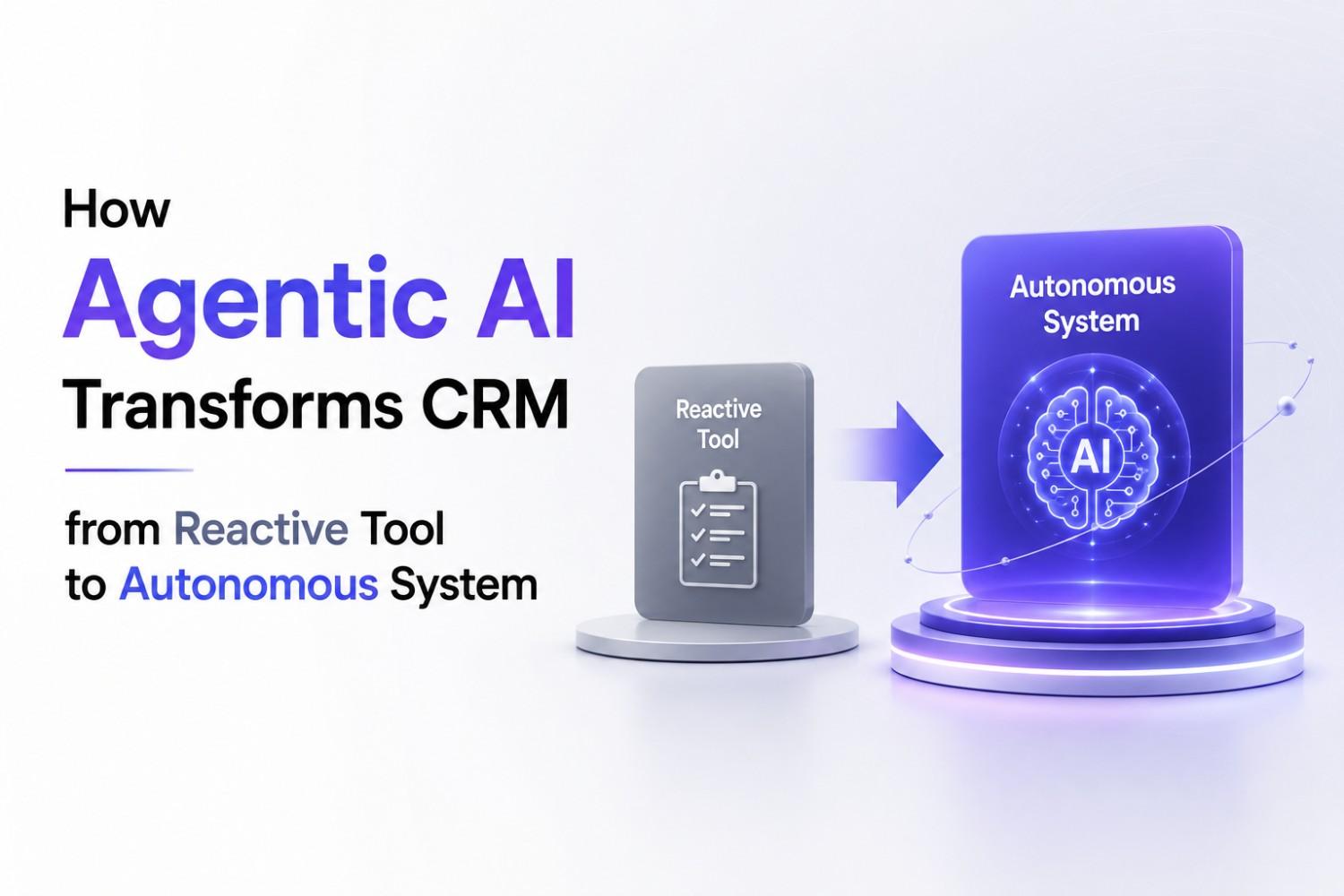
Agentic AI is rewriting what CRM can do. Instead of waiting for your team to manually qualify leads, chase follow-ups, and log interactions, modern CRM systems now act autonomously. They initiate conversations, prioritise high-intent prospects, make decisions in real time, and escalate only what needs human judgment. For SMBs across education, automobile, real estate, and B2B sales, this shift means faster pipelines without proportional team growth.
This guide explains what agentic AI in CRM actually means, how it differs from traditional automation, and why adoption requires specific groundwork.
[wpforms id=”535″]
Agentic AI is software that makes decisions and takes action without being explicitly told what to do in every situation. Unlike traditional CRM automation that follows predefined rules (“if X, then Y”), agentic systems observe context, reason about it, and choose the best next action from multiple options.
In a CRM context, the system doesn’t just track leads. Instead, it actively works to move prospects closer to conversion. It qualifies leads by analysing their digital footprint. It knows when to send that WhatsApp message. It recognises when a prospect needs a product demo versus a consultation call. And critically, it learns from each interaction to improve future decisions.
Think of it this way: traditional CRM is a filing cabinet that stores information. Agentic AI CRM is an assistant sitting at your desk, reading the same information, deciding what matters, and acting on it while you focus on closing deals.
The gap between workflow automation and agentic AI is significant.
| Feature | Traditional CRM Automation | Agentic AI CRM |
|---|---|---|
| Decision-Making | Follows Preset Rules (If-Then Logic) | Analyses Context and Chooses the Best Action |
| Learning | Static; Doesn’t Improve from Outcomes | Learns from Every Interaction and Adapts Its Approach |
| Scope | Executes Specific Tasks Such as Sending Emails or Logging Calls | Manages the Entire Prospect Journey Autonomously |
| Escalation | Manual; Requires Human Review | Intelligent; Escalates Based on Complexity and Customer Intent |
| Personalization | Template-Based; Sends the Same Message to Similar Segments | Dynamic; Personalizes Communication in Real Time Based on Customer Behaviour |
| Lead Qualification | Manual Scoring or Rule-Based Lead Scoring | Continuous Real-Time Lead Scoring Based on Engagement Patterns |
Key takeaway: With traditional automation, you might send an email to 100 leads and follow up on all 100 replies manually. With agentic AI, the system qualifies interested prospects automatically and flags only genuine opportunities for your team. Your team’s time shifts from sorting to selling.
Let’s walk through a concrete example. A property developer sees a new lead: a prospective homebuyer who visited their website, watched a project video, and abandoned the contact form.
Step 1: Initial Analysis
The agentic AI system reads the lead’s behaviour. It knows they spent 8 minutes on the 2 BHK property page and viewed the payment plan twice. No form submission, but clear interest signals.
Step 2: Autonomous Outreach
Instead of waiting for your team, the system initiates. It sends a WhatsApp message personalised to their behaviour: “Hi, saw you were interested in our 2 BHK units. Happy to walk you through the payment flexibility we offer. Free call in 5 mins?” The system picks the timing based on the prospect’s typical activity window.
Step 3: Response Intelligence
The prospect replies: “Tell me more about the lower EMI options.”
The system recognises this as a finance-focused question. It doesn’t send a generic brochure. Instead, it prepares a targeted comparison showing EMI structures and immediately offers a call with your finance team (not a sales rep, because the question signals different intent).
Step 4: Escalation
Your finance team receives the lead pre-qualified with full context. A 10-minute call closes the deal that would have taken three email exchanges and two follow-ups.
This same flow applies whether you’re an education institute qualifying applicants, an auto dealer following up on test drive inquiries, or a B2B SaaS company managing enterprise demos.
As businesses grow, manual lead management becomes unsustainable. A typical SMB sales team spends substantial time on admin, qualification, and follow-up: data entry, email chains, and chasing prospects who went silent.
Additionally, human response times create opportunity loss. A prospect inquires at 11 PM. Your team sees it at 9 AM the next day. In a competitive market, that delay is often enough for them to talk to a competitor or lose interest.
Traditional CRM automation tries to solve this with scheduling (“send email at 9 AM”) but misses the bigger picture. It doesn’t know if 9 AM is when that particular prospect is active. It doesn’t know if they’ve already received three emails this week. It certainly doesn’t know their objection has shifted from pricing to timeline.
Agentic AI fills this gap. It responds in minutes. It personalises at scale. And it qualifies rigorously, so your team’s time is spent on conversations that close, not prospects that never will.
Real-Time Intent Scoring
The system updates lead scores continuously based on behaviour, not just demographics. A prospect who replies gets a higher score than one who viewed a page. After the second engagement, the system understands their likely buying timeline and primary pain point.
Proactive Conversation Initiation
Your CRM doesn’t wait for prospects to come back. When a prospect shows buying signals (spent time on pricing page, returned after three days, filled half a form), agentic AI reaches out first. Timing, channel (email, WhatsApp, SMS), and message content are all tailored to that prospect’s behaviour.
Multi-Channel Coordination
A lead might interact across WhatsApp, email, and your website within one week. Traditional CRM treats these as separate events. Agentic AI sees the full conversation thread. Your team sees a coherent narrative, not fragmented touch points.
Contextual Response Automation
When a prospect asks “your competitor is cheaper,” the system doesn’t just log the objection. It recognises the objection type, retrieves relevant case studies or comparative data, and responds contextually. For complex deals, it escalates. For straightforward responses, it handles it independently.
Intelligent Escalation
Simple FAQ questions are answered by the agentic system. Prospects ready to buy go straight to your sales rep with full context. Prospects asking for custom solutions get escalated to your account manager. This triage happens automatically based on intent and complexity.
Education
Institutes receive enquiries across WhatsApp, website forms, and social media DMs. An agentic system answers the “what’s the eligibility?” question at the moment it’s asked. It qualifies interested students by checking whether they’ve viewed course details and fee structures. It flags students ready for counselling so your admissions team calls them immediately.
Automobile
A showroom gets a lead from a test drive enquiry. Agentic systems send personalised follow-up based on which vehicle was tested. They ask qualifying questions (“Are you planning to purchase within 3 months?”) and capture key preferences. When your sales team reaches out, they know the prospect’s timeline, budget, and preferred features.
Real Estate
Developers manage hundreds of inquiries monthly. An agentic system qualifies by detecting genuine interest: which properties get multiple views, which price range the prospect favours, and their timeline. Serious buyers are identified and passed to your team; window shoppers get nurture campaigns.
B2B Sales
Enterprise cycles involve multiple stakeholders. Agentic systems track engagement across your account contacts. If the Finance Director suddenly views your pricing page after the VP of Operations engaged last week, the system flags this (buying committee is expanding). Your sales rep gets this signal before the call.
Agentic AI isn’t plug-and-play. Success depends on foundational work.
Clean Lead Source Tracking
The system learns from data. If your lead sources are messy (inconsistent UTM tags, missing form fields, unclear event tracking), the AI’s decisions will be poor. Before deploying, audit your data:
Defined Sales Stages and SLAs
Agentic AI escalates based on stage and complexity, but it needs to know your stages. Do you have:
Without these, the system doesn’t know when to escalate or to whom.
Basic AI Governance
You can’t set agentic AI loose without oversight. Establish:
What Can Go Wrong
Agentic AI amplifies existing problems. Bad data in, bad decisions out. A lead scoring model trained on 10 leads is less accurate than one trained on 1000. A system that doesn’t escalate enough leaves prospects waiting; one that escalates too much overloads your team. Common failure modes:
These aren’t deal-breakers; they’re normal. Plan for a 4-6 week calibration period where you monitor, adjust rules, and retrain the model.
Agentic AI CRM isn’t a standalone tool. It works alongside revenue operations (RevOps) infrastructure. Understand where it fits:
Paired together, these tools create a modern sales ops engine. Alone, each does less.
The shift from traditional CRM to agentic AI requires process change. Your team will receive pre-qualified leads instead of raw leads. That’s a welcome change, but it requires mindset adjustment.
Your sales pitch can shift from broad discovery to focused discussion because initial discovery is already done. Your follow-up timelines compress because the system doesn’t let interested prospects slip away. Your team’s KPIs will shift: less time on “response rate” (the system handles that) and more focus on “qualified lead to demo” and “demo to close.”
This transition typically takes 2-3 weeks for your team to feel comfortable. After that, they’ll be wondering how they ever managed without it.
If you’re considering adopting agentic AI, look for these capabilities:
Real-Time Intent Scoring
The system should update scores continuously, not daily. Ask how often: instantly as engagement happens, hourly, or nightly?
Multi-Channel Autonomy
It should act across email, WhatsApp, SMS, and web without separate integrations for each. A single pane should show all prospect interactions.
Transparent Decision-Making
You should understand why the system made a specific decision. If a lead was escalated, which signals triggered that? This transparency builds trust.
Vertical-Specific Logic
A CRM for education should understand education buyer journeys (enquiry to application to enrolment). One for real estate should distinguish investor from end-user based on behaviour.
Sandbox Testing
Before going live, test the system in a controlled environment. This prevents early mistakes and lets you tune the system to your business before prospects interact with it.
Agentic AI is production-ready for Indian SMBs today. The competitive advantage goes to businesses that adopt it first. Traditional CRM passively stores information. Agentic AI CRM actively works to convert prospects into customers, 24/7, without human intervention.
For education institutes trying to fill seats faster, auto dealers competing on response time, real estate developers juggling hundreds of inquiries, and B2B sales teams pursuing complex deals, agentic AI CRM is the difference between scaling and staying flat.
Groweon’s AION engine qualifies leads in real time, reaches out proactively across WhatsApp and email, and hands your team only the prospects ready to buy. See how your lead-to-close cycle compresses.
Book a 20-minute demo to explore agentic AI for your vertical.
What’s the difference between agentic AI and chatbots?
Chatbots answer questions within a fixed set of options. They respond to customer input but don’t initiate action or make complex decisions. Agentic AI systems initiate conversations, make decisions in ambiguous situations, and learn from outcomes. A chatbot might answer “what’s your pricing?” but agentic AI reads that question as a budget concern and adjusts the entire conversation strategy.
How do we measure ROI in the first 90 days?
Track three metrics: lead response time (from inquiry to first touch), qualified lead rate (percentage of leads that meet your definition of “ready for sales”), and pipeline velocity (average days from qualified lead to demo). Most customers see response time drop by 50-70% immediately. Qualified lead rate typically improves 20-30% after the system learns your data patterns. Pipeline velocity improves as prospects no longer wait for human follow-up.
What happens when the AI makes a wrong decision? How is it corrected?
Wrong decisions happen, especially early. The system flags escalations for your team to review. When a decision is wrong, your team marks it as such in the interface, and the system learns from that feedback. After 2-3 weeks of corrections, accuracy improves significantly. Some vendors offer a weekly audit report so you can proactively catch drift.
Can I integrate agentic AI CRM with my existing tools?
Most modern systems integrate with Zapier, Google Workspace, Microsoft integrations, and WhatsApp Business API. You don’t need to replace your entire tech stack; you add agentic AI on top.
Is my data secure with agentic AI systems?
Security depends on the vendor. Ask about data encryption, compliance certifications (SOC 2, ISO 27001), and data storage location. Ensure they meet your local compliance requirements (e.g., data residency mandates in India).
Does agentic AI CRM work for small teams?
Yes. Small teams benefit most because agentic AI multiplies capacity. A team of 3 people with agentic AI can manage the pipeline a team of 5-6 using traditional CRM would require.
[wpforms id=”535″]

21 Sep, 2026
Summary (TL;DR): The best Zoho CRM alternatives in India are...

21 Sep, 2026
Summary (TL;DR): Groweon suits Indian SMBs that want one AI-first...

21 Sep, 2026
Summary (TL;DR): Groweon suits Indian SMBs that want one AI-first...
18 Sep, 2026
Summary (TL;DR) B2B CRM is essential infrastructure for Indian SMBs...

17 Sep, 2026
Summary: CRM Software Customer relationship management software has become essential...