Is Traditional CRM Dead? Why the Agentic Revenue Engine Is…
06 Jul, 2026
Traditional CRM is not dead, but for most businesses it...


Auto Capturing, nurturing, and converting potential customer leads.

Manage AMC contracts, track service requests, ensure timely renewals.

Tracks, resolves, manages issues, and gathers customer feedback.

Manage purchases, expenses, vendors, and POs efficiently with CRM.

Manages order lifecycle from placement to delivery completion.

Generates invoices and manages sales transactions and records efficiently.

Manages stock levels, tracks items, ensures efficient inventory control.

Manages dealer workflows, assigns leads, and tracks progress centrally.

WhatsApp CRM integration with bulk messaging, auto notifications, chatbots.

IVR enabled CRM integrates click-to-call, bulk dialling, recording features.

Achieves optimum productivity of tele-sales team with auto dialler.

Updated: 6th July, 2026
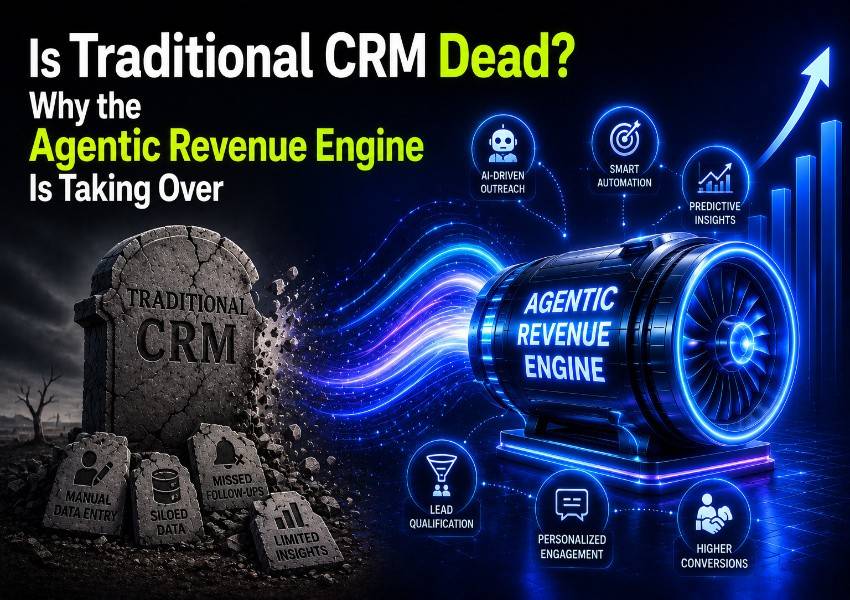
Traditional CRM is not dead, but for most businesses it is quietly bleeding revenue every single day it sits unfixed. The real question is not whether CRM software still has value. It is whether your CRM is costing you leads right now, and by how much. This post gives you a scorecard to check that, and the math to put a rupee figure on the damage.
Summary
A CRM is not dead because it is old. It is dead the moment it stops acting fast enough to protect revenue. Therefore, the test is not “does it store my leads correctly.” The test is “does it respond, qualify, and follow up before my competitor does.”
Run through the scorecard below. Score one point for every statement that is true for your business today.
The 8-Point Dead CRM Scorecard
Scoring
| Score | What it Means |
|---|---|
| 0 – 2 | Your CRM is functioning well as an operational tool. |
| 3 – 5 | Your CRM is passive. It is likely costing you leads without you noticing. |
| 6 – 8 | Your CRM is effectively dead as a revenue tool. It stores data but does not protect revenue. |
Most businesses underestimate this because the loss never shows up as a line item. It shows up as leads that quietly went cold. However, the research on this is specific enough to illustrate.
Responding to a lead within 5 minutes makes you up to 21 times more likely to qualify that lead compared to waiting 30 minutes, according to the MIT study conducted by Dr. James Oldroyd at MIT Sloan School of Management, in partnership with InsideSales.com. Separately, an HBR study auditing 2,241 companies found that firms contacting a lead within one hour were nearly 7 times more likely to qualify it than those waiting just one more hour, and over 60 times more likely than firms waiting a full day. That same audit found the average B2B lead response time is 42 hours, which means most businesses are operating far outside the window where these odds still favor them.
Here is an illustrative example of what that speed gap can mean in revenue terms. These conversion figures are for demonstration only and not sourced data, but they reflect the direction and scale that industry research points to. Assume each converted customer is worth ₹8,000 to your business, and you generate 100 leads in a month.
| Response Speed | Illustrative Conversion Rate |
Customers Won (per 100 Leads) |
Revenue (₹8,000 per Customer) |
|---|---|---|---|
| Under 5 Minutes | 3% | 3 | ₹24,000 |
| 30+ Minutes | 0.15% | 0.15 | ₹1,200 |
That gap, roughly ₹22,800 per 100 leads in this example, repeats every month, across every campaign, for as long as response time stays slow. For a business running paid ads across Meta, Google, and WhatsApp, this is not a small leak. It is often the single biggest hidden cost in the entire sales funnel, and the 42-hour industry average explains why: most competitors are just as slow, which means the first business to fix this gains a disproportionate advantage.
Owning a CRM does not fix this on its own. A CRM only helps if something inside it actually acts the moment a lead arrives. Most CRMs, including well-known ones, simply were not built to do that.
The lead sits in a queue
A form fill or missed call creates a record. However, nothing happens until a human opens that record, which could be minutes or hours later depending on workload.
Qualification depends on a rep’s judgment
Even when a rep does call, deciding whether a lead is hot, warm, or cold is subjective. As a result, two reps looking at the same lead often reach different conclusions.
After-hours leads lose the most value
Leads that arrive in the evening or on weekends face the longest delays, and delay is precisely what destroys conversion odds fastest.
This is where an agentic revenue engine changes the equation. Instead of a lead waiting for a rep to become available, Groweon’s AION Autopilot responds and qualifies the moment a lead enters the system, at any hour, across calls and WhatsApp. The scorecard above maps directly onto what it fixes:
Because this shifts response time from hours to minutes, the revenue math from the table above works in the opposite direction, recovering the money that a slow CRM quietly gives away.
Traditional CRM is not dead in the sense of being useless. For many Indian SMBs, it has stopped actively protecting revenue. The 8-point scorecard is a fast way to find out where your business actually stands. A score of 3 to 5 means leads are already leaking without anyone noticing. A score of 6 or higher means the CRM has effectively stopped functioning as a revenue tool, and the loss is a measurable, recurring one that compounds every month it goes unaddressed.
Run your numbers through a free audit with Groweon and see exactly how much faster response times through AION Autopilot could recover for your business.
What counts as a “dead” CRM score?
A score of 3 to 5 means your CRM is passive and likely leaking leads without obvious signs. A score of 6 or higher means it has effectively stopped protecting revenue altogether.
Can I fix this without replacing my entire CRM?
In many cases, yes. Adding an agentic layer like AION Autopilot on top of existing CRM workflows can close the response and qualification gap without a full system migration.
Does this apply to WhatsApp leads too, or only phone leads?
It applies to both. Delayed response on WhatsApp enquiries causes the same drop in conversion as delayed phone response, which is why AION Autopilot covers both channels.
What is the fastest way to reduce lead response time without hiring more reps?
Automating the first response and initial qualification step, so a system engages the lead within minutes instead of a rep doing it manually, is the single highest-impact change available.

06 Jul, 2026
Traditional CRM is not dead, but for most businesses it...

03 Jul, 2026
Summary: Agentic AI turns CRM from a passive contact database...

30 Jun, 2026
Summary: Sales reps lose a large share of their working...

30 Jun, 2026
Summary: An agentic sales team is a group of AI...
29 Jun, 2026
Summary: Agentic CRM adoption is no longer a luxury for...