

Best Lead Management Software in India: What to Check Before…
01 Oct, 2026
Summary (TL;DR): Lead management software captures, scores, routes, and nurtures...
Updated: 3rd July, 2026
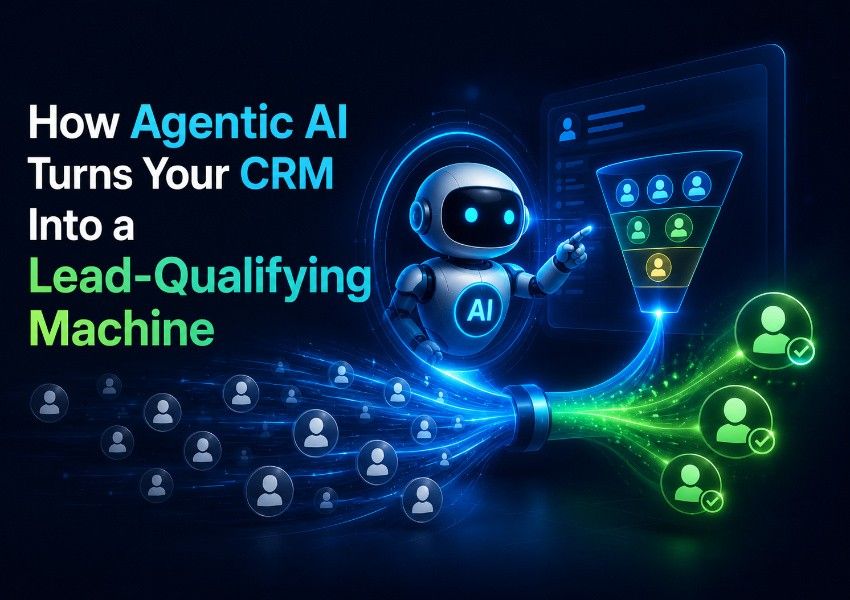
Summary: Agentic AI turns CRM from a passive contact database into an active lead-qualifying system. Groweon’s AION Autopilot uses the AI Calling Agent, WhatsApp AI Chatbot, and Auto Lead Qualifier together to hand sales reps fully scored, context-rich leads instead of raw contact details. Gartner data confirms this shift is accelerating fast, with enterprise AI agent adoption expected to jump sharply through 2026, making now the right time for SMBs to move first.
Most CRMs collect leads. Very few help you close them. Agentic AI changes that by qualifying, scoring, and prioritizing every lead automatically, often before a sales rep even logs in.
Agentic AI means software that does not just store data. It takes action on its own, like calling a lead, asking questions, and deciding what happens next. In a CRM, that turns a static contact database into an active lead-qualifying system. Groweon’s AION Autopilot is built on exactly this model, using AI agents to run qualification conversations and hand sales reps a ready-to-close lead record instead of a raw phone number.
A traditional CRM is a filing cabinet with a search bar. It logs calls, tracks emails, and holds contact details, but every action still depends on a human deciding what to do next.
This creates three predictable problems for sales teams. First, leads sit untouched for hours or days before anyone reaches out. Second, reps spend time qualifying unqualified leads instead of closing ready ones. Third, context gets lost between the marketing team, the sales team, and the CRM itself.
Gartner’s research on enterprise AI shows this gap clearly. Gartner predicts that 40% of enterprise applications will be integrated with task-specific AI agents by the end of 2026, up from less than 5% in 2025. That jump signals a broader shift away from passive software toward systems that take action on their own.
Here is how the system works as a single qualification pipeline, not a set of disconnected features.
Step one, initiate contact.
The AI Calling Agent conducts real qualification conversations with new leads. It asks the right questions, listens for buying signals, and records responses directly into the CRM, all without a rep picking up the phone first.
Step two, continue engagement.
The WhatsApp AI Chatbot picks up the conversation on the channel leads already use daily. It answers questions, captures intent signals, and keeps the lead moving until they are ready for a human touch.
Step three, structure and score.
The Auto Lead Qualifier is the classification layer behind these conversations. It does not talk to leads itself. Instead, it tags and scores every interaction the AI Calling Agent and WhatsApp AI Chatbot generate, turning raw conversation data into a structured, sales-ready record.
Step four, scale the process.
Bulk Calling and Rule-Based Calling let this same pipeline run across large volumes of leads on a schedule or trigger, applying consistent qualification logic every time instead of relying on rep availability.
A real estate lead submits a form at 2:00 PM.
By 2:02 PM, the AI Calling Agent calls and asks about budget, location, and timeline.
At 2:05 PM, the Auto Lead Qualifier tags the lead as high intent, ready to move within 30 days.
By the time a sales rep logs in, they see a prioritized, qualified opportunity, not just a phone number and a guess.
The real transformation shows up in what the sales rep sees at the end of the process. A traditional CRM hands a rep a name, a phone number, and maybe a lead source. An agentic AI CRM hands a rep a fully qualified profile.
That profile includes intent signals from the qualification conversation, a lead score from AION AI+, a summary of concerns or objections raised, and a recommended next action. The rep opens one record and already knows whether this lead is worth a call today or a nurture sequence over the next few weeks.
McKinsey’s broader research on AI-driven sales tools points to a similar pattern across industries. Multi-agent workflows, where one agent qualifies leads, another drafts personalized outreach, and a third validates requirements, are becoming standard practice in 2026, with agents maintaining shared context and handing off work without human intervention.
| Capability | Traditional CRM | Agentic AI CRM (AION Autopilot) |
|---|---|---|
| Lead Outreach | Manual, rep-initiated | Automated via AI Calling Agent and WhatsApp AI Chatbot |
| Lead Qualification | Rep judgment, inconsistent | Auto Lead Qualifier tags and scores every lead |
| Response Time | Hours to days | Minutes |
| Scale | Limited by rep headcount | Scales via Bulk Calling and Rule-Based Calling |
| Sales Rep Starting Point | Raw contact details | Fully scored, context-rich lead record |
| Consistency | Varies by rep experience | Same qualification logic every time |
Faster response time cuts the gap between form submission and first contact from hours to minutes. Consistent qualification logic removes the variation that comes from different reps asking different questions. Structured data means every lead record includes intent signals and a score, not just contact details. Scale without headcount lets Bulk Calling and Rule-Based Calling handle volume that would otherwise need more reps.
Adoption data backs up why 2026 is the turning point for agentic CRM systems. According to the 2026 Gartner CIO and Technology Executive Survey, only 17% of organizations have deployed AI agents to date, yet more than 60% expect to do so within the next two years, marking the most aggressive adoption curve among all emerging technologies measured in the survey.
For SMBs specifically, this creates an opening. Larger enterprises move slowly because of complex legacy systems, but SMBs using platforms like Groweon can deploy agentic qualification workflows without rebuilding their entire tech stack. The advantage goes to teams that adopt early, not teams that wait for the technology to become mainstream.
The CRM’s job used to end at storage. Agentic AI extends that job to qualification, scoring, and context-building, all before a rep says a single word to a lead. Groweon’s AION Autopilot brings this shift to Indian SMBs across education, automobile, real estate, insurance, FMCG distribution, and B2B sales, turning a passive contact list into a system that actively qualifies revenue-ready leads.
Book a walkthrough to see the AI Calling Agent, WhatsApp AI Chatbot, and Auto Lead Qualifier work together inside your CRM, live.
What is an agentic AI CRM?
An agentic AI CRM is a customer relationship management platform where AI agents perform actions on their own, such as calling leads, chatting with them, and scoring their intent, instead of only storing data for a human to act on.
Does the Auto Lead Qualifier talk to leads?
No. It is a classification and tagging layer. The AI Calling Agent is the feature that conducts the actual qualification conversations with leads.
Can agentic AI CRM tools work over WhatsApp?
Yes. Groweon’s WhatsApp AI Chatbot engages leads directly on WhatsApp, and its follow-ups run as sequential messages rather than a traditional drip email campaign.
Is agentic AI CRM suitable for small businesses?
Yes. Agentic AI CRM platforms like Groweon are built for SMB budgets and do not require the complex infrastructure that slows down enterprise adoption.
[wpforms id=”535″]

01 Oct, 2026
Summary (TL;DR): Lead management software captures, scores, routes, and nurtures...

01 Oct, 2026
Summary (TL;DR): CRM pricing in India typically runs ₹250 to...

30 Sep, 2026
Summary (TL;DR): A CRM with native Meta Conversions API integration...

29 Sep, 2026
Summary (TL;DR): The best choice depends on whether you want...

28 Sep, 2026
Summary (TL;DR): So, a B2B CRM has moved from a...