

Customer Relationship Management Software for Indian SMBs: (2026 Complete Guide)
17 Sep, 2026
Summary: CRM Software Customer relationship management software has become essential...
Updated: 15th June, 2026
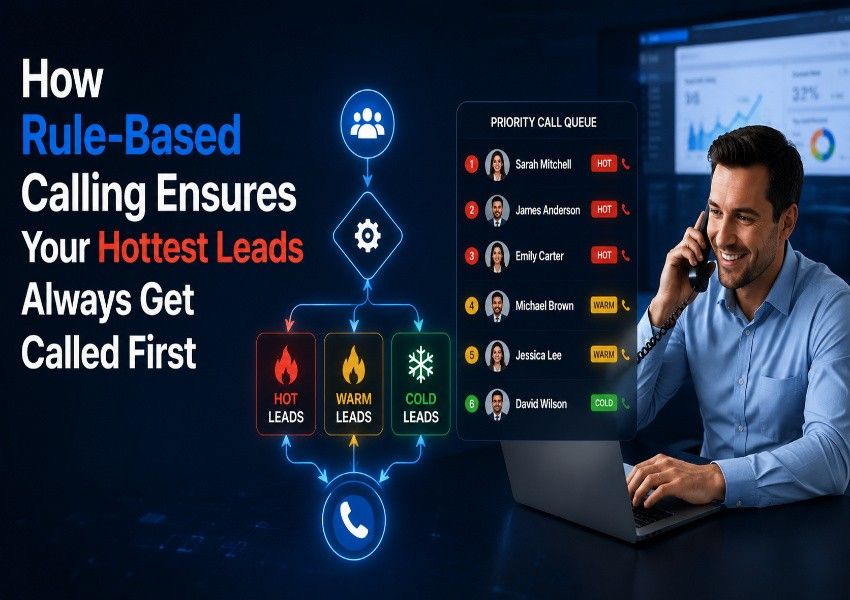
Rule-based calling automates lead prioritization by applying predefined conditions, such as lead score, source, or buying intent, to determine call order. This ensures hot leads are contacted quickly while reducing manual sorting effort for sales teams. Groweon’s AION Autopilot applies this directly within the CRM, dynamically reordering call queues based on real-time lead behavior across verticals like Education, Real Estate, and Automobile CRM.
Rule-based calling is a system that automatically prioritizes which leads your sales team calls first, based on predefined criteria like lead score, source, recency, or buying intent. Instead of agents picking leads randomly or working through a list in the order it arrives, the system pushes high-value leads to the top of the queue automatically. This means your hottest prospects get a call within minutes, not hours, which directly improves conversion rates.
For Indian SMBs juggling dozens of leads daily across WhatsApp, web forms, and ads, this small shift can make a measurable difference in how many leads actually convert into customers.
Rule-based calling works on a simple principle: if a lead matches certain conditions, the system applies a specific action automatically.
For example, a rule might say “if lead source is Google Ads AND lead score is above 80, assign to senior sales rep and call within 5 minutes.” Another rule might say “if a lead has visited the pricing page twice, move to top of call queue.”
These rules run continuously in the background. There is no manual sorting, no spreadsheet shuffling, and no guesswork about who calls whom next.
Lead response time is one of the strongest predictors of conversion. A lead that fills out a form and gets called within 5 minutes is significantly more likely to convert than one called after an hour.
However, most sales teams treat every lead the same way. A cold lead from an old campaign sits in the same queue as a hot lead who just requested a demo. By the time a rep gets to the hot lead, the moment of interest has often passed.
Rule-based calling fixes this by ensuring urgency and value determine order, not arrival time alone.
Setting up rule-based calling typically follows these steps:
Once these rules are configured, the system handles prioritization without any manual intervention from sales managers.
| Factor | Manual Prioritization | Rule-Based Calling |
|---|---|---|
| Speed of Response | Depends on rep availability and discipline | Automatic, near-instant |
| Consistency | Varies by rep and day | Same logic applied every time |
| Hot Lead Visibility | Easy to miss in a long list | Automatically surfaced first |
| Scalability | Breaks down as lead volume grows | Handles high volume without delay |
| Manager Effort | High, requires constant oversight | Low, rules run independently |
This comparison shows why growing teams move away from manual sorting. As lead volume increases, manual prioritization simply cannot keep pace.
Groweon’s AION Autopilot, the agentic AI layer built into Groweon CRM, uses rule-based calling to automatically reorder call queues based on lead behavior and scoring.
When a lead performs a high-intent action, such as requesting a callback or has higher lead score, AION Autopilot detects this and moves that lead ahead of others in the queue. Sales reps see their priority list update in real time, so they always know who to call next without checking multiple dashboards.
This is particularly useful for vertical CRMs like Education, Real Estate, and Automobile, where lead intent signals differ significantly. A parent inquiring about admission deadlines, for instance, behaves very differently from someone browsing course information casually, and the rules can be tailored accordingly.
Fresh leads get called first
When a new lead comes in from a paid campaign, rule-based calling can immediately push it above older, unconverted leads, since fresh leads typically have the highest conversion probability.
High-intent actions trigger instant follow-up
If a lead requests a demo, downloads a brochure, or asks for pricing, the system flags this as a priority signal and schedules an immediate call.
Inactive leads get deprioritized automatically
Leads that have not responded after multiple attempts can be moved to a lower-priority nurture queue, freeing up reps to focus on active opportunities.
Territory and language-based routing
Leads can be automatically routed to reps who speak the lead’s preferred language or who manage that specific region, improving the quality of the first conversation.
Rule-based calling helps sales teams protect momentum by making sure the right leads are contacted first, not just the ones that arrived first. By prioritizing high-intent prospects automatically, teams can respond faster, reduce manual effort, and improve conversion rates across the funnel. For growing businesses, the real value is not just efficiency, it is timing. When the hottest leads are called within minutes instead of hours, sales conversations start at the right moment, and more opportunities turn into revenue.
Groweon’s AION Autopilot brings rule-based calling directly into your CRM, so your team never has to guess which lead to call next. Book a free demo today and see how automated lead prioritization can improve your conversion rates within weeks.
FAQs
What is rule-based calling in a CRM?
Rule-based calling is a feature that automatically prioritizes and assigns leads for calling based on predefined conditions like lead score, source, or behavior, rather than relying on manual sorting.
How is rule-based calling different from a regular call queue?
A regular call queue typically follows the order leads arrive in. Rule-based calling reorders that queue dynamically based on lead value and urgency, ensuring high-priority leads are called first regardless of when they entered the system.
Can rule-based calling work with WhatsApp and email leads too?
Yes. In platforms like Groweon, rule-based calling can pull in signals from WhatsApp responses, email opens, and form submissions to determine lead priority, not just phone-based interactions.
Does rule-based calling require technical setup?
Most CRMs, including Groweon, offer pre-built rule templates that sales managers can customize without needing technical or coding knowledge. Rules can be adjusted anytime as business priorities change.
Will rule-based calling replace sales reps?
No. It does not replace reps, it simply ensures they spend their calling time on the leads most likely to convert, instead of working through lists in arbitrary order.
[wpforms id=”535″]

17 Sep, 2026
Summary: CRM Software Customer relationship management software has become essential...

17 Sep, 2026
Summary Customer relationship management in 2027 will be fundamentally different...

17 Sep, 2026
Summary Salesforce CRM is the world’s most widely adopted customer...

16 Sep, 2026
For Indian small and medium businesses, the choice between Zoho...

15 Sep, 2026
Justdial is an important source of local enquiries for Indian...