Test Drive to Sale: Why Automobile Dealerships Are Rebuilding Their…
28 Jul, 2026
A test drive is where buying intent peaks, and it...


Auto Capturing, nurturing, and converting potential customer leads.

Manage AMC contracts, track service requests, ensure timely renewals.

Tracks, resolves, manages issues, and gathers customer feedback.

Manage purchases, expenses, vendors, and POs efficiently with CRM.

Manages order lifecycle from placement to delivery completion.

Generates invoices and manages sales transactions and records efficiently.

Manages stock levels, tracks items, ensures efficient inventory control.

Manages dealer workflows, assigns leads, and tracks progress centrally.

WhatsApp CRM integration with bulk messaging, auto notifications, chatbots.

IVR enabled CRM integrates click-to-call, bulk dialling, recording features.

Achieves optimum productivity of tele-sales team with auto dialler.

Updated: 11th June, 2026
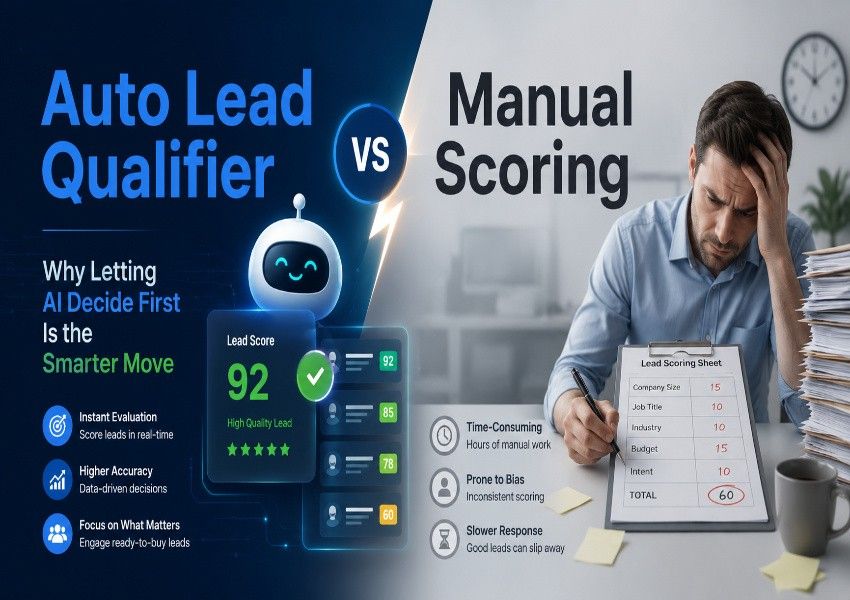
An auto lead qualifier is an AI-powered system that automatically classifies and prioritises leads based on real-time conversation data, eliminating the need for manual lead scoring. For Indian SMBs managing high lead volumes, automated lead qualification consistently outperforms manual scoring on speed, consistency, and conversion rates.
Sales teams across India are losing deals they never knew they had. Not because the product failed. Not because the pricing was wrong. Because the lead sat untouched for 48 hours while a rep was busy updating a spreadsheet.
The reason this happens is simple: most SMBs still rely on manual lead scoring, a process where human judgment decides which leads matter, after a delay, with incomplete information. The auto lead qualifier flips this model entirely. It classifies and tags every lead the moment a conversation ends, giving your team a ranked list before the morning chai goes cold.
This post breaks down exactly what separates these two approaches, why the gap matters in high-volume sales environments, and how AION Autopilot’s Auto Lead Qualifier is built to solve this problem for Indian businesses.
Manual lead scoring sounds structured on paper. In reality, it looks like this: a sales rep finishes a call, makes a mental note, maybe updates a CRM field a few hours later, and the lead either gets a follow-up or quietly disappears.
Even when companies implement formal scoring frameworks, assigning points based on company size, budget, or intent signals, the execution breaks down at the human layer. Reps score inconsistently. Managers don’t audit frequently enough. High-potential leads get the same follow-up cadence as cold ones, simply because no one flagged the difference in time.
Furthermore, manual scoring scales poorly. A team handling 50 leads a day might manage. That same team handling 300 leads a day, which is increasingly common as Meta and Google Ads scale up, cannot keep pace with manual classification alone.
The hidden cost isn’t just missed leads. It’s the energy spent on bad ones. When sales reps spend equal time chasing low-intent contacts, close rates drop and burnout rises.
An auto lead qualifier is a form of automated lead qualification that continuously analyses conversations and classifies leads in real time, unlike manual lead scoring models that rely on delayed human input.
In AION Autopilot’s case, the AI lead qualification software works in direct coordination with the AI Calling Agent. Here is how the sequence operates:
The AI Calling Agent engages the lead first.
It conducts the qualification conversation, asking the right questions, handling objections, and assessing intent in real time. This is the conversational intelligence layer.
The Auto Lead Qualifier then classifies the outcome.
Based on what the AI Calling Agent recorded, the Auto Lead Qualifier assigns tags: hot, warm, not interested, callback requested, wrong number, and more. These tags are written directly into the CRM record.
The Qualified Lead Alert fires immediately.
The moment a lead crosses a set threshold, the relevant sales rep gets notified, on WhatsApp, by email, or through the CRM dashboard, so follow-up happens within minutes, not hours.
This sequence removes the human bottleneck entirely from the classification step. Importantly, human judgment re-enters at the right moment: when a qualified lead is handed over for a high-value conversation.
| Parameter | Manual Lead Scoring | Auto Lead Qualifier (AION) |
|---|---|---|
| Speed of Classification | Hours to days | Seconds after call ends |
| Consistency | Varies by rep | Uniform across all leads |
| Scale | Degrades with volume | Improves with volume |
| Data Source | Rep’s memory and notes | Full call analysis |
| CRM Tagging | Manual, often delayed | Automatic, real-time |
| Follow-Up Trigger | Depends on rep discipline | Qualified Lead Alert fires instantly |
| Bias Risk | High (recency, likability) | Eliminated |
The table above captures the operational difference, but the strategic difference is even larger. Manual scoring tells you what happened. Automated lead qualification tells you what to do next and when.
When a Meta campaign generates 400 leads over a weekend, a manual review process means Monday becomes a triage session, not a selling day. Consequently, the best leads, those who showed strong intent on Saturday, are contacted on Tuesday, when their interest has already cooled. The auto lead qualifier tags and prioritises all 400 leads in real time, so the hottest ones are waiting in the follow-up queue before the weekend ends.
When reps operate across Delhi, Mumbai, Pune, and Bangalore, centralised manual scoring is nearly impossible. Each city scores differently. Each manager has a different threshold. Therefore, leads tagged in one city mean something different in another. A uniform automated lead qualification standard eliminates this inconsistency entirely, giving the national sales head one reliable dataset across geographies.
Admissions enquiries spike during application seasons, and the window to convert is tight. A prospective student who enquires today is likely comparing three institutions simultaneously. Accordingly, AI lead qualification based on conversation outcomes, including course interest, timeline, and budget clarity, allows counsellors to prioritise same-day callbacks for the highest-intent leads, while lower-intent leads enter a nurture sequence automatically.
In automobile sales, a test drive request is a strong buying signal. However, not every inquiry has the same urgency. Someone calling to ask about EMI options for a vehicle they want this month is fundamentally different from someone casually comparing brands with no timeline. Automated lead qualification separates these within seconds, so the sales manager knows exactly who to call first.
Real estate teams routinely face the problem of distinguishing genuine site visit requests from curiosity enquiries. Since manual scoring depends on what the rep remembered from the call, the classification is often wrong. An auto lead qualifier that analyses the actual call outcome and tags the lead based on commitment signals gives the channel sales team a far more reliable action list.
Most conversations about lead quality focus on the score itself. However, the more impactful variable is how quickly the score is available.
Studies show that responding to leads within 5 minutes can increase conversion rates by up to 8x compared to delayed follow-ups. For Indian SMBs competing on speed, particularly in education, real estate, and automobile verticals, a 24-hour lag in lead classification is not a process inefficiency. It is a structural competitive disadvantage.
The auto lead qualifier removes this lag entirely. Because classification happens at the point of conversation, the qualified lead alert fires while the prospect is still in a buying mindset. This is not a marginal improvement. In high-competition verticals, it is the difference between a deal won and a lead lost to a faster competitor.
Manual lead scoring is not just slow. It is systematically biased in ways that most sales managers don’t track.
Recency bias causes reps to score the last few leads of the day more generously because they’re fresh. Likability bias causes leads from people who were friendly on the phone to score higher, even when their buying signals were weak. Availability bias causes high-ticket leads with complex situations to get lower effort simply because the rep is fatigued.
None of these biases are intentional. However, they compound at scale. Over a quarter, a manual scoring system produces a distorted pipeline, one where the data reflects the rep’s state of mind more than the lead’s actual intent.
The auto lead qualifier operates without any of this. Every lead receives the same analytical process. Moreover, the output is tied to objective call data, what was actually said, how the prospect responded, and what outcome was reached, rather than how the rep felt about it.
AION Autopilot is a fully integrated agentic AI system where every component works in sequence.
The AI Calling Agent conducts the first conversation. The Auto Lead Qualifier classifies the outcome. The Qualified Lead Alert notifies the right rep. The WhatsApp AI Chatbot continues engagement for leads that need nurturing. The Bulk Calling and Rule-Based Calling features then handle re-engagement at scale.
Every step is logged, tagged, and synced inside Groweon CRM. Therefore, the sales manager always has a live view of the pipeline, not a reconstructed one built from rep memory.
This integration matters because it eliminates the data gaps that make manual scoring unreliable. When AI handles classification and the CRM stores every tagged outcome, the pipeline reflects reality.
A sales manager relying on manual scoring spends a significant part of every week doing work that should not require a manager: reviewing call notes, chasing reps for CRM updates, and trying to reconstruct which leads were actually qualified and which were filed optimistically.
With an auto lead qualifier in place, the manager’s dashboard does this work automatically. Hot leads are tagged and escalated. Warm leads are in nurture. Disqualified leads are correctly parked. The manager can now focus entirely on coaching the team on high-value conversations, not on auditing classification hygiene.
This shift from pipeline administration to pipeline acceleration is one of the clearest operational benefits of moving to an AI-first qualification system.
Manual lead scoring was built for a lower-volume, slower-paced sales environment. For Indian SMBs running Meta campaigns, managing distributed sales teams, and competing in high-velocity verticals, it is no longer fit for purpose.
The auto lead qualifier is not a replacement for human judgment. Instead, it is the mechanism that ensures human judgment is applied at the right moment, after classification is done, when a rep is speaking to a qualified prospect, not deciding whether the lead was worth calling.
AION Autopilot’s Auto Lead Qualifier classifies every lead based on call outcomes, writes the tags directly into Groweon CRM, and fires qualified lead alerts in real time. The result is a faster, fairer, and far more consistent pipeline, one that scales with your ad spend rather than breaking under it.
If your team is still scoring leads manually, you are making a speed and consistency trade-off you may not have consciously chosen. Groweon’s AION Autopilot can show you exactly what changes when AI handles the first classification step.
Book a free demo of AION Autopilot and see automated lead qualification in action.
What is the difference between lead scoring and lead qualification?
Lead scoring assigns a numerical value to a lead based on demographic or behavioural data, typically configured manually. Lead qualification, by contrast, determines whether a lead is genuinely ready to buy, based on a real conversation or interaction. An auto lead qualifier combines both by analysing actual call outcomes and assigning classification tags automatically, without waiting for rep input.
Is an auto lead qualifier the same as an AI calling agent?
No. These are two distinct components within AION Autopilot. The AI Calling Agent conducts the qualification conversation with the prospect. The Auto Lead Qualifier analyses the call outcome and classifies the lead into relevant tags, such as hot, warm, or not interested, inside the CRM. They work in sequence, not interchangeably.
How does AI improve lead conversion rates?
AI improves lead conversion rates primarily through speed and consistency. Automated lead qualification classifies leads the moment a conversation ends, triggering follow-up alerts while the prospect is still in a buying mindset. Studies show that contacting leads within 5 minutes can increase conversions by up to 8x compared to delayed outreach. Beyond speed, AI removes the rep-level bias and inconsistency that distort manual pipelines.
Can the auto lead qualifier work without an AI calling agent?
In AION Autopilot, the Auto Lead Qualifier is designed to operate on the outcomes generated by the AI Calling Agent. The classification is based on actual conversation data, which makes it significantly more accurate than scoring systems that rely only on form fills or demographic signals.
How does auto lead qualification reduce bias in sales pipelines?
Manual scoring is influenced by factors like recency, rep fatigue, and personal rapport. An auto lead qualifier removes these variables by applying the same analytical process to every lead, based solely on objective call data and conversation outcomes.
Is AION Autopilot suited for SMBs running high-volume ad campaigns?
Yes. AION Autopilot is specifically built for Indian SMBs that generate leads at scale through Meta and Google Ads. The Auto Lead Qualifier, Bulk Calling, and Qualified Lead Alert features are all designed to handle high-volume pipelines without adding headcount.
What CRM does the auto lead qualifier integrate with?
AION Autopilot integrates natively with Groweon CRM. Every classification tag, call outcome, and lead status update is written directly into the Groweon CRM dashboard, giving sales managers a real-time view of the full pipeline.
How quickly does the auto lead qualifier classify a lead?
Classification happens immediately after the AI Calling Agent completes the conversation. The tag is written into the CRM within seconds, and if the lead meets the qualified threshold, the Qualified Lead Alert fires to the relevant rep in real time.

28 Jul, 2026
A test drive is where buying intent peaks, and it...

25 Jul, 2026
Summary Most CRM teams already use some form of AI,...

24 Jul, 2026
Summary Roughly 35% of purchased insurance leads never get contacted...

24 Jul, 2026
Summary A generic CRM is built around a sales pipeline....

23 Jul, 2026
Summary Site visits, not inquiries, are the real conversion lever...