

Best Lead Management Software in India: What to Check Before…
01 Oct, 2026
Summary (TL;DR): Lead management software captures, scores, routes, and nurtures...
Updated: 2nd March, 2026
Here is a number that should concern every sales leader: 79% of marketing leads never convert into sales. Not because the leads are bad. Not because the product is wrong. But because nobody followed up properly, or at all.
Leads come in from your website, your ads, your events, your referrals. And then what? Without a structured way to track where each one stands, what they have been told, and what needs to happen next, opportunities quietly disappear. A prospect who was genuinely interested does not hear back for a week and buys from a competitor. A hot lead falls off a rep’s radar because they were busy with another deal. A qualified contact gets forgotten simply because it was never logged anywhere.
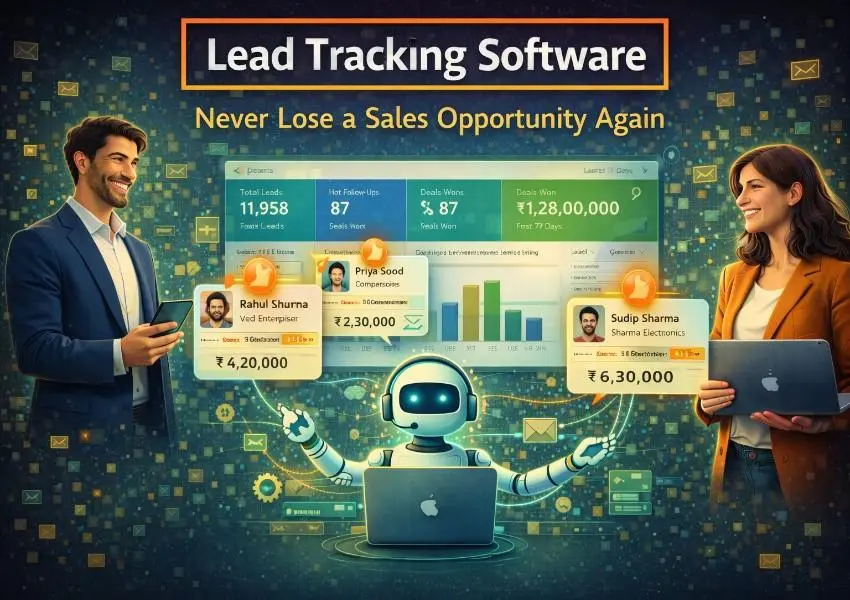
Lead tracking software fixes this. It gives your team complete visibility into every lead, every interaction, and every next step, so no opportunity slips through unnoticed and no follow-up is left to chance.
This guide covers what lead tracking software is, how it works, what to look for, and how to use it to build a sales process where every lead gets the attention it deserves.
Lead tracking software is a tool that helps sales teams monitor and manage every lead throughout the sales process, from the moment they first express interest to the moment they become a customer or are disqualified. It records where each lead came from, what stage they are in, every interaction they have had with your team, and what action needs to happen next.
Think of it as a live map of every sales opportunity your business is working on. Instead of relying on memory, spreadsheets, or a pile of business cards, lead tracking software gives your entire team a single, shared view of the pipeline that is always up to date.
At its most basic, lead tracking software logs contacts and conversations. At its most powerful, it scores leads by their likelihood to convert, alerts reps when a lead takes a meaningful action, automates follow-up sequences, and generates reports that tell you exactly where your pipeline is strong and where it is leaking.
Groweon CRM includes a fully built-in lead tracking software that covers every stage of this process, giving growing teams the visibility and automation they need to close more deals without adding headcount.
Before lead tracking software became widely accessible, sales teams managed leads with spreadsheets, notebooks, and email folders. For very small teams with a handful of leads, this sometimes worked. For anyone dealing with real sales volume, it is a recipe for missed revenue.
Here is where manual lead tracking breaks down.
No real-time visibility. A spreadsheet updated once a day, or once a week, is already out of date. Managers have no idea what the pipeline actually looks like right now. Decisions get made on stale data.
Leads fall through the cracks. When follow-up depends on someone remembering to do it, it happens inconsistently. The lead that came in during a busy week never gets a second touch. The prospect who asked to be contacted next month gets forgotten entirely.
No lead source data. Most manual systems have no reliable way to track where a lead originally came from. This means you cannot measure which marketing channels are actually producing revenue, so you end up spending budget based on assumption rather than evidence.
Context is lost in transition. When a lead is passed from one rep to another, or when a new rep joins the team, the history of every conversation, objection, and commitment lives in someone’s head or scattered across emails. Lead tracking software keeps that history centralized and accessible to anyone who needs it.
No accountability. Without a system, it is almost impossible to know which leads each rep is responsible for, what actions they have taken, and what results they have produced. Lead tracking software creates the accountability layer that makes performance coaching possible.
Not all lead tracking tools are created equal. Here is what a strong lead tracking software should capture and manage.
Lead source. Where did this lead come from? Organic search, paid ad, LinkedIn, referral, webinar, cold outreach? Knowing the source of every lead is essential for measuring marketing ROI and doubling down on what works. Good lead tracking software captures this automatically rather than relying on reps to log it manually.
Lead status and pipeline stage. Where does this lead sit in your sales process right now? New, contacted, qualified, demo scheduled, proposal sent, negotiating, closed? Lead tracking software visualizes this as a pipeline so the status of every opportunity is clear at a glance.
Interaction history. Every call, email, meeting, and message should be logged against the lead record automatically. This gives any rep full context before reaching out and ensures that if ownership changes, nothing is lost.
Lead score. Based on how well the lead matches your ideal customer profile and how actively they are engaging with your content and outreach, a lead score tells your team which opportunities to prioritize. Lead tracking software updates these scores dynamically as new information comes in.
Next action and due date. Every active lead should have a clear, scheduled next step with a due date. Lead tracking software surfaces overdue tasks so nothing gets missed and reps are always focused on the right action at the right time.
Deal value. Attaching a potential revenue figure to each lead allows your team to prioritize by value, not just by activity, and gives managers an accurate read on pipeline worth.
Time in stage. How long has a lead been sitting in the same pipeline stage? When a lead stalls, it often means there is a problem worth addressing. Lead tracking software that flags leads exceeding expected stage duration helps managers spot and rescue deals before they go cold.
The direct impact of lead tracking software on sales performance shows up in several measurable ways.
Faster response times. Lead tracking software with automated lead assignment means the right rep is notified the moment a new lead arrives. Automated first-touch messages can go out instantly while the rep prepares for a personal follow-up. The days of leads sitting unassigned for 24 hours are over.
Higher follow-up completion rates. When the system creates follow-up tasks automatically and surfaces overdue actions every morning, reps complete more follow-ups simply because they cannot miss them. This consistency directly translates to more qualified conversations.
Better prioritization. With lead scoring built into your lead tracking software, reps start every day knowing which leads deserve their attention first. The highest-scoring, highest-value prospects are at the top of the queue, not buried under a pile of unorganized contacts.
Shorter sales cycles. When reps have full context before every conversation, they stop wasting time re-explaining who they are or asking questions that have already been answered. Conversations are more productive from the first word, and deals move faster as a result.
More accurate forecasting. When pipeline data is clean, current, and complete inside your lead tracking software, sales forecasts stop being guesswork. Managers can see the real value of the pipeline at any stage and predict revenue with genuine confidence.
Better coaching. Lead tracking software gives managers visibility into what their reps are actually doing: how many leads they are working, how quickly they respond, how many touchpoints they make before giving up, and where deals most often stall. This data makes coaching specific, actionable, and effective.
If you are evaluating lead tracking software for your team, here are the features that separate tools that genuinely improve sales performance from those that just add another layer of admin.
Automatic lead capture. The best lead tracking software pulls leads in automatically from your website forms, landing pages, chat tools, social media, and ad platforms. Manual data entry creates gaps and inaccuracies. Automation keeps your pipeline complete.
Pipeline visualization. A clear, visual pipeline view is essential. You should be able to see every lead, in every stage, at a glance, and filter by rep, source, deal size, or date range without digging through menus.
Activity logging. Calls, emails, and meetings should be logged automatically wherever possible, with manual logging kept simple for interactions that cannot be automated. If logging an activity takes more than 30 seconds, reps will skip it.
Lead scoring. Automatic, criteria-based scoring that updates in real time as leads engage is a significant differentiator. Manual scoring is better than nothing, but automatic scoring based on behavior and fit is what truly helps teams prioritize at scale.
Automation and workflow triggers. Lead tracking software that can trigger follow-up tasks, email sequences, and internal notifications based on lead behavior or pipeline stage changes multiplies the effectiveness of every rep on your team.
Reporting and analytics. You need to be able to measure conversion rates by stage, track lead source performance, monitor rep activity, and forecast revenue from a clear, accessible dashboard. Reporting should require no manual data compilation.
Mobile access. Reps are not always at a desk. Lead tracking software with a strong mobile app ensures the pipeline stays updated after field calls, networking events, and client visits.
CRM integration or built-in CRM. Lead tracking is most powerful when it is part of a complete CRM rather than a standalone tool. When lead data connects directly to deal management, customer history, and communication tools, the whole system becomes more valuable. Groweon CRM delivers lead tracking software as an integrated part of a full sales platform, so there is no need to stitch together separate tools.
Lead tracking software is not just for enterprise sales teams. The right tool scales with your business at every stage.
Solo sales reps and freelancers. Even a one-person operation benefits from lead tracking software. Knowing which leads are active, what was last said, and what needs to happen next is just as important with ten leads as with a hundred. It removes the mental load of tracking everything yourself and frees up energy for selling.
Small teams (2-10 reps). At this stage, consistency becomes critical. Lead tracking software ensures every rep manages their pipeline the same way, making it possible for managers to coach effectively and for deals to be handed off cleanly. Groweon CRM is built with small teams in mind, offering a setup that is fast, intuitive, and immediately useful without a lengthy implementation process.
Growing teams (10-50 reps). As the team grows, visibility and accountability become the primary challenges. Lead tracking software with territory management, rep-level performance dashboards, and manager alerts keeps everyone aligned and ensures no part of the pipeline is being neglected.
Enterprise teams. At scale, lead tracking software needs to handle complex routing rules, multiple pipelines for different products or regions, advanced reporting, and integration with a wide range of marketing and support tools. Groweon CRM’s enterprise features cover all of these needs within a single, unified platform.
Buying lead tracking software is the easy part. Using it consistently and strategically is where most teams fall short. Here is how to get maximum value from day one.
Define your pipeline stages before setup. Your lead tracking software should reflect how your customers actually buy, not a generic template. Map out the real stages a lead moves through and configure your pipeline to match before you start entering data.
Make lead source tracking non-negotiable. Every lead that enters your lead tracking software should have a source tag. This is the foundation of understanding your marketing ROI. Make it a required field and audit it regularly.
Set activity benchmarks. Use your lead tracking software to define minimum activity standards: how many touches before a lead is marked as unresponsive, how quickly new leads must be contacted, how often pipeline should be reviewed. Then use the reporting tools to hold the team accountable.
Review pipeline weekly. A weekly pipeline review using your lead tracking software is the single most effective habit for maintaining pipeline health. Remove stale leads, update stages, reassign overdue tasks, and identify deals that need manager intervention.
Use automation to stay consistent. The follow-up sequences, task creation triggers, and automated alerts inside your lead tracking software are only valuable if they are set up and actively used. Invest time in configuring automations that match your sales process and review them quarterly.
Groweon CRM is built around the belief that lead tracking should be effortless for reps and insightful for managers. Every feature in Groweon CRM’s lead tracking software is designed to reduce manual effort, improve visibility, and drive consistent follow-up across your entire team.
With Groweon CRM you get automatic lead capture from every channel your business uses, a visual pipeline that shows the status of every opportunity in real time, activity logging that keeps the full interaction history one click away, built-in lead scoring that surfaces your hottest prospects automatically, workflow automation that creates the right tasks and sends the right messages at the right time, and performance dashboards that give managers the data they need to coach, forecast, and grow.
Whether you are setting up lead tracking for the first time or replacing a system that is no longer working, Groweon CRM gives you the tools to build a process where no lead is ever lost, no follow-up is ever missed, and no sales opportunity slips through unnoticed.
Not tracking lead sources. If you do not know where your best leads come from, you cannot invest your marketing budget intelligently. Source tracking should be set up from day one.
Letting pipeline stages go stale. Leads that sit in the same stage for weeks without being updated or actioned create a false picture of pipeline health. Set stage duration alerts in your lead tracking software and review them weekly.
Skipping the qualification step. Filling your pipeline with every contact who has ever shown a vague interest inflates your numbers and wastes rep time. Be disciplined about what qualifies as an active lead.
Relying on reps to self-report activity. Manual activity logging is unreliable. Choose lead tracking software that captures as much activity automatically as possible and minimize the burden of manual entry.
Not using the reporting tools. Your lead tracking software generates valuable performance data that most teams barely look at. Build a habit of weekly pipeline reviews and monthly source analysis so the data drives real decisions.
Every lead your business generates represents time, money, and effort. Letting them fall through the cracks because your tracking process is not good enough is one of the most preventable revenue leaks in sales.
Lead tracking software gives you the infrastructure to make sure that never happens. Every lead is captured, every interaction is logged, every follow-up is scheduled, and every opportunity gets the attention it deserves until it converts or is disqualified with a clear reason.
Groweon CRM’s lead tracking software is built to make this level of discipline easy, not burdensome. Set it up, configure your automations, and give your team the system they need to stop losing deals they should be winning.
Because the leads are there. The question is whether your tracking process is good enough to convert them. Interested in a lead tracking software that is both affordable and enterprise-grade, book a quick free demo today!
Q1. What is lead tracking software?
It is a tool that monitors every lead in your sales process, recording where they came from, what stage they are in, every interaction with your team, and what needs to happen next. It keeps your entire pipeline visible and organized in one place.
Q2. How is lead tracking software different from a CRM?
Lead tracking software focuses specifically on managing leads from first contact to conversion. A CRM covers the broader customer relationship including post-sale. Most modern CRMs like Groweon CRM include lead tracking built in, so you get both without needing separate tools.
Q3. Can lead tracking software work for small sales teams?
Yes. Even a two-person team benefits from having a structured way to track leads, log interactions, and schedule follow-ups. Groweon CRM is designed to be quick to set up and easy to use for teams of any size.
Q4. What should I look for when choosing lead tracking software?
Prioritize automatic lead capture, pipeline visualization, activity logging, lead scoring, automation triggers, and strong reporting. The best lead tracking software minimizes manual data entry and gives managers real-time visibility into the pipeline.
Q5. How does lead tracking software help with follow-ups?
It creates automatic follow-up tasks when leads enter new stages, sends alerts when leads take key actions, and surfaces overdue tasks every day so nothing slips through. Reps stop relying on memory and start relying on a system that never forgets.
[wpforms id=”535″]

01 Oct, 2026
Summary (TL;DR): Lead management software captures, scores, routes, and nurtures...

01 Oct, 2026
Summary (TL;DR): CRM pricing in India typically runs ₹250 to...

30 Sep, 2026
Summary (TL;DR): A CRM with native Meta Conversions API integration...

29 Sep, 2026
Summary (TL;DR): The best choice depends on whether you want...

28 Sep, 2026
Summary (TL;DR): So, a B2B CRM has moved from a...