

Best CRM for Rubber and Tyre Manufacturers
16 Oct, 2026
Summary (TL;DR) The best CRM for rubber and tyre manufacturers...
Updated: 29th August, 2026
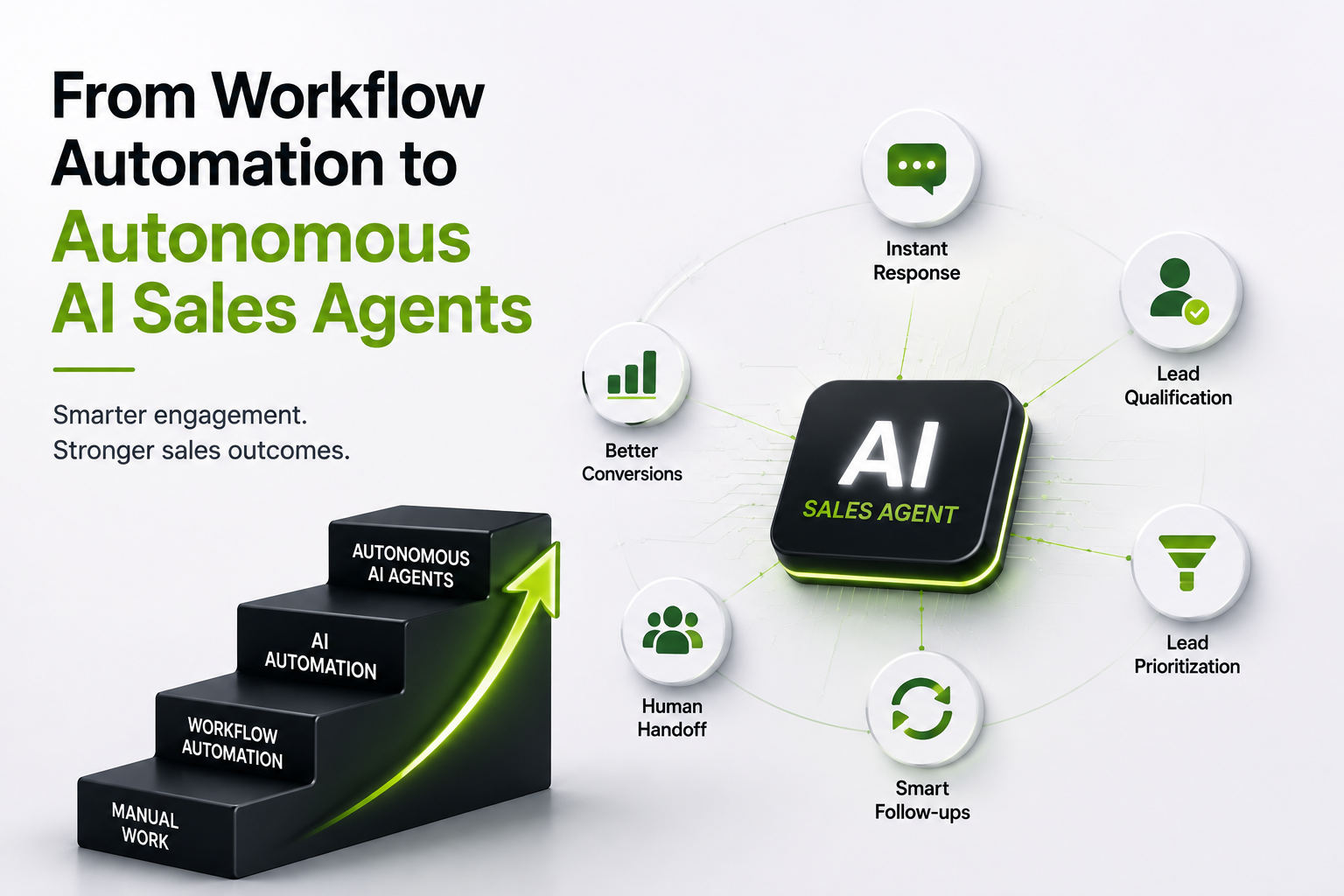
Sales teams are moving beyond basic workflow automation because high-volume sales require systems that can work with customer context.
Autonomous AI agents can support lead response, qualification, prioritisation, follow-ups and routine customer engagement. Traditional automation remains valuable for predictable tasks, while AI adds flexibility to conversations and multi-step sales activities.
The strongest approach combines AI agents, CRM software, workflow automation and human sales expertise rather than replacing people completely.
For growing businesses, the goal is simple: automate repetitive work, improve lead handling and give salespeople more time to close meaningful opportunities.
Sales automation has changed the way businesses manage leads and customer conversations. Instead of relying entirely on manual lead entry, calling and follow-ups, sales teams can now use CRM workflows to handle repetitive tasks.
However, traditional automation mainly follows predefined rules. It can assign a lead, send a message or create a reminder, but it may struggle when every prospect requires a different next step.
This is where autonomous AI sales agents come in. They can interact with prospects, understand their responses, collect relevant information and support follow-ups based on the conversation and defined business rules.
For high-volume sales teams, the goal is not to replace traditional automation. It is to combine workflow automation, AI agents and CRM software so salespeople can spend more time on opportunities that need human expertise.
Traditional workflow automation works well when the sales process follows a predictable pattern.
For example, when a new lead enters the CRM, a workflow can automatically assign it to a salesperson, send an acknowledgement and create a follow-up task.
New Lead → Lead Assignment → Email → Follow-Up Reminder
The challenge starts when the prospect responds differently. They may ask a question, request a demo, provide incomplete information or need immediate human assistance.
In such situations, businesses often need additional rules for every possible scenario. As the number of exceptions grows, managing multiple workflows can become complicated.
This is where autonomous AI agents offer a different approach. Instead of following only fixed triggers, they can use the available conversation and customer context to support the next appropriate sales action within defined business rules.
Research from McKinsey on agentic AI in sales highlights how AI agents can support sales activities beyond simple automation by helping with tasks such as lead prioritisation, research and seller support.
An autonomous AI sales agent is an AI system designed to perform sales-related tasks toward a defined objective while operating within business rules and permissions.
Instead of waiting for a salesperson to perform every step, the agent can potentially respond to a prospect, ask qualification questions, understand answers, update relevant information and determine when a human should become involved.
The word autonomous does not mean the AI should operate without supervision.
Businesses should establish clear boundaries around what the AI can do, what information it can provide and when a conversation must be transferred to a human representative.
This makes autonomous AI particularly useful for repetitive sales activities that occur at high volume.
The difference becomes clearer when both approaches are compared.
Traditional automation is still valuable. In fact, businesses should continue using it wherever the process is predictable.
Autonomous AI becomes more useful when the process involves conversation, interpretation, changing customer responses and multiple possible next steps.
Businesses should not attempt to automate every sales activity immediately.
A better approach is to identify tasks that are repetitive, time-consuming and relatively easy to define.
The first priority for many businesses should be responding to new enquiries.
A prospect submitting a form or sending a WhatsApp message expects some form of acknowledgement. If the response is delayed, the opportunity may become harder to engage.
An AI sales agent can provide an immediate first response, collect basic information and determine whether the prospect requires further assistance.
This is particularly useful when enquiries arrive outside business hours or when sales representatives are already occupied.
According to InsideSales research on lead response time, speed of response can have a substantial effect on contact and qualification outcomes.
The objective is simple: do not let a new enquiry sit unattended when AI can begin the conversation immediately.
Once the initial response is automated, lead qualification is a natural next step.
Instead of sending every enquiry directly to a salesperson, an AI agent can ask relevant questions based on the company’s qualification criteria.
For a CRM business, the AI may ask about:
A real estate business may need information about property type, location, budget and purchase timeline.
The important point is that qualification should be business-specific.
A connected lead management solution can keep this information associated with the lead so that sales representatives have useful context when they take over.
High-volume businesses often face a simple problem: there are more leads than salespeople can immediately contact.
This makes prioritisation important.
AI can analyse available information such as customer responses, engagement, requirements, timeline and previous activity to help identify higher-priority opportunities.
For example, someone who has requested pricing and a product demo may deserve faster attention than a prospect who has only requested general information.
AI should support this decision rather than automatically making every final sales judgement.
Follow-up is another area where automation can deliver significant value.
A prospect may request pricing, receive a proposal and then stop responding.
A traditional workflow might create a reminder for the salesperson.
An AI agent can potentially go further by continuing an appropriate conversation within predefined rules.
The follow-up can be based on what happened previously rather than sending the same generic message to every inactive lead.
This makes automation more useful because the objective is not simply to send more messages. It is to maintain relevant conversations.
Sales representatives often spend considerable time answering repetitive questions about products, features, implementation, pricing structures and basic processes.
AI can handle suitable routine questions using approved business information.
When a question becomes complex or requires human judgement, the conversation can be transferred to a salesperson.
This creates a practical division of responsibilities: AI handles predictable information requests, while people handle conversations that require expertise.
Sales teams also spend time maintaining CRM records.
After every conversation, someone may need to update lead status, add notes, record requirements and schedule the next activity.
At high volumes, this administrative workload becomes significant.
AI can assist in capturing relevant information from conversations and keeping customer records updated.
This is important because the value of CRM software depends heavily on the quality and availability of customer information.
An AI sales agent becomes considerably more useful when it has access to relevant CRM context.
Imagine an AI communicating with a prospect without knowing their previous conversations, sales stage or existing requirements.
The interaction may become repetitive or disconnected.
Now consider an AI working with information about:
Lead source → Previous conversations → Requirements → Sales stage → Follow-up history → Customer activity
The AI can make its next interaction more relevant.
This is why businesses should evaluate autonomous AI and CRM as connected parts of the sales infrastructure rather than separate technologies.
Businesses looking for a central platform can explore Groweon CRM to manage leads, sales activities, customer information and follow-ups.
One of the strongest use cases for AI agents is maintaining continuity between sales interactions.
Consider a prospect who submits an enquiry, receives an initial response, shares their requirement and requests pricing.
After receiving the quotation, the prospect becomes inactive.
In a traditional process, the salesperson needs to remember to follow up.
An AI-enabled process can support the follow-up according to the prospect’s previous interaction and predefined business rules.
If the prospect responds with a question, the AI can continue the conversation where appropriate. If the prospect indicates strong buying intent or asks for human assistance, the system can alert or transfer the opportunity to a salesperson.
The result is a sales process that is less dependent on someone manually remembering every next step.
Autonomous AI should not mean handing every sales decision to a machine. Businesses should identify clear human handoff points. Complex negotiations, high-value accounts, sensitive customer situations, unusual requirements and final commercial decisions often require human judgement.
A practical division could look like this:
This approach allows businesses to automate repetitive work without removing the human element from important sales conversations.
Implementing an AI agent is not successful simply because the system handles thousands of conversations. Businesses should measure whether those conversations are producing meaningful business outcomes.
Important metrics include:
These metrics help businesses identify whether AI is genuinely improving the sales process or simply increasing automation activity.
The move toward autonomous AI does not make traditional workflow automation irrelevant.
Both technologies have different strengths.
Workflow automation is excellent for predictable processes such as lead assignment, notifications, task creation and standard CRM updates.
Autonomous AI is more useful where customer behaviour changes and the next step depends on context.
The future of sales automation will therefore likely involve a combination of both.
Workflow automation provides structure.
AI agents provide adaptability.
CRM software provides customer context.
Salespeople provide human judgement.
Together, these capabilities can create a sales process that is easier to scale.
Businesses handling large volumes of enquiries can explore Groweon AION Autopilot to bring AI-powered sales engagement into their workflow.
AION Autopilot supports capabilities including AI calling, WhatsApp AI engagement, automated lead qualification, bulk calling, rule-based calling and qualified-lead alerts.
This can help businesses automate repetitive lead engagement while keeping sales representatives involved when human interaction is required.
The important point is that AI should not exist as an isolated communication tool. Its value increases when customer interactions, qualification and sales activities remain connected with the wider CRM process.
Businesses do not need to move from manual sales to autonomous AI overnight.
A practical implementation can happen in stages.
Start with instant lead response. Make sure new enquiries are acknowledged quickly.
Add basic qualification. Identify the information salespeople need before contacting prospects.
Automate routine follow-ups. Reduce the number of opportunities lost because of missed reminders.
Introduce lead prioritisation. Help sales teams focus on higher-intent opportunities.
Connect AI with CRM. Keep customer context available throughout the sales journey.
Define human handoff rules. Decide which situations always require salesperson involvement.
Measure results. Track response time, qualification, conversion and productivity.
This approach allows businesses to expand automation according to actual results rather than implementing AI simply because it is a current technology trend.
Sales teams are moving from workflow automation toward autonomous AI agents because modern sales processes require more than predefined triggers.
High-volume businesses need systems that can respond quickly, understand customer context, qualify opportunities, maintain follow-ups and know when human intervention is required.
The goal is not to automate every part of selling.
The goal is to remove repetitive work so salespeople can focus on the activities where human expertise creates the most value.
Traditional automation will continue to handle predictable tasks. AI agents can support contextual interactions and decision-making within defined boundaries. CRM software can keep the entire customer journey connected.
For businesses managing thousands of leads, this combination can turn sales automation from a collection of individual workflows into a more intelligent and scalable sales operation.
What is the difference between workflow automation and autonomous AI agents?
Workflow automation follows predefined rules to perform specific actions. Autonomous AI agents can work with context and defined objectives, allowing them to handle more flexible, conversational and multi-step sales activities.
What should sales teams automate first?
The best starting points are generally high-volume and repetitive activities such as instant lead response, basic qualification, routine follow-ups, common customer questions and CRM data updates.
Can autonomous AI agents qualify sales leads?
Yes. AI agents can ask relevant qualification questions, collect prospect information and help identify leads that match predefined business criteria.
Can AI agents replace salespeople?
AI can automate many repetitive activities, but salespeople remain important for complex requirements, relationship building, negotiation, objection handling and deal closure.
Why is CRM integration important for autonomous AI?
CRM integration gives AI access to customer and sales context while ensuring that information collected during AI interactions remains available to sales representatives.
How can businesses measure AI sales automation?
Businesses can track response time, qualification rate, follow-up completion, demo bookings, sales handoff time, conversion rate and sales productivity.

16 Oct, 2026
Summary (TL;DR) The best CRM for rubber and tyre manufacturers...

16 Oct, 2026
Summary (TL;DR) A CRM for agricultural equipment manufacturers tracks farmer...

16 Oct, 2026
Summary (TL;DR) The best CRM for paint and coatings manufacturers...

15 Oct, 2026
Summary (TL;DR) A CRM for cement and building material manufacturers...

15 Oct, 2026
Summary (TL;DR) A CRM for pharma API and bulk drug...