WhatsApp Marketing Automation: How to Send the Right Message at…
17 Mar, 2026
Email open rates hover around 20%. WhatsApp open rates sit...


Auto Capturing, nurturing, and converting potential customer leads.

Manage AMC contracts, track service requests, ensure timely renewals.

Tracks, resolves, manages issues, and gathers customer feedback.

Manage purchases, expenses, vendors, and POs efficiently with CRM.

Manages order lifecycle from placement to delivery completion.

Generates invoices and manages sales transactions and records efficiently.

Manages stock levels, tracks items, ensures efficient inventory control.

Manages dealer workflows, assigns leads, and tracks progress centrally.

WhatsApp CRM integration with bulk messaging, auto notifications, chatbots.

IVR enabled CRM integrates click-to-call, bulk dialling, recording features.

Achieves optimum productivity of tele-sales team with auto dialler.

Updated: 17th March, 2026
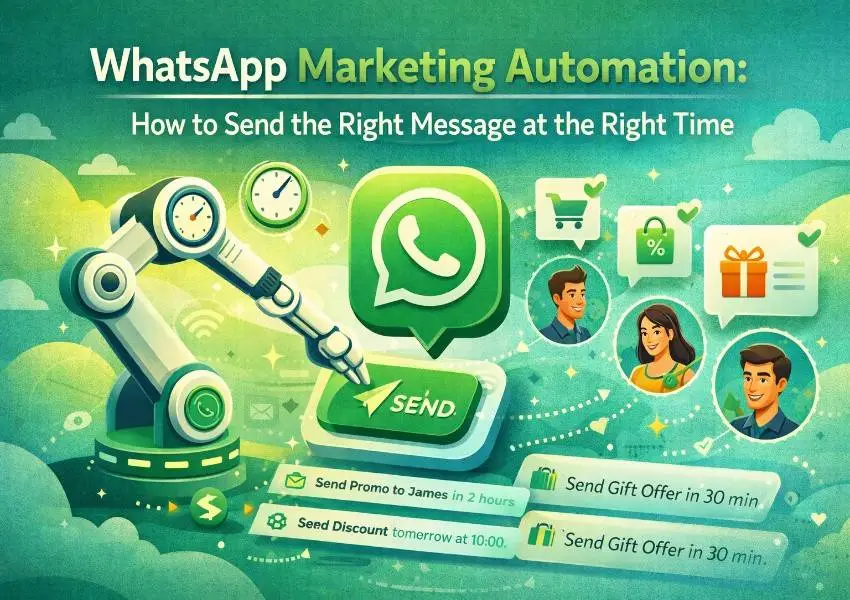
Email open rates hover around 20%. WhatsApp open rates sit at 98%. If your business is still relying entirely on email to reach customers and prospects, you are communicating on a channel where the majority of your messages are never seen.
WhatsApp marketing automation changes this. It lets you send the right message, to the right person, at the right moment, automatically, without your team having to manually send each communication. The result is faster engagement, higher conversion rates, and a customer experience that feels personal even at scale.
For Indian businesses in particular, WhatsApp is not just a preferred channel. It is the primary channel. With over 850 million active users in India, WhatsApp is where buying decisions are influenced, where trust is built, and where customers expect businesses to show up. The businesses that automate their WhatsApp marketing intelligently are building a competitive advantage that is increasingly difficult to close.
This guide covers everything you need to know about WhatsApp marketing automation: how it works, what to automate, how to personalize at scale, and how to connect it to your CRM for maximum impact.
WhatsApp marketing automation is the use of software to send, schedule, and trigger WhatsApp messages automatically based on predefined rules, customer behavior, or pipeline events, without requiring manual action for every touchpoint.
It is powered by the WhatsApp Business API, which is the enterprise-grade layer of WhatsApp that enables integration with CRM platforms, marketing tools, and automation workflows. Unlike the standard WhatsApp Business app, the API supports multiple users, automated messaging, message templates, and programmatic triggers, making it the foundation of any serious WhatsApp marketing automation strategy.
With WhatsApp marketing automation your business can send instant responses to new enquiries at any hour, trigger follow-up sequences based on where a lead is in your pipeline, deliver personalized product recommendations based on browsing or purchase history, remind customers of appointments, send order updates and delivery notifications, and re-engage cold leads with relevant offers, all automatically, all through WhatsApp.
The case for WhatsApp marketing automation comes down to three things: reach, speed, and trust.
Reach
According to Meta’s WhatsApp Business data, over 2 billion people use WhatsApp globally and more than 175 million people message a WhatsApp Business account every day. In India, WhatsApp is embedded into daily life in a way that email and SMS have never achieved. Your customers are already there. Automation helps you meet them where they are, consistently.
Speed
Automated WhatsApp messages go out the moment a trigger condition is met. A prospect fills out a form and receives a WhatsApp response within seconds. A customer places an order and gets an instant confirmation. A lead goes quiet for five days and a re-engagement message fires automatically. This speed of response, at every stage of the customer journey, creates an experience that manual processes simply cannot match.
Trust
WhatsApp feels personal. Unlike email, which carries the weight of promotional connotation, a WhatsApp message arrives in the same inbox where people chat with friends and family. When those messages are well-timed and genuinely relevant, they build trust rather than eroding it. WhatsApp marketing automation done right does not feel like marketing. It feels like attentive service.
Not every WhatsApp message should be automated. The goal is to automate the predictable, repetitive touchpoints so your team can focus human attention on conversations that genuinely need it. Here is where automation delivers the most value.
When a prospect enquires through your website, ad, or QR code, they expect a fast reply. An automated WhatsApp message sent within seconds of the enquiry acknowledges their interest, sets expectations for when a team member will follow up, and keeps the conversation alive before it cools. This single automation alone can dramatically improve your lead contact rate.
After the first contact, a structured welcome sequence introduces your business, highlights your key value proposition, and nudges the lead toward the next step, whether that is booking a call, watching a demo, or visiting a location. These messages are spaced over two to three days and personalized using the lead’s name and the specific product or service they enquired about.
Whether you are a real estate agency scheduling site visits, a clinic managing patient appointments, or a business running product demos, automated WhatsApp reminders reduce no-shows significantly. Send a reminder 24 hours before and another one hour before, and your attendance rate will improve noticeably.
After a sales call, a site visit, a demo, or a support interaction, an automated follow-up message asking for feedback or nudging toward the next step keeps momentum going without the rep having to remember to send it manually.
Leads that have gone quiet are not necessarily lost. An automated re-engagement sequence sent after a defined period of inactivity, with a relevant piece of content or a new offer, reactivates a percentage of these contacts and brings them back into your active pipeline.
For e-commerce and retail businesses, automated WhatsApp notifications for order confirmation, dispatch, and delivery create a professional, trust-building customer experience that reduces inbound support queries and improves satisfaction.
For subscription businesses, service providers, and B2B companies, automated payment reminders sent via WhatsApp have significantly higher open and response rates than email equivalents. A friendly reminder two days before a due date and a gentle follow-up the day after reduces overdue balances without requiring manual chasing.
The biggest concern businesses have about automating WhatsApp messages is that they will feel impersonal. This concern is valid if automation is done carelessly. But with the right setup, WhatsApp marketing automation can feel more personal than most manual outreach.
The key is using your CRM data to make every automated message contextually relevant.
Every automated message should include the recipient’s first name at a minimum. Beyond that, reference their company name, the specific product or service they enquired about, the location they are interested in, or the last interaction they had with your team. These details transform a generic message into one that feels like it was written specifically for that person.
The most effective WhatsApp marketing automation is triggered by what a contact actually does, not by a fixed schedule. A lead who visits your pricing page gets a different message from one who downloaded an introductory guide. A customer who has not logged into your platform in 30 days receives a different message from one who uses it daily. Behavioral triggers make automation feel intelligent rather than robotic.
Not everyone in your CRM should receive the same WhatsApp sequence. Segment by industry, product interest, stage of the buying journey, or customer type, and tailor your messaging accordingly. A first-time buyer needs different communication from a repeat customer. A B2B prospect from the manufacturing sector needs different content from one in hospitality.
Automated WhatsApp messages sent at 11 PM will not be well received regardless of how well-written they are. Set your automation workflows to send messages during business hours or at times when your audience is typically active. Most CRM and automation platforms allow you to define send windows so messages queue and deliver at appropriate times.
WhatsApp marketing automation delivers its full potential when it is connected to your CRM. In isolation, automated WhatsApp messages are useful. Connected to a CRM, they become part of a fully integrated sales and marketing system where every message, every response, and every trigger feeds back into your pipeline data.
When WhatsApp is integrated with your CRM, every incoming message is automatically logged against the relevant contact record. Every automated message sent is tracked and visible in the conversation history. Responses from prospects trigger pipeline stage updates. Clicks on links in WhatsApp messages register as behavioral signals that update lead scores.
This integration means your sales team always has context. A rep picking up a WhatsApp conversation can see every message sent and received, every automated touchpoint the lead has been through, and exactly where they sit in the pipeline, before saying a single word.
Groweon CRM’s WhatsApp integration is built for this exact workflow. Automated sequences are triggered directly from pipeline events, lead scores, or time-based rules inside Groweon CRM. Every WhatsApp conversation is logged, searchable, and connected to the lead’s full sales history. And when a lead responds and is ready for a human conversation, the assigned rep is notified instantly with full context in hand.
The standard WhatsApp Business app does not support automation or CRM integration. You need WhatsApp Business API access, which requires verification of your business through Meta. Most CRM providers including Groweon CRM handle this setup process on your behalf.
WhatsApp requires that outbound automated messages use pre-approved templates submitted to Meta for review. Templates cover scenarios like appointment reminders, order updates, follow-up sequences, and re-engagement campaigns. Approval typically takes 24 to 48 hours and approved templates can be used indefinitely.
You can only send automated WhatsApp messages to contacts who have opted in to receive communications from your business. Your CRM should track opt-in status and automatically suppress any contact who has not consented or who has opted out. This is not just best practice. It is a requirement under WhatsApp’s Business Policy and data protection regulations.
As covered above, WhatsApp marketing automation is significantly more powerful when connected to a CRM. The CRM provides the trigger data, the personalization fields, the behavioral signals, and the pipeline context that make automation intelligent rather than generic.
Like any marketing channel, your WhatsApp automation performance should be measured and optimized continuously.
Message delivery rate confirms that your messages are reaching recipients. A low delivery rate may indicate contact data quality issues or opt-out problems.
Open rate on WhatsApp is typically very high compared to email, but tracking it confirms that your messages are being seen and helps identify whether timing or frequency needs adjustment.
Response rate measures what percentage of automated messages generate a reply. This is the most direct indicator of message relevance and quality.
Conversion rate tracks how many contacts who received an automated WhatsApp sequence took the desired action, whether that is booking a call, completing a purchase, or responding to a follow-up.
Opt-out rate measures how many recipients are unsubscribing from your WhatsApp communications. A rising opt-out rate is a signal that your messaging frequency, relevance, or timing needs review.
Groweon CRM brings WhatsApp marketing automation and CRM pipeline management together in one platform so your team does not have to manage multiple disconnected tools.
With Groweon CRM you get native WhatsApp Business API integration that connects your WhatsApp number directly to your pipeline, automated message sequences that trigger based on lead stage, behavior, or time-based rules, a shared team inbox where every WhatsApp conversation is logged and assignable, pre-built message templates for common sales and support scenarios, real-time alerts when leads respond so your team can step in at the right moment, and performance dashboards that show message delivery, response rates, and conversion metrics.
For businesses that want to use WhatsApp as a serious revenue channel rather than an informal side tool, Groweon CRM provides the automation infrastructure to make that possible at scale.
WhatsApp marketing automation is not about replacing human relationships with robots. It is about ensuring that every lead, every customer, and every prospect receives timely, relevant communication at every stage of their journey, without your team having to manually send every message.
When your automation is triggered by real behavior, personalized with real data, and connected to a CRM that gives your team full context, WhatsApp stops being a messaging app and becomes your highest-converting marketing and sales channel.
Groweon CRM gives you the complete WhatsApp marketing automation infrastructure to make this a reality. Connect your WhatsApp Business account, build your sequences, and start sending the right message at the right time, every time.
Q1. What is WhatsApp marketing automation?
It is the use of software to automatically send, trigger, and schedule WhatsApp messages based on customer behavior, pipeline stage, or predefined rules, without manual effort for every touchpoint.
Q2. Do I need the WhatsApp Business API for automation?
Yes. The standard WhatsApp Business app does not support automation or CRM integration. The API is required and most CRM providers like Groweon CRM handle the setup process for you.
Q3. How do I make automated WhatsApp messages feel personal?
Use merge fields to include the recipient’s name, company, and specific context. Trigger messages based on actual behavior rather than fixed schedules. Segmented messaging by audience type also makes a significant difference in relevance.
Q4. Is WhatsApp marketing automation compliant with data protection rules?
Yes, as long as you collect explicit opt-in from recipients before messaging them and provide an easy way to opt out. Your CRM should track consent status and automatically suppress non-opted contacts.
Q5. How is WhatsApp marketing automation different from email automation?
WhatsApp messages have significantly higher open rates (around 98% vs 20% for email), are read faster, and feel more personal. The channel requires opt-in compliance and message templates but delivers far better engagement for time-sensitive and conversational communication.

17 Mar, 2026
Email open rates hover around 20%. WhatsApp open rates sit...

16 Mar, 2026
At some point in every growing business, the same question...

13 Mar, 2026
Most businesses treat lead generation and lead management as two...
11 Mar, 2026
CRM implementation has a reputation problem. Ask any sales leader...
10 Mar, 2026
Every sales leader wants the same thing: more revenue, more...