Sales Automation Software: How to Close More Deals with Less…
24 Feb, 2026
Sales is one of the most human-driven professions in business....


Auto Capturing, nurturing, and converting potential customer leads.

Manage AMC contracts, track service requests, ensure timely renewals.

Tracks, resolves, manages issues, and gathers customer feedback.

Manage purchases, expenses, vendors, and POs efficiently with CRM.

Manages order lifecycle from placement to delivery completion.

Generates invoices and manages sales transactions and records efficiently.

Manages stock levels, tracks items, ensures efficient inventory control.

Manages dealer workflows, assigns leads, and tracks progress centrally.

WhatsApp CRM integration with bulk messaging, auto notifications, chatbots.

IVR enabled CRM integrates click-to-call, bulk dialling, recording features.

Achieves optimum productivity of tele-sales team with auto dialler.

Updated: 23rd February, 2026
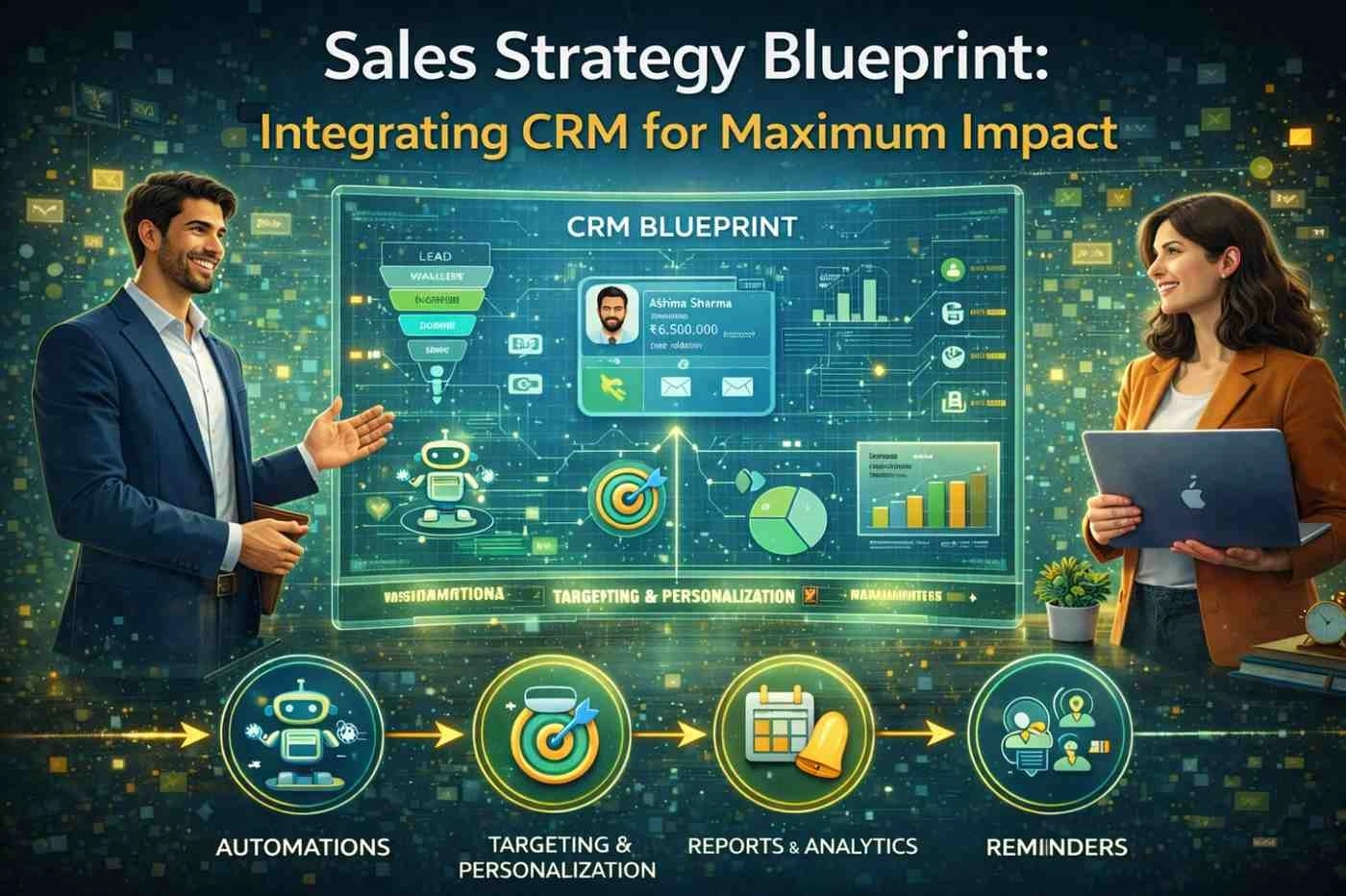
EacEvery high-performing sales organization has one thing in common: a strategy that is repeatable, measurable, and built on reliable data. Without a structured sales strategy blueprint, even the most talented sales teams end up working harder than they need to, missing follow-ups, losing deals to competitors, and struggling to forecast revenue with any accuracy.
Integrating a CRM into your sales strategy is no longer optional. It is the foundation on which modern, scalable sales operations are built. According to Nucleus Research, CRM applications deliver an average return of $8.71 for every dollar spent. Yet many businesses invest in a CRM and never unlock its full potential because they treat it as a contact database rather than a strategic sales engine.
This sales strategy blueprint will show you how to build a comprehensive sales strategy around your CRM so that every stage of your process, from prospecting to closing to retention, is faster, smarter, and more consistent.
A sales strategy blueprint is a documented, step-by-step plan that defines how your business will attract, qualify, convert, and retain customers. It covers your target audience, your sales process, your messaging, your metrics, and the tools your team will use to execute at every stage.
The problem with most sales strategies is that they live in someone’s head or in a slide deck that gets revisited once a year. They are not operationalized. A CRM changes that by turning your strategy into daily, measurable action.
When your CRM is configured to reflect your sales strategy blueprint, it becomes more than a tool. It becomes the system that enforces your strategy, tracks its performance, and continuously surfaces opportunities to improve. Every rep follows the same process. Each deal is tracked the same way. Every insight feeds back into your approach.
The result is a sales operation that doesn’t depend on heroics from individual reps. It scales.
Every effective sales strategy blueprint starts with clarity on who you’re selling to. Your Ideal Customer Profile (ICP) defines the characteristics of the businesses or individuals most likely to buy your product, get value from it, and stay as long-term customers.
Your ICP should include firmographic data (industry, company size, revenue, geography), technographic data (tools they currently use), behavioral signals (content they consume, events they attend), and pain points your product directly addresses.
Once your ICP is defined, build it into your CRM. Create custom fields that capture ICP-related attributes for every contact and company. Use these fields to score and segment leads automatically, so your sales reps spend their time on prospects who actually match your profile rather than chasing anyone who raises their hand.
Groweon CRM makes this straightforward with customizable lead fields, smart segmentation filters, and tagging systems that help your team instantly identify whether a new lead fits your target profile.
Most companies have a sales process, but it exists informally. Reps do things their own way, use inconsistent language, and skip steps when they are in a hurry. This inconsistency makes it nearly impossible to diagnose why deals are won or lost.
Your CRM pipeline should be a precise reflection of your sales process, with each stage representing a clear milestone and a specific set of actions required to advance a deal.
A well-structured pipeline typically looks like this: Lead Identified, Lead Qualified, Discovery Call Completed, Solution Presented, Proposal Sent, Negotiation, Closed Won, or Closed Lost. Each stage should have defined entry criteria (what must be true for a deal to be in this stage) and exit criteria (what actions must be taken to move it forward).
When every rep uses the same pipeline in the CRM, managers can instantly see where deals are getting stuck, which reps are moving deals efficiently, and where the process needs improvement. This visibility is the difference between managing by instinct and managing by data.
Not every lead deserves equal attention. Without a systematic way to prioritize, sales reps default to working on whichever leads feel easiest or most recent, which rarely aligns with what is most likely to close.
Lead scoring solves this by assigning numerical values to leads based on two dimensions. The first is fit, which measures how closely a lead matches your ICP based on demographics and firmographics. The second is intent, which measures how actively engaged the lead is based on their behavior, such as opening emails, visiting your pricing page, requesting a demo, or downloading resources.
Set up your lead scoring model in your CRM so that scores update automatically as leads take actions. Build in threshold alerts that notify reps when a lead crosses a score that indicates they are sales-ready. This ensures the right leads are always at the top of your team’s queue, and no high-intent prospect slips through unnoticed.
Review and recalibrate your scoring model quarterly. As you accumulate more closed won and closed lost data, you will get better at identifying which behaviors and attributes actually predict a purchase.
A sales playbook is a documented guide that tells your reps exactly what to do at each stage of the sales process. It includes talk tracks, objection handling responses, qualifying questions, email templates, and competitive positioning. The problem with most playbooks is that they live in a shared folder and are rarely referenced in the flow of actual selling.
The solution is to embed your playbook directly into your CRM. Use CRM features like deal stage checklists, task templates, and email sequence libraries to surface the right content and actions at the right moment. When a rep moves a deal to the “Discovery Call Completed” stage, the CRM can automatically prompt them to send a follow-up summary email and schedule the next step. When a deal enters “Negotiation,” the CRM can surface your pricing guidelines and common objection responses.
This approach turns your playbook from a document into a system. Reps don’t have to remember what to do next. The CRM guides them through it, keeping your strategy consistent across every rep and every deal.
One of the biggest gaps in most sales strategies is visibility. Managers don’t know what’s actually being said in calls and emails. Reps lose context when they pick up a deal someone else started. And customers get a disjointed experience because their history isn’t centralized.
Your CRM should be the single source of truth for every customer interaction. This means integrating your email client so every sent and received message is automatically logged. It means integrating your calendar so every meeting is recorded against the relevant deal. It means connecting your phone system or VoIP tool so call logs and recordings are accessible in the contact record.
When this is done correctly, any rep can open a deal in the CRM and immediately see the full history of every touchpoint, regardless of who was involved. This context is invaluable for personalized follow-up, seamless handoffs between reps, and accurate coaching by managers.
The most strategic use of CRM automation is not about replacing human judgment. It is about removing the manual tasks that prevent your reps from applying their judgment more often. Time spent on data entry, scheduling reminders, and updating records is time not spent selling.
Map out every repetitive task in your sales process and evaluate whether it can be automated. Common high-value automations include: automatically assigning new leads to reps based on territory or product line, triggering a follow-up task if a proposal has been open for 48 hours without a response, sending a re-engagement sequence to leads that have gone quiet, updating deal probability as deals move through pipeline stages, and notifying managers when a high-value deal changes status.
The goal is to build a sales machine where the routine work runs itself, and your reps show up each day focused entirely on conversations, relationships, and closing.
The most sophisticated sales strategies don’t end at the closed won stage. They treat the sale as the beginning of a longer relationship, and they use the CRM to manage that relationship proactively.
After a deal closes, your CRM should trigger an onboarding workflow that ensures the customer is handed off to the success team smoothly. It should log every support interaction so your sales reps have full context when they reach out for renewal or upsell conversations. It should track product usage signals (if integrated with your product data) to identify customers who are getting high value and are therefore ripe for expansion.
This lifecycle view transforms your CRM from a sales tool into a revenue tool. It surfaces upsell and cross-sell opportunities systematically, reduces churn by flagging at-risk accounts early, and generates more revenue from your existing customer base without requiring new leads.
Data without action is just noise. The final component of a high-impact CRM strategy is a reporting framework that turns your data into decisions.
Every sales leader should have a set of dashboards that give them instant clarity on the health of the business. At the sales representative level, this means tracking activities (calls made, emails sent, meetings booked), pipeline coverage (total value of open deals relative to quota), and conversion rates by stage. For the team level, this means monitoring win rates, average deal size, sales cycle length, and revenue attainment. Whereas, at the strategic level, this means analyzing which lead sources produce the highest lifetime value customers, which market segments close fastest, and where the process loses the most deals.
Schedule a weekly pipeline review where managers and reps walk through their CRM dashboards together. Use the data to identify coaching opportunities, spot deals that need intervention, and forecast the coming month with confidence. Over time, this rhythm of review and action compounds into a continuously improving sales operation.
A CRM strategy is only as strong as the adoption behind it. The most sophisticated setup in the world produces zero value if your reps aren’t using it consistently.
Adoption starts at the top. When sales leaders run every meeting, every forecast, and every coaching conversation from the CRM, it signals to the team that the system matters. When commission calculations and deal approvals flow through the CRM, it becomes non-negotiable.
Beyond leadership modeling, reduce friction wherever possible. Minimize required fields to only what is truly essential. Use mobile apps so reps can update records immediately after a call rather than waiting until end of day. Invest in onboarding and ongoing training. And create a feedback loop where reps can flag CRM processes that feel burdensome so you can continuously simplify and improve.
Adoption is not a one-time initiative. It is an ongoing cultural commitment that requires reinforcement, recognition, and iteration.
Executing a strategy of this depth requires a CRM that is flexible enough to adapt to your process, powerful enough to automate at scale, and simple enough that your team will actually use it every day.
Groweon CRM is purpose-built for growing sales teams that want enterprise-grade strategy without enterprise-grade complexity. It gives you full pipeline visibility, smart lead management, workflow automation, deep reporting, and seamless integrations, all in an interface that reps adopt quickly and managers love.
Whether you are building your first structured sales strategy or overhauling an existing one, Groweon CRM provides the infrastructure to execute every step of this blueprint with consistency and confidence. From ICP-based lead scoring to lifecycle management and real-time dashboards, everything you need to turn your strategy into results is in one place.
Even well-planned CRM integrations can go off track. Here are the most common mistakes to watch for.
Treating the CRM as an admin task. If reps view CRM updates as busywork rather than a tool that helps them sell, adoption will suffer. Frame every CRM activity in terms of how it directly benefits the rep, not just the manager.
Building a pipeline that reflects aspiration, not reality. Your pipeline stages should reflect how your customers actually buy, not how you wish they would. Stages that don’t align with buyer behavior create confusion and inaccurate forecasts.
Over-complicating the setup. More fields, more automation, and more dashboards are not always better. Start with what you need to answer your most important questions and add complexity incrementally as your team matures.
Skipping the review rhythm. A CRM without a regular pipeline review is like a compass no one looks at. The cadence of review and action is what transforms data into sales performance.
Neglecting data quality. Duplicate records, missing fields, and stale contacts erode trust in the system. Assign someone ownership of data hygiene and build it into your monthly operations rhythm.
Building a sales strategy around your CRM is one of the highest-leverage investments a sales organization can make. It replaces inconsistency with process, replaces instinct with data, and replaces reactive selling with proactive pipeline management.
The blueprint outlined here is not a one-time project. It is a living system that improves with every deal won, every deal lost, and every insight your CRM surfaces along the way. The teams that commit to this approach do not just hit their numbers. They build the kind of predictable, scalable revenue engine that compounds over time.
Start with one step. Tighten your pipeline stages, build your lead scoring model, or set up your first automation. Then build from there. With Groweon CRM as your foundation, every step of this blueprint becomes faster to execute and easier to sustain.
Your strategy deserves a system that can keep up with it.
Q1. What is a CRM-integrated sales strategy and why does it matter?
A CRM-integrated sales strategy is a documented sales process that uses a CRM as its operational backbone. Instead of relying on memory, spreadsheets, or inconsistent habits, every stage of the sales cycle is tracked, automated, and measured inside the CRM. It matters because it makes your sales process repeatable and scalable, reduces revenue lost to missed follow-ups, and gives leadership real-time visibility into pipeline health and team performance.
Q2. How do I align my sales pipeline stages with my CRM?
Start by mapping out the actual stages your prospects move through before buying, based on real deals rather than ideal scenarios. Define clear entry and exit criteria for each stage, meaning what must be true for a deal to be in that stage and what actions must be completed to move it forward. Then configure your CRM pipeline to match these stages exactly. Tools like Groweon CRM allow you to fully customize pipeline stages, add stage-specific checklists, and automate task creation as deals advance.
Q3. How does lead scoring work inside a CRM?
Lead scoring assigns a numerical value to each lead based on two factors: fit (how closely the lead matches your Ideal Customer Profile) and intent (how actively engaged they are with your brand). Your CRM automatically updates scores as leads take actions, such as opening emails, visiting your website, or requesting a demo. Reps are then notified when a lead crosses a threshold score, ensuring the hottest prospects always receive attention first. This system eliminates guesswork and ensures your team focuses effort where it is most likely to result in a closed deal.
Q4. What sales tasks can be automated using a CRM?
A well-configured CRM can automate a wide range of repetitive tasks, including assigning new leads to the right reps, sending follow-up email sequences after key actions, creating tasks when a deal has been inactive for a set number of days, updating deal probabilities as stages change, notifying managers of high-value deal activity, and triggering onboarding workflows after a deal is closed. Automating these tasks gives your reps more time for high-value activities like conversations, discovery, and negotiations.
Q5. How long does it take to see results after integrating a CRM into a sales strategy?
Most teams begin seeing operational improvements within the first 30 to 60 days of proper CRM integration, including better pipeline visibility, fewer missed follow-ups, and more consistent rep activity. Measurable revenue impact, such as improved win rates and shorter sales cycles, typically becomes visible within 90 to 180 days as data accumulates and the team builds habits around the system. The key accelerator is leadership adoption. When managers run every review and forecast from the CRM from day one, team-wide adoption and results happen significantly faster.

24 Feb, 2026
Sales is one of the most human-driven professions in business....
23 Feb, 2026
EacEvery high-performing sales organization has one thing in common: a...
20 Feb, 2026
Most sales teams do not lose deals because of a...
19 Feb, 2026
If your sales team is juggling spreadsheets, sticky notes, and...
18 Feb, 2026
Indian businesses have used Excel for decades. It handled early...