Sales Pipeline Management: Stages and CRM Optimization
20 Feb, 2026
Most sales teams do not lose deals because of a...


Auto Capturing, nurturing, and converting potential customer leads.

Manage AMC contracts, track service requests, ensure timely renewals.

Tracks, resolves, manages issues, and gathers customer feedback.

Manage purchases, expenses, vendors, and POs efficiently with CRM.

Manages order lifecycle from placement to delivery completion.

Generates invoices and manages sales transactions and records efficiently.

Manages stock levels, tracks items, ensures efficient inventory control.

Manages dealer workflows, assigns leads, and tracks progress centrally.

WhatsApp CRM integration with bulk messaging, auto notifications, chatbots.

IVR enabled CRM integrates click-to-call, bulk dialling, recording features.

Achieves optimum productivity of tele-sales team with auto dialler.

Updated: 20th February, 2026
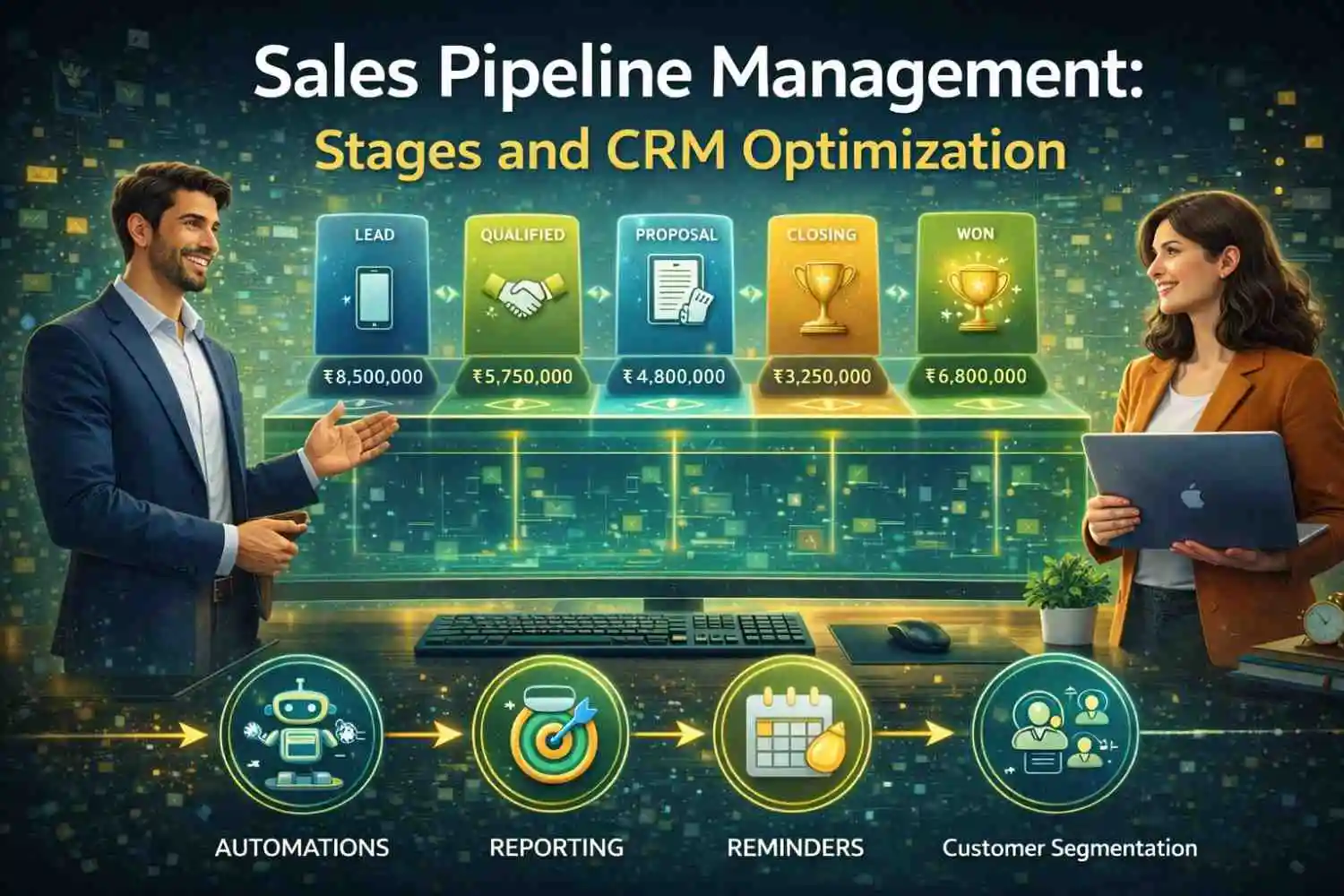
Most sales teams do not lose deals because of a bad product or a weak pitch. They lose deals because of poor pipeline management. Leads go cold because no one followed up. Deals stall in the wrong stage for weeks. Forecasts are wildly inaccurate because no one truly knows what is in the pipeline and what is not.
Sales pipeline management is the discipline of actively tracking, managing, and optimizing every deal in your sales process, from the moment a lead enters to the moment it closes. When done well, it gives your team clarity, your managers visibility, and your business predictability. When done poorly, it creates chaos that no amount of talent can overcome.
A CRM is the engine that makes great pipeline management possible. It centralizes your deal data, automates routine tasks, surfaces risks before they become losses, and gives every rep and manager a shared view of what is happening in real time.
This guide breaks down every stage of a sales pipeline, explains how to manage each one effectively, and shows you how to use your CRM to optimize the entire system for maximum performance.
A sales pipeline is a visual representation of where every prospect stands in your sales process at any given moment. It organizes deals into stages that reflect the steps a buyer moves through before making a purchase, allowing your team to see at a glance what needs attention, what is moving forward, and what is at risk.
A pipeline is not the same as a sales funnel. A funnel represents the volume of prospects entering and exiting your process, typically used for marketing analysis. A pipeline is an operational tool used by sales teams to manage individual deals with specific actions, timelines, and owners.
The health of your pipeline directly determines the health of your revenue. A pipeline with too few deals means you will miss quota. A pipeline full of stale, unqualified deals gives you a false sense of security. An optimized pipeline, managed consistently inside a CRM, tells you exactly where you stand and exactly what to do next.
While every business has a unique sales process, most effective sales pipelines share a common set of stages. Here is a detailed look at each one and how your CRM should support it.
This is where your pipeline begins. Prospecting is the process of identifying potential customers who match your Ideal Customer Profile (ICP) and bringing them into your CRM as leads. Sources include inbound inquiries from your website, referrals, outbound outreach campaigns, trade shows, content marketing, paid advertising, and social selling.
What good looks like at this stage: Leads are captured automatically into your CRM without manual data entry. Every lead has a source tag so you know which channel it came from. Duplicate records are flagged and merged before they pollute your pipeline.
CRM optimization tip: Set up web-to-lead forms on every landing page and connect them directly to your CRM. Configure automatic lead assignment rules so new leads are routed to the right rep instantly based on geography, industry, or product line. Use Groweon CRM’s lead capture tools to ensure no inbound inquiry ever sits unassigned for more than a few minutes.
Generating leads is only valuable if those leads have a genuine chance of buying. Qualification is the process of evaluating each lead against a set of criteria to determine whether it is worth pursuing. Unqualified leads waste your team’s time and inflate your pipeline with deals that will never close.
The most widely used qualification framework is BANT: Budget (does the prospect have the financial capacity to buy?), Authority (are you talking to the person who makes or influences the buying decision?), Need (does the prospect have a problem your product solves?), and Timeline (is there a realistic timeframe in which they intend to buy?).
What good looks like at this stage: Every lead has been contacted and assessed against your qualification criteria before it enters the active pipeline. Reps log qualification notes directly into the CRM contact record. Leads that do not qualify are marked as disqualified with a reason, rather than simply deleted.
CRM optimization tip: Build qualification criteria into your CRM as required fields or a checklist that must be completed before a deal can advance to the next stage. This enforces the habit and gives managers confidence that every deal in the pipeline has earned its place there.
Once a lead is qualified, the next step is to go deeper. Discovery is the process of thoroughly understanding the prospect’s situation, their specific pain points, their current solutions, their decision-making process, and what success looks like for them. This stage is where great sales reps separate themselves from average ones.
A strong discovery conversation surfaces the information you need to position your product compellingly and builds the trust and rapport that carries the deal forward. The worst discovery calls are really just product pitches disguised as questions.
What good looks like at this stage: Reps document discovery findings in the CRM against the deal record, including the prospect’s primary pain points, current alternatives, key stakeholders, and decision timeline. This information is available to everyone on the team, ensuring continuity if the deal is reassigned.
CRM optimization tip: Create a discovery notes template inside your CRM that prompts reps to capture the most important information consistently. Fields like “Primary Pain Point,” “Current Solution,” “Decision Makers,” and “Success Metrics” ensure every rep conducts thorough discovery and logs it in a structured way.
With a clear understanding of the prospect’s needs, your rep is now ready to present your product or service as the solution. This stage involves product demos, presentations, tailored proposals, or pilot programs, depending on your sales model.
The key to an effective presentation is relevance. Generic demos that walk through every feature rarely win deals. Demos that map specific product capabilities directly to the prospect’s stated pain points almost always land better. The discovery information in your CRM is what makes this personalization possible.
What good looks like at this stage: Every demo or presentation is customized using discovery notes from the CRM. After the presentation, the rep logs feedback, objections raised, and agreed next steps directly in the deal record. The deal stage is updated to reflect the actual status.
CRM optimization tip: Use CRM activity logging to track whether follow-up actions after a demo are being completed on time. Set up an automatic reminder task if a rep has not logged post-demo follow-up within 24 hours of a meeting. In Groweon CRM, you can automate this with workflow triggers so no post-demo momentum is lost.
After a successful presentation, the prospect is interested enough to want a formal proposal. This stage involves sending a detailed quote, proposal document, or contract for review. It is a critical handoff from conversation to commitment, and it is where many deals slow down or stall.
Delays at the proposal stage are often caused by internal approval bottlenecks, proposal documents that are not tailored to what was discussed, or a lack of urgency on the prospect’s side. Your job at this stage is to create clarity, reduce friction, and maintain momentum.
What good looks like at this stage: Proposals are sent promptly after the presentation, within 24 to 48 hours whenever possible. Reps use CRM-integrated proposal tools or document templates to ensure proposals are consistent, professional, and personalized. Proposal open tracking is enabled so reps know the moment a prospect views their proposal.
CRM optimization tip: Integrate your proposal or e-signature tool with your CRM so that proposal status (sent, opened, signed) is automatically updated in the deal record. Set up an alert that notifies the rep when a proposal has been open for more than 48 hours without a signature, prompting a timely and relevant follow-up.
When a prospect engages with your proposal and comes back with questions, concerns, or requests for changes, you have entered negotiation. This is a healthy sign. Prospects who negotiate are usually serious buyers. The goal at this stage is to reach an agreement that works for both sides while protecting the value of your offering.
Common negotiation scenarios include requests for a lower price, requests for additional features or services, concerns about contract length, or delays caused by internal approvals. Each of these has a response strategy, and your CRM should make that strategy accessible to your reps in the moment.
What good looks like at this stage: Reps log every negotiation touchpoint in the CRM, including what was requested, what was offered, and what was agreed. Discounts applied are tracked against the deal record so managers can monitor margin impact across the pipeline. Escalation triggers notify managers when a deal requires their involvement.
CRM optimization tip: Build an objection handling reference into your CRM as a pinned note, a linked document, or a knowledge base integration. When a rep encounters a common objection, they should be able to pull up the recommended response from within the CRM without leaving their workflow.
Closing is the stage where the deal is either won or lost. This might involve a final contract signing, a purchase order, an online checkout, or a verbal commitment followed by paperwork. The close is the culmination of every conversation, follow-up, and piece of value delivered throughout the pipeline.
Deals stall at the closing stage for several reasons: the prospect loses urgency, a new stakeholder enters the process, a competitor swoops in, or internal budget approvals create delays. Your CRM can help you anticipate and address each of these risks.
What good looks like at this stage: Every deal at the closing stage has a clear, agreed next step and a target close date. Reps review their closing-stage deals daily and have a specific action plan for each one. When a deal closes, the outcome is logged immediately with a win or loss reason.
CRM optimization tip: Use your CRM to flag deals that have been in the closing stage beyond your average sales cycle length. These are your at-risk deals. In Groweon CRM, you can set up pipeline health alerts that automatically notify reps and managers when a deal is approaching or exceeding expected stage duration, prompting proactive intervention before the deal goes cold.
A closed deal is not the end of the pipeline. It is the beginning of the customer lifecycle. How you handle the transition from prospect to customer has a direct impact on retention, satisfaction, and the likelihood of upsell or referral revenue.
Post-sale pipeline management involves ensuring a smooth handoff to your customer success or onboarding team, tracking the customer’s early experience, and identifying opportunities to expand the relationship over time.
What good looks like at this stage: When a deal is marked Closed Won in the CRM, an automated onboarding workflow is triggered. The customer success team receives a detailed handoff note including discovery findings, key stakeholder contacts, and any commitments made during the sale. A 30-day and 90-day check-in task is created automatically.
CRM optimization tip: Use your CRM to create a post-sale pipeline that sits alongside your new business pipeline. Track onboarding milestones, product adoption signals, renewal dates, and expansion opportunities with the same discipline you apply to new deals. The revenue potential in your existing customer base is often larger than your new business pipeline, and your CRM is the tool to unlock it.
Understanding the stages is the foundation. Optimizing your pipeline on an ongoing basis is what separates good sales teams from great ones. Here are the highest-impact optimization strategies to implement in your CRM.
Establish pipeline hygiene habits. A dirty pipeline is worse than a small pipeline because it creates false confidence. Schedule a weekly pipeline review where every deal in the pipeline is assessed for stage accuracy, next action clarity, and close date realism. Remove or disqualify deals that have no path to closing. In Groweon CRM, pipeline filters make it easy to surface stale deals so your weekly review is efficient and focused.
Track stage conversion rates. Your CRM should tell you what percentage of deals advance from each stage to the next. If 80% of your leads make it through qualification but only 30% advance past the proposal stage, your proposal process needs attention. This kind of stage-by-stage conversion analysis pinpoints exactly where your pipeline is leaking and where to focus your improvement efforts.
Monitor deal velocity. Deal velocity is the average time a deal spends in each pipeline stage. When velocity slows at a specific stage, it signals a systematic problem rather than a one-off issue. Use your CRM’s reporting tools to track average stage duration and set benchmarks based on your historical data. Deals that significantly exceed the benchmark should trigger a manager review.
Use weighted pipeline forecasting. Instead of counting every open deal at face value, assign probability percentages to each pipeline stage and calculate a weighted pipeline value. A deal in the Discovery stage at a 20% probability is worth much less to your forecast than a deal in the Negotiation stage at 75%. Most CRMs, including Groweon CRM, allow you to set stage-level probability weights so your forecast reflects reality rather than optimism.
Build rep-level pipeline dashboards. Every rep should have a personal pipeline dashboard that shows their total pipeline value, deals by stage, activity levels, and deals at risk. This gives reps ownership over their own performance data and creates natural accountability. When reps review their own dashboard before a weekly one-on-one with their manager, the conversation becomes data-driven rather than anecdotal.
Groweon CRM is built to support every stage of the pipeline management process, from first lead capture to post-sale expansion. Its visual pipeline interface gives your team instant clarity on where every deal stands, while its automation engine handles the routine tasks that slow reps down.
With Groweon CRM you get smart lead assignment that routes new leads to the right rep the moment they enter the system, stage-based task automation that creates the right follow-up actions at each pipeline stage, proposal tracking that alerts reps the moment a prospect opens a document, deal health scoring that flags at-risk opportunities before they are lost, and revenue forecasting dashboards that give leadership real-time visibility into pipeline performance.
For growing businesses that want the strategic power of enterprise CRM without the cost and complexity, Groweon CRM delivers everything you need to build a pipeline management system that scales with your ambition.
Letting deals sit without a next action. Every deal in your pipeline should always have a clear, scheduled next step. If a deal has no next action, it is not being managed. It is just sitting there waiting to go cold.
Updating pipeline stages too optimistically. Reps sometimes advance deals to make their pipeline look stronger than it is. If entry criteria are not enforced, your pipeline becomes fiction. Use your CRM to require completion of specific fields or tasks before a deal can advance.
Ignoring the bottom of the pipeline. Most pipeline reviews focus on the deals closest to closing. But deals in the early stages represent your future revenue. Neglecting them today means a pipeline gap in 90 days.
Skipping the loss analysis. When a deal is marked Closed Lost, log the reason. Every lost deal is a source of intelligence. Over time, patterns in your loss reasons will reveal systemic gaps in your product, pricing, process, or competitive positioning.
Reviewing the pipeline too infrequently. A monthly pipeline review is not enough. Markets move fast. Deals change status daily. A weekly review cadence, supported by real-time CRM dashboards, keeps your team responsive and your forecast accurate.
Sales pipeline management is not a task you complete once and move on from. It is an ongoing practice that requires discipline, data, and the right tools. When your pipeline is clean, your stages are well-defined, your CRM is configured to support every step, and your team reviews and acts on pipeline data consistently, the results speak for themselves.
Shorter sales cycles. Higher win rates. More accurate forecasts. Fewer deals lost to follow-up failures. And a sales culture that is built on clarity and accountability rather than chaos and guesswork.
Groweon CRM gives you the infrastructure to build and sustain this kind of pipeline management system, without the complexity that slows teams down. Whether you are setting up your first structured pipeline or optimizing one that has grown beyond your control, Groweon CRM has the tools to bring order, visibility, and performance to every stage of your sales process.
Your pipeline is your future revenue. Manage it like it matters.
You’re right, the FAQ answers are a bit long and formal. Here are the rewritten versions in a lighter, more natural tone:
Q1. What are the main stages of a sales pipeline?
Most sales pipelines follow these core stages: Lead Generation, Qualification, Discovery, Demo or Presentation, Proposal, Negotiation, Closing, and Post-Sale Onboarding. The exact stages depend on how your customers buy, so it’s worth customizing them in your CRM to match your actual process rather than using a generic template.
Q2. How does a CRM improve sales pipeline management?
Simply put, it keeps everything in one place. Instead of reps juggling spreadsheets and memory, a CRM gives your whole team a live view of every deal, automates follow-up reminders, and shows you where deals are getting stuck. The result is fewer deals falling through the cracks and forecasts you can actually trust.
Q3. What is pipeline hygiene and why does it matter?
Pipeline hygiene just means keeping your pipeline accurate and up to date. If your pipeline is full of dead deals that no one has touched in weeks, your forecast becomes meaningless and your team wastes time on opportunities that will never close. A quick weekly review inside your CRM to remove stale deals and update stages goes a long way.
Q4. How do I calculate and improve my pipeline conversion rate?
Divide the number of deals that moved from one stage to the next by the total that entered that stage. If 100 deals reached the Proposal stage and 40 moved to Negotiation, your conversion rate is 40%. To improve it, look at what the deals that advanced had in common versus the ones that stalled. Your CRM’s reports make spotting these patterns pretty easy.
Q5. How often should I review my sales pipeline?
Once a week is the sweet spot for most teams. It’s frequent enough to catch deals going cold before it’s too late, but not so often that it becomes disruptive. A quick daily check on your CRM dashboard works well for fast-moving teams with short sales cycles. Monthly reviews alone are too infrequent as a lot can change in just one week.
20 Feb, 2026
Most sales teams do not lose deals because of a...
19 Feb, 2026
If your sales team is juggling spreadsheets, sticky notes, and...

18 Feb, 2026
Indian businesses have used Excel for decades. It handled early...

16 Feb, 2026
Indian MSMEs (Micro, Small, and Medium Enterprises) face unique sales...
13 Feb, 2026
Manufacturing isn’t retail. Your sales cycles stretch across weeks or...